
1. Background
In the Philippines, there are 46 residential drug treatment and rehabilitation centers (TRCs), of which 19 are government-operated and 27 are private centers. These centers are facilities where people who use drugs (PWUDs) are treated and managed to prevent them from disrupting peace and order within families, the community, and the country. PWUDs are individuals diagnosed with substance use disorder or the excessive use of substances, like alcohol and illicit drugs, such as marijuana, heroin, cocaine, stimulants, methamphetamine, pain relievers, and other prescription-type psychotherapeutics used non-medically (1). PWUDs often have harmful lifestyles, such as poor eating patterns, sedentary lifestyle, and poor sleeping patterns. These compounding factors may lead to an increased risk of chronic health issues, including diabetes, metabolic syndrome, hypertension, and other non-communicable diseases (NCDs) (2). PWUDs are also vulnerable to vitamin and mineral deficiencies due to their poor eating patterns (3, 4).
Incidence of SUD can be successfully prevented, treated, and controlled by healthcare professionals with the aid of family or peer support (1). While psychological intervention is an important part of recovery, eating the right kind and amount of foods can help assuage cravings, and avoiding certain foods can help stabilize mood swings (5).
Currently, the Republic Act 9165 otherwise known as "Comprehensive Dangerous Drugs Act of 2002" mandates the Department of Health (DOH) to regulate, oversee and monitor the integration, coordination, and supervision of all drug rehabilitation, intervention, aftercare, and follow-up programs, projects, and activities as well as the establishment, operations, maintenance and management of TRCs nationwide. The DOH Manual of Operations for Drug Abuse TRCs serves as standard reference material to aid administrators and practitioners in the management and operations of the different TRCs in the country.
2. Objectives
This study was done to assess and benchmark the nutrition care processes offered to PWUDs in selected government-owned and private TRCs in the Philippines and identify treatment gaps. The results of this study will be used to develop recommendations on how to improve the nutrition component in the existing DOH Manual for the holistic rehabilitation of PWUDs.
3. Patients and Methods
3.1. Study Design
This is a cross-sectional study involving 19 TRCs coming from both government-owned (n = 9) and private (n = 10) rehabilitation centers as samples. The information gathered included interviews of the director and other key personnel on the nutrition care processes and programs offered in the center; ocular observation on dietary facilities, as well as document reviews of existing hospital policies and services.
3.2. Sampling
A list of TRCs was obtained from the DOH. There are 46 residential drug treatment and rehabilitation centers across the Philippines: 19 are government-owned and 27 private centers. From the 46 residential TRCs, the sample size of 15 (government = 7: private = 8) was computed using Slovin’s formula. However, to consider an allowance for non-acceptance, a total of 19 TRCs were selected located in Regions 1, III, IV-A, VI, XI, and the National Capital Region. Random sampling from the list of government-owned and private TRCs was done to obtain the samples of the study. Key personnel of the selected TRCs, such as the director or program manager, nutritionist-dietitian, psychometrician, head nurse, doctor, social worker, head cook, and administrative officers were interviewed to obtain the relevant information needed. There were 24 respondents from the government TRCs and 21 from the private TRCs, resulting in a total of 45 respondents.
TRCs included in the study were those with residential services, meaning those who have live-in patients, with signed consent from the director or program manager. On the other hand, TRCs that were excluded were those with only out-patient services, and the management was reluctant to participate in the study.
3.3. Data Collection
Key informant interviews with the key personnel were conducted using pre-tested questionnaires. This questionnaire was developed for the purpose of this study, which generally consists of a combination of close and open-ended questions on the TRC’s nutrition management services and policies. The questionnaire has three parts: 1) general information about the operations, which included the nutrition care processes; 2) the rehabilitation programs offered to PWUDs; and 3) the existing dietary management implemented.
Other relevant documents, which may provide supplementary information, such as brochures or handbooks of the rehabilitation centers, rules and regulations, sample meal plan/ cycle menu, daily activity schedule, and organizational chart, were requested. Ocular visits were also done to assess the physical condition of the dietary facilities, as well as observe the actual nutrition services and/or nutritional assessment being performed in the TRCs.
3.4. Statistical Analysis
Descriptive statistics were used to describe the collected data in this study. It provides simple summaries about the sampled TRCs and the measures. STATA version 13 was used to perform all analyses.
3.5. Ethical Considerations
The study protocol was carried out in accordance with the 1975 Declaration of Helsinki, guided by the Council for International Organizations of Medical Sciences Ethical Guidelines for Biomedical Research Involving Human Subjects. The Department of Science and Technology Food and Nutrition Institutional Ethics Review Board (IRB) approval was sought before the start of the study (Protocol Code: FIERC-2018-003). The profiles of the TRCs are kept confidential, and only the researchers have access to the datasets in a coded format. All details of the study were discussed thoroughly with the management of rehabilitation centers.
4. Results
Table 1 shows the distribution of the key personnel interviewed as respondents. Among private TRCs, respondents were mostly male (66.7%), while in government TRCs, the respondents were mostly female (58.3%). The mean age of the respondents from the government TRCs was 41.7, while the mean age of private TRC respondents was 39.3 years.
Table 1.
Profile of Respondents
| Variable | Government, No. (%) | Private, No. (%) | Total, No. (%) |
|---|---|---|---|
| Male | 10 (41.7) | 14 (66.7) | 24 (53.3) |
| Female | 14 (58.3) | 7 (33.3) | 21 (46.7) |
| Mean Age | 41.7 | 39.3 | 40.5 |
| Position | |||
| Program director/ manager | 7 (29.2) | 9 (42.8) | 16 (35.6) |
| RND | 6 (25.0) | 0 (0.0) | 6 (13.3) |
| Psychometrician | 1 (4.2) | 3 (14.3) | 4 (8.9) |
| Head nurse | 4 (16.7) | 3 (14.3) | 7 (15.6) |
| Doctor | 2 (8.3) | 2 (9.5) | 4 (8.9) |
| Social worker | 0 (0.0) | 1 (4.8) | 1 (2.2) |
| Head cook | 2 (8.3) | 2 (9.5) | 4 (8.9) |
| Administrative officer | 2 (8.3) | 1 (4.8) | 3 (6.7) |
4.1. Intervention Period
The usual rehabilitation period of PWUDs in government rehabilitation centers lasts from 6 to 12 months, while 6 to 18 months in the private centers.
Common visiting hours and day for both government and private TRCs start from 8:00 in the morning and ends by 5:00 in the afternoon during weekends. Most of the petitioners or family members are allowed to bring only ready-to-eat foods, such as biscuits and cup noodles, as well as toiletries for personal hygiene. As per policy of the facilities, spicy foods, menthol-flavored foods, chocolates, caffeine-containing foods, and sweet foods are often restricted food items inside the rehabilitation centers. Upon entry, strict inspections are observed, and visitation is only allowed after 2 to 3 months of confinement.
Most of the TRCs maintain canteens, and based on ocular inspection, the different food items usually sold include biscuits, bread, chocolate drinks, chips, and sodas.
4.2. Assessment of Nutrition Services
Table 2 shows the different types of assessments practiced in the TRCs from the interviews with the key personnel and ocular visits. Anthropometric measurements performed by most of the TRCs included height and weight, which were obtained upon admission and after admission. Overall, 89.47% (17 out of 19) TRCs conducted anthropometric measurements.
Table 2.
Nutrition Assessments Conducted in Selected TRCs
| Type of Assessment | Government, No.(%) | Private, No. (%) | Total, No. (%) |
|---|---|---|---|
| Anthropometric | |||
| None | 1 (11.11) | 1 (10.00) | 2 (10.53) |
| Yes | 8 (88.89) | 9 (90.00) | 17 (89.47) |
| Daily | 0 | 1 (10.00) | 1 (5.26) |
| Once a week | 1 (11.11) | 3 (30.00) | 4 (21.05) |
| Once a month | 3 (33.33) | 1 (10.00) | 4 (21.05) |
| Twice a month | 0 | 2 (20.00) | 2 (10.53) |
| Before admission | 2 (22.22) | 1 (10.00) | 3 (15.79) |
| Before and after intervention | 2 (22.22) | 0 | 2 (10.53) |
| Dietary (food wastage monitoring) | |||
| None | 7 (77.78) | 8 (80.00) | 15 (78.95) |
| Yes | 2 (22.22) | 2 (20.00) | 4 (21.05) |
| Weekly | 1 (11.11) | 2 (20.00) | 3 (15.79) |
| Monthly | 1 (11.11) | 0 | 1 (5.26) |
Only 21.05% (4 out of 19) of the TRCs, on the other hand, were able to conduct a dietary assessment in the form of food wastage monitoring on a weekly or monthly basis.
The use of anthropometric data as a reference for dietary management was not considered; hence, specific nutrition diagnosis, appropriate nutrition intervention, monitoring, and evaluation of foods offered were not installed as regular activities.
4.3. Availability of Registered Nutritionist-Dietitians
The results showed that only 42.1% (8) of the TRCs had RNDs who oversees the dietary services of TRCs (Table 3). For those with no resident RNDs, the kitchen staff, or the PWUDs who are assigned as kitchen duty, are the ones who prepare and cook the meals. PWUDs with underlying diseases, on the other hand, were given special diets based on diet prescriptions of doctors or nurses but these were not carried out properly due to the non-availability of RND in some areas. Also, due to the lack of RNDs, none of the TRCs visited were able to provide nutrition counseling or nutrition education for the PWUDs.
Table 3.
Availability of Registered Nutritionist-Dietitians
| Government, No. (%) | Private, No. (%) | Total, No. (%) | |
|---|---|---|---|
| Registered Nutritionist-Dietitians (RNDs) | |||
| With RNDs | 4 (33.4) | 4 (40.0) | 8 (42.1) |
| Without RNDs | 5 (66.6) | 6 (60.0) | 11 (57.9) |
4.4. Diet Provided to PWUDs
Table 4 shows that the most common dietary pattern offered in government TRCs was 3 meals a day (breakfast-lunch-dinner), while in the private TRCs it was divided into 3 meals and 1 snack (Breakfast-Lunch-PM Snack-Dinner). PWUDs in government TRCs usually buy their snacks from the cooperative-managed canteens (COOP).
Table 4.
Dietary Regimen in Selected TRCs
| Type of Diet Given to the Patients | Government, No. (%) | Private, No. (%) | Total, No. (%) |
|---|---|---|---|
| Dietary pattern | |||
| Breakfast-Am Snack-lunch-PM Snack-dinner | 1 (11.1) | 4 (40.0) | 5 (26.3) |
| Breakfast-lunch-dinner | 5 (55.6) | 1 (10.0) | 6 (31.6) |
| Breakfast-lunch-PM Snack-dinner | 3 (33.3) | 5 (50.0) | 8 (42.1) |
| Type of diet provided | |||
| Calculated normal diet (diet by RND) | 2 (22.2) | 2 (20.0) | 4 (21.1) |
| Typical/usual Filipino diet | 6 (66.7) | 7 (70.0) | 13 (68.4) |
| Typical/usual Filipino diet but unlimited rice | 1 (11.1) | 1 (10.0) | 2 (10.5) |
Most of the TRCs provide a non- calculated or normal diet (government = 6, private = 7). On the other hand, some TRCs offer a calculated diet for PWUDs with underlying diseases (government = 2, private = 2). TRCs that provide special diets had their own RND responsible for the meal planning and computing of dietary recommendations. As for several TRCs without RNDs, unlimited rice servings during meals were allowed among the PWUDs.
4.5. Food Service and Dietary Facilities
In terms of the cycle menu (Table 5), most of the selected TRCs change their menu on a weekly basis (government = 5, private = 4), while some implemented a 4-week cycle menu (government = 2, private = 5). Some TRCs allow PWUDs to plan the menu for a week, which is approved by the head cook, nurse, or the attending physicians. This practice was common among TRCs with no RNDs.
Table 5.
Food Services and Dietary Facilities Available in the TRCs
| Government, No. (%) | Private, No. (%) | Total, No. (%) | |
|---|---|---|---|
| Types of food service | |||
| Commissary | 0 | 0 | 0 |
| Centralized | 9 (100.0) | 10 (100.0) | 19 (100.0) |
| Duration of cycle menu | |||
| New menu every week | 5 (55.6) | 4 (40.0) | 9 (47.4) |
| 2 weeks | 1 (11.1) | 0 | 1 (5.3) |
| 3 weeks | 0 | 1 (10.0) | 1 (5.3) |
| 4 weeks | 2 (22.2) | 5 (50.0) | 7 (36.8) |
| 8 weeks | 1 (11.1) | 0 | 1 (5.3) |
| Dining facility | |||
| With dining area | 6 (66.7) | 10 (100.0) | 16 (84.2) |
| Without dining area | 3 (33.3) | 0 (0.0) | 3 (15.8) |
| Dietary/counselling room | |||
| With dietary room | 3 (33.3) | 3(30.0) | 6 (31.57) |
| Without dietary room | 6 (66.7) | 7 (70.0) | 13 (68.4) |
All TRCs in the study had a centralized type of food service where all meals are prepared in the facilities’ kitchen manned by non-professionals. Food wastage was usually monitored on a weekly or monthly basis.
Residential TRCs should have at least four hundred (400) square meters (for 30 patients) for different facilities, including dining areas and dietary/ counseling rooms (2). Based on the study results, the majority of the TRCs (68.4%) had no dietary/ counseling room. Although all of the private TRCs had dining facilities, there were 33.3% government TRCs, which had no designated dining areas for the PWUDs.
4.6. Budget for Meals
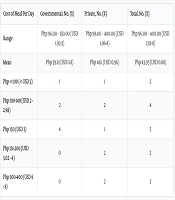
The average cost per meal in government TRCs is Php 39.83, while for the private TRCs, it is Php 48.05 (Table 6). Private TRCs had higher service fee per month; thus, more budget is allotted for the meal for their confined PWUDs. The cost of meals is subsidized by the government, and this ranges from Php 96.00 to Php 150 per day, while for private TRCs, it ranges from Php 98.00 to Php 400.
Table 6.
Cost of Meal Per Day in Selected TRCs
| Cost of Meal Per Day | Government, No. (%) | Private, No. (%) | Total, No. (%) |
|---|---|---|---|
| Range | Php 96.00 – 150.00 (USD 1.92-3) | Php 98.00 – 400.00 (USD 1.96-8) | Php 96.00 – 400.00 (USD 1.92-8) |
| Mean | Php 39.8 (USD 0.8) | Php 48.1 (USD 0.96) | Php 43.95 (USD 0.88) |
| Php < 100 (< USD 2) | 1 | 1 | 2 |
| Php 100-149 (USD 2 - 2.98) | 2 | 2 | 4 |
| Php 150 (USD 3) | 4 | 1 | 5 |
| Php 151-200 (USD 3.02 - 4) | 0 | 2 | 2 |
| Php 300-400 (USD 6 - 8) | 0 | 2 | 2 |
5. Discussion
The profiling of current nutrition services and management in the rehabilitation of PWUDs was conducted among 19 selected government and private TRCs in the Philippines is vital. The nutrition care processes, which are nutritional assessment, nutrition diagnosis, intervention, monitoring, and evaluation, are not properly installed in the different TRCs.
Most of the visited TRCs conducted nutrition assessments only during admission and upon discharge of the PWUDs. Nutritional assessment acts as a tool in healthcare settings to monitor individual changes in nutritional status over time. This capacity does not rely on any single indicator but on information obtained from various sources. To maximize benefits, nutrition assessment must also provide a framework for a therapeutic plan and a means to evaluate response to therapy (3), which was not done in most of the TRCs visited.
RNDs are the health care professionals qualified to provide nutrition services to PWUDs. Based on the study results, the majority of the TRCs did not have RNDs, while some of the TRCs were below the required ratio of the number of RNDs and the bed capacity. As per the recommendation of the DOH, there should be 2 RNDs for every 100 bed capacity, 3 RNDs for 300 bed capacity, 5 RNDs for 500 bed capacity, and 6 for 1000 bed capacity (4). RNDs perform important professional services in health care, such as (a) providing medical nutrition therapy using the nutrition care process for purposes of disease prevention, treatment, and management; (b) ensuring the health and well-being of patients through the delivery of quality products, programs, and services; (c) promoting nutritional health and well-being of individuals, groups, communities, and populations; (d) setting standards, guidelines, and policies that establish and encourage an atmosphere that promotes nutritional health; (e) managing food and nutrition systems, including programs, projects, and services; (f) facilitating and conducting food, nutrition and related research across a variety of practice settings; and (g) educating and training others about food and nutrition across various practices (RA No. 10862, 2015). Having the appropriate number of RNDs in a TRC would ensure that the right nutrition services would be delivered to the PWUDs.
The majority of the TRCs provide a typical Filipino Diet, which is not computed, and only provided 3 big meals a day. Several studies have shown that although drug abuse has no significant effect on the average energy intake, the nutritional quality of foods consumed and the frequency of meals may be affected.
To support optimal recovery, it is recommended that the meals are computed according to the needs of the PWUDs, and the meal pattern be shifted to 5 meals a day to ensure that the high protein and high-calorie diet will be met. Frequent feeding is highly encouraged among PWUDs and they are supposed to eat every two to four hours or five to six meals per day. It should be taken into account that when PWUDs seek assistance, it is more likely that they are malnourished due to poor dietary habits, unhealthy food choices, and adverse effects of the substance on the body’s metabolism, which all could represent health hazards (6). Psychoactive drugs and foods high in sugar and fat can both trigger the dopaminergic reward system associated with substance abuse and eating disorders, while low levels of serotonin can reduce inhibitory control as seen in cravings and seeking for both food and psychoactive drugs (7). Also, an insufficient supply of essential nutrients among PWUDs over a long period of time may result in poor well-being and onset of illnesses. However, studies have revealed several similarities between non-homoeostatic eating and substance abuse (8).
Since drug abuse results in nutritional deficiencies, PWUDs are more vulnerable to infectious agents (9, 10). Thus, proper nutrition, especially a calculated individualized diet, is necessary for long-term recovery. During the initial phases of recovery, caloric intake should not only be substantial but also be mostly coming from fresh nutrient-dense sources, such as fruits, vegetables, fish, nuts, and pulses. Processed foods and sugary food items should be avoided at this point.
Some studies also recommended that PWUDs in recovery should eat small, frequent meals comprising of whole foods to maintain energy and stabilize moods. The composition of a recovery-friendly diet is 25% protein, 45% carbohydrates, 30% fats, and a total of 2000 kcal (11). SUD can be treated but it is vital to correct any nutritional deficiencies immediately and address any medical conditions to prevent the risk of developing harmful diseases that may lead to severe illnesses and even death. Increased consumption of antioxidant-rich foods helps decrease inflammation, reduce cell deterioration, and provide a healthful diet for optimum recovery (12). Consumption of foods high in Vitamins C and E may help reduce oxidative damage by scavenging free radicals and by detoxifying the oxidants (13). Adequate vitamins and minerals are crucial for recovery because drugs and alcohol deplete the body of vitamins and minerals (11).
The budget per day for government TRCs ranges from Php 96.00 to Php 150, while for private TRCs meal budget was from Php 98.00 to as high as Php 400. According to the Hospital Licensure Act (RA 4226) of 1971, the nutrition service is one of the six (6) major services of a health facility and is integral to total patient care. As such, it plays a crucial role in quality patient care, which includes the provision of nutritious meals tailored to the patient's specific health condition. The standardization of per capita budget for residents amounting to one hundred fifty pesos (Php 150.00) for 1,800 calories/day as prescribed by the physician is applicable to all types of diets to all kinds of patients. This Php 150 budget was proven to be enough to provide daily meals for patients that are adequate in quantity and of high dietary quality. The DOH Administrative Order No. 2016-0020 is therefore imperative for government hospitals to be allocated with increased per capita budget for meals to enable the nutrition services to achieve its goal in providing patient-centered dietetics services, which are focused on the quantity and quality of meals served to inpatients.
Several studies have reported that nutrition interventions, such as nutrition education, were used successfully to support addiction recovery (14-16). A 6-week environmental and educational intervention to reduce excessive weight gain among men in residential treatment was shown to reduce total energy intake, body mass index, and percentage of energy from simple carbohydrates and fats (17). Drug and alcohol abuse can significantly damage the digestive system, and many recovering PWUDs experience problems, such as constipation, diarrhea, indigestion, and poor appetite. Chronic problems with digestion may result in the onset of nutritional deficiencies (18) and thereby preventing the brain to obtain necessary nutrients for it to work properly. A well-nourished brain means less likelihood of withdrawal symptoms, especially during the early stages of detoxification, and has a higher possibility of achieving long-term recovery.
Given the positive impact of incorporating nutrition interventions in the rehabilitation regimen, it is indubitable that the employment of these services would be best implemented if there is enough manpower, availability of the necessary facilities and equipment, and adequate budget for the meals. An established standard dietary recommendation would better cater to PWUDs nutritional needs and may aid in the faster recovery process of the PWUDs. Also, it should always be put into consideration that nutrition interventions should be holistic in nature and therefore, should not stop in providing nutritious meals alone. Thus, the incorporation of nutrition education in the regular activities of the rehabilitation program would greatly help in increasing appreciation of proper nutrition and a healthy lifestyle among the PWUDs. Alongside providing the right diet and nutrition education, regular monitoring of the nutrition status of the PWUDs is necessary to monitor their progress through the conduct of the anthropometric and dietary assessment.
5.1. Conclusion
The nutrition care process is not appropriately installed in all the TRCs. The lack of RND to man the dietary section and implement the nutrition services is a critical gap identified in this study. Given these identified gaps, it is inarguable that there is a need to improve the nutrition services provided in the TRCs through the implementation of the detailed Nutrition Management Guidelines (NMG) for PWUDs. The NMG would include prescribed Nutrition services, such as nutrition screening, diet intervention, nutrition education, nutrition monitoring, and nutrition evaluation, which may contribute to a holistic rehabilitation regimen.
Sustainability of the nutrition component of the rehabilitation regimen could be best provided through the integration of the NMG in the DOH Manual of Operations for TRCs. With the presence of this standardized manual, it would be easier for the TRCs’ health care team to provide all the necessary nutrition services, which go alongside the other therapies and treatments for the recovery of PWUDs. Healthy physical well-being brought about by optimal nutrition would be a great help for long-term recovery from addiction.