
1. Background
The coronavirus disease 2019 (COVID-19) can cause serious mental health consequences and increase individuals’ vulnerability to psychological distress (1, 2). Several studies have identified specific groups, such as university students, who are more prone to the mental impacts of the COVID-19 pandemic (3, 4).
Given that measures, such as home quarantining and long-term closure of educational establishments (i.e., schools, colleges, and universities), are expected to have significant effects on students’ learning and mental health (5-7), university students are considered one of the most vulnerable groups (8). In most countries, the COVID-19 pandemic led to the closure of universities and colleges, forcing many students to leave university accommodations and return home (9). This issue has led to decreased in-person communication, loneliness, lifestyle changes, uncertain academic outcomes, conflicts with parents, and concerns about the physical health of themselves and close ones (10, 11). Anxiety and depression appear to be among the most common psychological problems experienced by university students during the pandemic (12).
Various factors are associated with COVID-19 anxiety, including symptoms of depression and stress (13, 14). Studies conducted on university students in China and Iran show that the most common causes of increased COVID-19-related anxiety and stress include students’ concerns about the harmful effects of disease-related holidays on their life, education and/or occupation, lower income, and unemployment (12, 15).
Given that the COVID-19 pandemic is associated with COVID-19 anxiety and can be considered a vulnerability factor for other psychological disorders, it is necessary to identify factors associated with COVID-19 anxiety among vulnerable groups, such as university students. Several studies have investigated the Iranian mental health status during the outbreak (15, 16). However, no previous study has investigated the psychological impacts of the outbreak and COVID-19 on students who return home due to quarantine.
2. Objectives
The present study investigated the effects of COVID-19 and returning home on Iranian students’ mental health (i.e., anxiety, depression, and stress) and examined the effect of anxiety, depression, and stress on Iranian students on predicting anxiety related to COVID-19. As there is no guarantee that another COVID-19 (or other viruses) outbreak will not occur, such knowledge will be effective in supporting preparations for future geographically-spread viral outbreaks.
3. Materials and Methods
3.1. Participants, Procedure, and Ethics
The present study had a cross-sectional design and used convenience sampling. An online cross-sectional survey (hosted on Google Forms) was used to collect the data. Iranian students were purposefully targeted on social media (via Telegram and Instagram) with a link to the survey embedded within the recruitment message. The sample comprised participants from five Iranian universities (i.e., Shahid Beheshti University, Kharazmi University, Tehran University, Isfahan University, and Semnan University) that responded to the survey anonymously from June to July 2020. All the participants were informed about the study’s purpose. The students reported their demographic data, including gender, age (all within the age range of 18 - 40 years), marital status, occupational status, and COVID-19-related information (e.g., whether they and/or their family and/or friends had been infected with COVID-19). Additionally, the participants completed two standardized psychometric scales that assessed psychological distress and COVID-19 anxiety (see Measures section below).
To increase the response quality of the survey, some of the items were reverse-coded and encouraged the participants to answer carefully by providing instructions. Only participants who lived in dormitories, flats, and share houses and returned home due to the outbreak were included. Furthermore, the surveys completed in less than 10 minutes or more than 60 minutes (n = 87) were excluded from the analysis. A total of 715 participants completed the survey and were included in the final analysis. The target sample size was estimated based on World Health Organization recommendations for the minimum sample size required for a cross-sectional study (32). The study was approved by the Ethics Committee of Kharazmi University, Tehran, Iran (approved on 7/7/2020). All the participants gave electronic informed consent prior to data collection. The participants were told they could withdraw their data at any time prior to the commencement of data analysis. Furthermore, the participants were assured that their personal information would remain confidential.
3.2. Measures
3.2.1. Depression, Anxiety, and Stress Scale-21
The Depression, Anxiety, and Stress Scale-21 (DASS-21) (17, 18) assess depression, anxiety, and stress symptoms. All items respond to on a four-point Likert scale (0 = did not apply to me at all; 3 = applied to me very much, or most of the time); an example item is “I found it difficult to work up the initiative to do things.” On each of the three subscales, the scores range from 0 to 21. As the score gets higher, depression, anxiety, and stress, become greater, respectively (18, 19). The validity and reliability of the DASS-21 have been shown to be good in previous studies (20, 21). Cronbach’s alpha values for the present study sample were 0.87, 0.89, and 0.87 for depression, anxiety, and stress, respectively.
3.2.2. Corona Disease Anxiety Scale
The 18-item Corona Disease Anxiety Scale (CDAS) was developed by Alipour et al. in the Persian language and assesses COVID-19-related anxiety (16). The scale assesses both psychological symptoms (9 items) and physical symptoms (9 items). The items respond to on a four-point Likert scale (0 = never; 3 = always); an example item is “It is hard for me to sleep because I’m thinking about COVID-19.” The total scores range from 0 to 54. As the score gets higher, the level of COVID-19-related anxiety among individuals becomes higher. The reliability values in the original validation study were α = 0.87, α = 0.86, and α = 0.91 for psychological components, physical components, and the total scale, respectively (22). Cronbach’s alpha values in the present study sample were 0.90, 0.92, and 0.9 for psychological symptoms, physical symptoms, and the total scale, respectively.
3.3. Data Analysis
SPSS software (version 23.0) was used to analyze the data. Because it was an online survey, there were no missing values. Three multivariate regression analyses were conducted to determine whether there was a predictive relationship between the independent variables (i.e., depression, anxiety, and stress) and criterion variables (i.e., COVID-19 anxiety, psychological symptoms, and physical symptoms). This type of statistical analysis is recommended when predicting a dependent variable from a set of predictors (23).
The assumptions of multiple regression, including linearity, independence, homoscedasticity, normality, and multicollinearity, were obtained. Overall, a visual inspection of the scatterplot indicated that the assumption of linearity was met for all the dependent variables. Normality was tested by the visual inspection of a histogram and analysis of the Shapiro-Wilk test for each criterion variable. Homoscedasticity and multicollinearity were checked carefully, and both criteria were acceptable for the analysis. A multivariate analysis of variance (MANOVA) was performed to answer the question of to what extent overall differences existed across demographic variables in COVID-19 anxiety, psychological symptoms, and physical symptoms. Additionally, means, standard deviations (SDs), and correlations were calculated in the analysis (23).
4. Results
4.1. Sociodemographic Characteristics
The total sample consisted of 715 participants (521 females and 194 males), with a mean age of 28.70 years (SD = 9.06). Among the sample, 262 participants were employed in part-time jobs, and 453 participants were unemployed. The descriptive statistics of the variables included means, standard deviations, and zero-order relationships (Pearson correlations; Table 1).
Table 1.
Descriptive Statistics and Pearson (Zero-order) Correlations of Variables (n = 715)
| Variable | Mean | Standard Deviation | 1 | 2 | 3 | 4 | 5 |
|---|---|---|---|---|---|---|---|
| 1. COVID-19 anxiety | 13.75 | 9.47 | |||||
| 2. Psychological symptoms | 10.43 | 5.75 | 0.93 a | ||||
| 3. Physical symptoms | 3.33 | 4.57 | 0.89 a | 0.68 a | |||
| 4. Depression | 5.54 | 4.94 | 0.59 a | 0.49 a | 0.60 a | ||
| 5. Anxiety | 4.74 | 4.69 | 0.72 a | 0.60 a | 0.73 a | 0.80 a | |
| 6. Stress | 6.68 | 5.10 | 0.64 a | 0.56 a | 0.61 a | 0.83 a | 0.86 a |
Abbreviation: COVID-19, coronavirus disease 2019.
a P < 0.001; multicollinearity (r < 0.85) was not observed.
As shown in Table 2, there were positive and significant associations between all the independent variables (i.e., depression, anxiety, and stress) and criterion variables (i.e., COVID-19 anxiety, psychological symptoms, and physical symptoms). Multiple regression analyses were performed to examine the unique relationships between depression, anxiety, stress, and criterion variables (i.e., COVID-19 anxiety, psychological symptoms, and physical symptoms). Depression, anxiety, and stress were entered as predictor variables, in addition to COVID-19 anxiety, psychological symptoms, and physical symptoms as the criterion variables, in the three separate models (Table 2). All the assumptions were checked and approved (Table 2).
Table 2.
Multiple Regression Analysis regarding the Relationship of Depression, Anxiety, and Stress with Coronavirus Disease 2019 Anxiety
| Predictor Variable | Criterion Variable | R | R2 | F (3, 711) | B | Beta | T | P | Collinearity Statistics | Durbin-Watson | |
|---|---|---|---|---|---|---|---|---|---|---|---|
| VIF | Tolerance | ||||||||||
| Depression | Total COVID-19 anxiety | 0.72 | 0.51 | 252.01 | 0.04 | 0.02 | 0.38 | 0.70 | 3.75 | 0.28 | 0.91 |
| Anxiety | 1.31 | 0.65 | 12.09 | 0.001 | 4.26 | 0.23 | |||||
| Stress | 0.11 | 0.06 | 0.98 | 0.33 | 5.14 | 0.19 | |||||
| Depression | Psychological symptoms | 0.61 | 0.37 | 140.12 | -0.07 | -0.06 | -1.15 | 0.25 | 3.57 | 0.28 | 0.68 |
| Anxiety | 0.58 | 0.47 | 7.73 | 0.001 | 4.26 | 0.23 | |||||
| Stress | 0.23 | 0.21 | 3.08 | 0.002 | 5.14 | 0.19 | |||||
| Depression | Physical symptoms | 0.73 | 0.35 | 272.77 | 0.11 | 0.12 | 2.49 | 0.01 | 3.57 | 0.28 | 0.96 |
| Anxiety | 0.73 | 0.75 | 14.27 | 0.001 | 4.26 | 0.23 | |||||
| Stress | 0.12 | 0.14 | 2.43 | 0.01 | 5.14 | 0.19 | |||||
Abbreviations: VIF, variance inflation factor; COVID-19, coronavirus disease 2019.
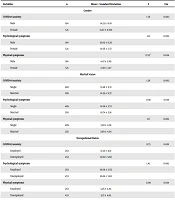
As shown in Table 2, the result of the regression analysis indicated that depression, anxiety, and stress, only anxiety significantly predicted total COVID-19 anxiety (β = 0.65, P < 0.001). However, anxiety (β = 0.47, P < 0.001) and stress (β = 0.21, P < 0.01) significantly predicted the psychological symptoms of COVID-19 anxiety. Finally, depression (β = 0.11, P < 0.01), anxiety (β = 0.73, P < 0.001), and stress (β = 0.12, P < 0.01) significantly predicted the physical symptoms of COVID-19 anxiety. Table 3 shows the descriptive statistics of COVID-19 anxiety scores based on demographic characteristics and the results of MANOVA comparing these variables.
Table 3.
Descriptive Statistics of Coronavirus Disease 2019 Anxiety Scores Based on Demographic Variables and Differences between Them (Multivariate Analysis of Variance)
| Variables | n | Mean ± Standard Deviation | F | Eta |
|---|---|---|---|---|
| Gender | ||||
| COVID-19 anxiety | 1.79 | 0.003 | ||
| Male | 194 | 14.53 ± 11.10 | ||
| Female | 521 | 13.47 ± 8.780 | ||
| Psychological symptoms | 1.12 | 0.002 | ||
| Male | 194 | 10.05 ± 6.20 | ||
| Female | 521 | 10.56 ± 5.57 | ||
| Physical symptoms | 17.23 c | 0.024 | ||
| Male | 194 | 4.47 ± 5.90 | ||
| Female | 521 | 2.90 ± 3.87 | ||
| Marital Status | ||||
| COVID-19 anxiety | 1.26 | 0.002 | ||
| Single | 489 | 13.48 ± 9.51 | ||
| Married | 226 | 14.35 ± 9.37 | ||
| Psychological symptoms | 0.98 | 0.001 | ||
| Single | 489 | 10.28 ± 5.72 | ||
| Married | 226 | 10.74 ± 5.81 | ||
| Physical symptoms | 1.17 | 0.002 | ||
| Single | 489 | 3.20 ± 4.58 | ||
| Married | 226 | 3.60 ± 4.54 | ||
| Occupational Status | ||||
| COVID-19 anxiety | 0.75 | 0.001 | ||
| Employed | 263 | 13.35 ± 9.13 | ||
| Unemployed | 453 | 13.99 ± 9.66 | ||
| Psychological symptoms | 1.42 | 0.002 | ||
| Employed | 263 | 10.09 ± 5.65 | ||
| Unemployed | 453 | 10.62 ± 5.80 | ||
| Physical symptoms | 0.09 | 0.001 | ||
| Employed | 263 | 3.26 ± 4.44 | ||
| Unemployed | 453 | 3.37 ± 4.65 | ||
| History of COVID-19 in the Participant | ||||
| COVID-19 anxiety | 40.65 a | 0.054 | ||
| Infected | 20.23 ± 12.78 | |||
| Regular | 13.02 ± 8.72 | |||
| Psychological symptoms | 18.15 a | 0.025 | ||
| Infected | 13.09 ± 6.15 | |||
| Regular | 10.12 ± 5.62 | |||
| Physical symptoms | 62.13 a | 0.080 | ||
| Infected | 7. 13 ± 7.57 | |||
| Regular | 2.89 ± 3.58 | |||
| History of COVID-19 in Family Members/Relatives/Friends | ||||
| COVID-19 anxiety | 6.82 b | 0.009 | ||
| With history | 14.45 ± 9.61 | |||
| No history | 12.53 ± 9.11 | |||
| Psychological symptoms | 7.03 b | 0.010 | ||
| With history | 10. 85 ± 5.55 | |||
| No history | 9.67 ± 6.02 | |||
| Physical symptoms | 4.30 c | 0.006 | ||
| With history | 3.59 ± 4.85 | |||
| No history | 2.86 ± 3.98 | |||
Abbreviation: COVID-19, coronavirus disease 2019.
a P < 0.001.
b P < 0.01.
c P < 0.05.
The results indicated a significant difference between males and females regarding physical symptoms. There were also significant differences between the participants with and without a history of COVID-19 in both components; however, the variables of gender, marital status, educational status, and occupational status were not significant concerning COVID-19 anxiety (P > 0.05).
5. Discussion
The present study investigated the roles of anxiety, depression, and stress in predicting COVID-19 anxiety among university students. The results of the present study indicated a positive and significant relationship between all the independent variables (i.e., anxiety, depression, and stress) and dependent variables (i.e., COVID-19 anxiety and psychological and physical symptoms), which is consistent with the results of previous studies (2, 3, 7, 9, 24). Moreover, the results of the regression analysis showed that regarding the included predictors, only general anxiety significantly predicted COVID-19 anxiety. However, both general anxiety and stress significantly predicted the psychological symptoms of COVID-19 anxiety. Finally, depression and general anxiety significantly predicted the physical symptoms of COVID-19 anxiety. The present study’s findings concur with those of previous studies (16), which showed relationships between general anxiety, stress, and depression with COVID-19 anxiety.
One explanation for the present study’s results was that universities had to be closed to prevent the spread of the virus, and the data were collected when the students were away from the university. With the closure of universities, their associated dormitories were also closed, forcing students to return home (9). The sudden leaving of their dormitories is likely to have led to several problems for students because it likely negatively impacted the independence that students had experienced by living away from their families (25). This issue might also have led to problems, including conflicts at home with parents and increasing anxiety and stress (26). Moreover, having to leave university physically might have caused students to become socially isolated from their friends and peers, increasing the symptoms of loneliness and depression (27). Associated worrying due to health concerns might have led to a possible cycle of negative thoughts, which can increase COVID-19 anxiety (28, 29).
Additionally, following the closure of universities, educational institutions continued operating using e-learning methods to continue teaching (22). This sudden change in education methods might have caused some students to become dissatisfied with the quality of education they received (30). Moreover, students’ concerns about home internet costs (i.e., line rental costs) are another problem of e-learning (9). Due to the COVID-19 pandemic, some families lost their source of income and experienced economic problems, which can also lead to anxiety and worries for the affected students (12).
The continuation of these conditions appears to be putting a strain on students’ psychological well-being (11). Studies show that, compared to surveys conducted before the COVID-19 pandemic, anxiety and depression significantly increased among students (2, 9). This increase in stress, anxiety, and depression is not limited to the effects of COVID-19 on students’ education; nevertheless, the increase is also affected by students’ ambiguity and questions about the disease itself, for which there are no definitive answers. Moreover, constant exposure to information related to COVID-19 and its consequences in the media, lockdown measures to prevent the further spread of the disease, and recommendations and prohibitions (e.g., staying at home) will all likely contribute to worsening mental health (27).
Other results of the present study showed a significant difference between male and female students in terms of the physical symptoms of COVID-19 anxiety (i.e., female students experiencing more significant physical symptoms as a result of COVID-19 anxiety). A study also indicated that females were more vulnerable to experiencing COVID-19 anxiety than males (12). One of the possible reasons for this is that females show a greater general risk for anxiety and affective disorders than males (27). This result is consistent with the research results of Luo et al. (31). A large body of evidence has shown that compared to males, the prevalence rates of loneliness, depression, and anxiety are higher among females (32). Compared to males, females are more emotionally sensitive and tend to attach greater importance to self-perception and their inner experiences. The present study appeared to confirm the aforementioned finding.
In a previous outbreak of severe acute respiratory syndrome, one study reported that females were more likely than males to receive counseling for their emotional needs and problems (32). Such a finding highlights the gender difference concerning psychological responses to a public health emergency. Additionally, the participants with a personal history of COVID-19 were more likely to have COVID-19 anxiety than the participants who had not been infected with COVID-19. Moreover, students with a family member infected with COVID-19 had higher COVID-19 anxiety than those who did not, confirming previous results (22, 32).
In addition, familiarity with the conditions of the disease and the direct experience of negative physical and psychological consequences of their family members during the COVID-19 pandemic might have caused higher anxiety among this group of students. There might also be individuals in these families who have experienced the death of a family member, which would likely increase their COVID-19 anxiety (32). Other results of the present study indicated that marital status, occupational status, and educational status were not significantly associated with COVID-19 anxiety.
5.1. Conclusions
Based on the results of the present study, there was a positive and significant relationship between anxiety, depression, and stress with COVID-19 anxiety, psychological symptoms, and physical symptoms. The results showed that anxiety and stress significantly predicted the psychological symptoms of COVID-19 anxiety. Moreover, depression and anxiety significantly predicted the physical symptoms of COVID-19 anxiety. Other results of the present study indicated a significant difference between males and females regarding the physical symptoms of COVID-19 anxiety. Some variables, including a personal history of COVID-19, family members infected with COVID-19, and the experience of the death of a family member due to COVID-19, predicted a higher level of suffering from COVID-19 anxiety. To the best of our knowledge, the present study is the first to target students who returned home due to quarantine measures to investigate the psychological impacts of the outbreak.
5.2. Limitations
The present study has several limitations. All the data concerning psychological impacts (i.e., stress, anxiety, and depression) were self-reported and might differ from those provided by trained healthcare professionals. Moreover, the self-reported data might have included biased responses (due to factors such as social desirability). In addition, all the participants were self-selected Iranian students from several universities, and the sample size was modest. Therefore, the findings cannot be generalized to all Iranian students or students from other countries and cultures. Further studies are required to replicate the findings of this study using more representative student samples, including those outside Iran. Moreover, the exclusion criteria did not exclude individuals with a history of psychological problems, psychological counseling, psychoactive substance use, and psychological problems with parents. Additionally, further questions could have been included on the differences and stresses that students faced after returning home.
5.3. Practical Implications
Despite the aforementioned limitations, the present study provides valuable information concerning the psychological responses during the COVID-19 pandemic from university students in Iran. The outbreak of COVID-19 severely affected the psychological functioning of students and led to the spread of a new form of anxiety among students (32). The evidence shows that young generations are more vulnerable to depression during epidemics (9). Therefore, it can be concluded that with the continued spread of the virus and associated casualties, there is a chance that there will be an increased vulnerability of university students to anxiety and depression and, as a result, a potential drop in academic performance and long-term adverse effects on other aspects of students’ lives. Therefore, many researchers have emphasized paying particular attention to providing psychosocial care for special groups, such as university students, during COVID-19 (33). The present study’s results emphasize the necessity of planning effective interventions to control the psychological damage experienced by students. Primarily, the present study’s results can help create psychological interventions that target stress, anxiety, and depression during public health crises and inform individuals of future viral outbreaks.
It is particularly recommended that during quarantines, universities should implement programs to support students who return home. These programs could include providing educational and therapeutic counseling, online courses and events, and educational facilities (e.g., online libraries). Moreover, further longitudinal studies are required to investigate the longer-term impacts of the outbreak on students who were forced to return home.