
1. Background
Marriage has been one of the most important human characteristics since the beginning of civilization. After marriage, couples expect themselves and their spouse to remain sexually and emotionally loyal to each other (1). Marital infidelity, or extramarital relations, is a major cause of family breakdown, conflict, and marital disagreement. It signifies a breach of the assumed contract between spouses (2). Many mental health professionals consider marital infidelity to be the most destructive harm likely to occur in marital relationships (3). While marital infidelity often leads to separation, in some cases, individuals attempt to murder their partner in response. Gender murder is a violent act where men in a family kill a female family member (sister, daughter, mother, wife, or cousin) for reasons such as illicit relationships, to purify the family’s and relatives’ stigma. The main victims are women and girls (4).
In Iran, accurate statistics on such murders are lacking, as many are not reported by families or are declared as missing, suicidal, or suspicious deaths. However, reports from 2010 to 2014 indicate over 8,000 murders in Iran, many related to honor killings (5). Gender murder is considered intentional, committed with the will and intention of the perpetrator, excluding those caused by lack of skill, carelessness, inaccuracy, negligence, and non-compliance with regulations (6). This type of murder can result from culturally unacceptable behaviors, such as contact outside of marriage and behaviors violating family dignity (7).
While gender-based killings appear to stem from tribal customs in the Middle East, South Asia, and North Africa, research suggests they also occur in European countries and modern societies, known as honor or shameful killings (8). The United Nations Fund for Population Activity (UNFPA) estimates annual gender killings worldwide reach 5,000 women and girls, though some NGOs estimate 20,000 annually. Despite limited statistics, research shows gender assassinations vary among women of different ages, religions, social statuses, wealth, education, and locations (9).
Sociologists believe culture plays a prominent role in gender murder incidence. In less developed and traditional societies, such murders are not considered crimes but legitimate measures to protect and defend honor and the tribe (10). Psychological evidence indicates information processing and decision-making styles play a role in conformity with aggregation. People from the same cultural societies do not always react similarly to individual and social events. In everyday life challenges, decisions range from: (1) Absolutely rejected (results inconceivable) to (2) uncertainty or ambiguity (results clear, but occurrence probability uncertain) to (3) risk-taking (results probability predictable) and (4) certainty (results clear) (11).
Some individuals are less sensitive to decision consequences and less capable of using negative feedback to guide decisions in challenging situations. Decision-making is a complex cognitive function involving assessing short-term and long-term actions’ advantages and disadvantages. Neuroscience findings introduce two prominent decision-making patterns, separated by ambiguity and information presented (12). In some cases, decision consequences and possibilities are uncertain, requiring "decision under ambiguity" based on previous choices’ feedback. In contrast, risky decisions involve explicit information about options and consequences.
From the rational choice perspective (RCP), deliberate human behavior is deterred or facilitated by situational factors knowledge (13). Internal impulses of criminal practice, specifically gender murder, occur in interaction with cultural factors and information processing. Research shows 25.7% of killers decide to kill with a predetermined schedule (13). Critics argue that crimes committed in emotional arousal (jealousy, sexual arousal, aggression) cannot be logically explained (14). Evidence suggests decision-making can be limited by emotional arousal, cognitive bias, and alcohol or drugs (14).
Challenging situations (e.g., facing marital infidelity in collective cultures) with double information ambiguity about infidelity causes and community judgment provoke emotional reactions and risk-taking. Ambiguity and "risk as feeling" sometimes overcome cognitive assessment and risk analysis (15). Studies show cognitive and emotional states in information processing play a significant role in risk identification and decision-making, depending on the subject’s level or nature (16-18).
2. Objectives
In total, according to the research literature, there are two prominent models in decision-making: The likelihood of increased risk-taking in the face of ambiguous information and the lack of research on risk-taking and risky decision-making styles in the context of marital infidelity in Iran. The main objective of the present research is to predict risky decision-making styles in gender assassins and divorce applicants affected by marital infidelity within a cultural framework.
3. Materials and Methods
3.1. Participants
The present research employs a descriptive design of the discriminant analysis type. Discriminant analysis is a separation method that aims to distinguish individuals in groups with nominal or ordinal data using independent variables, ultimately identifying variables that differentiate groups. The study community includes all those accused of gender murders in Ahvaz Prison and those referred to the relaxation clinic of the Ahvaz Police Center. Therefore, the prototype of the present study was available to 86 prisoners and individuals referred to the relaxation clinic of the FARAJA Police Center in Ahvaz.
For a robust discriminant analysis, the sample size in a differentiation function should be at least four times the number of independent variables (19). Based on the ultimatum game and 11 questions related to the high-risk decision styles questionnaire, the targeted sample was estimated at 48 people per group, totaling 96 participants. However, due to the withdrawal of 5 gender killers and 5 divorce applicants, 86 prisoners and referrals to the relaxation clinic of the FARAJA Police Center in Ahvaz were eventually studied.
In the first step, 43 men accused of gender murder in Ahvaz Prison completed the discriminant test and the risky decision-making styles questionnaire. In the second step, 43 men applying for divorce, referred by the court to the FARAJA relaxation clinic in Khuzestan province, completed the questionnaire. The criteria for entering this study were: (1) Lack of history of addiction, and (2) literacy. The criteria for leaving the research were: (1) Lack of willingness to cooperate, and (2) incomplete questionnaires.
3.2. Measurements
3.2.1. Ultimatum Game
The test was first developed by Goethe et al. (1982) to evaluate decisions about choosing less money or choosing more money over a longer time with a partner who can be a source of risk. It examines the ability to delay receiving rewards or the lack thereof. This task is popular in social cognitive studies, and numerous neurological studies have demonstrated the activity of brain centers involved in social decision-making during its implementation. Imaging studies have shown that the transplantation of parietal, temporal, and postsecondary fragments play an important role in this assignment. This area is related to understanding situations from another person’s point of view (20).
The test involves imagining you need a colleague to find a ten-coin treasure. You have two people to choose from: One you know and one you do not. If the person you know accepts your offer, you must give half the coins to them. If the person you failed to know accepts your offer, you can give them two of the ten coins and keep eight for yourself. In both cases, if people do not accept your offer, the entire coin will be lost. Which person would you choose as a colleague?
Today, trust tests and the ultimatum game are widely used to measure economic trends based on trust and risk-taking (21). Both have strong research evidence with brain imaging and psychosomatic studies, alongside most psychological tests. The Cronbach’s alpha for this test is 0.79, and its retest reliability is 0.71 (22). In the simultaneous study by Nejati and Alipour, this scale’s correlation with the trust test was 0.81, and its Cronbach’s alpha was 0.70 (23) (Figure 1).
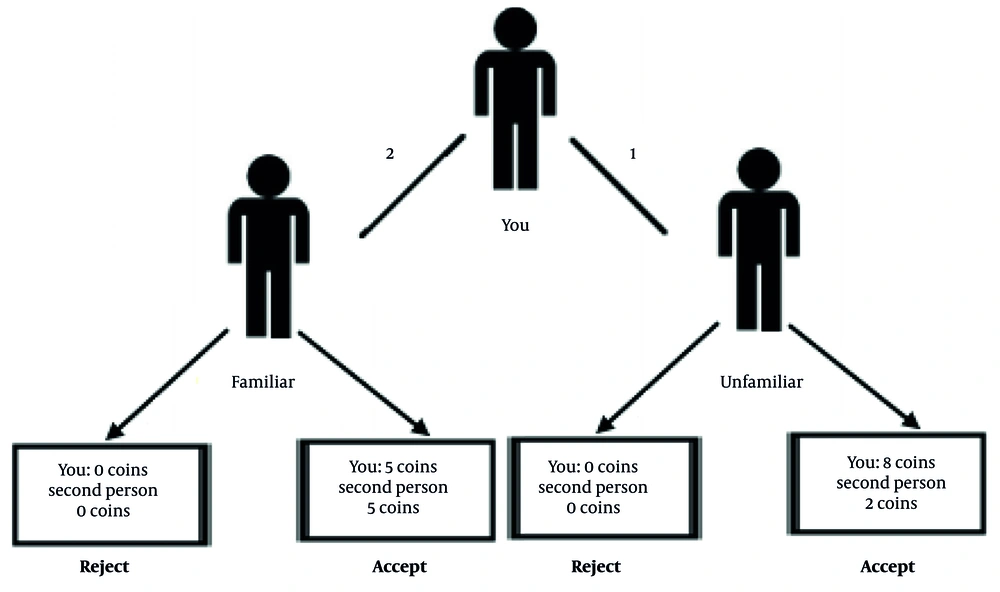
Figure 1.
Image of ultimatum game
To score this test, choosing an unfamiliar person is considered trusting a stranger and making risky decisions, while choosing a familiar person indicates not trusting a stranger and making low-risk decisions.
3.2.2. High-risk Decision Styles
The test was designed by Nejati to assess risky decision-making in social situations. The questionnaire consists of 11 questions related to social situations, which participants answer by selecting "yes" or "no" to four components: Economic risk, life risk, adolescence/diversity, and ambiguity. The reliability of this questionnaire was reported with a Cronbach’s alpha of 0.67. The convergent correlation of the total score of this tool with the ultimatum game is 0.25, and the simultaneous validity of the questionnaire is desirable using the Spearman correlation method (20).
3.3. Procedure
After receiving the necessary permits from the university and coordinating with the Applied Research Center of FARAJA, Khuzestan, the prison and the relaxation clinic were accessed to complete the ultimatum game and the high-risk decision-making styles questionnaire by the participants. Finally, the statistical software SPSS version 24 was used to process and analyze the data.
According to the professional ethics code of the Islamic Republic of Iran Psychological and Counseling System Organization, before distributing the questionnaires to the participants, explanations were provided about the study’s objectives and how to observe the ethical principles of the research, including the principle of informed consent, the principle of minimal risk, and the principle of confidentiality. Participants were reminded to complete only descriptive information such as age and education and refrain from writing names and surnames to observe these principles. Participants were also given the opportunity to withdraw from the study at any stage if they did not wish to continue cooperating. Additionally, participants were advised that their information would be preserved by the researcher and that the analysis of the answers would be conducted in groups without names or identifiers.
4. Results
The findings are described in Table 1 to provide general insight into the data and include mean, standard deviation, score range.
Table 1.
Mean and Standard Deviation of Risky Decision-Making Components
| Variables and Groups | Mean ± SD | Score Range | Qty |
|---|---|---|---|
| Economic vulnerability | |||
| Gender killers | 5.79 ± 0.85 | 4 - 7 | 43 |
| Divorce applicants | 5.88 ± 1.12 | 4 - 8 | 43 |
| Health risk | |||
| Gender killers | 6.57 ± 1.05 | 5 - 9 | 43 |
| Divorce applicants | 5.51 ± 0.70 | 4 - 7 | 43 |
| Diversification | |||
| Gender killers | 3.18 ± 0.69 | 2 - 4 | 43 |
| Divorce applicants | 2.93 ± 0.73 | 2 - 4 | 43 |
| Ambiguity | |||
| Gender killers | 5.78 ± 0.87 | 4 - 8 | 43 |
| Divorce applicants | 5.79 ± 0.94 | 4 - 8 | 43 |
| Ultimatum | |||
| Gender killers | 1.90 ± 0.83 | 2 - 7 | 43 |
| Divorce applicants | 1.17 ± 0.96 | 1 - 4 | 43 |
As you can see, the results of Table 1 show that the highest average with (6.57) health risk belongs to the group of gender killers, and the lowest average (1.17) is observed in divorce applicants. It should be noted that the gender of all participants in the present study was male.
As shown in Table 2, the significance of the Wilks’ Lambda value (P < 0.001) indicates a meaningful relationship between the two variable categories (ultimatum and risky decision styles). Lambda represents the variance not explained by the model; therefore, 1-λ reveals the effect size of the complete model in the matrix r2. Based on this, the effect size of a conventional function of analysis is equal to 1 - 0.721 = 0.279. This effect size represents the value of the common variance between the two categories of variables that the full model can explain. Therefore, the model obtained in this study explains 28% of the variance between risk variables and the high-risk decision style. In Table 3, the value of the first function shows a greater mean difference in the groups in question.
Table 2.
Eigenvalues and Wilks’ Lambda
| Function | Eigenvalue | % of Variance | Cumulative % | Canonical Correlation | Wilks’ Lambda | Chi-Square | df | P-Value |
|---|---|---|---|---|---|---|---|---|
| 1 | 0.388 a | 100.0 | 100.0 | 0.529 | 0.721 | 26.873 | 5 | 0.001 |
a It is statistically significant.
Table 3.
Standardized Canonical Discriminant Function Coefficients and Structure Matrix
| Variables | Standardized | Structure Matrix |
|---|---|---|
| Function 1 | Function 1 | |
| Ultimatum game | 0.806 | 0.768 |
| Health risk | 0.510 | 0.489 |
| Seeking diversity | 0.081 | 0.044 |
| Ambiguity | 0.069 | -0.032 |
| Economic vulnerability | -0.230 | -00.007 |
Table 3 presents the standard coefficients and structural coefficients for the set of variables in the first function. According to Allport and Patterson (24), only variables with structural coefficients of at least 30% are considered and interpreted. In this context, the contents of Table 3 indicate that in the first function, the end of the argument (structural coefficient, 0.768) and health risk (structural coefficient, 0.489) have a greater contribution to the linear composition of the predictive variables. In other words, the ultimatum and health risk have effectively distinguished between the groups being examined.
As shown in Table 4, in the murderer group, 65.1% and in the divorce applicants’ group, 72.1% are correctly classified. Additionally, on average, 68.6% of the grouped individuals (murderers and people applying for divorce) are properly classified.
Table 4.
Predicted Group Membership a
| Groups | No. (%) | Qty |
|---|---|---|
| Murdered | 15 (34.9) | 43 (100.0) |
| 28 (65.1) | ||
| Divorced | 12 (27.9) | 43 (100.0) |
| 31 (72.1) |
a 68.6% of original grouped cases correctly classified.
5. Discussion
The present study aimed to predict risky decision-making styles in gender killers and divorce applicants affected by marital infidelity. The findings show a significant difference in the ultimatum game (risk-taking) and the health risk component between the groups examined, with no significant difference observed in other components of risky decision-making, such as ambiguity, diversification, and economic risk, between the two groups. The findings suggest that, in the face of marital infidelity, gender killers can be distinguished from divorce applicants based on the ultimatum game and health risk.
Although no research has yet been conducted to assess risky decision-making styles in gender killers and divorce applicants affected by marital infidelity, the current results align with some research (25-31) on the interference of emotion and cognition in decision-making problems and high-risk behaviors among offenders. In other words, criminals often follow risky and impulsive decision styles due to cognitive errors in information processing and emotional regulation failures. Traditionally, it was thought that risk recognition and decision-making involved mental calculations encompassing only the probability of decision outcomes and their evaluation (32). However, recent research literature concludes that risk recognition and decision-making are a combination of two different processes: Rapid and automated information processing (system 1) and slow and voluntary information processing (system 2) (33, 34). Risk-taking involves both "risk as analysis" (system 2) and "risk as feeling" (system 1) systems (33). This interaction between cognition and emotion is called the dual process of processing risk information (35).
In challenging situations, people must first process experience and feedback to assess potential risks and rewards associated with specific decision-making options. Feedback processing, along with probabilities and "emotions" for specific options, can play an important role in participants’ performance in tests such as the completion of the argument. Sanfey et al. were the first to examine the neurological basis of motivational contradictions during the risk-taking process and decision-making in the ultimatum game. They argue that the decision to ignore a small financial gain proposed by the audience is a response to negative emotions caused by the proposer’s unfair behavior in dividing primary financial resources (36). Evidence suggests that social rewards from confronting violators of positive norms (such as lack of fairness) can activate brain areas associated with the reward system (such as the putamen) despite financial losses (37, 38).
In explaining the higher scores of gender killers in the ultimatum game, it seems that when unfair economic proposals are rejected by the killers to adhere to the norm of fairness, it can prevent the audience (researcher) from repeating subsequent unfair proposals. According to the findings of the present study, marital infidelity seems to be considered unfair to killers, activating system 1, i.e., risk as emotion. Risk-taking also prevents the repetition of unfair behavior, emotional regulation, and serves as a reward. Dual processing approaches in risk information processing suggest that both cognitive and emotional processing systems interact in risk recognition and decision-making, although responses to different situation characteristics may vary from person to person (39, 40). Emotional, cognitive, risk recognition, and decision-making are involved in risk decision-making depending on the situation, context, and content of the layout. In emotional processing, individuals rely on visual considerations based on emotional effects, while in cognitive processing, they are more sensitive to analytical considerations such as probabilities and numbers (33).
Damasio’s study (41) on brain damage in the middle ventricular cortex of the forehead is of particular importance, leading to the formation of the somatic marker hypothesis in decision-making. According to this theory, people implicitly use physical changes caused by decision results in the decision-making process. When it comes to marital infidelity, if the physiological and physical aspects of negative emotions are properly recognized and processed by killers, they can make efficient decisions. Emotional processing is subconscious, automated, and effortless, with risk recognition occurring based on visual cues and reconciling cues with schemas stored in long-term memory (42). This process is often described as an "inner feeling" and uses schematics that provide speed to risky decision-making (43, 44).
Health-related cognitive and emotional schemas play a crucial role in determining which signs and sources of information to consider, which to ignore, and when to take risks. Detailed inferences of schematics (or recipes) are formed through frequent exposure and learning in early life environments, guiding human behavior in challenging situations. Biases in processing health-related information can lead some people to perceive hostility or provocation, observed in heat-of-passion homicides. A health risk is the chance or likelihood that something will harm or otherwise affect people’s health. Risk doesn’t mean something bad will definitely happen; it’s just a possibility. Several characteristics, called risk factors, affect whether health risks are high or low. Understanding health risks is key to making informed decisions, providing perspective on potential harms and benefits, and enabling smart choices based on facts rather than fears.
5.1. Conclusions
Overall, according to the results obtained, the different scores achieved in the ultimatum game by gender killers and divorce applicants may be attributed to the varying activity of both the "risk as analysis" (i.e., system 2) and the "risk as feeling" (i.e., system 1) systems. Additionally, a study (29) showed that exposure to high levels of violence can lead to the formation of "a style of information processing with being on the alert to hostile signs and beliefs". Similarly, cultural roots and different social interactions in health risk can confirm a hostile-world schema through certain biases (45).
Therefore, it seems that the analysis and interpretation of the negative aspects of marital infidelity (risk-taking system 2) and the hostile meaning of social cues, such as questions and taunts from others (risk-taking system 1), along with health risk-taking, play a fundamental role in the aggressive response of gender killers. By evaluating risky decision-making styles in individuals who have been victims of marital infidelity, an important step can be taken in the prognosis and screening of potential future murders.
Each study has limitations that affect the generalization of findings. Among the limitations of the present study is the assessment of decision-making styles of killers based on self-reporting tools (risky decision-making styles questionnaire). Additionally, due to the possibility of statistical regression and the small sample size, results should be generalized with caution.
In line with Damasio’s theory of somatic markers in emotion processing, it is suggested that future research investigate other factors affecting risky decision-making, including problems in emotion processing such as alexithymia in gender murderers. Future studies should also explore additional factors influencing risky decision-making, including emotion processing issues like alexithymia, in gender killers.