


1. Background
Self-compassion is a positive attitude towards oneself, characterized by accepting experiences as part of the universal human experience and maintaining awareness of thoughts and feelings without becoming entangled in them (1). In recent years, self-compassion has gained recognition as an important factor for mental health, particularly among emerging adults — individuals aged 18 to 29 who are navigating a stage of exploration and instability (2). This demographic is particularly vulnerable to mental health issues, with high prevalence rates of anxiety, depression, and suicidal ideation, influenced by factors such as academic stress, identity development, and social isolation (3). Research indicates that self-compassion serves as a protective factor against suicidal ideation, especially when facing emotional pressures and high social expectations (4).
Emerging adults encounter various stressors, including significant life transitions such as entering the workforce, pursuing higher education, and forming deep social relationships (5). These stressors can elevate the risk of suicidal ideation (6). However, not all individuals experiencing such stress develop suicidal ideation, suggesting that protective factors like resilience and social support play crucial roles in mitigating this risk (7). Understanding these factors is essential for developing effective interventions.
Resilience, defined as the ability to adapt in the face of adversity, is a key component of mental well-being during early adulthood (8). More resilient individuals tend to employ better coping strategies and exhibit lower rates of suicidal ideation (9). Resilience can be bolstered by positive social interactions, adaptive coping mechanisms, and self-compassion (10). Self-compassion enhances an individual’s capacity to manage emotional difficulties, thereby strengthening resilience and reducing suicidal ideation (10).
Social support, encompassing emotional, informational, and instrumental support from family, friends, and communities (11), is also vital for mental health. Strong social support networks protect individuals from the adverse effects of stress and reduce the risk of suicidal ideation (12). Social support is particularly crucial for emerging adults, who often rely on peers and family during times of transition and uncertainty (12). Moreover, social support can amplify the positive effects of self-compassion on mental health (13).
The interaction between self-compassion, resilience, and social support forms a complex network that warrants further investigation. Self-compassion can enhance resilience by promoting adaptive coping and reducing negative self-criticism (14). Individuals with self-compassion are more proactive in seeking and utilizing social support, creating a positive feedback loop that enhances mental well-being (10). In the context of suicidal ideation, resilience acts as a mediator between self-compassion and suicidal thoughts. Self-compassion can improve resilience by reducing negative self-criticism and helping individuals manage stress related to suicidal ideation (10). Conversely, social support can either strengthen or weaken this relationship (13). Individuals with robust social networks and emotional support tend to maintain higher mental well-being, even when facing emotional challenges or stress.
Although extensive research exists on self-compassion, resilience, and social support, few studies have integrated these three factors in the context of suicidal ideation among emerging adults. Research linking these factors provides deeper insights into the protective interactions that can mitigate suicidal thoughts (10, 11, 13). Given the rising prevalence of mental health issues in this age group, it is crucial to explore how self-compassion, resilience, and social support interact concerning suicidal ideation. This study aims to elucidate the mechanisms through which self-compassion affects resilience and the moderating effects of social support, contributing to a deeper understanding of mental health in this vulnerable population. By addressing gaps in the literature, this research seeks to provide insights that can inform future interventions and support systems tailored to the unique needs of emerging adults.
2. Objectives
The present study aims to explore the moderating effects of social support and the mediating effects of resilience on the relationship between suicidal ideation and self-compassion. We hypothesize that self-compassion is positively related to resilience (H1) and negatively related to suicidal ideation (H2). Additionally, we propose that resilience is negatively associated with suicidal ideation (H3), social support moderates the relationship between self-compassion and suicidal ideation (H4), and resilience mediates the relationship between self-compassion and suicidal ideation (H5). Five pathways have been tested to verify the associations between these variables (Figure 1).
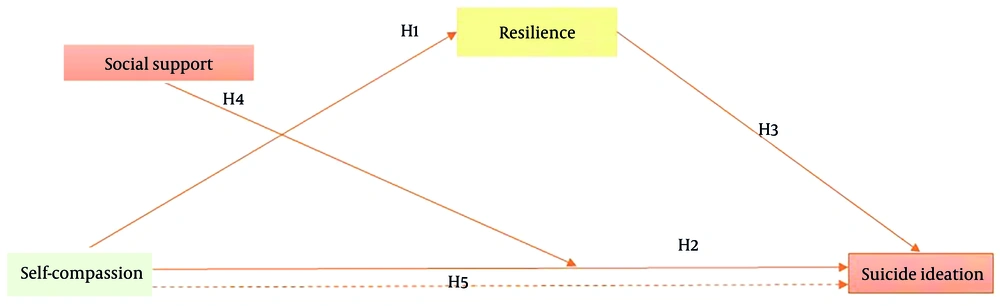
Figure 1.
Hypothetical path model of self-compassion, resilience, social support and suicidal ideation
3. Patients and Methods
3.1. Study Design
This study employed a descriptive correlational design with a cross-sectional approach, aimed at exploring the relationships between self-compassion, resilience, social support, and suicidal ideation among emerging adults at a single point in time. Although the cross-sectional design does not establish causal relationships, it provides valuable insights into the interrelations among variables within the social context of emerging adults (15). Data collection was conducted in July and August 2024. The writing of this report adhered to the strengthening the reporting of observational studies in epidemiology (STROBE) guidelines.
3.2. Sample and Participants
Participants in this study were emerging adults (aged 18 - 29 years) in Indonesia in 2024, totaling 309 respondents. A convenience sampling method was chosen for its efficiency and ease of access to the relevant population, although it may introduce bias and limit the generalizability of findings. Nevertheless, convenience sampling can still provide important preliminary insights into existing patterns of relationships (16). Data collection was facilitated using Google Forms to enhance respondent access, although this approach may exclude individuals without internet access or those uncomfortable with technology. Researchers took steps to mitigate these limitations. The collected data also included socio-demographic information such as gender, marital status, and educational level. All research procedures complied with applicable ethical guidelines, with consent obtained via an online form after explaining the research purpose and respondents’ rights. Participants indicated their consent by selecting "agree" on Google Forms.
3.3. Measurements
To ensure validity, each measurement tool in this study underwent validation and reliability processes. The instruments were translated and adapted to the Indonesian cultural context.
3.3.1. Self-compassion
Self-compassion was measured using the Self-compassion Scale (SCS) developed by Kristin Neff and adapted into Indonesian as the Skala Welas Diri (SWD) (17). This scale consists of 26 items encompassing six components of self-compassion, with a Cronbach’s alpha value of 0.872 in the Indonesian context (17). In this study, the Cronbach’s alpha value was 0.928, indicating very good consistency and strong construct validity in measuring self-compassion in the Indonesian sample.
3.3.2. Resilience
Resilience was measured using the 10-item Connor-Davidson Resilience Scale (10-item CD-RISC) in its Indonesian version. This scale has demonstrated good validity and reliability, with a Cronbach’s alpha value of 0.868 in previous research (18). In this study, the Cronbach’s alpha value was 0.913, indicating very good reliability.
3.3.3. Social Support
Social support was measured using the Social Provision Scale (SPS) developed by Cutrona and Russell (1987) (19). The SPS measures various dimensions of social support that affect mental health, with a Cronbach’s alpha value of 0.879 in earlier studies (19). In this study, the Cronbach’s alpha value was 0.947, indicating excellent internal consistency.
3.3.4. Suicidal Ideation
Suicidal ideation was measured using the Revised Suicidal Ideation Scale (R-SIS), which has been adapted into Indonesian (20). The Indonesian version of the R-SIS demonstrated excellent reliability with a Cronbach’s alpha value of 0.943 (20). In this study, the Cronbach’s alpha value for the R-SIS was 0.964, indicating very good consistency in its measurement.
3.4. Statistical Analysis
Data analysis was performed using IBM SPSS statistics version 26.0. Descriptive analysis was utilized to summarize the socio-demographic data. To examine the role of resilience as a mediator and social support as a moderator, Hayes PROCESS macro model 8 was employed. This model is capable of analyzing both mediation and moderation within a single framework (21), making it particularly suitable for demonstrating that resilience, as an individual’s ability to withstand stress, plays a crucial role in psychological well-being and can reduce suicidal ideation (10, 11). Additionally, social support functions as a protective factor that strengthens the relationship between self-compassion and suicidal ideation (13).
4. Results
4.1. Descriptive Analysis
The study included 309 respondents, comprising 243 females (78.6%) and 66 males (21.4%). The ages of the respondents ranged from 18 to 29 years, with an average age of 22.02 years (SD = 2.74). The majority of respondents were unmarried (n = 272, 88%) and had completed their highest level of education at the high school level (n = 188, 60.8%). Among the 309 respondents, 29 (9.4%) exhibited a high level of suicidal ideation, with an average score of 17.26 (SD = 9.487).
4.2. Relationship Between Self-compassion, Resilience, Social Support, and Suicidal Ideation in Emerging Adulthood
The analysis of the relationships between these variables is further detailed in Table 1.
Table 1.Analysis of the Roles of Self-compassion, Resilience, Social Support, and Suicidal Ideation in Emerging Adulthood
| Variables | Coeff | SE | t | P-Value | LLCI | ULCI |
|---|---|---|---|---|---|---|
| SC and resilience | 0.24 | 0.02 | 11.50 | 0.00 | 0.20 | 0.28 |
| SC and SI | -0.25 | 0.05 | -5.10 | 0.00 | -0.34 | -0.15 |
| Resilience and SI | -0.37 | 0.11 | -3.34 | 0.00 | -0.59 | -0.15 |
| Social support as moderation between SC and SI | 0.02 | 0.00 | 9.19 | 0.00 | 0.01 | 0.02 |
4.2.1. The Role of Self-compassion and Resilience
A significant positive relationship was found between self-compassion and resilience (Coeff = 0.24, P < 0.001) (H1), indicating that higher levels of self-compassion are associated with increased resilience.
4.2.2. Self-compassion and Suicidal Ideation
Self-compassion has a negative relationship with suicidal ideation (Coeff = -0.25, P < 0.001) (H2). Respondents with higher levels of self-compassion exhibited lower levels of suicidal ideation.
4.2.3. Resilience and Suicidal Ideation
A significant negative relationship was found between resilience and suicidal ideation (Coeff = -0.37, P < 0.001) (H3). Higher resilience is associated with lower suicidal ideation.
4.2.4. Social Support as a Moderator in the Relationship between Self-compassion and Suicidal Ideation
Social support moderated the relationship between self-compassion and suicidal ideation (Coeff = 0.02, P < 0.001) (H4). Respondents with higher social support benefit more from self-compassion in reducing suicidal ideation. This indicates that social support enhances the protective effect of self-compassion against negative thoughts related to suicidal ideation. The following is a visualization of the relationship between self-compassion and suicidal ideation, with social support as a moderator (Figure 2).
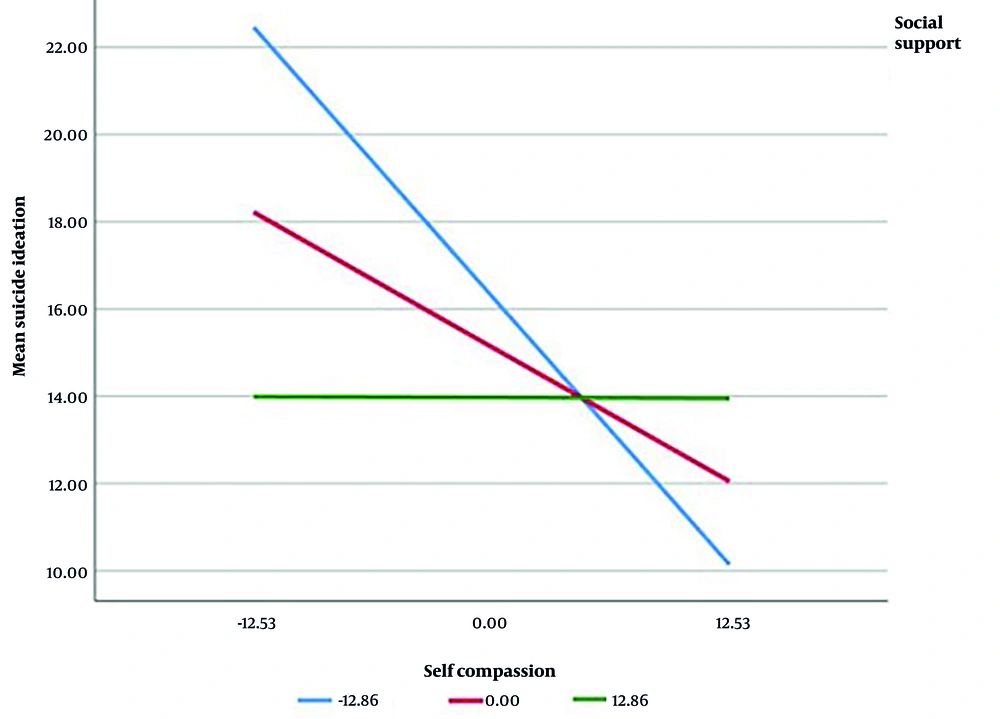
Figure 2.
Relationship between self-compassion and suicidal with social support as a moderator
4.2.5. Resilience as a Mediator in the Relationship Between Self-compassion and Suicidal Ideation
For the explanation of H5, please refer to Table 2, which provides a detailed analysis of resilience as a mediator in the relationship between self-compassion and suicidal ideation.
Table 2.The Role of Resilience in the Relationship Between Self-compassion and Suicidal Ideation
| Variable | Effect | BootSE | BootLLCI | BootULCI |
|---|---|---|---|---|
| Resilience as mediation between SC and SI | -0.09 | 0.04 | -0.16 | -0.01 |
Resilience was identified as a mediator in the relationship between self-compassion and suicidal ideation (H5). The BootLLCI (-0.16) and BootULCI (-0.01) values do not include zero, confirming the presence of a mediation effect. The mediation effect of -0.09 indicates that increased self-compassion is associated with higher resilience, which in turn is related to decreased suicidal ideation. This suggests that enhancing self-compassion may be an effective approach to preventing suicidal ideation by fostering resilience. Overall, the results of this study can be illustrated as shown in Figure 3.
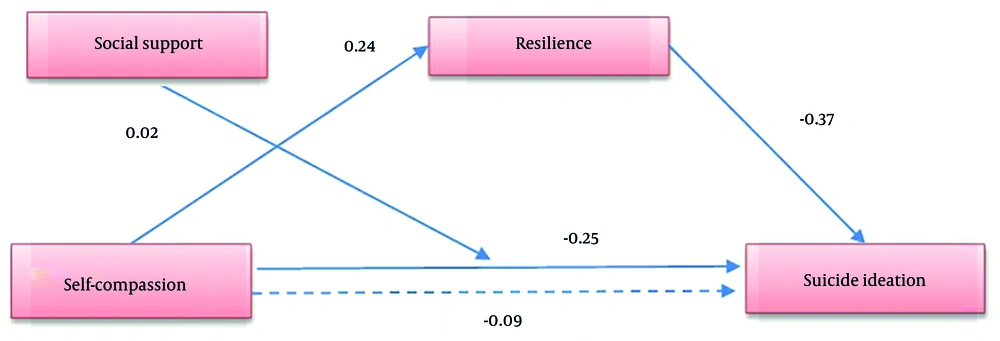
Figure 3.
The framework for the research results is the model of self-compassion, resilience, social support, and suicidal ideation
5. Discussion
This study found that self-compassion correlates positively with resilience, aligning with previous research indicating that self-compassion enhances individuals’ ability to adapt to life’s challenges and improves mental fortitude (17). As explained by Neff in 2003 (1), self-compassion encompasses three main components: Self-kindness, common humanity, and mindfulness, which support each other in fostering resilience. When individuals behave with compassion toward themselves, they are more likely to adopt a positive attitude in facing difficulties, thereby strengthening their capacity to endure. The theoretical model that explains this relationship is the sustainability model proposed by Tugade and Fredrickson, which suggests that positive emotions can enhance individuals’ psychological resources and strengthen resilience in the face of stress (22).
The research also identified a negative relationship between self-compassion and suicidal ideation, consistent with previous findings that self-compassion can serve as a psychological buffer to prevent the emergence of suicidal ideation (23). Self-compassion provides individuals with the capacity to accept emotional discomfort without self-judgment, reducing feelings of despair and anxiety that often trigger suicidal ideation (1). In this context, self-compassion can diminish cognitive distortions, protect individuals from the negative consequences of harsh self-judgment, and function as a positive coping strategy, enhancing psychological well-being relevant to reducing feelings of hopelessness and thus contributing to a decrease in suicidal ideation (24).
The results of this study indicate that resilience is associated with suicidal ideation. These findings reinforce the understanding that resilience plays a crucial role in lowering the risk of suicidal thoughts. According to Connor and Davidson, resilience encompasses the ability to bounce back after facing difficulties and to adapt to stress, which can be an important factor in the treatment of depression and the prevention of suicide (19). Resilient individuals are capable of confronting negative emotions, such as depression and anxiety (25), which are often linked to suicidal ideation.
One important finding from this study is that social support can moderate the relationship between self-compassion and suicidal ideation. The results suggest that sufficient social support can enhance the protective function of self-compassion against suicidal ideation (26, 27). As previous study has shown, social support acts as a protective factor that strengthens individuals’ capacity to manage stress and adapt to difficulties (28). The moderating effects of support from family, close friends, and peers reinforce the relationship between depressive symptoms and suicidal ideation among adolescents (29). Social support is believed to either strengthen or weaken the influence of self-compassion on suicidal ideation. Respondents with low self-compassion might not experience suicidal thoughts if they receive adequate social support, as they do not feel isolated and recognize that others care about their issues. In such conditions, respondents become better protected from suicidal ideation (28, 29).
Furthermore, this study demonstrates that resilience mediates the relationship between self-compassion and suicidal ideation. As previously explained, suicidal ideation is influenced by resilience (27, 28). Seligman defines resilience as an individual’s ability to recover from failure in a positive manner despite facing stress or trauma (30). Based on prior research, resilience functions as a mediating variable (29, 31). Resilience, as a positive personality characteristic, mediates the relationship between self-compassion and suicidal ideation. This finding is supported by evidence that resilience mediates the relationship between self-compassion and depression (32). Therefore, the findings indicate that high self-compassion leads to good resilience, which can prevent suicidal ideation.
Although self-compassion may help reduce suicidal ideation, adequate social support is key to enhancing the protective effects of self-compassion (21). This indicates that external factors, such as social support, play an important role in increasing the effectiveness of self-compassion in protecting individuals from suicidal thoughts. Based on these findings, interventions that combine the enhancement of self-compassion with improved social support may be more effective in preventing suicidal ideation, particularly among emerging adults experiencing various life pressures.
Limitations of this study include its cross-sectional design, which does not allow for the identification of clear causal relationships among the variables. Therefore, further research employing longitudinal or experimental designs is essential to explore the long-term effects of self-compassion, resilience, and social support on suicidal ideation. Additionally, this study utilized convenience sampling, which has limitations in terms of external validity, as the sample obtained may not accurately reflect the broader population. Hence, it is important for future researchers to consider alternative sampling techniques that are more representative.

