1. Introduction
Macroglossia is defined as the protrusion of the tongue beyond the teeth or alveolar ridges at rest. Common complications of macroglossia include speech and swallowing difficulties, malocclusion, and impaired mastication. An enlarged tongue can obstruct the upper airway, making macroglossia a recognized etiology of obstructive sleep apnea (OSA), which significantly compromises quality of life (1).
Surgical treatment of macroglossia is indicated when the underlying cause has been addressed, but complications persist (2). Current evidence suggests that glossectomy significantly improves the apnea-hypopnea index and other sleep quality parameters in OSA patients (2).
Although surgical intervention is preferred for patients experiencing complications due to macroglossia, the enlarged tongue presents significant challenges for intubation and the administration of anesthesia required for the procedure (3). Even with spontaneous breathing, clinicians often find it necessary to maintain intubation for several days post-glossectomy to ensure a secure airway (4, 5).
Here, we present the anesthetic management of a patient with macroglossia undergoing surgical treatment.
2. Case Presentation
After obtaining ethical approval from Shiraz University of Medical Sciences, we reported this case. The patient was a 57-year-old man who presented to the otolaryngology clinic with complaints of dyspnea (Figure 1).
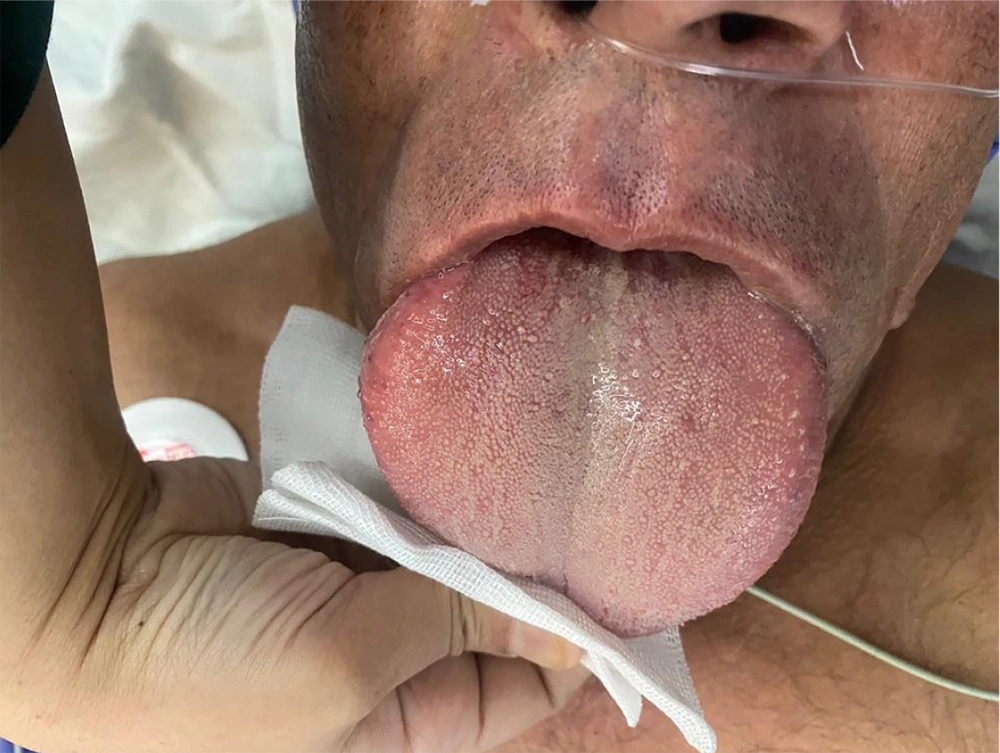
Figure 1.
Anterior view of macroglossia
He weighed 90 kg, and OSA was suspected based on clinical evaluation. His medical history was significant for hypertension, which was managed with losartan. His surgical history included a previous urologic procedure for nephrolithiasis, with no reported complications related to either the procedure or anesthesia. After a thorough physical examination, the patient was deemed a suitable candidate for a reduction glossectomy due to macroglossia.
The patient provided informed consent for the procedure and was transferred to the operating room. Difficult airway management equipment, including an endotracheal tube introducer, McCoy laryngoscope blade, and endotracheal tube guide wire, was prepared. Initial vital signs following cardiovascular monitoring in the operating room were as follows: Blood pressure of 150/110 mmHg, pulse rate of 100 bpm, and SpO2 of 94%. The dorsal aspect of the tongue was anesthetized using lidocaine spray. Intravenous sedation was administered with midazolam (2 mg), fentanyl (100 mcg), and propofol (50 mg). To ensure adequate anesthesia depth, vaporized sevoflurane was initiated. Subsequently, nasotracheal intubation was performed using a 7.5-mm endotracheal tube. Correct tube placement and sufficient oxygenation were confirmed, after which muscle relaxation and other necessary medications were administered.
The surgical site was prepared and draped, and a midline incision was made on the dorsal aspect of the tongue. The neurovascular structures were carefully preserved, and excess tongue muscle was debulked. The procedure was completed in 210 minutes.
At the conclusion of surgery, the patient was electively kept intubated to maintain a patent airway and was admitted to the intensive care unit (ICU). Extubation was performed the following day once the patient was fully awake and alert. He was discharged in good condition 24 hours later (Figure 2).
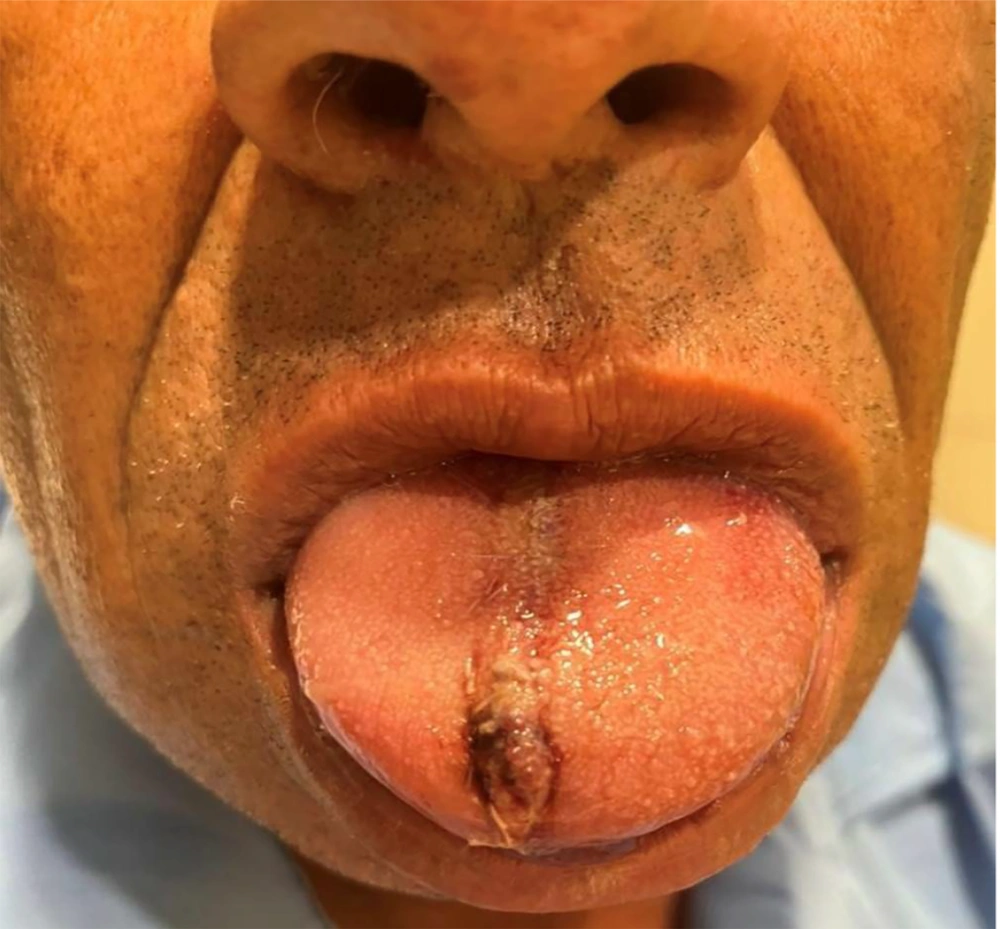
Figure 2.
5 days after partial glossectomy.
3. Discussion
Macroglossia is a rare anatomical abnormality characterized by the tongue protruding beyond the teeth or alveolar ridge in a resting position. Diagnosis is typically clinical, but cephalometric features have been described to confirm the diagnosis and differentiate it from pseudomacroglossia (6). Complications arising from an abnormally large tongue are the primary reason patients seek medical attention. An enlarged tongue can impair upper airway patency, as its base may obstruct the nasopharynx and hypopharynx, particularly in the supine position (7). This can lead to OSA, which manifests as daytime fatigue and other associated symptoms (8). In severe cases, as seen in our presented patient, breathing difficulties may develop.
Other complications, which may go unnoticed without thorough physical examination and cephalometric analysis, include orthodontic and orthognathic sequelae of chronic tongue enlargement. Generalized teeth spacing, malocclusion, and mandibular protrusion may occur. Additionally, painful mastication and deglutition can result in weight loss and malnutrition (6, 7). These orthodontic and orthognathic complications may necessitate surgical correction, which can be performed concurrently with glossectomy or scheduled separately (8, 9).
Glossectomy is the treatment of choice for patients with medically recalcitrant macroglossia and is also indicated in cases of extreme tongue enlargement, tooth impressions on the tongue periphery, the ability to extend the tongue to the chin or nose tip, and speech or psychological difficulties (6, 7). Partial glossectomy has minimal postoperative complications and does not impair speech or tongue movement. Furthermore, if the lingual nerve remains intact, taste sensation is largely preserved (1, 10). In fact, speech disabilities caused by macroglossia often improve significantly following reduction glossectomy (11, 12). However, clinicians must be vigilant about transient postoperative tongue enlargement due to edema, which, if severe, can lead to airway obstruction (7). To minimize this life-threatening risk, muscular debulking at the base of the tongue is often avoided, as seen in the "W" resection technique (13).
Despite the minimal postoperative complications of partial glossectomy and the adequacy of respiratory drive, patients are often kept intubated for several days following surgery (3-5). The rarity of macroglossia precludes a consensus on optimal postoperative care, particularly in adult patients, as most reported cases in the literature involve children with congenital anomalies (12, 13). Another study reported a cohort of 24 pediatric patients who underwent reductive glossectomy due to macroglossia secondary to Beckwith-Wiedemann syndrome. In their study, the "W" resection technique was used, and all 24 patients were successfully extubated immediately after surgery without complications (13). However, it is premature to conclude that immediate postoperative extubation is safe for all macroglossia patients undergoing partial glossectomy, as this study only included pediatric patients and surgical resection methods vary. Further studies are needed to determine the optimal postoperative management for such patients. Until then, clinical judgment remains paramount in decision-making regarding postoperative management pathways.
3.1. Conclusions
Reductive glossectomy is a safe and effective treatment for patients suffering from macroglossia, significantly improving its associated complications. However, current anesthetic guidelines do not specify the optimal mode of postoperative management in such patients, necessitating careful clinical judgment. Given the large size of the tongue, the nature of the surgery (debulking), and the involvement of the airway, along with the patient's history of OSA attacks at night, it was essential to reserve an ICU bed for postoperative monitoring. Additionally, oxygen support and airway edema management were crucial considerations. Consequently, the patient was transferred to the ICU in a sedated and intubated state to ensure airway patency and facilitate optimal postoperative care.