
1. Background
Smoking is a major public health issue worldwide, causing significant preventable morbidity and mortality (1). According to the World Health Organization (WHO), Smoking is responsible for more than 8 million deaths each year, predominantly in low- and middle-income countries (2). Smoking not only affects the smoker but also poses a significant risk to non-smokers through exposure to secondhand smoke (3). Smoking has been linked to several health problems, including cardiovascular and respiratory diseases, impaired wound healing, and reduced fertility (2, 4). Furthermore, Smoking has been shown to increase rates of depression and stress among smokers and has been linked to decreased productivity and increased healthcare costs (5, 6).
Despite the well-documented risks associated with this behavior, Smoking remains prevalent in many countries (2). In Oman, the WHO estimated that approximately 11% of the local population were smokers in 2010, affecting approximately 18% of men and 1% of women. If current tobacco control measures remain unchanged, the WHO predicts that Smoking prevalence could increase to 23% by 2025, with approximately 33% of men smoking, while the rate among women is expected to remain at around 1% (7).
Several studies have investigated the characteristics of college student smokers and associated predictors for smoking behaviors. Findings suggest that sociodemographic factors such as gender and socioeconomic status play a significant role in college students' smoking behaviors in the Eastern Mediterranean region (8, 9). In Oman, previous research from 2008 involving 1,962 school students indicated that 26.6% reported having smoked tobacco at some point in their lives, with 9.6% currently using tobacco products (10). Among males, 15.5% were current users, whereas only 2.6% of females reported currently smoking. Another study from Oman showed that 4.6% of secondary school students were current smokers (11). The probability of participants smoking increased if they had a friend or parent who smoked. However, adolescents were less inclined to smoke if they believed that Smoking had adverse health effects (10).
Evidence suggests that smoking cessation interventions can effectively help college students quit smoking (12). In Oman, the Sultan Qaboos University Hospital (SQUH) in Muscat Governorate offers a dedicated smoking cessation clinic integrated into the university's primary student health services since 2013. This clinic offers psychological counseling and nicotine replacement therapy to college students registered at the affiliated Sultan Qaboos University. However, despite the relatively high prevalence of Smoking among college students in Oman, there is limited information on the number and characteristics of those who utilize this service. Such knowledge is essential for healthcare providers to assess clinic outcomes and design tailored interventions that address their specific needs and motivations to quit.
2. Objectives
This study, therefore, aimed to investigate the sociodemographic and clinical characteristics of college students attending the SQUH Smoking Cessation Clinic from the year 2013 to 2020 using the information available in the electronic health records. Baseline nicotine dependency levels were also assessed using the Fagerström test for nicotine dependence (13). Furthermore, the study sought to explore the reasons behind the students' smoking behaviors and their motivations for quitting.
3. Materials and Methods
3.1. Study Design and Participants
A retrospective cross-sectional study was conducted among 63 college students attending the SQUH Smoking Cessation Clinic from 2013 to 2020. The inclusion criteria encompassed all undergraduate and graduate college students, regardless of gender and nationality, who smoked and attended the clinic during this period. Non-university students and SQUH employees attending the cessation clinic were excluded. Data collection continued until the end of 2020, when the clinic temporarily ceased services due to the global Coronavirus Disease 2019 pandemic.
3.2. Data Collection
Relevant data were collected from the students' electronic medical records. Sociodemographic information such as gender, age, place of residence, and specific college was gathered. In addition, clinical and smoking-related characteristics were assessed, including the presence of comorbidities, age at first clinic visit, type of tobacco used, nicotine dependence level, age of smoking initiation, reasons for starting to smoke, and motivations for quitting. Nicotine dependence was assessed using the Fagerström test for nicotine dependence by the treating physician. Dependency levels were classified as low (scores of 1 - 2), low-to-moderate (scores of 3 - 4), moderate (scores of 5 - 7), or high (scores of ≥ 8). The Fagerström test for nicotine dependence has demonstrated reliability in assessing nicotine dependence across various settings and populations (14).
3.3. Statistical Analysis
Collected data were analyzed using the statistical package for the social sciences (SPSS) software, version 26 (IBM Corp., Armonk, New York, USA). The analysis included both descriptive statistics and inferential statistics. Categorical variables were reported as frequencies and percentages, while continuous categorical variables were presented as medians with ranges. Associations between dependent and independent variables were analyzed using appropriate significance tests, including chi-squared, Mann-Whitney U, and Kruskal-Wallis tests. A P-value of ≤ 0.05 was considered statistically significant. The Kolmogorov-Smirnov test was employed to explore the normality of distribution between the independent continuous variables and the dependent categorical variables. A P-value of < 0.05 indicated a non-normal distribution. Place of residence was categorized as Muscat versus elsewhere, while type of college attended was divided into scientific (agricultural and marine sciences, engineering, science, medicine and health science, and nursing) and non-scientific (art and social sciences, economics and political science, education, and law) categories.
3.4. Ethical Considerations
This study was approved by the Medical Research and Ethics Committee of the College of Medicine and Health Sciences, Sultan Qaboos University (MREC #3033).
4. Results
4.1. Baseline Characteristics
Most college students who attended the SQUH Smoking Cessation Clinic were male (98.4%), with only one female participant (1.6%). The median age at smoking initiation was 16 years (range: 8 - 22 years old), while the median age upon first clinic visit was 21 years (range: 17 - 26 years old). The most frequently represented colleges were the College of Economics & Political Science and the College of Engineering (15.9% each), followed by the College of Education (11.1%). Most students originated from Al-Sharqiyah South (15.9%), followed by Muscat and Al-Batinah North (14.3%). The majority smoked midwakh pipes (79.4%) and cigarettes (60.3%). Additionally, 30.2% smoked Shisha Waterpipes, and 17.5% used Afdhal Chewing Tobacco. Only three students (4.8%) used electronic cigarettes or vape pens (Table 1).
Table 1.
Characteristics of College Students Attending a University Hospital Smoking Cessation Clinic in Muscat, Oman (N = 63)
| Characteristic | Values a |
|---|---|
| Gender | |
| Male | 62 (98.4) |
| Female | 1 (1.6) |
| Median age in years (range) | |
| At smoking initiation (8 - 22) | 16 |
| Upon first clinic visit (17 - 26) | 21 |
| College | |
| Agricultural and Marine Sciences | 4 (6.3) |
| Arts and Social Sciences | 6 (9.5) |
| Economics and Political Science | 10 (15.9) |
| Education | 7 (11.1) |
| Engineering | 10 (15.9) |
| Law | 3 (4.8) |
| Nursing | 0 (0) |
| Medicine and Health Sciences | 0 (0) |
| Science | 3 (4.8) |
| Unknown | 20 (31.7) |
| Place of residence | |
| Ad Dakhiliyah | 8 (12.7) |
| Ad Dhahirah | 5 (7.9) |
| Al Batinah North | 9 (14.3) |
| Al Batinah South | 4 (6.3) |
| Al Buraymi | 2 (3.2) |
| Al Wusta | 1 (1.6) |
| Ash Sharqiyah North | 7 (11.1) |
| Ash Sharqiyah South | 10 (15.9) |
| Dhofar | 8 (12.7) |
| Muscat | 9 (14.3) |
| Musandam | 0 (0) |
| Type of tobacco product used b | |
| Pipe (midwakh) | 50 (79.4) |
| Cigarettes | 38 (60.3) |
| Hookah/waterpipe (shisha) | 19 (30.2) |
| Chewing tobacco (Afdhal) | 11 (17.5) |
| E-cigarette/vape pen | 3 (4.8) |
| Unknown | 3 (4.8) |
a Values are expressed as No. (%) unless otherwise indicated.
b Percentages may not add up to 100% as some individuals may have used more than one type of tobacco product.
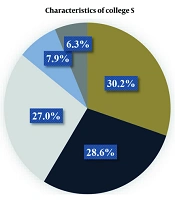
Upon their first clinic visit, the majority of students exhibited either high (30.2%) or moderate (28.6%) levels of nicotine dependence (Figure 1). In terms of the reasons for smoking initiation, 42 students (66.7%) started smoking due to peer influence, 17 (27.0%) out of curiosity, 14 (22.2%) due to stress and emotional reasons, 10 (15.9%) due to the influence of a family member who smoked, and 10 (15.9%) for social reasons. Health-related concerns were the most common reason to quit smoking (65.1%), followed by family reasons (34.9%), social image (28.6%), and religious beliefs and feelings of guilt (23.8%). Additionally, 14 students (22.2%) indicated a desire to quit smoking due to peer influence, while only three (4.8%) attempted to quit either because they wanted to marry or were already married (Table 2).

Figure 1.
Baseline nicotine dependency levels among college students attending a university hospital Smoking Cessation Clinic in Muscat, Oman (N = 63). Dependency was assessed using the Fagerström test for nicotine dependence, with scores of 1 - 2, 3 - 4, 5 - 7, and ≥ 8 classified as low, low-to-moderate, moderate, and high nicotine dependence, respectively.
Table 2.
Reasons for Smoking Initiation and Cessation Among College Students Attending a University Hospital Smoking Cessation Clinic in Muscat, Oman (N = 63)
| Reason | No. (%) |
|---|---|
| For starting to smoke | |
| Friends | 42 (66.7) |
| Curiosity | 17 (27) |
| Stress/emotional reasons | 14 (22.2) |
| Family | 10 (15.9) |
| Social reasons | 10 (15.9) |
| Unknown | 5 (7.9) |
| For deciding to quit a | |
| Health | 41 (65.1) |
| Family | 22 (34.9) |
| Social image | 18 (28.6) |
| Religious reasons/guilt | 15 (23.8) |
| Friends | 14 (22.2) |
| Marriage | 3 (4.8)) |
| Unknown | 2 (3.2) |
a Percentages may not add up to 100% as some individuals may have had more than one reason for quitting.
4.2. Associations Between Smoking Behaviors and Sociodemographic Characteristics
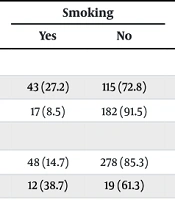
Age at smoking initiation was not associated with the level of nicotine dependence, place of residence, or type of college attended (P > 0.05) (Table 3). However, significantly more students from scientific colleges wanted to quit smoking for health-related reasons compared to students attending non-scientific colleges (82.4% versus 46.2%; P = 0.040). In addition, students with low nicotine dependence levels more frequently began smoking out of curiosity compared to those with moderate or high nicotine dependence levels (58.8% versus 9.5% and 27.8%, respectively; P = 0.050). Similarly, students with low nicotine dependence levels more frequently identified social image as a reason to quit smoking compared to those with moderate or high dependence levels (47.1% versus 34.8% and 10.5%, respectively; P = 0.004) (Table 4).
Table 3.
Associations Between Age of Smoking Initiation and Various Characteristics Among College Students Attending a University Hospital Smoking Cessation Clinic in Muscat, Oman (N = 63)
| Factors | Mean Rank | P-Value |
|---|---|---|
| Nicotine dependency level | 0.082 a | |
| Low | 37.12 | |
| Moderate | 25.75 | |
| High | 27.03 | |
| Place of residence | 0.920 b | |
| Muscat | 30.56 | |
| Elsewhere | 29.91 | |
| College type | 0.877 b | |
| Scientific | 21.15 | |
| Non-scientific | 21.74 |
a Using a Kruskal-Wallis test.
b Using a Mann-Whitney U test.
Table 4.
Associations Between Reasons for Smoking Initiation/Cessation and Various Characteristics Among College Students Attending a University Hospital Smoking Cessation Clinic in Muscat, Oman (N = 63) a
| Factors | College Type | Nicotine Dependency Level | Nicotine Dependency Level | P-Value | |||||
|---|---|---|---|---|---|---|---|---|---|
| Scientific | Non-scientific | Low | Moderate | High | Low | Moderate | High | ||
| Health as reason for quitting | 0.040 b | ||||||||
| Yes | 14 (82.4) | 12 (46.2) | |||||||
| No | 3 (17.6) | 14 (53.8) | |||||||
| Social image as reason for quitting | 0.050 | ||||||||
| Yes | 8 (47.1) | 8 (34.8) | 2 (10.5) | ||||||
| No | 9 (52.2) | 15 (65.2) | 17 (89.5) | ||||||
| Curiosity as reason for starting to smoke | 0.004 | ||||||||
| Yes | 10 (58.8) | 2 (9.5) | 5 (27.8) | ||||||
| No | 7 (41.2) | 19 (90.5) | 13 (72.2) | ||||||
a Values are presented as No. (%).
b Using Pearson’s chi-squared test.
5. Discussion
This study is one of the first in Oman to explore students' sociodemographic differences, tobacco consumption types, and levels of nicotine addiction at the time of their first visit to a smoking cessation clinic. It also sheds light on key factors influencing smoking initiation, such as peer pressure and curiosity, as well as common motivations for quitting, including health-related concerns. The findings offer valuable insights for healthcare providers and public health organizations to design tailored smoking cessation campaigns and educational programs targeting high school and college students.
This study investigated the characteristics of college students attending the SQUH Smoking Cessation Clinic, revealing a predominance of male gender students (98.4%). This likely reflects the low smoking rates among Omani female students. These findings are consistent with a systematic review that identified a similar pattern among Saudi college students, where male gender was strongly associated with smoking behaviors (15). Additionally, research across five countries in the Eastern Mediterranean region, including Egypt, Jordan, Occupied Palestinian Territories, Oman, and the United Arab Emirates, has also indicated a higher prevalence of waterpipe smoking among male university students, as well as a lower perceived risk of harm from engaging in this behavior (8). This underscores the need for targeted interventions addressing the unique challenges and influences driving smoking behaviors in this group.
Similarly, the present study also identified an early age of smoking initiation, with a median age of 16 years, which aligns with patterns reported in Oman, where the mean age of starting to smoke was 18.7 years old (16). Two studies conducted in Saudi Arabia also reported a mean age of 16 years for the initiation of tobacco use, highlighting the early onset of smoking behaviors during adolescence (17, 18). Regarding geographical distribution, most smokers in the current study originated from Al-Sharqiyah South, followed by Muscat and Al-Batinah North. This information is significant as it can help guide the development of targeted smoking awareness and outreach programs in these regions. Furthermore, further investigation into cultural or environmental factors could help explain the higher prevalence of smoking in these regions.
Our research revealed that college students utilized various forms of tobacco products, with many participating in culturally ingrained practices such as smoking midwakh pipes (79.4%) and Shisha Waterpipes (30.2%). Cigarettes were also commonly used (60.3%), while a minority opted for Afdhal chewing tobacco (17.5%) and electronic cigarettes or vape pens (4.8%). A previous study of adult Omani smokers documented that the majority (82.9%) smoked manufactured cigarettes, with smaller percentages smoking Shisha (6.4%), Gadou (traditional waterpipes; 7.9%), pipes (7.7%), and other forms of tobacco products, like chewable tobacco (4.5%). Acknowledging and respecting these cultural preferences while designing effective smoking cessation programs is imperative.
The study also underscores the significant challenge of nicotine addiction, given that the majority of the cohort demonstrated either high or moderate levels of dependence at their first visit to the smoking cessation clinic. Similarly, a study conducted among students at King Faisal University in Saudi Arabia found that 47.0% of current smokers exhibited high nicotine dependence levels according to the Fagerström test for nicotine dependence (19). This highlights the necessity of developing tailored, intensive cessation strategies, including educational campaigns targeting adolescents early to prevent the uptake of tobacco products or to assist those who are still in the mild stages of addiction, as quitting is more manageable at lower levels of dependence.
Understanding the reasons for starting and quitting provides valuable insights into the motivations behind college students' smoking behaviors. In this study, peer influence was the most prevalent reason for smoking initiation (66.7%), followed by curiosity (27.0%) and stress or emotional reasons (22.2%). Similarly, a study from neighboring Saudi Arabia also indicated that curiosity was the primary reason cited for smoking, cited by 44.3% of respondents, with tension relief following closely behind at 26.1%. These findings suggest that social dynamics and the exploratory nature play a significant role in initiating this behavior. Additionally, numerous studies have identified the behaviors and attitudes of friends as significant influencers of individual behavior (20). Regarding cessation, we found health-related reasons to constitute the most common motivation for quitting (65.1%), underscoring the importance of health awareness in driving individual cessation efforts. This finding aligns with a previous study, which showed that approximately 70% of smokers quit due to increased awareness of the hazards associated with smoking, highlighting the potential effectiveness of health-focused interventions in promoting smoking cessation (17).
Interestingly, a later age of smoking initiation was linked with lower nicotine dependence, although this trend was not statistically significant (P = 0.082). The higher mean age of smoking initiation in the low nicotine dependence group could indicate that individuals with lower nicotine dependence may start smoking later compared to those with moderate or high dependence. This finding suggests a complex relationship that warrants further investigation, possibly with a larger sample size to enhance the study's power to detect genuine associations between these variables. Moreover, no significant relationship was found between the age of smoking initiation and place of residence or type of college attended.
Nonetheless, the associations between reasons for quitting smoking and sociodemographic factors provide insights into the motivations behind smoking cessation among college students. In particular, a significantly higher percentage of students from scientific colleges cited health-related concerns as their primary motivation to quit smoking compared to non-scientific colleges (P = 0.040), reaffirming the influence of educational background in shaping attitudes towards smoking cessation. Additionally, the link between social image and nicotine dependence (P = 0.050), as well as curiosity and nicotine dependence (P = 0.004), highlights key psychosocial factors affecting smoking behaviors. Specifically, curiosity as a reason to start smoking was significantly associated with low nicotine dependence, while social image represented a significant motivator for quitting in the same group. These findings underscore the necessity for tailored interventions addressing both the physiological and psychosocial aspects of nicotine dependence.
The findings of this study should be interpreted in light of its limitations. Results were based on data collected from a single center, which provides smoking-quitting services only to college students attending one affiliated university. This impacted the generalizability of the study findings about students attending other public or private colleges. Furthermore, the sample size was small, consisting of only 63 college students. This limited sample size could have affected the study's statistical power, potentially influencing the results of the association analyses. Additionally, the cross-sectional nature of the study design and the retrospective data collection method could have affected the availability of certain information, leading to missing data.
5.1. Conclusions
The findings of this study provide essential baseline information that may help healthcare providers and public health organizations develop tailored smoking cessation campaigns and educational programs targeting college students. These initiatives should emphasize the adverse health consequences of smoking while taking into account common motives for starting and the types of tobacco that lead to dependence. Moreover, the low uptake of the freely available Smoking Cessation Clinic on campus, despite the likely high prevalence of student smokers, highlights the need for better promotion of these services and the benefits of quitting smoking among this population. Future studies could benefit from a prospective longitudinal design to address the limitations of missing data. Expanded smoking cessation services across Oman would also provide a more comprehensive understanding of the health profile of affected patients, offering a better representation of the broader population.