
1. Background
Suicidal ideation, the thought or wish for death that implies the termination of an individual’s life (1), typically initiates during adolescence (2, 3). Most adolescents who progress from suicidal ideation to suicidal attempts usually do it within 1 - 2 years following the onset of suicidal ideation (4, 5). This emerging and increasing risk phase may provide a developmental window for early intervention opportunities (3, 6).
Theories of suicide are important in understanding and preventing the phenomenon of suicide (7, 8). Despite the proven high utility of traditional suicide theories in guiding suicide research and intervention efforts (9), there still exists a gap in improving the ability to anticipate or reduce suicide (10, 11). Limited progress in this domain could be attributed to the fragmented framework used to examine suicide (12). A comprehensive theoretical framework is needed to facilitate hypothesis generation, findings integration, and further investigation guidance (9, 10, 12). Ideation-to-action theories [i.e., the Integrated Motivational Volitional Model (IMV), Interpersonal Theory of Suicide (IPTS), and Three Step Theory (3ST)] offer a promising framework to fill this gap (13). In this framework, it is essential to differentiate between a) the suicidal ideation development and b) the progression from suicidal ideation to attempted suicide as distinct phenomena, each characterized by unique determinants and underlying mechanisms. In this approach, suicidal ideation is essential but not adequate to threaten an individual’s life (10).
The IPTS proposes that a combination of thwarted belongingness and perceived burdensomeness leads to suicidal ideation, while the acquired capability facilitates the transition to suicide attempts (14, 15). Thwarted belongingness is the unmet need to belong, and perceived burdensomeness is viewing oneself as a burden on others. These moderately correlated constructs jointly contribute to active suicidal ideation (13, 14).
The IMV model explains suicide in three phases: Pre-motivational (background factors like environment, personality, and genetics), motivational (defeat leading to entrapment, which fosters suicidal ideation), and volitional (factors influencing the transition from ideation to suicidal behavior) (16).
The 3ST elucidates suicide through four factors (i.e., pain, hopelessness, connectedness, and capability for suicide) in three steps. Step 1 of the 3ST suggests that the interaction of psychological pain and hopelessness leads to suicidal ideation. In the 3ST’s second step, connectedness to others, projects, and purpose acts as a protective factor. For those with passive suicidal ideation caused by pain and hopelessness, a sense of connection can prevent progression to active suicidal ideation. Step 3 suggests that suicide attempts occur when an individual has both the means and capability to act on suicidal thoughts (13, 17).
It is essential to go beyond traditional research to examine the intricate relationships among the variables that contribute to the emergence of suicidal ideation (18). One of the recommendations from past studies is to compare the predictive utility of ideation-to-action variables as a means of validating theories related to suicide (7). Although ideation-to-action theories have been validated in previous studies, only a study by Ordonez-Carrasco compared the variables of these theories in a sample of adults using network analysis. The results demonstrated that defeat was the central variable, and all variables, except for thwarted belongingness, were correlated with suicidal ideation (19). However, as the authors know, no study has yet compared these variables regarding the development of suicidal thoughts in adolescents, and adult findings may not apply to adolescents due to developmental differences (3).
2. Objectives
The current study aimed to explore the role of key variables from ideation-to-action theories in predicting suicidal ideation among a sample of Iranian adolescents. Through this exploratory analysis, we anticipate that the results will help identify which variables have a stronger predictive relationship with suicidal ideation.
3. Patients and Methods
3.1. Participants
This cross-sectional study included 476 Iranian adolescents (76.3% female, 23.7% male), who were recruited from four secondary schools in grades 6 to 12 across different regions of Tehran, Iran. The inclusion criteria were (A) adolescents aged 12 to 20 years, and (B) obtaining informed consent from both parents and adolescents. The exclusion criteria were incomplete responses to the questionnaires. Out of the 525 adolescents who received the survey link, 476 provided complete responses and were included in the final analysis. The response rate was 90.6%. The final sample size of 476 participants exceeded the recommended minimum for hierarchical regression with nine predictors, which is typically 15 - 20 participants per variable (20). This ensures adequate statistical power (0.80) to detect small to medium effect sizes (f2 < 0.02) and reduces the risk of overfitting, thereby supporting the stability and generalizability of the results.
3.2. Procedures
The current study received approval from the Research Ethics Committee of School of Medicine-Shahid Beheshti University of Medical Sciences. The samples were selected based on the convenience sampling method. Adolescents completed online surveys in 20 minutes. Data were collected from September to October 2024, with confidentiality and voluntary participation assured.
3.3. Measures
3.3.1. Beck Scale for Suicidal Ideation
The Beck Scale for Suicidal Ideation (BSSI) is a self-report scale designed to evaluate the presence and severity of suicidal thoughts experienced in the past week. The BSSI comprises 19 items, each offering three response options that range from 0 to 2. The total score can vary from 0 to 38, with higher scores reflecting greater levels of suicidal ideation. The BSSI can also serve as a screening instrument, specifically using items 1 to 5. If participants indicate nonzero score on any of the initial five items of the BSSI, they are asked to complete the full BSSI, and their score for suicidal ideation is calculated by summing the BSSI total score. Otherwise, they receive a score of 0 for suicidal ideation (21). Since the main objective of this study was to assess the presence of suicidal ideation rather than suicide planning, preparation, or attempts, the first five items of the BSSI were used to measure suicidal desire. Previous research has consistently demonstrated that these items load onto a distinct suicidal ideation factor (22). Internal consistency of the Persian version has been reported to be 0.80 in the general population. It demonstrated a positive association with depression and the Global Severity Index measured by the SCL-90, while showing a negative relationship with social support. Additionally, the screening scores showed a positive correlation with anxiety, psychoticism, hostility, and hopelessness (23). In our study, Cronbach’s alpha was .88.
3.3.2. The Interpersonal Needs Questionnaire
The 15-item version of the Interpersonal Needs Questionnaire (INQ) was used to evaluate thwarted belongingness (the feeling of disconnection from others) and perceived burdensomeness (the belief that one is a burden to others). The INQ measures thwarted belongingness with 9 items and perceived burdensomeness with 6 items, utilizing a 7-point Likert scale (1 = Never, 7 = Always). Items 7, 8, 10, 13, 14, and 15 are scored in reverse (24, 25). In a sample of undergraduate students, Cronbach’s alpha for the Persian version of the INQ was 0.85 for thwarted belongingness and 0.90 for perceived burdensomeness. Convergent, discriminant, and concurrent validity were also confirmed (26). In our sample, Cronbach’s alpha was 0.85 for thwarted belongingness and 0.91 for perceived burdensomeness.
3.3.3. The Defeat Scale
The Defeat Scale (DS), developed by Gilbert and Allan, is a self-report measure consisting of 16 items that evaluate an individual’s perception of losing status and experiencing unsuccessful efforts over the past week. It is rated on a five-point Likert scale (1 = Never, 5 = Almost always), with higher scores reflecting a stronger sense of failure (27). The Persian version of the DS has demonstrated good internal consistency, with a Cronbach’s alpha of 0.91 in a sample of university students (28). In the present study, the Cronbach’s alpha was found to be 0.93.
3.3.4. The Entrapment Scale
This 4-item self-report scale is adapted from the 16-item Entrapment Scale (ES) developed by De Beurs et al. It is designed to measure feelings of entrapment using four items. In this version, items 1 and 2 assess external entrapment, while items 3 and 4 evaluate internal entrapment. The scale employs a five-point Likert scale (0 = Not at all like me, 4 = Extremely like me), with higher scores indicating a greater sense of entrapment. The correlation between the short form and the full version of the scale is excellent (clinical population = 0.94, general population = 0.97) (29). This scale was translated into Persian for the purpose of the study and the Cronbach’s alpha was 0.84.
3.3.5. The Beck Hopelessness Scale
This 20-item scale developed to assess hopelessness during the past week. Responses are rated as true or false. The total score (0 to 20) is obtained by summing the responses. Higher scores display greater hopelessness (30). Cronbach’s alpha of the Persian version of the Beck Hopelessness Scale (BHS) has been reported to be 0.79 in a sample of university students (31). In our sample, the Cronbach’s alpha was .88.
3.3.6. The Psychache Scale
This 13-items scale developed by Holden et al assesses current psychological pain. Answers are scored on a 5-point Likert scale, with higher scores representing frequent and intense perceptions of psychological pain. The total score ranges from 13 to 65 (32). This scale was translated into Persian for the purpose of the study and the Cronbach’s alpha was 0.96.
3.4. Statistical Analysis
Data were analyzed by SPSS 24. Pearson correlation examined the relationships between variables. Multiple regression analysis assessed the predictive role of the variables related to ideation-to-action theories in predicting suicidal ideation among adolescents. In our analysis, we controlled for gender, age, and education level to account for their potential influence on the results.
4. Results
4.1. Descriptive Statistics and Inter-correlations for the Key Variables
The final study population comprised 476 adolescents, including 363 (76.3%) female and 113 (23.7%) male. Their age range was from 12 to 20 years (Mage = 17.03, SD = 4.83). Table 1 provides the subjects' descriptive and demographic characteristics.
Table 1.
Sample Characteristics
| Parameters | Values; No. (%) |
|---|---|
| Gender | |
| Male | 363 (76.3) |
| Female | 113 (23.7) |
| Total | 476 |
| Educational level (grade) | |
| Sixth | 48 (10.1) |
| Seventh | 59 (12.4) |
| Eighth | 18 (3.8) |
| Ninth | 49 (10.3) |
| Tenth | 40 (8.4) |
| Eleventh | 90 (18.9) |
| Twelfth | 172 (36.1) |
| Total | 476 |
The Theories examined were: (A) the 3ST, encompassing pain and hopelessness; (B) the IMV, focusing on defeat and entrapment; and (C) IPTS emphasizing perceived burdensomeness and thwarted belongingness. The mean, standard deviation, skewness, and kurtosis of the variables are reported in Table 2.
Table 2.
Descriptive Statistics for the Key Variables
| Theory and Variables | Values (M ± SD) | Skewness | Kurtosis |
| Suicidal Ideation | 2.25 ± 2.62 | 1.09 | 0.30 |
| 3ST | |||
| Pain | 32.96 ± 14.38 | 0.31 | -0.92 |
| Hopelessness | 6.39 ± 4.38 | 0.73 | -0.12 |
| IMV | |||
| Defeat | 40.80 ± 14.30 | 0.39 | -0.59 |
| Entrapment | 9.59 ± 5.37 | 0.12 | -0.003 |
| IPTS | |||
| Perceived burdensomeness | 31.65 ± 9.80 | -0.68 | -0.65 |
| Thwarted belongingness | 39.36 ± 12.39 | -0.10 | -0.70 |
Abbreviations: 3ST, three step theory; IMV, integrated motivational volitional model; IPTS, interpersonal theory of suicide.
Table 3 indicates correlation matrix for the study variables that are associated with suicidal ideation. A significant positive association was detected between pain and suicidal ideation ("R = 0.67, P < 0.01"), and also between hopelessness and suicidal ideation (R = 0.66, P < 0.01). Defeat (R = 0.71, P < 0.01) and entrapment (R = 0.64, P < 0.01) also demonstrated a positive association with suicidal ideation. Additionally, perceived burdensomeness (R = 0.66, P < 0.01) and thwarted belongingness (R = 0.66, P < 0.01) showed a positive correlation with suicidal ideation as well. Overall, the results indicate a positive and significant correlation between all studied variables and suicidal ideation.
Table 3.
Correlation Matrix
| Variables | 1 | 2 | 3 | 4 | 5 | 6 | 7 |
|---|---|---|---|---|---|---|---|
| Suicidal ideation | 1 | - | - | - | - | - | - |
| Pain | 0.67 a | 1 | - | - | - | - | - |
| Hopelessness | 0.66 a | 0.57 a | 1 | - | - | - | - |
| Defeat | 0.71 a | 0.79 a | 0.77 a | 1 | - | - | - |
| Entrapment | 0.64 a | 0.78 a | 0.67 a | 0.80 a | 1 | - | - |
| Perceived burdensomeness | 0.64 a | 0.65 a | 0.59 a | 0.65 a | 0.59 a | 1 | - |
| Thwarted belongingness | 0.52 a | 0.63 a | 0.51 a | 0.59 a | 0.57 a | 0.57 a | 1 |
a P < 0.01
Prior to regression analyses, assumptions of normality, linearity, homoscedasticity, independence of residuals, and multicollinearity were evaluated. Visual inspections of histograms and Q-Q plots, along with skewness and kurtosis values (all within the range of ±2), indicated that the variables were approximately normally distributed. No significant outliers were detected. The assumption of multicollinearity was assessed using Variance Inflation Factors (VIFs) and tolerance values. All VIF values ranged from 1.21 to 2.84, and all tolerance values exceeded 0.40, indicating no significant multicollinearity among the predictors (33).
4.2. Hierarchical Regression Analysis to Predict Suicidal Ideation
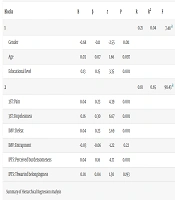
A hierarchical regression analysis evaluated the predictive power of various theories of suicidality, summarized in Table 4.
Table 4.
Summary of Hierarchical Regression Analysis
| Blocks | B | β | t | P | R | R2 | F |
|---|---|---|---|---|---|---|---|
| 1 | 0.21 | 0.04 | 7.48 a | ||||
| Gender | -0.68 | -0.11 | -2.55 | 0.011 | |||
| Age | 0.03 | 0.07 | 1.66 | 0.097 | |||
| Educational level | 0.13 | 0.15 | 3.35 | 0.001 | |||
| 2 | 0.81 | 0.65 | 98.43 a | ||||
| 3ST: Pain | 0.04 | 0.23 | 4.39 | 0.001 | |||
| 3ST: Hopelessness | 0.16 | 0.30 | 6.67 | 0.001 | |||
| IMV: Defeat | 0.04 | 0.23 | 3.69 | 0.001 | |||
| IMV: Entrapment | -0.03 | -0.06 | -1.22 | 0.22 | |||
| IPTS: Perceived burdensomeness | 0.04 | 0.16 | 4.17 | 0.001 | |||
| IPTS: Thwarted belongingness | 0.01 | 0.04 | 1.30 | 0.193 |
Abbreviations: 3ST, three step theory; IMV, integrated motivational volitional model; IPTS, interpersonal theory of suicide.
a P < 0.001
First, we assessed the contribution of variables from each theory in predicting suicidal ideation. We also included demographic factors such as age, sex, and education in the regression equation (Table 4, Block 1). This approach was employed to account for the influence of demographic factors on the regression equation.
In the second step, we introduced the variables from 3ST (i.e., hopelessness and pain), IMV (i.e., entrapment and defeat), and IPTS (i.e., thwarted belongingness and perceived burdensomeness) into the analysis concurrently (Table 4, Block 2). The explained variance increased significantly upon entering the theoretical variables in the second block (R2 = 0.65, P < 0.001). At this step, after controlling for the influence of demographic variables, the strongest predictors of suicidal ideation among the studied variables were: Hopelessness (β = 0.309, P = 0.001), pain (β = 0.239, P = 0.001), defeat (β = 0.234, P = 0.001), and perceived burdensomeness (β = 0.166, P = 0.001).
5. Discussion
This study examined the predictive influence of key variables associated with the development of suicidal ideation based on three prominent suicide theories (i.e., the IPTS, the IMV, and the 3ST) within the ideation-to-action framework, in a sample of Iranian adolescents. In line with previous studies (13), all variables were found to be correlated with suicidal ideation. Regression analysis revealed that, with the exception of entrapment and thwarted belongingness, the other variables were significant predictors of suicidal ideation. Among these, hopelessness emerged as the strongest predictor, followed by psychological pain, defeat, and perceived burdensomeness.
Our results showed that hopelessness was the most significant predictor of suicidal ideation among adolescents. Within the ideation-to-action framework, two theories (3ST and IPTS) highlight the importance of hopelessness in the emergence of suicidal thoughts. According to the 3ST, the combination of hopelessness and psychological pain is the closest predictor of suicidal ideation (15, 17). The IPTS posits that the simultaneous experience of thwarted belongingness and perceived burdensomeness, when viewed as unchangeable and persistent (i.e., a sense of hopelessness), serves as a sufficient and immediate cause of active suicidal ideation (15). Another traditional theory (i.e., the hopelessness theory of suicidality) asserts that hopelessness is the primary predictor of suicidal ideation (34). According to Abramson et al.(35), Hopelessness is a negative cognitive style affecting the interpretation of adverse events. Those attributing negative experiences to stable, pervasive causes are more prone to suicidal ideation (34, 36). Previous studies conducted across diverse populations and using various methodological approaches have consistently validated the association between hopelessness and suicidality (37, 38).
Psychological pain was the second significant predictor of suicidal ideation. It represents the painful internal experience characterized by negative emotions. According to Shneidman’s theory, intolerable psychological pain, or psychache, is the fundamental cause of suicide, explaining the effects of other psychological factors. Psychache can directly result in suicide when the intensity of pain exceeds an individual’s threshold of tolerance, leading them to perceive death as the only means of escape (39). The importance of psychological pain in relation to suicidality has been emphasized in studies among adolescent populations (40, 41).
Consistent with the important role of hopelessness and psychological pain in our study, previous studies indicated that suicidal behaviors were more driven by these factors than by other variables such as feelings of burdensomeness, thwarted belongingness, or the desire to seek help. Overall, our results align with 3ST’s core assumption, which posits that psychological pain and hopelessness play a crucial role in suicidal ideation (42, 43).
Concerning the IMV variables, defeat was identified as the third significant predictor of suicidal ideation, while entrapment could not significantly predict suicidal ideation. Defeat can be particularly harmful and may lead to suicidal thoughts as a perceived escape (44). Consistent with our findings, Ordonez-Carrasco et al. (19) found that defeat was a central variable associated with suicidal ideation. Also, like the study by Taylor et al. (45), we found that defeat, but not entrapment, was a significant predictor of suicidal ideation. Recent theories suggest that both defeat and entrapment load significantly onto a single latent variable, making it difficult to distinguish between them (44, 46). This overlap may explain entrapment’s non-significance in predicting suicidal ideation. Another explanation could be the simultaneous measurement of defeat and entrapment. As noted by O’Connor and Kirtley, sufficient time is essential for transition from defeat to entrapment (16), which may have been missed due to our cross-sectional design.
Another finding from this study was that perceived burdensomeness was a significant predictor of suicidal ideation, whereas thwarted belongingness did not significantly predict it. This aligns with prior research, including Chu et al.’s meta-analysis (47) and Ma et al.’s review (48), which found that burdensomeness had stronger associations with suicidal ideation. To explain this, the INQ subscale may inadequately capture thwarted belongingness, possibly explaining this discrepancy (48, 49). Additionally, measures of thwarted belongingness validated for adults may be less effective when applied to adolescents (50). Furthermore, the IPTS suggests that the simultaneous experience of perceived burdensomeness and thwarted belongingness is critical for the emergence of active suicidal ideation (i.e., the desire to end one’s life versus the desire to be dead, which is considered passive suicidal ideation) (15). In our study, we used the BSSI screening to assess suicidal ideation, but it cannot effectively distinguish between passive and active ideation (51, 52). This lack of distinction limits the scale specificity in assessing the varied nature of suicidal ideation. Moreover, previous studies indicated that the association between passive suicidal ideation and thwarted belongingness is stronger compared to the relationship between thwarted belongingness and active suicidal ideation (53, 54). Moreover, the absence of interaction terms (perceived burdensomeness * thwarted belongingness) further constrains the ability to capture the complexities of these ideations in a predictive model according to IPTS (15). In addition, within the Iranian collectivist context, where social and familial obligations are emphasized (55), adolescents navigating academic and identity challenges (56) may internalize perceived thwarted belongingness. Our study did not distinguish between perceived and actual experiences of thwarted belongingness, and the INQ-15 lacked sensitivity to the distinction between the number of relationships and their relational quality. These limitations may explain the non-significant role of thwarted belongingness in our results.
Overall, our findings are somewhat aligned with Ordonez-Carrasco et al.’s network study, which identified defeat as central to suicidal ideation. In both studies, thwarted belongingness was not significant predictor of suicidal ideation. In the network study, suicidal ideation was linked to psychological pain, defeat, and perceived burdensomeness (19). The three mentioned variables were also significant predictors of suicidal ideation in our study. However, hopelessness played a more critical role in our sample. These differences may stem from methodology, samples, and cultural contexts.
5.1. Conclusions
We examined the predictability of key variables of ideation-to-action theories to the occurrence of suicidal ideation among Iranian adolescents. Our findings revealed that, aside from entrapment and thwarted belongingness, the other variables — namely hopelessness, psychological pain, defeat, and perceived burdensomeness — were the most significant predictors of suicidal ideation. These factors are crucial targets for suicide prevention and intervention programs aimed at adolescents.
5.2. Limitations
Our study has several limitations. First, its cross-sectional design limits causal interpretation; future studies should adopt longitudinal approaches. Second, self-report measures may involve response bias; alternative methods like interviews are recommended. Third, focusing solely on a non-clinical sample of Iranian adolescents limits generalizability; future research should include clinical and culturally diverse groups. Fourth, convenience sampling reduces representativeness, so random sampling is recommended. Fifth, uncontrolled socioeconomic factors (e.g., income) may have influenced findings. Finally, regression analysis does not examine mediating or moderating effects; approaches like network analysis are suggested.
Despite limitations, our study was a novel effort to compare key variables within ideation-to-action theories and to assess the specific role of each variable in predicting adolescent suicidal ideation. Our study provided valuable insights into factors contributing to suicidal ideation, advancing understanding in an underexplored area.