
1. Background
Recently, there has been growing global attention on problematic behaviors among children (1). The family plays a crucial role in the psychosocial development of children (2). Additionally, poor parent-child interactions, inappropriate disciplinary methods, inconsistent parental supervision, and parental neglect are significant family-related factors contributing to the emergence of problematic behaviors (3). Childhood is a critical period for a child’s development (4). Bullying is defined as a serious social issue associated with a wide range of short- and long-term academic, interpersonal, and psychosocial problems (5). Approximately one-third of children in elementary school experience bullying (6). The developmental stage of childhood, along with the child’s strategic role and their specific individual characteristics, helps explain the prevalence of bullying behaviors among children. In a study conducted in 2018 on 161 children, 41 cases (25.4%) of school-based bullying incidents were reported (7). Multiple investments in early childhood, including nurturing care (8) and parenting skills (9), are key factors in promoting child development. The nurturing care framework emphasizes sensitivity to children’s needs, responsiveness, emotional support, appropriate stimulation for play and exploration, and protection from adversity (8). Close relationships within the family setting provide nurturing care that fosters both mental and physical well-being in children (10). Positive parent-child interactions help reduce coercive behaviors and decrease behavioral problems in early childhood (11). At this age, children tend to learn quickly and acquire knowledge from the surrounding people. Therefore, introducing bullying prevention strategies within the family environment during early childhood is essential to instill non-bullying behaviors as a habit. Based on this perspective, a study was conducted to examine the role of parents in preventing childhood bullying (7). One of the key factors contributing to bullying behaviors is parenting style. The impact of parenting styles includes, for instance, how parents engage in violent acts against children and how children witness parental aggression or violence toward others (7). Parental education on effective disciplinary methods can reduce bullying behaviors in adolescents, particularly among boys who are more likely to engage in bullying. These findings indicate that parenting practices during childhood significantly influence bullying behavior. Therefore, prevention programs are more effective when initiated early. Future research should further investigate the mechanisms underlying changes in bullying behavior and its long-term effects (12).
According to a systematic review, existing parental intervention programs focus on enhancing parental knowledge and skills, promoting and strengthening parenting practices, reducing stress levels and emotional and behavioral problems, and improving child development (13). These behavioral problems impact parental caregiving competence, leading to physical, psychological, and social difficulties for both parents and family members (14-16). Psychological competence is defined as possessing sufficient knowledge and skills to successfully and effectively perform tasks (15). Furthermore, parental competence refers to the extent to which parents feel capable and confident in dealing with their children's challenges (16). Parental competence significantly influences children's social, emotional, and educational development (17). Thus, parental competence is a fundamental determinant of children's well-being and their ability to receive compassionate and competent care from their parents (18).
Additionally, the issue of childhood bullying, which remains a major concern for both schools and families, will be examined with a focus on educating mothers. The pressures of parenting, feelings of helplessness, a mother’s inability to effectively interact with her bullying child, repeated complaints from other parents and school officials, and societal blame for failing to manage and correct their child’s behavior all contribute to increased psychological stress for mothers. Ultimately, these challenges undermine a mother’s confidence in her parenting role (19, 20). Parental competence and satisfaction with the parenting role have a significant impact on parenting behaviors. Parental competence, similar to the concept of parental self-efficacy, refers to the belief in one's ability to fulfill the parental role effectively (21). Studies have indicated that parental self-efficacy directly influences parenting behaviors, which, in turn, impact children's physical, social, emotional, and academic development (22). A parent’s sense of competence and confidence is equivalent to their self-assessment of their skills and abilities (23).
Research findings suggest that women tend to express emotions in a more neutral, calm, or peaceful manner, whereas men are more likely to exhibit emotions such as surprise, curiosity, anger, or frustration (24). Emotional expression includes both positive emotions, such as affection and supportive statements, and negative emotions, such as critical remarks, hostility, and excessive emotional conflict (25). Negative emotional expression within families can contribute to inappropriate emotional development (26). Parental emotional dysregulation may result in inappropriate emotional expressions or experiences, leading to deficiencies in children's emotional skill development (27). Therefore, maternal emotion regulation plays a crucial role in how emotions are expressed, managed, and even how children's psychological and behavioral problems are handled (28).
Mindful training refers to the application of mindfulness techniques aimed at enhancing parenting by improving parental attentiveness, increasing awareness of parenting stressors, reducing parental reactivity, and strengthening parenting competence (29). Researchers have demonstrated how adopting a non-judgmental, present-focused approach to parenting fosters a deeper understanding of both oneself and one’s children (30). The mindful training intervention has been identified as an effective method for improving the psychological well-being of parents with children suffering from psychological disorders, including anxiety (31). This intervention also appears to contribute to better emotional regulation and reduced behavioral inhibition. Mindfulness involves being purposefully present in the moment without judgment or interpretation of ongoing experiences. Mindful individuals perceive both internal and external realities freely and without distortion, exhibiting a high capacity for managing a wide range of thoughts, cognitions, and emotions (32). Given that structured parenting programs designed for parents of bullying boys can help them better understand their child's behavioral and social difficulties while enhancing their sense of competence and positive emotional expression.
2. Objectives
The present study aims to assess the effectiveness of mindful training in improving parenting competence and emotional expression in mothers of bullying sons.
3. Materials and Methods
This applied study employed a quasi-experimental pre-test-post-test design with a control group and a three-month follow-up. Data were collected using the pre-test-post-test design, with one control group and an intervention group undergoing mindful training. The research population consisted of all mothers of male school students with bullying behavior who visited the Razai Psychological Services Clinic of the Education Department in Karaj, Alborz province, Iran, in 2024. The participants were selected through voluntary and convenience sampling from mothers of male students (aged 8 to 12) who were identified as bullies. The students exhibiting bullying behavior were identified through teacher nominations and confirmed using the Illinois Bullying Scale (IBS). To avoid labeling children as "bullies", which may have unintended psychosocial consequences for them, ethical measures were taken, and only the child's behavior was considered; this point was shared with the mothers.
First, mothers of male students identified as bullies were asked to complete the Parenting Sense of Competence (PSOC) Scale and the Conflict over Emotional Expression Questionnaire. The mothers who scored lower on the PSOC and higher scores in the Conflict over Emotional Expression Questionnaire were selected after sorting the scores obtained from their responses to the items on the scales. Afterward, 30 mothers were randomly assigned to one experimental and one control group based on the inclusion criteria, using block permutation (Figure 1). The sample size was estimated using the NFleiss sample size estimation equation (33), where β = 0.87, P0 = 0.91, P1 = 0.80, R = 0.91, and α = 0.05. Accordingly, the sample size for each group was estimated at 15.
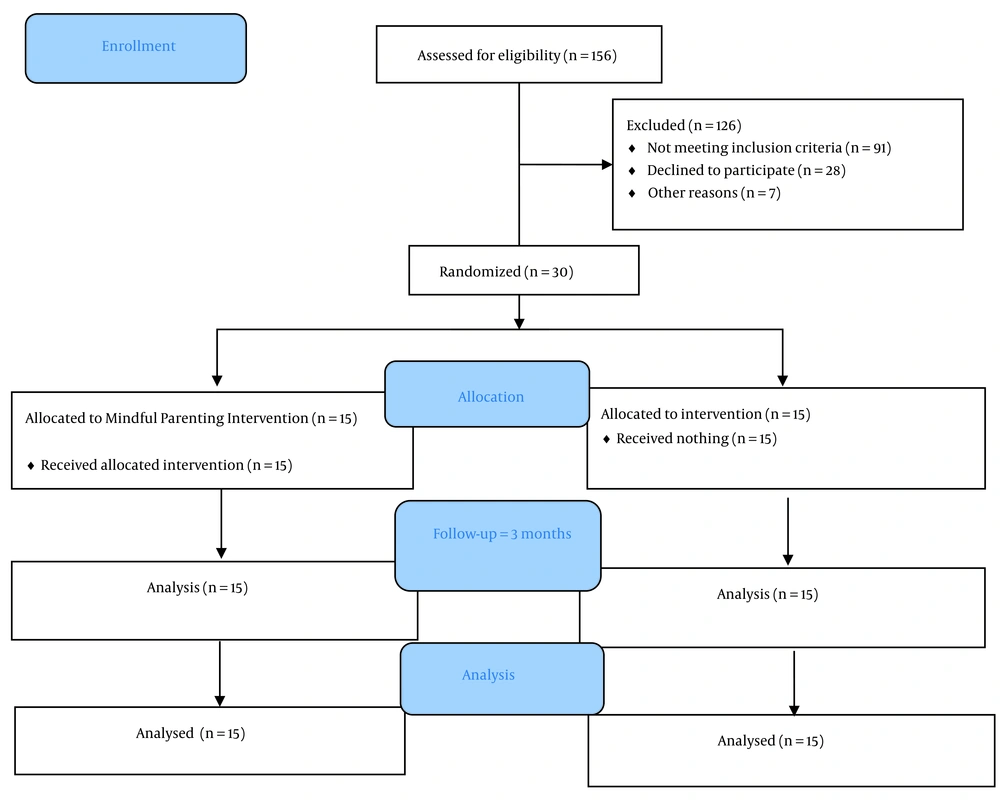
Figure 1.
The CONSORT flow diagram of the study process
The inclusion criteria were: (1) Having at least a high school diploma, (2) having a child who exhibited bullying behavior in school (identified through the IBS, 2001), (3) aged between 30 and 55 years, (4) mothers' consent to participate in the training sessions, and (5) the absence of psychiatric disorders was assessed through a structured clinical interview conducted by a licensed psychiatrist affiliated with the center, following standard ethical protocols. The exclusion criteria were: (1) Simultaneous participation in similar parenting or family counseling programs, (2) mothers who were divorced or widowed, (3) absence from more than two intervention sessions, and (4) failure to correctly complete the items in the scales. This research was implemented using the Strengthening the reporting of observational studies in epidemiology (STROBE) checklist.
3.1. Instruments
To identify bullying students, the IBS was used in this study. The PSOC Scale (for mothers) was employed to assess the mothers’ parenting competence. To assess emotional expression among mothers, the Conflict over Emotional Expression Questionnaire was used. After the initial interview with the mothers of bullying children, a pre-test was conducted, followed by the development of session structures and a mindful training protocol. Afterward, the training sessions were held, followed by assignments and the administration of the post-test, the completion of the program evaluation form, and a planned follow-up period.
3.1.1. Illinois Bullying Scale
This scale was used to screen target students exhibiting bullying behavior. Developed by Espelage and Holt (34), the scale assesses bullying behavior in students across various dimensions (bullying, physical aggression, and victimization). The scale consists of 18 items and three subscales, and the items are scored on a five-point Likert scale ranging from 1 (never) to 5 (often or more). The bullying subscale contains 9 items (1, 2, 8, 9, 14, 15, 16, 17, and 18), with scores ranging from a minimum of 9 to a maximum of 45. The victimization subscale has 4 items (4, 5, 6, and 7), with scores ranging from 4 to 20. The physical aggression subscale includes 5 items (3, 10, 11, 12, and 13), with scores ranging from 5 to 25. The total score for the scale ranges from 18 (lowest) to 90 (highest). To examine convergent validity, Espelage and Holt used the Adolescent Self-reported Aggression Scale, which showed a correlation coefficient of 0.65 (34) The reliability of the scale was assessed using Cronbach's alpha, with coefficients of 0.87 for the bullying subscale, 0.79 for physical aggression, and 0.70 for victimization. Bariyyah et al. also assessed the criterion validity of the scale by examining the correlation between the IBS results and other related scales, with reliability coefficients above 0.70, indicating good reliability (35). In this study, the reliability of the scale was recalculated, and Cronbach’s alpha for the entire scale was 0.73.
3.1.2. Parenting Sense of Competence
The PSOC (36) assesses maternal feelings of parenting competence with 17 items across two subscales: Parenting efficacy and satisfaction. Nine items measure satisfaction (with a score range of 9 - 54), and seven items assess parenting efficacy (with a score range of 7 - 42). Each item is scored on a six-point Likert scale, from strongly disagree (score 1) to strongly agree (score 6). A higher score indicates a greater sense of parenting competence. Scores between 70 and 96 indicate high competence, 51 to 69 show moderate competence, and scores between 16 and 50 suggest low competence. Johnston and Mash reported an internal consistency of 0.75 for the satisfaction Scale and 0.76 for the efficacy Scale (36). Lovejoy et al. reported internal consistencies of 0.82 and 0.88 for the efficacy Scale in two samples of mothers with preschool-aged children (37). The article presents evidence that the PSOC consists of three main factors: Parental role satisfaction, parental efficacy, and interest in parenting. The normative data provided for this scale are useful for assessing the impact of parenting interventions and can help identify parents who are at risk of either ineffective or overly idealized interactions with their children (38). In the present study, the reliability of the questionnaire was assessed using Cronbach's alpha, yielding a value of 0.83, indicating an acceptable level of reliability for measuring parenting competence.
3.1.3. Conflict over Emotional Expression Questionnaire
This questionnaire was developed by King and Emmons to assess emotional expression. The questionnaire consists of three subscales and 16 items. Items 1 - 7 pertain to the subscale of positive emotional expression, items 8 - 12 measure intimacy, and items 13 - 16 address the subscale of negative emotional expression. The items are scored on a Likert scale ranging from strongly agree (score 5) to strongly disagree (score 1). Items 6, 8, and 9 are scored reversely. The total score ranges from 19 to 80, with higher scores indicating greater conflict over emotional expression (38). King and Emmons reported internal consistency reliability for the full scale and subscales of positive emotional expression, intimacy, and negative emotional expression as 0.69, 0.60, 0.65, and 0.68, respectively (38). In this study, the reliability of the questionnaire was recalculated, and Cronbach's alpha for the whole scale was 0.78.
3.2. Procedure
After making the required arrangements, the researcher, who was serving as a counselor at the Razai Clinic of the Education Department in Karaj, Alborz province in 2024, distributed the PSOC and the Conflict over Emotional Expression Questionnaire among mothers of bullying children visiting the clinic. After identifying mothers with low parenting competence and high conflict over emotional expression, 30 women were selected and randomly assigned to the mindful training and control groups (each with 15 participants) through drawing lots. The mindful training intervention program, consisting of 8 sessions (one per week), was conducted for the participants in the intervention group. The benefits of participating in this free training program (reducing problems related to low parenting competence and high conflict over emotional expression) and the consequences of withdrawal (distortion of results, obscuring the actual impact of the treatment program, and losing an opportunity to alleviate psychological issues) were fully explained to the participants. The study did not have specific outcomes for the participants in the intervention groups beyond attending the 8 one-hour sessions. All sessions were delivered by a licensed family counselor trained in mindfulness-based interventions. The sessions were videotaped and shown to the supervisor and research director to verify proper program implementation. For the control group, interventions were carried out after a three-month follow-up phase. The control group was on a waiting list and did not receive any intervention during the 8-week study period. However, they were offered a post-study program. The mindful parenting program was developed based on related training protocols in the literature and published guidelines (30, 39, 40) in the field (Table 1).
Table 1.
A Description of Mindful Training Sessions
| Sessions | Objectives | Contents and Home Assignments |
|---|---|---|
| 1 | Introduction and briefing | Introducing the group, discussing group rules, practicing eating a raisin mindfully, and body scan practice: Relaxation, morning stress exercises, and mindful daily activities |
| 2 | Mindfulness practice and meditation | Teaching a beginner's mindset regarding a bullying child, body scan practice: Sitting meditation, morning exercises from a friend's perspective, teaching gratitude, and a 3-minute breathing exercise |
| 3 | Yoga and relaxation techniques | Sitting relaxation practice, observing the body during parenting stress, lying down yoga, mindful activities with a bullying child, completing a stress moment calendar, and a 3-minute breathing exercise |
| 4 | Acceptance and positive visualization through awareness | Practicing acceptance of unpleasant things instead of avoiding or pushing them away, role-playing different reactions to problems, sitting relaxation practice with attention to sounds and thoughts, discussing stressful events, learning to avoid fight responses, surrender and coping with parenting stress, standing yoga, 3-minute stress breathing, positive visualization through awareness, and accepting parenting stress |
| 5 | Awareness of parenting styles, relaxation techniques | Awareness of childhood patterns, understanding how childhood experiences influence parenting styles, sitting relaxation practice with feelings, introduction to parenting schemas and their reflexive reactions, 3-minute breathing exercise, meditation practice, walking, and completing the parenting stress calendar |
| 6 | Awareness and acceptance of emotions and feelings, meditation practice | Awareness of childhood patterns, understanding how childhood experiences influence parenting styles, practicing awareness and acceptance of emotions and feelings, meditation practice, walking after a serious conflict with a bullying child, discussing and reconsidering others' perspectives |
| 7 | Relaxation with self-compassion | Relaxation with kindness and love, practicing fragmentation and connection, discussing mindfulness and needs, and visualization practice through paired exercises |
| 8 | Review and practice of learned skills | Offering daily mindfulness strategies in parenting, reviewing learned meditations, body scans, meta-meditation, gratitude practice, and reviewing past exercises |
3.3. Statistical Methods
The collected data were analyzed using descriptive statistics (mean and standard deviation), Levene’s test (to check the assumption of the equality of variance of variables), and the Kolmogorov-Smirnov test (to assess skewness and kurtosis for the assumption of normality of the distribution of the scores across the population). The statistical analysis section has been revised to explicitly state that repeated measures analysis of variance (ANOVA) was used to analyze time × group interactions, and Bonferroni post-hoc tests with SPSS-26 software. The significance level in the tests was considered 0.05.
3.4. Ethical Consideration
Ethical principles were strictly adhered to for the control group as well. To comply with ethical protocols, measures such as obtaining informed consent, providing information about potential risks, allowing participants to withdraw, maintaining confidentiality, respecting participant welfare, securely storing information, and avoiding dual relationships were implemented. In addition, psychological counseling services were provided free of charge, and the sessions were scheduled to prevent interference with participants' commitments. The protocol for this study was approved by the Iran National Committee for Ethics in Biomedical Research with code (IR.IAU.SRB.REC.1403.127).
4. Results
The demographic details include maternal age range (28 - 46), education level (60% university graduates), child age (8 - 12), and socio-economic status (middle income bracket). In addition, analysis of the participants’ demographic data showed that the mean age of participants in the mindful training group was 44.94 ± 4.93 years, and the mean age for the control group was 41.66 ± 4.01 years. Most participants (40%) in the mindful training group had a high school diploma, and 66.7% of the participants in the control group also had a high school diploma. The majority of participants (46.7%) in the mindful training group had one child, and 53.3% of the participants in the control group had two children (Table 2).
Table 2.
Mean Scores (± SD) of Parenting Outcomes for Intervention and Control Groups at Pre-test, Post-test
| Variables | Intervention (Mean ± SD) | Control (Mean ± SD) | t (df) | P-Value | Effect Size (Cohen’s d) |
|---|---|---|---|---|---|
| Parental satisfaction | 35.20 ± 1.61 | 26.26 ± 2.18 | ~ 11.10 | < 0.001 | Large (~ 2.65) |
| Parental efficacy | 31.60 ± 2.41 | 25.66 ± 1.44 | ~ 7.86 | < 0.001 | Large (~ 2.00) |
| Parental competence (total) | 67.00 ± 2.72 | 52.60 ± 3.66 | ~ 12.30 | < 0.001 | Large (~ 2.40) |
| Positive expression | 26.20 ± 1.47 | 18.26 ± 1.86 | ~ 13.90 | < 0.001 | Large (~ 4.60) |
| Intimacy | 21.20 ± 1.93 | 13.73 ± 1.43 | ~ 12.00 | < 0.001 | Large (~ 4.30) |
| Ambivalence expression | 9.86 ± 1.35 | 17.86 ± 1.35 | ~ 15.10 | < 0.001 | Large (~ 5.93) |
| Emotional expression competence | 40.21 ± 3.20 | 31.86 ± 2.69 | ~7.10 | < 0.001 | Large (~ 2.82) |
The data in the table above show the descriptive statistics for parenting competence and emotional expression in the pre-test, post-test, and follow-up phases for the mindful training intervention group and the control group. The mean scores for the mindful training intervention group, in comparison to the control group, exhibited an increase in the post-test and 3-month follow-up phases relative to the pre-test. However, no significant differences were observed in the scores gained by the participants in the control group. Repeated measures ANOVA was run to determine whether this increase was statistically significant.
The results presented in Table 3 indicate that the effects of the group, time, and the time-group interaction are statistically significant (P < 0.01). Given the effect of mindful training, the intervention group showed an increase in parenting competence and emotional expression, along with a decrease in ambivalence expression, compared to the control group. Furthermore, the effect of time and the time-group interaction revealed significant differences between the pre-test, post-test, and follow-up phases.
Table 3.
Repeated Measures analysis of variance to Determine the Effectiveness of Mindful Training in Parenting Competence and Emotional Expression
| Variables | SS | df | MS | F | P-Value | η2 |
|---|---|---|---|---|---|---|
| Parental satisfaction | ||||||
| Group | 100.980 | 1 | 100.980 | 107.05 | 0.01 | 0.79 |
| Time | 156.298 | 1.04 | 158.285 | 60.71 | 0.01 | 0.68 |
| Time × group | 667.181 | 1.04 | 747.173 | 36.991 | 0.01 | 0.56 |
| Parental efficacy | ||||||
| Group | 508.844 | 1 | 508.844 | 65.210 | 0.01 | 0.70 |
| Time | 169.800 | 1.88 | 90.211 | 66.859 | 0.01 | 0.70 |
| Time × group | 141.756 | 1.88 | 75.311 | 55.81 | 0.01 | 0.66 |
| Parenting competence (total) | ||||||
| Group | 2800.044 | 1 | 2800.044 | 145.92 | 0.01 | 0.83 |
| Time | 1006.067 | 1.51 | 665.296 | 128.56 | 0.01 | 0.82 |
| Time × group | 611.489 | 1.51 | 404.368 | 78.14 | 0.01 | 0.73 |
| Positive expression | ||||||
| Group | 547.600 | 1 | 547.600 | 81.78 | 0.01 | 0.74 |
| Time | 452.067 | 1.18 | 380.521 | 355.558 | 0.01 | 0.92 |
| Time × group | 361.667 | 1.18 | 304.428 | 284.45 | 0.01 | 0.91 |
| Intimacy | ||||||
| Group | 656.100 | 1 | 656.100 | 148.685 | 0.01 | 0.84 |
| Time | 270.422 | 1.24 | 217.403 | 90.66 | 0.01 | 0.76 |
| Time × group | 186.067 | 1.24 | 149.586 | 62.38 | 0.01 | 0.69 |
| Ambivalence expression | ||||||
| Group | 426.844 | 1 | 426.844 | 152.35 | 0.01 | 0.84 |
| Time | 215.756 | 1.49 | 144.537 | 119.65 | 0.01 | 0.81 |
| Time × group | 279.089 | 1.49 | 186.965 | 154.77 | 0.01 | 0.84 |
| Competence expression | ||||||
| Group | 4651.211 | 1 | 4651.211 | 306.41 | 0.01 | 0.91 |
| Time | 2669.067 | 1.46 | 1826.648 | 442.27 | 0.01 | 0.94 |
| Time × group | 2488.622 | 1.46 | 1703.315 | 412.37 | 0.01 | 0.93 |
A Bonferroni correction was applied to adjust for multiple comparisons across the three outcome variables. The data from the Bonferroni post-hoc test in Table 4 indicate that the mean scores for both variables and their dimensions in the control group and the intervention group show significant differences. Accordingly, mindful training had a positive and significant impact on increasing parenting competence and emotional expression in mothers of bullying children. As a result, the first hypothesis of the study, which posits that mindful parenting is effective in enhancing parenting competence and emotional expression in mothers of bullying sons, was confirmed.
Table 4.
Comparing the Mean Scores for the Two Groups Based on the Bonferroni Test a
| Variables | MD | SE | P-Value |
|---|---|---|---|
| Parental satisfaction | 6.60 | 0.59 | 0.01 |
| Parental efficacy | 4.75 | 0.67 | 0.01 |
| Parenting competence (total) | 11.15 | 0.90 | 0.01 |
| Positive expression | 4.93 | 0.49 | 0.01 |
| Intimacy | 5.40 | 0.39 | 0.01 |
| Ambivalence emotional expression | 4.35 | 0.34 | 0.01 |
| Competence emotional expression | 14.37 | 0.72 | 0.01 |
a Group 1: Mindful parenting; group 2: Control.
5. Discussion
The findings from this study revealed that mindful training led to a reduction in ambivalent emotions and an increase in emotional expression competence, parenting satisfaction, and efficacy in mothers of bullying children. These changes persisted even after a three-month follow-up. Mindful training can significantly assist parents by fostering non-judgmental awareness (41). Mindful parenting is integrated into a parent-focused intervention, with the main goal being the enhancement of the parent-child relationship through improving self-awareness, mindfulness, and intentionality in parenting (39). Research has shown that mindfulness-based interventions have significant benefits for reducing parental stress and managing problematic child behaviors (42).
The dominant view is that the parent-child relationship and its quality significantly influence early brain development and the onset of mental health disorders. Mindful parenting is defined as the ability to pay attention to your child and parenting in a particular way — mindfully, non-judgmentally, and fully present in the moment (43). Research has demonstrated that mindful parents experience positive outcomes in the parent-child relationship and reduced maternal stress, along with decreased behavioral issues in children (44). Furthermore, mindful parenting has been linked to high-quality parent-child relationships, such as positive emotional connections between parents and children (45). Studies have shown that early maladaptive schemas mediate the relationship between individuals' perceptions of their childhood experiences with caregivers and their current feelings of parenting competence. Furthermore, stronger early maladaptive schemas were associated with lower levels of parenting competence (46).
Given the effectiveness of mindful parenting on parenting competence, it can be argued that mothers of bullying children often experience feelings of helplessness, confusion, low self-confidence, and inefficacy in their parenting style. Mindful parenting interventions aim to reduce parental stress, increase acceptance, and foster non-judgmental approaches, which may lead to higher-quality caregiving (e.g., more warmth and responsiveness) (47). Generally, parent training programs provide significant assistance to parents, particularly mothers of bullying children, by increasing their awareness. A study comparing two parenting methods for mothers of bullying children — coaching approach behavior and leading by modeling (CALM) and supportive parenting for anxious childhood emotions (SPACE) — found that both programs were effective in reducing rumination and anxiety in mothers (15).
Based on the findings of the study, conflict over emotional expression was reduced through mindful parenting training. It can be concluded that since mothers of bullying children often suffer from tension, stress, distress, helplessness, and negative emotions caused by their children's bullying behavior, mindful parenting training, by controlling parental stress and preventing extreme responses to negative child behavior, helps reduce negative challenges between parent and child and promotes successful experiences in managing children's behavior. It can also be argued that in mindful training, parents learn conflict and avoidance response patterns by using personal examples and can identify their habitual responses, such as worrying and using punishment or deprivation when dealing with parenting issues. By gaining insights, they can find opportunities for more mindful responses (43).
Therefore, increased self-regulation might be the strongest mechanism in breaking the compulsive parent-child cycles related to external behavioral expressions, and improvements in value clarification and flexibility can help parents support children with behavioral problems (48). Mindful parenting teaches parents to focus their attention on their thoughts, feelings, and behaviors, and to deliberately, present-focused, and non-judgmentally attend to their children (49). Concerning the effectiveness of mindful parenting in emotional expression, it can be argued that individuals with higher levels of trait mindfulness report more positive emotions, adaptive emotional regulation, greater social connection, higher satisfaction in interpersonal relationships, stable cortisol levels, and reduced experiences of depression, anxiety, and stress, compared to individuals with lower levels of trait mindfulness (47).
Mindful parenting is interpersonal and refers to a deliberate moment-to-moment awareness of the parent-child relationship. By listening attentively to the child, fostering emotional awareness and self-regulation in parenting, and creating compassion and non-judgmental acceptance for both the parent and child, mindful parenting strengthens parent-child interactions (50). Parents who understand their feelings and thoughts can better connect with their children and help them become emotionally regulated and adaptable (51). When parents become aware of their emotional reactions and experience them personally, they show fewer emotional responses to their children and can use the parenting knowledge and skills they have learned. As a result, their capacity for emotional regulation and coping is enhanced. This increased emotional awareness enables parents to better understand their child's emotions (52). By practicing non-judgmental acceptance and focusing attention on their breath, parents can pause before reacting to their child, which in turn reduces their stress levels and diminishes emotional disturbances (53).
Mothers of children with behavioral and social disorders, and even those with children at risk, require skills to overcome their children's problems and prevent psychological harm. Parenting skills can also enhance their sense of parenting competence, which is closely related to the concept of parental self-efficacy and belief in their ability to effectively perform the parenting role. Intervention programs can help these mothers increase their ability to express positive emotions, thereby reducing stress, negative feelings, and a sense of inadequacy, which in turn leads to improved mental health for both the mothers and their families. It seems that parenting programs, when conducted in a group setting, can contribute to parents' awareness and enhance their parenting experiences. Parents have the opportunity to become familiar with each other's perspectives and gain mutual understanding. When these programs focus on growth and mindfulness, they tend to lead to more positive outcomes and changes.
This study was conducted with some limitations. For instance, sample size, self-report bias, lack of blinding, and follow-up duration. In addition, data were exclusively collected through questionnaires, indicating that some participants might have refrained from giving truthful answers and may have provided inaccurate responses, and the sample size of the research was small. Besides, this study was conducted solely with mothers of bullying children who attended the Razi Counseling Center in Karaj, Alborz province. Fathers often have less interest or fewer opportunities to participate in parent training programs, whereas having both parents involved in the training would yield more effective results.
Raising children, in itself, is a stressful responsibility, and this stress increases when children exhibit harmful social behaviors, such as bullying. The mindful parenting program helps parents by providing exercises and assignments (e.g., guided meditation, body scan, and breathing exercises). This program not only fosters mental calmness but also offers awareness that helps parents gain a deeper and less stressful understanding of their life circumstances. This research has practical implications for school counselors, pediatricians, and psychologists, who can apply these findings in real-world settings.
While parental emotion regulation encompasses multiple components, this study focused specifically on emotional expression due to its observable and communicative impact on children's emotional and social development. However, the researchers acknowledge this limitation and agree that future studies should incorporate a broader spectrum of parental emotion regulation skills, including regulation strategies and emotional awareness. Additionally, the researchers agree that factors like parent-child interaction and disciplinary practices play significant roles in bullying and should be considered in subsequent research to provide a more comprehensive understanding.
5.1. Conclusions
The findings from this study showed that the mindful parenting program was effective in reducing conflict over emotional expression and increasing parenting satisfaction and efficacy in mothers of bullying children. Since mindful parenting emphasizes reducing parental stress in parent-child interactions, it empowers parents for further coaching and monitoring. Hence, mindful parenting can be used to enhance parenting competence. Furthermore, as mindful parenting provides more effective strategies for emotional regulation, it can be applied to improve emotional expression. Thus, using mindful training can enhance mothers' ability to express positive emotions and reduce stress and negative feelings, while increasing their competence and promoting mental health for both themselves and their families.