
Int J High Risk Behav Addict

Image Credit:Int J High Risk Behav Addict

A Model of Experiential Avoidance and Executive Function Deficits Affecting Hypersexual Behavior with the Mediating Role of Self-compassion: Suggesting an Integrated Intervention Protocol

Author(s):
Mohammad FadaeiMohammad Fadaei1, Ali Akbar SoleimanianAli Akbar SoleimanianAli Akbar Soleimanian ORCID1,*, Tayebe Rahimi PordanjaniTayebe Rahimi PordanjaniTayebe Rahimi Pordanjani ORCID2, Ahmad HeydarniaAhmad Heydarnia1
1Department of Counseling, Faculty of Humanities, University of Bojnord, Bojnord, IR Iran
2Department of Psychology, Faculty of Humanities, University of Bojnord, Bojnord, IR Iran

International Journal of High Risk Behaviors and Addiction:Vol. 14, issue 4; e162420
Published online:Aug 31, 2025
Article type:Research Article
Received:May 17, 2025
Accepted:Aug 25, 2025
How to Cite:Fadaei M, Soleimanian A A, Rahimi Pordanjani T, Heydarnia A. A Model of Experiential Avoidance and Executive Function Deficits Affecting Hypersexual Behavior with the Mediating Role of Self-compassion: Suggesting an Integrated Intervention Protocol.Int J High Risk Behav Addict.2025;14(4):e162420.https://doi.org/10.5812/ijhrba-162420.

Abstract

Background:

Hypersexuality (HS) is characterized by individuals' repeated unsuccessful efforts to manage or decrease the duration of their involvement in sexual fantasies, urges, and behaviors.

Objectives:

The interplay between experiential avoidance (EA) and executive function deficits (EFDs) was explored, examining self-compassion (SC)'s mediating role in HS within a comprehensive framework. An additional objective was to create and validate an integrated intervention protocol for hypersexual behaviors.

Materials and Methods:

A cross-sectional study was conducted with 370 unmarried students in Bojnord city, Iran, during 2023 - 2024. Data were collected using the Hypersexual Behavior Inventory (HBI), Abbreviated Multidimensional Experiential Avoidance Questionnaire (BEAQ), Barkley Deficits in Executive Functioning Scale (BDEFS), and Self-compassion Inventory-Short Form (SCI-SF). The integrated protocol was evaluated by six psychotherapy specialists for content validity. Structural equation modeling (SEM) was performed using AMOS-23, while SPSS-26 analyzed descriptive data.

Results:

The analysis, conducted after verifying the statistical assumptions, revealed that hypersexual behavior was significantly associated with EA (β = 0.251, P = 0.001) and EFDs (β = 0.357, P = 0.001). Also, SC mediated the relationship between EA, EFDs, and hypersexual behavior (indirect effects: B = 0.154 for EA and B = 0.117 for EFDs, P = 0.001). The proposed integrated protocol was validated by confirming the Content Validity Ratio (CVR = 1) and Index (CVI ~ 0.83 to 1).

Conclusions:

The EA and EFDs were significantly linked to hypersexual behavior. The SC mediated these associations, relating to better emotional regulation and impulse control. It enables adaptable emotional management, reducing reliance on sexually aggressive behaviors. Thus, therapies targeting SC and executive function may better address HS.

1. Background

Hypersexuality (HS) is characterized by unsuccessful efforts to control sexual fantasies, urges, or behaviors, often arising from distress or boredom (1). Manifestations include compulsive pornography use, frequent masturbation, multiple partners, and intrusive sexual thoughts (2). The prevalence of HS is estimated to be between 2% and 6%, with higher rates in men, particularly gay men, and sex offenders (3). The HS can be conceptualized as an obsessive-compulsive disorder where obsession begins with pleasure or satisfaction, and compulsion continues it (4). Early experiences and dysregulation of emotional and cognitive systems correlate with hypersexual behaviors (5), with recent research focusing on experiential avoidance (EA) and executive function deficits (EFDs) (6).

The EA involves changes in unpleasant emotions that trigger avoidance responses (7). From acceptance and commitment theory, it includes cognitive avoidance and emotional avoidance (8). These components are initially reinforced by reducing cognitive suffering but eventually disrupt life with unpleasant emotions and thoughts (9). The EA significantly correlates with EFDs, which manage thoughts and behavior through working memory, cognitive flexibility, and attention control (10).

The EFDs are a core vulnerability in HS (11). The EFDs involve impairments in working memory, inhibitory control, and decision-making (10). Neuroimaging shows altered activity in brain regions responsible for impulse regulation in individuals with compulsive sexual behaviors (12). High executive dysfunction correlates with steeper delay discounting and difficulty inhibiting responses to sexual cues (13). Few models have integrated EFDs and EA to explore their interaction in HS symptoms where self-compassion (SC) shows protective effects (14).

The SC was first defined by Neff as the concept of paying attention, recognizing, and clearly seeing unpleasant feelings, and it is defined by the three main components of self-kindness, common humanity, and mindfulness (15). The SC has been consistently linked to various indicators of psychological well-being, including reduced psychopathology and improved emotional resilience (16). Phillips et al. demonstrated that SC buffers the shame-HS cycle by promoting alternative self-relational strategies and reducing the propensity for sexual aggression among those high in shame but low in SC (17). However, some research has noted that SC’s protective effects can vary by context and measurement: For instance, Bates et al. found that SC’s inverse relationship with social anxiety depended on stress levels (18), and Yela et al. reported that reductions in EA, rather than SC itself, primarily drove improvements in well-being following mindfulness and SC training (19). These mixed findings underscore the importance of examining SC’s mechanisms and boundary conditions before positioning it as a universal buffer in HS.

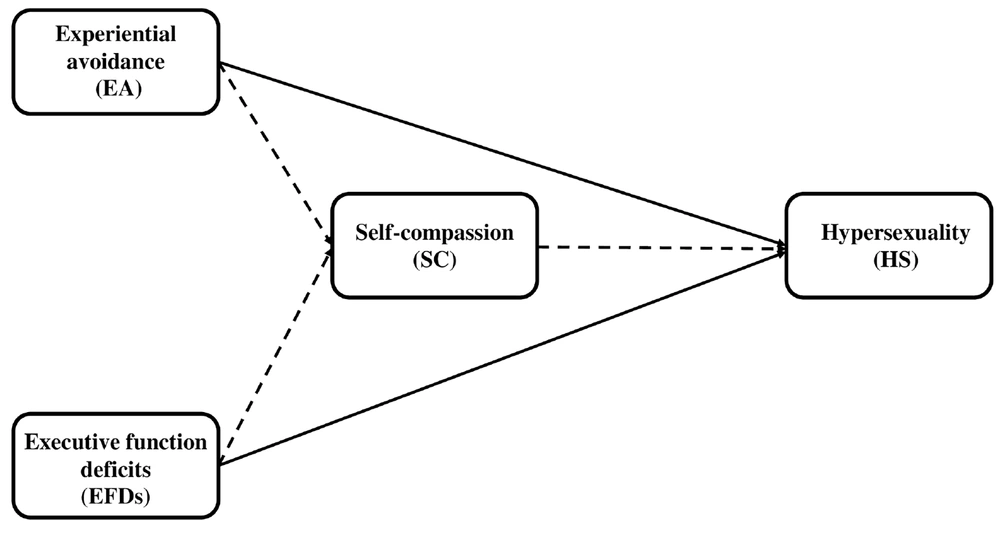
Drawing on theoretical and empirical literature (Figure 1), an integrated model is presented in which EA and EFDs both contribute to hypersexual behavior through intertwined cognitive-emotional pathways. The EFDs were linked to poorer inhibitory control and less effective long-term consequence evaluation (20), while EA perpetuates maladaptive coping by suppressing aversive internal states (21). The SC is conceptualized as a mediator that can weaken these effects by fostering mindful awareness, reducing self-judgment, and enhancing emotional regulation, potentially disrupting the cycle underlying HS (22).

The mediating role of self-compassion (SC) in the proposed research model (solid lines represent direct pathway; dashed lines indicate indirect pathway).
Figure 1.

The mediating role of self-compassion (SC) in the proposed research model (solid lines represent direct pathway; dashed lines indicate indirect pathway).

2. Objectives

While interventions target hypersexual behavior, they often lack clarity about change mechanisms. This study has two aims: To test a mediation model where EA and EFDs influence hypersexual behavior through SC as a mediator, and to develop an eight-session intervention protocol targeting these components. The SC is expected to improve emotional regulation and cognitive control, interrupting how avoidance and executive dysfunction increase hypersexual risk. The intervention protocol's design links each component to specific pathways in our model to enhance theoretical understanding and treatment effectiveness.

3. Materials and Methods

3.1. Study Design and Implementation Method

A cross-sectional study was conducted on 370 single students at Bojnord city, Iran, during 2023 - 2024. Using the Krejcie and Morgan table and G*power software, a sample size of 400 was determined (23), with 10% added for exclusions. Quota sampling was used based on Bojnord University's faculties: Engineering, humanities, basic sciences, and arts, considering each faculty's proportion of the 4,714 total students. Participants had to provide informed consent, be over 18, unmarried, and free from psychiatric or addictive drugs for six months. Students were excluded if they left over 20% of items unanswered, showed biased responses, or damaged questionnaires, resulting in 30 exclusions.

After validating the study's hypothesis, an integrated intervention protocol for hypersexual behaviors was developed, incorporating findings from current and previous research. The protocol drew from therapeutic approaches including acceptance and commitment therapy (ACT) (24), emotion-focused therapy (EFT) (25), behavioral skill training (26), Barkley behavioral training (27), unified protocol for transdiagnostic treatment (28), Hackmann cognitive therapy (29), transcranial direct current stimulation (tDCS) (30), attention network training (31), mindful self-compassion program (MSC) (32), and compassion-focused therapy (CFT) (33). Six psychotherapists specializing in hypersexual behavior evaluated the protocol's content validity through the Content Validity Ratio (CVR) and the Content Validity Index (CVI) assessments, until full validity was achieved.

3.2. Research Tools

In this research, the Hypersexual Behavior Inventory (HBI), the short form of the Multidimensional Experiential Avoidance Questionnaire (BEAQ), the Barkley Deficits in Executive Functioning Scale (BDEFS), and the Self-compassion Inventory-Short Form (SCI-SF) were used for data gathering.

3.2.1. The Hypersexual Behavior Inventory

The HBI was designed by Reid et al. and includes 19 self-report questions that examine hypersexual behavior in three dimensions: Control, consequence, and coping (34). The HBI ranks responses on a five-point Likert scale (from 1 = never to 5 = always), with higher scores indicating more hypersexual behavior (34). Cronbach's alpha coefficient and factor analysis of the HBI have been confirmed in different studies (35). In Iran, Shalchi and Seyed Hashemi showed Cronbach's alpha coefficient for the whole scale to be 0.9, and for the three subscales of control, consequence, and coping to be 0.82, 0.8, and 0.86, respectively (36). In the present sample, Cronbach’s α for the HBI was 0.87.

3.2.2. The Multidimensional Experiential Avoidance Questionnaire

The BEAQ is a short version of the MEAQ by Gamez et al. (37). The BEAQ has six subscales and 15 items on a 1 - 6 Likert scale, with higher scores indicating higher EA (37). Gamez et al. reported Cronbach's alpha coefficients of 0.86, 0.8, and 0.85, with correlations of 0.74 and 0.75 with AAQ-II and MEAQ scales (37). In Iran, Cronbach's alpha coefficients ranged between 0.68 - 0.89, with confirmed differential validity and goodness-of-fit indices (38). The present sample Cronbach's α was 0.85.

3.2.3. The Barkley Deficits in Executive Functioning Scale

The BDEFS by Barkley contains 89 items across five subscales: Planning, self-organization/problem solving, impulse control, self-motivation, and emotion regulation (39). Responses range from 1 ("never") to 4 ("often"), with higher scores indicating greater dysfunction (39). The Latin version's validity has been confirmed (40). In Iran, Mashhadi et al. found Cronbach's alpha above 0.8 for all subscales, with good model fit (41). The present sample Cronbach's α was 0.82.

3.2.4. The Self-compassion Inventory-Short Form

The SCI-SF by Raes et al. comprises 12 items measuring SC versus self-judgment, common humanity versus isolation, and mindfulness versus over-identification (42). Items use a 5-point Likert scale, with higher scores indicating greater SC (42). The scale shows a 0.97 correlation with its long form and 0.92 test-retest reliability (42). In Iranian populations, Khanjani et al. found Cronbach's alpha of 0.86 for the total score and 0.79, 0.71, and 0.68 for components, with 0.9 retest reliability (43). The present sample Cronbach's α was 0.84.

3.3. Statistical Analysis

Statistical analyses included descriptive statistics to summarize demographic characteristics and key variables. Structural equation modeling (SEM) examined direct and indirect effects among exogenous, endogenous, and mediating variables (44). Models used covariance matrices with relationships formalized through regression equations. Content analysis was conducted for quantitative findings and therapeutic intervention components. The intervention's content validity was assessed through expert evaluations using CVR and CVI. AMOS-23 was used for SEM modeling and SPSS (version 26) for descriptive information.

4. Results

The frequency and mean of demographic information and main research variables for participants are shown in Table 1. Prior to analyzing primary hypotheses, normality, multicollinearity, and homogeneity of variances were examined. Results indicated the data were suitable for statistical tests. The Pearson correlation coefficient assessed relationships between variables (Table 2). Results showed significant positive relationships between HS, EA, and EFDs, while negative relationships were observed with compassion components (self-kindness, common humanity, and mindfulness). Additionally, negative relationships existed between EA and compassion components, as well as between EFDs and compassion components.

Table 1.The Demographic Details and Mean ± Standard Deviation of the Primary Research Variables
VariablesNo. (%)Mean ± SD
Age (y)21.02 ± 1.33
19 - 20109 (29.38)19.67 ± 0.12
21 - 22105 (28.35)21.88 ± 0.09
23 - 24111 (30.15)23.71 ± 0.22
> 2445 (12.12)25.88 ± 0.82
Gender
Male146 (39.4)-
Female224 (60.6)-
Education department
Engineering111 (30)-
Humanities170 (45.95)-
Basic sciences33 (8.92)-
Arts56 (15.13)-
HS-46.64 ± 12.25
EA-54.27 ± 10.75
EFDs-210.77 ± 40.14
SC-32.77 ± 4.98
Self-kindness-12.77 ± 2.29
Common humanity-11.74 ± 2.39
Mindfulness-12.94 ± 2.27

Abbreviations: HS, hypersexuality; EA, experiential avoidance; EFDs, executive function deficits; SC, self-compassion.

Table 2.Correlation Matrix Between Research Variables
Variables123456
EA1-----
EFDs0.46 a1----
Self-kindness-0.24 a-0.25 a1---
Common humanity-0.38 a-0.32 a0.21 a1--
Mindfulness-0.28 a-0.26 a0.29 a0.3 a1-
HS0.62 a0.66 a-0.39 a-0.37 a-0.31 a1

Abbreviations: EA, experiential avoidance; EFDs, executive function deficits; HS, hypersexuality.

a Significance at the 0.01 level.

The structural model was evaluated using structural equation modeling, positing that EA and EFDs predict HS directly and indirectly through SC mediation. The model's fitting indicators showed a good fit with the collected data (Table 3). Path coefficients (Table 4) indicated hypersexual behavior was significantly influenced by EA and EFDs, with SC significantly mediating these relationships.

Table 3.The Fit Indices of the Structural Model
Fit IndicesObserved ValueCut-off PointEvaluation
χ2/ df3.14< 5Optimal
RMSEA0.07< 0.08Optimal
AGFI0.93> 0.9Optimal
CFI0.97> 0.9Optimal
GFI0.91> 0.9Optimal

Abbreviations: RMSEA, root mean square error of approximation; AGFI, Adjusted Goodness of Fit Index; CFI, Comparative Fit Index; GFI, Goodness of Fit Index.

Table 4.Path Coefficients Between the Variables of the Structural Model of the Research
PathsBS.EΒP
EA → HS0.2870.0630.2510.001
EFDs → HS0.1090.0150.3570.001
EA → SC-0.0460.009-0.4360.001
EFDs → SC-0.0090.002-0.3320.001
SC → HS-0.3810.107-0.3530.001
EA → SC → HS--0.1540.001
EFDs → SC → HS--0.1170.001

Abbreviations: EA, experiential avoidance; HS, hypersexuality; EFDs, executive function deficits; SC, self-compassion.

The study developed an integrated intervention protocol for hypersexual behaviors, incorporating elements targeting executive functions, SC, and EA. An eight-session protocol was developed based on variables' influence and content validity. Using the Lawshe table, the minimum acceptable value for six experts was 0.99 (α = 0.05) (45). After revisions, the CVR was confirmed (= 1), and the CVI was validated for all sessions. Table 5 presents therapeutic components, content, and CVI for each session.

Table 5.Proposed Integrated Protocol for Hypersexual Behaviors and Content Validity Index
SessionsTherapeutic ComponentContentCVI
FirstCommunication, psychological needs and emotionsThe importance of confidentiality and trust; training to recognize emotions, distinguish pleasant from unpleasant ones, connect emotions with body and psychological needs1
SecondThe sexual patterns of avoiding emotion, the sexual history, the chain of sexual temptationExplaining sexual behavior's role in soothing and avoiding unpleasant emotions; examining emotional blockages and symbolization; investigating auditory and visual sexual memories (analysis of trauma); examining chain of temptation: Analysis of four recent sexual behavior situations; recognizing triggers: Identifying cues that initiate sexual urges and becoming aware to anticipate and avoid these scenarios1
ThirdExecutive functionsImpulse control exercises: (A) 15-minute activity to postpone impulses and (B) 5-minute mindful awareness practice; exercise negative consequences reminder for 5 minutes during delay; daily assignment: Negative consequences reminder0.83
FourthBehavior replacement, the neural pathway of self-inhibition and attentionAdaptable substitution behavior exercise: List person's behavioral preferences like favorite food and activities, prioritizing substitutions in written form; adaptable substitution behavior exercise: List behavioral preferences, prioritize substitutions in writing, perform in second 15 minutes after temporal delay; mental imaging exercise: Practice 10 - 15 minutes daily for 4 weeks, visualizing temptation situations where client uses visualization to control impulses instead of yielding to them0.83
FifthThe tDCS, concurrent behavioral exercisesThe tDCS in dorsolateral prefrontal cortex: Anode in F3 area, cathode in F4 area, 2 mA intensity for 30 minutes, 12 sessions (3 per week); summarizing text's key points during first 15 minutes of tDCS; mental imaging of temptation during second 15 minutes of tDCS0.83
SixthGetting to know the selfTeaching dialectical nature of self: Blaming, anxiety-giving, and compassion-giving parts; seven-part compassion exercise: Teaching SC concepts including self-kindness, common humanity, mindfulness0.83
SeventhRegulating and correcting the anxious and blaming selfRelaxation exercise: Managing uncomfortable feelings and sexual arousal; two chairs dialogue: Becoming conscious of inner conflicts and mixed feelings for integration0.83
EighthEmpowering SCSelf-interruption dialogue: Fostering SC through conversation between conflicting aspects; imaginary confrontation exercise: Confronting inner child's vulnerabilities through compassionate behavior1

Abbreviations: tDCS, transcranial direct current stimulation; SC, self-compassion.

5. Discussion

The present study had two main objectives. The first objective was to assess the adequacy of the proposed model that explored the relationship between EA and EFDs in hypersexual behavior, with the mediation of SC, which was evaluated through complementary hypotheses. The second objective involved the design and establishment of content validity of an integrated intervention protocol grounded in these variables.

The results established a significant positive association between EA and HS, corroborating prior research (5, 46). Wetterneck et al. (46) reported a similar link between EA and problematic internet pornography use, proposing that avoiding distressing internal experiences may propel individuals toward maladaptive sexual behaviors as a coping strategy. This study extends that perspective by situating EA within a broader model that includes EFDs and SC, revealing a more comprehensive picture of HS’s underpinnings.

Notably, a significant negative relationship emerged between EA and SC, aligning with Wang et al. (47), who found SC to mitigate EA’s adverse effects in adolescents. Within the framework of ACT, SC appears to counter EA’s rigidity by promoting mindfulness and compassionate self-engagement (48), suggesting its potential as a therapeutic lever to reduce EA and, by extension, HS.

Equally compelling is the positive association between EFDs and HS, consistent with findings from Rosenberg et al., Dominguez-Salas et al., and Montgomery-Graham (49-51). These studies highlight how impairments in executive functions — such as impulse control, decision-making, and working memory — predispose individuals to atypical sexual behaviors. This research advances that understanding by demonstrating a negative link between EFDs and SC, as supported by Jacobs (52), who noted that higher SC correlates with improved executive functioning. This interplay implies that bolstering SC could enhance cognitive flexibility and emotional regulation, offering a dual benefit in addressing EFDs and HS.

Central to this study is the confirmation that SC mediates the relationship between EA, EFDs, and HS. The data suggest that elevated EA and EFDs diminish SC, which in turn intensifies HS. This mediation aligns with Kotera and Rhodes (53), who identified SC as an emotion regulator that reduces anxiety and shame — emotions that might otherwise fuel hypersexual tendencies. By integrating these variables into a cohesive model, this research elucidates the cognitive-emotional pathways driving HS and underscores SC’s protective role, providing a nuanced framework for both theory and intervention.

The development and validation of an integrated intervention protocol mark another key contribution. Expert evaluation confirmed its content validity, affirming the relevance of its multi-component design, which draws from evidence-based approaches (24-33). These modalities were deliberately chosen and arranged based on an integrated cognitive-emotional regulation framework, where each component targets a specific mechanism involved in hypersexual behavior. For example, they aim to foster psychological flexibility to reduce EA (8, 25, 28, 33), cultivate adaptive emotion processing (25, 32, 33), interrupt shame-driven coping (28, 29), and enhance prefrontal executive control to improve impulse inhibition (30), enhance attention (31), and ultimately behavior (26, 27). Overall, this multi-component approach addresses complementary cognitive, affective, and neurophysiological processes within a coherent, theory-driven intervention model. Its progressive structure — beginning with emotional recognition, incorporating innovative techniques, and culminating in SC-focused sessions — reflects a theoretically sound approach. It is important to note that the long-term implementation of these strategies and cognitive-behavioral techniques may necessitate participation in group therapy, support systems, and lifestyle improvements for individuals with HS.

5.1. Conclusions

This study confirms that EA and EFDs were associated with hypersexual behavior, with SC mediating these associations through emotional regulation and impulse control. Expert evaluation established the content validity of our eight-session protocol within an integrated cognitive–emotional regulation framework. However, as this intervention has only undergone content validation, its clinical efficacy remains untested. Future research should implement randomized controlled trials to determine the protocol's impact, use longitudinal assessments to clarify causal mechanisms, and assess its applicability across populations. Such studies are essential to translate our framework into evidence-based treatment for hypersexual behavior.

5.2. Limitations

This study had limitations. The sample was from one university in Iran, limiting generalizability. A complete psychiatric examination was not performed on participants; therefore, psychiatric disorders may have affected the results.

5.3. Suggestions

The EFDs and HS were assessed by self-report, which could involve response bias. Future studies should modify evaluation methods and examine the pattern of variables in larger, diverse samples.

Footnotes

References

  • 1.
    Cassioli E, Tarchi L, Rossi E, Faldi M, Dani C, Giuranno G, et al. Early traumatic experiences are linked to hypersexual behavior and erectile dysfunction in men through the mediation of body uneasiness and general psychopathology. J Sex Med. 2024;21(7):635-47. [PubMed ID: 38778740]. https://doi.org/10.1093/jsxmed/qdae058.
  • 2.
    Lewczuk K, Wizla M, Gola M. The Relation of Sexual Attitudes to Hypersexuality and Problematic Pornography Use. Arch Sex Behav. 2023;52(1):411-30. [PubMed ID: 35896936]. [PubMed Central ID: PMC9328619]. https://doi.org/10.1007/s10508-022-02358-9.
  • 3.
    Malandain L, Blanc JV, Ferreri F, Thibaut F. Pharmacotherapy of Sexual Addiction. Curr Psychiatry Rep. 2020;22(6):30. [PubMed ID: 32377953]. https://doi.org/10.1007/s11920-020-01153-4.
  • 4.
    Sahithya BR, Kashyap RS. Sexual Addiction Disorder— A Review With Recent Updates. J Psychosexual Health. 2022;4(2):95-101. https://doi.org/10.1177/26318318221081080.
  • 5.
    Lew-Starowicz M, Lewczuk K, Nowakowska I, Kraus S, Gola M. Compulsive Sexual Behavior and Dysregulation of Emotion. Sex Med Rev. 2020;8(2):191-205. [PubMed ID: 31813820]. https://doi.org/10.1016/j.sxmr.2019.10.003.
  • 6.
    Sassover E, Weinstein A. 2 - Compulsive sexual behavior disorder and impulsivity. In: Richard Y, Moustafa A, editors. The Psychology and Neuroscience of Impulsivity. Cambridge, Massachusetts: Academic Press; 2024. p. 31-45. https://doi.org/10.1016/B978-0-443-13437-1.00009-4.
  • 7.
    Luoma JB, Pierce B, Levin ME. Experiential avoidance and negative affect as predictors of daily drinking. Psychol Addict Behav. 2020;34(3):421-33. [PubMed ID: 31999171]. https://doi.org/10.1037/adb0000554.
  • 8.
    Na E, Lee K, Jeon BH, Jo C, Kwak UH, Jeon Y, et al. Acceptance and Commitment Therapy for Destructive Experiential Avoidance (ACT-DEA): A Feasibility Study. Int J Environ Res Public Health. 2022;19(24). [PubMed ID: 36554315]. [PubMed Central ID: PMC9779048]. https://doi.org/10.3390/ijerph192416434.
  • 9.
    Kayhan F, Ghanifar MH, Ahi Q. Comparing the effectiveness of emotion-oriented couple therapy and acceptance and commitment-based couple therapy on cognitive indicators (experiential avoidance and emotion regulation) in couples affected by extramarital relationships. J Adolescent Youth Psychol Stud. 2023;4(3):9-19. https://doi.org/10.61838/kman.jayps.4.3.2.
  • 10.
    Jain T, Shukla R, Panwar N. Decoding Cognitive Control and Cognitive Flexibility as Concomitants for Experiential Avoidance in Social Anxiety. Psychol Rep. 2024;2024:332941241268625. [PubMed ID: 39091159]. https://doi.org/10.1177/00332941241268625.
  • 11.
    Prelog PR, Palandacic AK. Hypersexuality during treatment with cariprazine in a patient with schizophrenia? A case report. BMC Psychiatry. 2023;23(1):935. [PubMed ID: 38082232]. [PubMed Central ID: PMC10714445]. https://doi.org/10.1186/s12888-023-05432-1.
  • 12.
    Turner D, Briken P, Grubbs J, Malandain L, Mestre-Bach G, Potenza MN, et al. The World Federation of Societies of Biological Psychiatry guidelines on the assessment and pharmacological treatment of compulsive sexual behaviour disorder. Dialogues Clin Neurosci. 2022;24(1):10-69. [PubMed ID: 37522807]. [PubMed Central ID: PMC10408697]. https://doi.org/10.1080/19585969.2022.2134739.
  • 13.
    Muller SM, Antons S. Decision making and executive functions in problematic pornography use. Front Psychiatry. 2023;14:1191297. [PubMed ID: 37564242]. [PubMed Central ID: PMC10411905]. https://doi.org/10.3389/fpsyt.2023.1191297.
  • 14.
    Madukwe AU, Chukwuka NN, Nwaoru CR, Ewulonu CJ, Odoemenam EI. Gender, self-compassion and resilience as predictors of sexual immorality among youths in Owerri. J Professional Counsell Psychotherapy Res. 2024;5(1).
  • 15.
    Neff K. Self-Compassion: An Alternative Conceptualization of a Healthy Attitude Toward Oneself. Self Identity. 2003;2(2):85-101. https://doi.org/10.1080/15298860309032.
  • 16.
    Neff K, Germer C. Self-Compassion and Psychological 27 Well-being. In: Doty J, editor. The Oxford handbook of compassion science. Oxford, England: Oxford University Press; 2017. 371 p.
  • 17.
    Phillips LC, Moen CE, DiLella NM, Volk FA. The Moderating Influence of Self-Compassion on the Relationship between Shame Tendency and Hypersexuality. Sexual Addict Compulsivity. 2019;26(1-2):103-25. https://doi.org/10.1080/10720162.2019.1608878.
  • 18.
    Bates GW, Elphinstone B, Whitehead R. Self-compassion and emotional regulation as predictors of social anxiety. Psychol Psychother. 2021;94(3):426-42. [PubMed ID: 33215812]. https://doi.org/10.1111/papt.12318.
  • 19.
    Yela JR, Crego A, Buz J, Sanchez-Zaballos E, Gomez-Martinez MA. Reductions in experiential avoidance explain changes in anxiety, depression and well-being after a mindfulness and self-compassion (MSC) training. Psychol Psychother. 2022;95(2):402-22. [PubMed ID: 34904363]. https://doi.org/10.1111/papt.12375.
  • 20.
    Pergantis P, Bamicha V, Chaidi I, Drigas A. Driving Under Cognitive Control: The Impact of Executive Functions in Driving. World Electric Vehicle J. 2024;15(10). https://doi.org/10.3390/wevj15100474.
  • 21.
    Wang Y, Tian J, Yang Q. Experiential Avoidance Process Model: A Review of the Mechanism for the Generation and Maintenance of Avoidance Behavior. Psychiatry Clin Psychopharmacol. 2024;34(2):179-90. [PubMed ID: 39165887]. [PubMed Central ID: PMC11332439]. https://doi.org/10.5152/pcp.2024.23777.
  • 22.
    Garbutt K, Rennoldson M, Gregson M. Sexual Offending: Adverse Childhood Experiences, Shame, and Self-Compassion Explain the Variance in Self-Harm and Harm Towards Others? Sex Abuse. 2024;36(6):662-91. [PubMed ID: 37695944]. [PubMed Central ID: PMC11311929]. https://doi.org/10.1177/10790632231201398.
  • 23.
    Chaokromthong K, Sintao N. Sample size estimation using Yamane and Cochran and Krejcie and Morgan and green formulas and Cohen statistical power analysis by G* Power and comparisions. Apheit Int J Interdisciplinary Soc Sci Technol. 2021;10(2):76-86.
  • 24.
    Hayes SC. The ACT in context. Oxford, England: Routledge; 2016.
  • 25.
    Greenberg LS, Pascual-Leone A. Chapter 15 - Changing emotion with emotion. In: Samson AC, Sander D, Kramer U, editors. Change in Emotion and Mental Health. Cambridge, Massachusetts: Academic Press; 2024. p. 325-44. https://doi.org/10.1016/B978-0-323-95604-8.00012-5.
  • 26.
    Whiting SW, Cooper RN, Crook KC, Gifford MR, Evans N. Using behavioral skills training to establish extended conversational exchanges. Behav Analysis: Res Practice. 2024;24(3):174-9. https://doi.org/10.1037/bar0000292.
  • 27.
    Barkley RA, Murphy KR. Attention-deficit hyperactivity disorder: A clinical workbook. New York, USA: The Guilford Press; 1998.
  • 28.
    Barlow DH, Ellard KK, Fairholme CP, Farchione TJ, Boisseau CL, Allen LB, et al. Unified Protocol for Transdiagnostic Treatment of Emotional Disorders: Workbook. Oxford, England: Oxford University Press; 2010. https://doi.org/10.1093/med:psych/9780199772674.001.0001.
  • 29.
    Barlow DH, Ellard KK, Fairholme CP. Hackmann A, Bennett-Levy J, Holmes EA, editors. Oxford Guide to Imagery in Cognitive Therapy. Oxford, England: Oxford University Press; 2011. https://doi.org/10.1093/med:psych/9780199234028.001.0001.
  • 30.
    Jeong H, Oh JK, Choi EK, Im JJ, Yoon S, Knotkova H, et al. Effects of transcranial direct current stimulation on addictive behavior and brain glucose metabolism in problematic online gamers. J Behav Addict. 2020;9(4):1011-21. [PubMed ID: 33361487]. [PubMed Central ID: PMC8969730]. https://doi.org/10.1556/2006.2020.00092.
  • 31.
    Posner MI, Rothbart MK. Research on attention networks as a model for the integration of psychological science. Annu Rev Psychol. 2007;58:1-23. [PubMed ID: 17029565]. https://doi.org/10.1146/annurev.psych.58.110405.085516.
  • 32.
    Germer C, Neff K. Teaching the mindful self-compassion program: A guide for professionals. New York, USA: Guilford Publications; 2019.
  • 33.
    Gilbert P, Simos G. Compassion focused therapy: Clinical practice and applications. Oxford, England: Routledge; 2022.
  • 34.
    Reid RC, Garos S, Carpenter BN. Reliability, Validity, and Psychometric Development of the Hypersexual Behavior Inventory in an Outpatient Sample of Men. Sexual Addiction Compulsivity. 2011;18(1):30-51. https://doi.org/10.1080/10720162.2011.555709.
  • 35.
    Bothe B, Kovacs M, Toth-Kiraly I, Reid RC, Griffiths MD, Orosz G, et al. The Psychometric Properties of the Hypersexual Behavior Inventory Using a Large-Scale Nonclinical Sample. J Sex Res. 2019;56(2):180-90. [PubMed ID: 30028633]. https://doi.org/10.1080/00224499.2018.1494262.
  • 36.
    Shalchi B, Seyed Hashemi SG. [Internal Consistency and Confirmatory Factor Analysis of Hypersexual Behavior Inventory Among Students]. J Sch Public Health Institute Public Health Res. 2017;15(3):239-51. FA.
  • 37.
    Gamez W, Chmielewski M, Kotov R, Ruggero C, Suzuki N, Watson D. The brief experiential avoidance questionnaire: development and initial validation. Psychol Assess. 2014;26(1):35-45. [PubMed ID: 24059474]. https://doi.org/10.1037/a0034473.
  • 38.
    Moradi A, Barghi Irani Z, Bagiyan Koulemarz MJ, Kariminejad K, Zabet M. [Factor Determination and Psychometric Features of the Multidimensional Experiential Avoidance Questionnaire (MEAQ)]. Soc Cognition. 2018;6(2):57-82. FA.
  • 39.
    Barkley RA. Barkley Deficits in Executive Functioning Scale--Children and Adolescents (BDEFS-CA). New York, USA: Guilford Publications; 2012.
  • 40.
    Kamradt JM, Nikolas MA, Burns GL, Garner AA, Jarrett MA, Luebbe AM, et al. Barkley Deficits in Executive Functioning Scale (BDEFS): Validation in a Large Multisite College Sample. Assessment. 2021;28(3):964-76. [PubMed ID: 31431045]. [PubMed Central ID: PMC8010583]. https://doi.org/10.1177/1073191119869823.
  • 41.
    Mashhadi A, Mirdoraghi F, Hosainzadeh-Maleki Z, Hasani J, Hamzeloo M. [Factor Structure, Reliability and Validity of Persian Version of Barkley Deficits in Executive Functioning Scale(BDEFS)- Adult Version]. J Clin Psychol. 2015;7(1):51-62. FA. https://doi.org/10.22075/jcp.2017.2190.
  • 42.
    Raes F, Pommier E, Neff KD, Van Gucht D. Self-Compassion Scale--Short Form. 2017.
  • 43.
    Khanjani S, Foroughi AA, Sadghi K, Bahrainian SA. [Psychometric properties of Iranian version of self-compassionscale (short form)]. Pajoohande. 2016;21(5):282-9. FA.
  • 44.
    Civelek ME. Essentials of structural equation modeling. Morrisville, North Carolina: Lulu. com; 2018.
  • 45.
    Lawshe CH. A quantitative approach to content validity. Personnel Psychol. 1975;28(4).
  • 46.
    Wetterneck CT, Burgess AJ, Short MB, Smith AH, Cervantes ME. The Role of Sexual Compulsivity, Impulsivity, and Experiential Avoidance in Internet Pornography Use. Psychological Record. 2017;62(1):3-18. https://doi.org/10.1007/bf03395783.
  • 47.
    Wang H, Wang J, Wei X, Lei L. Cyber Dating Abuse Victimization and Experiential Avoidance Among Chinese Female Adolescents: The Roles of Self-Compassion and Interpersonal Flexibility. J Interpers Violence. 2023;38(3-4):4416-42. [PubMed ID: 35924309]. https://doi.org/10.1177/08862605221116316.
  • 48.
    Zhao T, Yang Y, Cui L. How Self-Compassion Components Develop in Adolescents? Evidence from Cross-Lagged Panel Network Analysis with Gender Considerations. Appl Res Quality Life. 2024;19(5):2767-84. https://doi.org/10.1007/s11482-024-10355-4.
  • 49.
    Rosenberg M, Pettifor A, Duta M, Demeyere N, Wagner RG, Selin A, et al. Executive function associated with sexual risk in young South African women: Findings from the HPTN 068 cohort. PLoS One. 2018;13(4). e0195217. [PubMed ID: 29608615]. [PubMed Central ID: PMC5880379]. https://doi.org/10.1371/journal.pone.0195217.
  • 50.
    Dominguez-Salas S, Diaz-Batanero C, Lozano-Rojas OM, Verdejo-Garcia A. Impact of general cognition and executive function deficits on addiction treatment outcomes: Systematic review and discussion of neurocognitive pathways. Neurosci Biobehav Rev. 2016;71:772-801. [PubMed ID: 27793597]. https://doi.org/10.1016/j.neubiorev.2016.09.030.
  • 51.
    Montgomery-Graham S. Conceptualization and Assessment of Hypersexual Disorder: A Systematic Review of the Literature. Sex Med Rev. 2017;5(2):146-62. [PubMed ID: 28041854]. https://doi.org/10.1016/j.sxmr.2016.11.001.
  • 52.
    Jacobs DF. Cognitive executive functioning and self-compassion of municipal employees in South Africa [Dissertaion]. North-West University (South-Africa); 2019.
  • 53.
    Kotera Y, Rhodes C. Pathways to Sex Addiction: Relationships with Adverse Childhood Experience, Attachment, Narcissism, Self-Compassion and Motivation in a Gender-Balanced Sample. Sexual Addiction Compulsivity. 2019;26(1-2):54-76. https://doi.org/10.1080/10720162.2019.1615585.
Indexed in

Crossmark
Crossmark
Checking
Share on
Cited by
Metrics

Purchasing Reprints

  • Copyright Clearance Center (CCC) handles bulk orders for article reprints for Brieflands. To place an order for reprints, please click here (   https://www.copyright.com/landing/reprintsinquiryform/ ). Clicking this link will bring you to a CCC request form where you can provide the details of your order. Once complete, please click the ‘Submit Request’ button and CCC’s Reprints Services team will generate a quote for your review.
Search Relations

Author(s):

Related Articles

