
1. Background
High-risk behaviors can occur at any age; however, adolescence is a particularly sensitive period during which these behaviors emerge. These behaviors, performed intentionally or without considering the consequences, constitute major psychosocial and public health concerns and contribute to numerous community-level problems (1, 2). A characteristic feature of high-risk students is substantial emotional difficulty. Psychological research indicates that emotion regulation is a crucial factor in overall well-being and successful social interactions. Effective emotion regulation skills serve as a protective factor against high-risk behaviors, similar to the role of family and peers (3). Emotion regulation enables students to cope with intense emotional stimuli, thereby creating optimal psychological, emotional, and spiritual conditions essential for academic progress (4).
Emotion regulation is among the factors associated with students’ academic progress. Emotion regulation skills encompass the strategies students use to manage and modify their thoughts and emotional responses. For students, emotion regulation refers to active engagement in behavioral, motivational, personal, and cognitive self-regulation to achieve important and valuable academic goals (5). Research has consistently shown that emotions constitute a substantial component of academic performance. Furthermore, emotions and their regulation directly affect academic progress and performance (6-9). Emotional and behavioral self-regulation are distinct and enduring constructs that must be considered separately to gain a comprehensive understanding of self-regulation and its impact on academic progress (10).
Academic progress has long been a primary concern for families and educational systems. Academic progress is defined as the measurable advancement of students in formal educational settings and is an important factor in community development, as well as a criterion for advancement and selection in various aspects of life. Academic progress can be measured using grades and class rankings (11). Therefore, enhancing emotion regulation, coping, and decision-making skills is crucial for helping young individuals navigate challenges and reduce external factors associated with high-risk behaviors (12).
In light of these considerations, the present study aimed to investigate the effectiveness of emotion regulation training in reducing behavioral problems and improving academic performance among high-risk vocational school students, with the aim of mitigating these behaviors and difficulties in adolescents.
2. Objectives
This study aimed to evaluate the effectiveness of emotion regulation training in reducing behavioral problems and improving academic performance among vocational school students at high risk.
3. Methods
3.1. Study Design and Participants
This quasi-experimental study with a pretest-posttest control group design was conducted among vocational school students identified as exhibiting high-risk behaviors in District 5 of Isfahan, Iran, during the 2019 - 2020 academic year. Students were screened using the Iranian Adolescent Risk Behavior Scale (IARS), and those scoring ≥ 95 were considered eligible for participation. Among those with the highest scores, 30 students were selected. Students who declined participation were replaced by the next highest scorers. Participants were then randomly assigned to the experimental (n = 15) and control (n = 15) groups. This approach can be described as targeted multistage cluster sampling combined with random assignment, ensuring that participants met the study inclusion criteria.
3.2. Iranian Adolescent Risk Behavior Scale
Risk-taking behaviors were assessed using the IARS, a 38-item self-report instrument developed for Iranian adolescents by Ali Zadeh-Mohammadi, Ahmadabadi, and Heidari. The scale assesses seven dimensions of risky behaviors, including violence, substance use, smoking, alcohol use, sexual relations/behavior, relations with the opposite sex, and dangerous driving. Its psychometric properties were established through exploratory and confirmatory factor analyses, which supported a seven-factor structure. The scale has demonstrated good reliability, with a Cronbach's alpha of 0.94 for the total score and alpha values ranging from 0.74 to 0.93 for the subscales, indicating sound validity and reliability for use with Iranian youth (13).
3.2.2. Child Behavior Checklist, Youth Self-Report Version
Behavioral and emotional problems were assessed using the Youth Self-Report, a self-report instrument from the Achenbach System of Empirically Based Assessment, designed for adolescents aged 11 - 18 years. The Youth Self-Report consists of 113 items rated on a three-point Likert scale ranging from 0 (not true) to 2 (very true or often true). The questionnaire assesses a range of behavioral and emotional domains, including anxiety/depression, withdrawal/depression, somatic complaints, social problems, thought problems, rule-breaking behavior, and aggressive behavior. The scale was validated in 642 students across several provinces of Iran during 2016 - 2017. Exploratory and confirmatory factor analyses indicated a six-factor structure, and the subscales demonstrated good reliability (α = 0.63 - 0.85). This instrument is suitable for assessing behavioral and emotional problems in Iranian adolescents. The Youth Self-Report has been widely used in adolescent populations and has demonstrated strong psychometric properties across diverse cultural contexts. Previous Iranian validation studies have reported satisfactory reliability and validity for the Youth Self-Report, with Cronbach's alpha coefficients indicating acceptable to excellent internal consistency for the total scale and subscales (14).
3.2.3. Academic Performance
To assess academic performance, students' report cards from the first and second semesters were collected and used to calculate their overall grade point averages.
3.3. Intervention
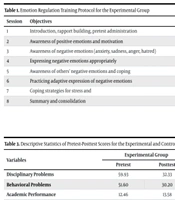
The experimental group received emotion regulation training delivered in eight scheduled 90-minute sessions based on a cognitive-behavioral therapy approach, following the protocol described by Leahy, Tirch, and Napoletano (15). The sessions included structured exercises in cognitive reappraisal, mindfulness, distress tolerance, emotional awareness, and adaptive coping strategies. Training was delivered by a qualified psychologist experienced in adolescent cognitive-behavioral therapy (Table 1). The control group did not receive this intervention.
Table 1.
Emotion Regulation Training Protocol for the Experimental Group
| Session | Objectives | Activities / Techniques |
|---|---|---|
| 1 | Introduction, rapport building, pretest administration | Orientation, group discussion, establishing expectations |
| 2 | Awareness of positive emotions and motivation | Mindfulness exercises, identifying positive experiences, discussion |
| 3 | Awareness of negative emotions (anxiety, sadness, anger, hatred) | Emotion labeling, journaling, cognitive discussion |
| 4 | Expressing negative emotions appropriately | Role-playing, guided expression, feedback |
| 5 | Awareness of others' negative emotions and coping | Perspective-taking exercises, social problem-solving tasks |
| 6 | Practicing adaptive expression of negative emotions | Homework assignments, reflection, group feedback |
| 7 | Coping strategies for stress and | Cognitive reappraisal, distress tolerance exercises, relaxation techniques |
| 8 | Summary and consolidation | Review of skills, discussion, posttest administration |
3.4. Program Composition and Structure
Emotion regulation training, the independent variable, was delivered exclusively to the experimental group in eight 90-minute sessions. The session content was based on the educational protocol described by Gail McCallum, Robert Leahy, Dennis Tirch, and Lisa Napoletano and was grounded in a cognitive-behavioral therapy approach.
3.5. Ethical Considerations
The study was approved by the Organizational Ethics Committee of Payam Noor University (Ethics Approval Code: IR.PNU.REC.1403.600). Written informed consent was obtained from parents or guardians, and assent was obtained from all participating students before enrollment. Participant data were anonymized by assigning serial numbers and removing identifiable information to ensure confidentiality. All participants were informed of their right to withdraw from the study at any time without penalty.
3.6. Statistical Analysis
Data were analyzed using SPSS version 22. Descriptive statistics, including means, standard deviations, and frequencies, were reported. The assumptions for analysis of covariance (ANCOVA) were assessed using the Shapiro-Wilk test for normality, Levene's test for homogeneity of variance, and tests of equality of covariance matrices. Pretest scores were controlled in the analyses. Univariate ANCOVA was used to test the main hypotheses, and multivariate analysis of covariance was used to test the secondary hypotheses. Statistical significance was set at P < 0.05.
4. Results
Regarding grade distribution, 66.7% (n = 10) of participants in the experimental group were in the 10th grade, and 33.3% (n = 5) were in the 11th grade. In the control group, 60% (n = 9) were in the 10th grade, and 40% (n = 6) were in the 11th grade (Table 2).
Table 2.
Demographic Characteristics of Participants by Group (Male)
| Group and Grade | No (%) |
|---|---|
| Control | |
| The tenth | 9 (60) |
| Eleventh | 6 (40) |
| Experimental | |
| The tenth | 10 (66.7) |
| Eleventh | 5 (33.3) |
Descriptive statistics were first calculated to summarize the study variables. Before conducting the main analysis, the assumptions for multivariate analysis of covariance were assessed, including the Shapiro-Wilk test for normality of score distributions, Levene's test for homogeneity of variances, the assumption of homogeneity of regression slopes, and Box's M test for equality of covariance matrices. Finally, ANCOVA was used to control for the potential effect of pretest scores. Levene's test was used to evaluate the homogeneity of variances between the experimental and control groups. A significance level greater than 0.05 indicated that the assumption of homogeneity of variances was satisfied (Table 3).
Table 3.
Descriptive Statistics of Pretest-Posttest Scores for the Experimental and Control Groups (n=15)
| Variables | Experimental Group | Control Group | P-Value | Frequency | ||
|---|---|---|---|---|---|---|
| Pretest | Posttest | Pretest | Posttest | |||
| Disciplinary Problems | 59.93 | 32.33 | 61.20 | 51.13 | 0.002 | 31.77 |
| Behavioral Problems | 51.60 | 30.20 | 47.80 | 46.45 | 0.003 | 34.18 |
| Academic Performance | 12.46 | 13.58 | 12.10 | 9.71 | 0.002 | 32.19 |
As shown in Table 4, emotion regulation training led to significant reductions in both disciplinary and behavioral problems, as well as a significant improvement in academic performance among high-risk vocational school students. The ANCOVA results indicated a significant difference between the experimental and control groups after controlling for pretest scores. These findings suggest that emotion regulation training was effective in reducing disciplinary and behavioral difficulties while simultaneously enhancing academic achievement.
Table 4.
ANCOVA Results for Behavioral Problems, Disciplinary Problems, and Academic Performance
| Sources of changes | SS | DF | MS | F | P-Value | Partial η² |
|---|---|---|---|---|---|---|
| Disciplinary problems . Pretest | 945.59 | 1 | 945.59 | 31.77 | 0.002 | 0.54 |
| Group | 5089.45 | 1 | 5089.45 | 171.02 | 0.002 | 0.86 |
| Error | 903.47 | 27 | 29.45 | - | - | - |
| Total | 69882 | 30 | - | - | - | - |
| Behavioral Problems . Pretest | 677.21 | 1 | 677.21 | 34.18 | 0.003 | 0.55 |
| Group | 208.92 | 1 | 208.92 | 105.58 | 0.003 | 0.79 |
| Error | 534.91 | 27 | 19.81 | - | - | - |
| Total | 45901 | 30 | - | - | - | - |
| Academic performance . Pretest | 97.61 | 1 | 97.61 | 32.19 | 0.002 | 0.54 |
| Group | 95.78 | 1 | 95.78 | 31.59 | 0.002 | 0.53 |
| Error | 81.85 | 27 | 3.03 | - | - | - |
| Total | 4364.13 | 30 | - | - | - | - |
5. Discussion
The present study aimed to evaluate the efficacy of emotion regulation training in reducing disciplinary and behavioral problems and enhancing academic achievement among high-risk vocational school students in Isfahan. The findings indicated that emotion regulation training was effective in reducing disciplinary problems among students exhibiting high-risk behaviors.
Consistent with previous research (16), the results showed that greater emotion regulation is associated with fewer disciplinary problems. Enhancing emotion regulation skills in children and adolescents through training appears to reduce disciplinary issues. Emotion regulation plays a central role in acquiring adaptive skills and facilitating constructive social interactions. It encompasses both conscious and unconscious processes used to increase or decrease components of emotional responses, enabling individuals to manage emotional experiences and expressions effectively (17).
Emotion regulation enhances individuals' understanding of their own emotional states and those of others, thereby increasing tolerance and adaptive functioning. Some parents, teachers, and coaches may show limited patience when addressing students' disciplinary and behavioral challenges, and they may hold unrealistic expectations. When students fail to meet these expectations, frustration may arise on both sides. Students with disciplinary difficulties often struggle with adaptation and emotional control in school settings, underscoring the importance of implementing structured interventions to address these issues (18). Self-regulation, defined as the effective management of emotions, enhances individuals' capacity for self-soothing and coping with anxiety, depression, and frustration (19).
The second finding indicated that emotion regulation training significantly reduced behavioral problems among high-risk vocational school students. This finding aligns with prior studies (3, 20), which reported that improved emotion regulation is associated with fewer behavioral problems in adolescents. Theoretical models of behavioral pathology emphasize that dysfunction in emotion regulation contributes to the onset and maintenance of behavioral disorders (21). According to emotion regulation models, difficulties in managing unpleasant emotions play a fundamental role in the development of behavioral problems during adolescence (22).
Adolescents who rely on maladaptive strategies such as catastrophizing, rumination, and self-blame are more vulnerable to psychological distress than those who use adaptive strategies (23). Difficulties in emotion regulation may lead to both internalizing and externalizing disorders (24), manifested through heightened negative emotions and maladaptive coping efforts (25). Therefore, strengthening emotion regulation skills may promote healthier behavioral patterns and more effective interpersonal functioning.
The third finding demonstrated that emotion regulation training positively influenced academic achievement among high-risk vocational school students. Consistent with previous research (4, 7-10), emotional and behavioral self-regulation are important predictors of academic success. Emotion regulation is significantly correlated with academic progress and directly influences performance.
Emotion regulation refers to the processes involved in initiating, maintaining, and modifying emotional responses to achieve personal goals (26). Improved emotion regulation contributes to enhanced executive functions, including inhibition, attentional control, and appropriate behavioral responses, all of which facilitate academic success. Developing emotion regulation skills in adolescents may therefore strengthen academic engagement and performance.
Based on the results of this study and related research, emotion regulation training can be considered an effective school-based intervention for reducing disciplinary and behavioral problems and enhancing academic achievement among high-risk vocational school students.
However, several limitations should be acknowledged. First, the small sample size (n = 30) limits statistical power and generalizability. Second, the study was conducted in a single vocational school using a non-random selection process from a high-risk subgroup, which may have introduced sampling bias and limited external validity.
Additionally, the absence of a follow-up assessment precludes conclusions regarding the long-term sustainability of the intervention effects. The lack of an active comparison group also limits causal interpretation, as non-specific factors, such as attention or engagement, may have influenced outcomes.
Future studies should employ randomized controlled designs, include longitudinal follow-up assessments, and control for potential confounding variables, such as student motivation, parental support, and teacher-student relationships. Addressing these factors would strengthen causal inferences and enhance the applicability of emotion regulation interventions.
Despite these limitations, the findings suggest that emotion regulation training represents a promising and practical school-based strategy for improving behavioral adjustment and academic engagement among adolescents with high-risk behaviors.
Footnotes