
1. Background
Excessive alcohol consumption has emerged as a major public health crisis (1). Alcohol dependence, often referred to as severe alcohol use disorder (AUD), affects 2.6% of individuals worldwide (2). Civil laws governing the trade and consumption of alcohol vary across Islamic countries, where alcohol consumption is prohibited. Consequently, alcoholic beverages are often produced domestically or distributed through the black market, leading to health consequences such as methanol toxicity and death. The true prevalence of alcohol consumption is likely underreported because of social stigma and prohibition laws, resulting in limited data and a lack of comprehensive population-based studies on its prevalence and related disorders (3).
Alcohol use disorder is characterized by a preference for alcohol over healthier alternatives, leading individuals to continue consuming alcohol despite adverse consequences (2). Alcohol use disorder is associated with various neurocognitive impairments (4), and its associated morbidity and mortality are partly attributable to the association between alcohol consumption and engagement in risky behaviors. The term risk denotes the likelihood of harm occurring (5, 6) and indicates a correlation between alcohol consumption and the exhibition of problematic or high-risk behaviors. Risky behaviors encompass a range of actions that may offer tangible benefits but also carry potential negative consequences (6). These behaviors deviate from socially accepted norms and pose threats to both the individuals engaging in them and those around them, including activities such as drunk driving, risky sexual behavior, truancy, and substance use (5). Notably, adults with AUD tend to engage in more risky behaviors than their healthier counterparts. This heightened engagement in risk may serve as both a consequence of and a risk factor for continued alcohol use (7).
A robust relationship has been established between risky behavior and impulsivity (6). Impulsivity is associated with problematic drinking and is recognized as a multidimensional construct that broadly reflects the tendency to act rapidly without careful consideration of potential consequences (8). It is linked to disruptions in response inhibition and affects the processing of delayed rewards; both positive and negative urgency are associated with AUD. These forms of urgency are linked to deficits in automatic components of emotion control (9). Emotion control is a critical construct in AUD (10). Effective emotion control is essential for sustained abstinence from alcohol and resistance to cravings. Difficulties in regulating negative emotions are key triggers for cravings and alcohol consumption (11). In individuals with AUD, heightened emotional reactivity related to alcohol consumption impairs self-regulation and disrupts impulsive systems, potentially creating a cycle that perpetuates AUD (12).
Recent studies indicate that impulsivity significantly moderates alcohol craving. Cue-induced craving is more pronounced in individuals with higher impulsivity, suggesting that craving and impulsivity should be considered together (13). Craving is now a diagnostic criterion for AUD in the DSM-5. It is the most common trigger for relapse among individuals with AUD and plays a central role in alcohol dependence relapse (14). Craving is a subjective urge to consume a substance, often accompanied by physical discomfort, intrusive thoughts, and emotional distress. It is driven by the belief that substance use will relieve this discomfort. Individuals with higher levels of impulsivity are at greater risk of relapse when exposed to alcohol-related cues that elicit craving (15). Previous research has shown that impulsivity and craving are significant predictors of relapse (16). Despite the established links among impulsivity, craving, response inhibition, and AUD, few studies have examined these constructs simultaneously, even though research suggests that the constrainer may contribute to AUD through various pathways.
Response inhibition training is effective in modulating cravings and the desire for pleasure (17). In recent years, computer-based cognitive rehabilitation has been recognized as an effective alternative to conventional therapy, with programs such as RehaCom demonstrating improvements in cognitive functions, including response inhibition and emotion regulation (18, 19). RehaCom is a computerized telerehabilitation program designed to improve cognitive deficits through psychoeducation, motivational enhancement, and skills training. It offers 29 modules targeting attention, working memory, visuospatial processing, and executive functions and is available in multiple languages. The software supports individualized therapy, adjusts task difficulty, and allows therapists to monitor performance and provide feedback. Given its low cost and high accessibility, RehaCom is a valuable tool for cognitive rehabilitation (19). Previous studies have indicated that RehaCom can enhance cognitive functions in adolescents with Internet addiction and improve working memory and selective attention among individuals who abuse methamphetamine (20, 21). However, this form of rehabilitation has not yet been applied to AUD.
2. Objectives
This study hypothesized that response inhibition training using RehaCom may help manage addictive behaviors by reducing risky behaviors and alcohol consumption, lowering impulsivity and cravings, and improving emotional control.
3. Methods
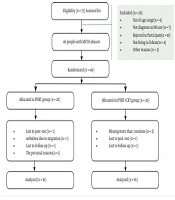
This study employed a double-blind experimental design with pretest and posttest assessments, a one-month follow-up, and a control group. Participants were males with alcohol dependence, aged 25 - 60 years. This study aimed to investigate the effectiveness of cognitive rehabilitation using RehaCom software in individuals with severe alcohol dependence. Given the social stigma and criminalization of alcohol consumption in Iranian society, which contribute to the reluctance of these individuals to seek treatment, 10 participants with severe alcohol dependence symptoms were selected from referrals to the Bahjoo Addiction Treatment Clinic in Tehran. Participants were randomly assigned to either a response inhibition rehabilitation group or a control group, with five individuals in each group. Informed consent was obtained from all participants, and the study was registered under the ethics code IR.UT.IRICSS.REC.1402.056.
Cognitive rehabilitation was delivered using RehaCom over 15 forty-five-minute sessions, three times per week for five weeks. The control group did not receive any intervention. The study used the Response Inhibition Module and the Executive Function Module, which enhance behavioral inhibition and executive control. These modules adapt to patient performance, making tasks progressively manageable as skills improve. The inclusion criteria required participants to have normal physical health, intact hearing and vision, and no history of psychiatric or neurological disorders. The exclusion criteria included refusal to continue participation and absence from more than three sessions. In this study, multivariate analysis of variance was used.
3.1. Desire for Alcohol Questionnaire
The Desire for Alcohol Questionnaire is a 14-item self-report assessment designed to evaluate alcohol cravings. It includes four subscales: (A) strong desires and intentions to drink, (B) negative reinforcement, (C) positive reinforcement, and (D) control over drinking.
3.2. Go/No-Go Task
In this task, the participant must make one of two decisions. This task evaluates the participant's response inhibition abilities by requiring the participant to click a "go" or "no-go" button.
3.3. Emotional Control Questionnaire
The Emotional Control Questionnaire consists of four subscales and 56 items focused on emotional inhibition, aggression control, rehearsal or rumination, and benign control. Respondents answer each item as "true" or "false," with a score of 1 for "true" and 0 for "false." Some items are reverse scored.
3.4. Balloon Analogue Risk Task
The Balloon Analogue Risk Task is an experimental tool that measures impulsivity under controlled conditions and captures the balance between risk and reward. It allows researchers to examine individual differences in decision-making, risk tolerance, and emotional regulation under uncertainty.
3.5. RehaCom Computer-Based Cognitive Rehabilitation
RehaCom is a computer-based cognitive rehabilitation system that improves executive functions, particularly inhibitory control. It features interactive tasks and customizable training modules to enhance user engagement. A key aspect of RehaCom is its self-adaptive capability, which adjusts exercise difficulty based on individual performance for a personalized training experience (22).
4. Results
Demographic data are presented in Table 1.
Table 1.
Demographic Data a
| Variables | Intervention | Control |
|---|---|---|
| Age | ||
| ≤ 38.50 | 1 (10) | 4 (40) |
| ≥ 38.51 | 4 (40) | 1 (10) |
| Education | ||
| Diploma | 3 (30) | 0 (0) |
| Bachelor's | 2 (2) | 4 (40) |
| Postgraduate diploma | 0 (0) | 1 (10) |
| Marriage | ||
| Single | 3 (30) | 2 (20) |
| Married | 2 (20) | 3 (30) |
| Father's addiction | ||
| Yes | 2 (20) | 3 (30) |
| No | 3 (30) | 2 (20) |
| Mother's addiction | ||
| Yes | 1 (10) | 2 (20) |
| No | 4 (40) | 3 (30) |
a Values are expressed as No. (%).
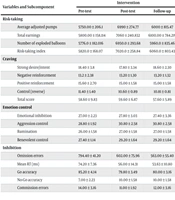
The descriptive analysis in Table 2 shows that the mean scores of the subcomponents differed between the two groups at the pretest, posttest, and follow-up stages. Table 2 also evaluates the significance of these differences, with the relevant assumptions verified.
Table 2.
Descriptive Data Analysis a
| Variables and Subcomponent | Intervention | Control | ||||
|---|---|---|---|---|---|---|
| Pre-test | Post-test | Follow-up | Pre-test | Post-test | Follow-up | |
| Risk-taking | ||||||
| Average adjusted pumps | 5750.00 ± 206.1 | 6990 ± 274.77 | 6000 ± 815.47 | 4732 ± 202.1 | 5390 ± 554.97 | 4830 ± 277.48 |
| Total earnings | 5800.00 ± 158.114 | 7060 ± 240.832 | 6100.00 ± 784.219 | 4802.00 ± 161.30 | 5470.00 ± 519.134 | 4890.00 ± 270.175 |
| Number of exploded balloons | 5776.0 ± 182.016 | 6950.0 ± 293.68 | 5960.0 ± 835.46 | 4618.0 ± 249.94 | 5310.0 ± 592.03 | 4780.0 ± 297.06 |
| Risk-taking index | 5820.0 ± 168.07 | 7020.0 ± 258.84 | 6060.0 ± 803.43 | 4692.0 ± 219.81 | 5410.0 ± 570.52 | 4840.0 ± 263.15 |
| Craving | ||||||
| Strong desire/intent | 18.40 ± 3.8 | 17.80 ± 3.34 | 18.60 ± 2.30 | 19.00 ± 2.55 | 18.80 ± 2.34 | 18.80 ± 2.60 |
| Negative reinforcement | 13.2 ± 2.38 | 13.20 ± 1.30 | 13.20 ± 1.32 | 13.80 ± 1.38 | 13.80 ± 1.78 | 13.80 ± 1.78 |
| Positive reinforcement | 15.60 ± 2.70 | 15.00 ± 1.58 | 15.00 ± 1.58 | 15.60 ± 2.07 | 15.60 ± 2.74 | 15.60 ± 2.07 |
| Control (reverse) | 11.40 ± 1.40 | 10.60 ± 0.89 | 10.81 ± 0.81 | 11.20 ± 1.30 | 11.0 ± 1.0 | 11.0 ± 1.0 |
| Total score | 58.60 ± 9.83 | 59.60 ± 6.87 | 57.60 ± 5.89 | 59.60 ± 7.66 | 59.00 ± 7.07 | 60.20 ± 7.36 |
| Emotion control | ||||||
| Emotional inhibition | 27.00 ± 2.23 | 27.80 ± 3.03 | 27.40 ± 3.36 | 33.60 ± 3.64 | 29.60 ± 5.41 | 28.80 ± 2.86 |
| Aggression control | 28.80 ± 1.92 | 30.80 ± 2.58 | 30.80 ± 2.58 | 36.40 ± 2.70 | 33.60 ± 3.05 | 30.60 ± 3.05 |
| Rumination | 26.00 ± 1.58 | 27.00 ± 1.58 | 27.00 ± 1.58 | 31.02 ± 2.86 | 31.20 ± 2.86 | 27.40 ± 1.40 |
| Benevolent control | 27.40 ± 1.14 | 29.20 ± 1.64 | 29.20 ± 1.64 | 36.20 ± 1.92 | 36.20 ± 1.62 | 32.20 ± 1.92 |
| Inhibition | ||||||
| Omission errors | 794.40 ± 41.20 | 602.00 ± 75.96 | 563.00 ± 55.40 | 647.00 ± 42.15 | 639.00 ± 41.89 | 633.00 ± 51.43 |
| Mean RT (ms) | 74.20 ± 7.36 | 56.00 ± 14.31 | 53.63 ± 10.80 | 44.40 ± 5.72 | 42.20 ± 5.58 | 45.20 ± 7.56 |
| Go accuracy | 85.20 ± 4.14 | 79.80 ± 3.49 | 80.00 ± 3.16 | 84.80 ± 1.92 | 85.80 ± 1.92 | 86.40 ± 2.40 |
| No-Go accuracy | 7.00 ± 2.23 | 10.00 ± 1.58 | 10.00 ± 1.58 | 7.40 ± 1.14 | 7.40 ± 1.14 | 6.40 ± 1.14 |
| Commission errors | 14.00 ± 3.16 | 11.00 ± 1.92 | 12.00 ± 3.16 | 11.20 ± 1.92 | 11.20 ± 1.92 | 10.20 ± 2.86 |
a Values are expressed as mean ± SD.
Given the limited sample size in this study (fewer than eight samples) and the comparison between two groups across three time points, the nonparametric Friedman test was used (Table 3).
Table 3.
Friedman Test Analysis
| Variables and Subcomponent | Chi-Square | P-Value |
|---|---|---|
| Risk-taking | ||
| Average adjusted pumps | 7.600 | 0.02 |
| Total earnings | 7.600 | 0.02 |
| Number of exploded balloons | 7.600 | 0.22 |
| Risk-taking index | 7.89 | 0.19 |
| Craving | ||
| Strong desire/intent | 0.105 | 0.94 |
| Negative reinforcement | 0.118 | 0.93 |
| Positive reinforcement | 0.778 | 0.67 |
| Control (reverse) | 2.23 | 0.32 |
| Total score | 0.40 | 0.81 |
| Emotion control | ||
| Emotional inhibition | 1.50 | 0.47 |
| Aggression control | 6.00 | 0.05 |
| Rumination | 6.00 | 0.05 |
| Benevolent control | 8.00 | 0.01 |
| Inhibition | ||
| Omission errors | 10.00 | 0.007 |
| Mean RT (ms) | 10.00 | 0.007 |
| Go accuracy | 9.50 | 0.009 |
| No-Go accuracy | 10.00 | 0.007 |
| Commission errors | 10.00 | 0.007 |
The Friedman test results (Table 3) indicate that risk-taking, emotion control, and inhibition differed significantly between the two groups across the three time points (P ≤ 0.05). However, craving did not differ significantly between the two groups across the three time points (P ≥ 0.05). To determine the direction of these differences, the mean ranks of these variables are presented in Table 4.
Table 4.
Mean Rank of Subcomponents
| Variables and Subcomponent | Pretest | Posttest | Follow-up |
|---|---|---|---|
| Risk-taking | |||
| Average adjusted pumps | 1.40 | 3.00 | 1.60 |
| Total earnings | 1.40 | 3.00 | 1.60 |
| Number of exploded balloons | 1.40 | 3.00 | 1.60 |
| Risk-taking index | 1.50 | 3.00 | 1.50 |
| Craving | |||
| Strong desire/intent | 2.00 | 1.90 | 2.10 |
| Negative reinforcement | 2.00 | 1.90 | 2.10 |
| Positive reinforcement | 2.30 | 1.90 | 1.80 |
| Control (reverse) | 2.50 | 1.70 | 1.80 |
| Total score | 2.20 | 1.80 | 2.00 |
| Emotion control | |||
| Emotional inhibition | 1.70 | 2.30 | 2.00 |
| Aggression control | 1.40 | 2.30 | 2.30 |
| Rumination | 1.40 | 2.30 | 2.30 |
| Benevolent control | 1.20 | 1.40 | 1.40 |
| Inhibition | |||
| Omission errors | 3.00 | 2.00 | 1.00 |
| Mean RT (ms) | 3.00 | 2.00 | 1.00 |
| Go accuracy | 1.00 | 1.40 | 1.60 |
| No-Go accuracy | 1.00 | 2.50 | 2.50 |
| Commission errors | 3.00 | 1.00 | 2.00 |
Comparison of the mean ranks for the subcomponents of risk-taking behavior (Table 4) demonstrated a decline in risk-taking across all subcomponents among individuals with AUD who participated in the RehaCom intervention.
Although craving did not differ significantly between the two groups across the three time points (P ≥ 0.05), the ranks of the alcohol craving subcomponents decreased for individuals with AUD who received RehaCom at the posttest compared with the pretest.
A significant difference in emotion control was observed between the two groups (P ≤ 0.05), except for the emotional inhibition subcomponent, which did not differ significantly (P ≥ 0.05). Changes in the ranks of these subvariables also indicated improved emotion control.
Furthermore, comparison of the mean ranks of the inhibition components revealed reductions in omission and commission errors and reaction times. Accuracy in the Go and No-Go tasks also increased, suggesting improved inhibitory control.
5. Discussion
The results demonstrated significant between-group differences in risk-taking, emotion control, and inhibition. Overall, the findings suggest that RehaCom could effectively reduce risk-taking and improve emotion control and inhibition among individuals with AUD.
Most individuals with addiction exhibit impairments in cognitive functions, such as risk-taking and response inhibition, which can vary widely in their clinical manifestations. We emphasize cognitive rehabilitation and emotion control because, without intervention, these deficits may persist or worsen. Cognitive deficits can negatively affect family dynamics and interpersonal relationships and hinder an individual’s reintegration into educational or professional settings (23). Individuals with AUD and substance use disorders often experience elevated levels of emotional dysregulation, exacerbated by societal labels associated with addiction, as well as challenges in managing substance use and fulfilling familial and social responsibilities. To mitigate distressing emotions, they may use avoidance strategies to alleviate pain and suffering. Conversely, effective emotion regulation enables individuals to use appropriate coping strategies in high-risk situations for substance abuse. Individuals with stronger emotion control skills can better anticipate the needs of others, recognize external pressures, and manage their own emotional responses, thereby reducing impulsivity (24).
RehaCom uses structured, adaptive exercises designed to target specific neural networks, progressively increasing in complexity as users advance, thereby promoting neuroplasticity. For example, in response inhibition training, users must rapidly determine whether to respond or refrain based on presented stimuli, thereby engaging the prefrontal cortex and executive control circuits. The objective of RehaCom is to strengthen cognitive control, enhance decision-making, and improve overall performance. This approach may benefit individuals recovering from neurological injuries, mental health disorders, cognitive impairment, substance use disorders, or alcohol use disorders. However, the observed instability of certain effects during follow-up may be attributable to an insufficient intervention dose, ongoing alcohol consumption, or cognitive fatigue.
Given the limited research on cognitive rehabilitation using RehaCom for AUD, this study compares its findings with the existing literature on other disorders. Consistent with the findings of the present study, another study indicated that RehaCom software can enhance cognitive functions related to mental imagery in adolescents with Internet addiction (20). In a separate study, the effectiveness of cognitive rehabilitation using RehaCom software was examined for enhancing working memory, selective attention, and quantitative electroencephalography in individuals with a history of methamphetamine abuse (21).
5.1. Conclusions
The RehaCom intervention could effectively reduce risk-taking and enhance emotional and inhibitory control in the short term. However, the improvements in risk-taking did not persist, indicating limited long-term effects. Maintaining these benefits may require ongoing support or follow-up strategies.
5.2. Limitations
The small sample size limits the statistical power and the generalizability of the results to larger populations with alcohol dependence. In addition, the lack of a concurrent standard treatment, purposive sampling, and the inclusion of only male participants restrict the applicability of the findings to other populations.
5.3. Future Research Directions
Future studies should use larger and more diverse samples to increase statistical power and improve generalizability to broader populations with alcohol dependence. Incorporating standard treatment comparison groups, using probability-based sampling methods, and including both male and female participants would strengthen the validity and external applicability of the findings.