
1. Background
The university years coincide with rapid developmental, social, and academic transitions that can intensify psychological stress and shape health behaviors. Students in the medical sciences may be particularly exposed to stressors because of demanding curricula, high-stakes examinations, sleep disruption, and early professional socialization in clinical environments. Perceived stress refers to the extent to which individuals appraise life situations as unpredictable, uncontrollable, and overloaded, and it is commonly measured using the Perceived Stress Scale (PSS). The PSS is one of the most widely used instruments for stress appraisal in student and community samples and is supported by substantial psychometric evidence across cultures and settings (1, 2). In Iranian populations, psychometric evaluations have also supported the use of Persian versions of the PSS, including the 14-item format used in the present study (3).
Stress is not only a mental health concern but also a behavioral risk context. Theoretical and empirical work suggests that stress may be associated with vulnerability to substance use initiation, escalation, and relapse through multiple pathways, including negative reinforcement, stress-related changes in reward sensitivity and inhibitory control, and impaired coping and decision-making under pressure (4-7). The self-medication hypothesis proposes that some individuals may use psychoactive substances to regulate dysphoric affective states (4), whereas neurobehavioral models emphasize stress-induced dysregulation in corticolimbic circuitry relevant to craving, impulsivity, and habit formation (5-7).
In Iran, substance use remains an important public health issue, with heterogeneous patterns across provinces, age groups, and sociocultural contexts. National evidence indicates that drug use disorders occur at a nontrivial prevalence and are shaped by socioeconomic and contextual determinants (8-10). Among university students, the transition to greater independence, changes in peer networks, and reduced parental supervision may increase exposure opportunities and reduce protective monitoring. A national Iranian study identified multiple risk and protective factors for substance use among university students, including gender, attitudes, peer norms, and family-related influences (11). Regional evidence also highlights variation across the country and the importance of local prevention strategies (12).
Although many studies focus on substance-use behaviors, addiction readiness captures a broader vulnerability profile, reflecting cognitive-affective predispositions and attitudes linked to substance-use risk. In Iranian contexts, the Iranian Addiction Potential Scale (IAPS) has been used to assess addiction-related vulnerability in a culturally adapted format (13, 14). In the present study, "addiction readiness" was used consistently as the primary outcome term. It refers to higher IAPS-based vulnerability scores and does not indicate a clinical diagnosis of addiction or confirmed substance-use behavior. Recent student-based studies also indicate that behavioral addiction and psychological distress often coexist in university populations and that loneliness, interpersonal problems, depression, anxiety, and stress may be important contextual factors for addiction-related vulnerability (15-17).
Despite the plausibility of links between stress and addiction vulnerability, evidence remains limited among medical sciences students in southeast Iran. Zahedan is located in a region with distinct socioeconomic conditions and proximity to major trafficking routes, which may shape exposure risks and the local stress ecology. Understanding whether perceived stress is associated with addiction readiness in this setting may inform targeted prevention, counseling services, and stress-management programming within universities and clinical training sites.
2. Objectives
This study aimed to examine the relationship between perceived stress and addiction readiness among ZaUMS students during the 2023 - 2024 academic year, while accounting for sociodemographic factors, field of study, and self-reported substance use. We also assessed whether the association differed by sex.
3. Patients and Methods
3.1. Study Design, Setting, and Timeframe
This cross-sectional study was conducted among ZaUMS students in Zahedan, Iran. Data collection started in October 2023 and continued until September 2024. The study is reported in accordance with the Strengthening the Reporting of Observational Studies in Epidemiology (STROBE) guideline (18).
3.2. Participants and Sampling
The target population comprised ZaUMS students enrolled during the 2023 - 2024 academic year. Eligible participants were students aged ≥ 18 years who were willing to participate and able to complete the questionnaires in Persian.
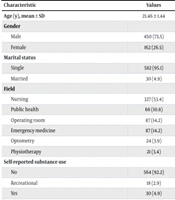
Sampling was conducted using a stratified proportional framework based on faculty enrollment size. Recruitment quotas were estimated proportionally for the faculties of Nursing, Public Health, Operating Room, Emergency Medicine, Physiotherapy, and Optometry to improve representation across academic disciplines. Within each faculty stratum, students were approached in classrooms, dormitories, hospital wards, and internship-placement settings using convenience recruitment until the prespecified quota for that stratum was reached. The final analyzed stratum-level numbers are presented in Table 1.
Table 1.
Demographic and Educational Characteristics of Participants (N = 612) a
| Characteristic | Values |
|---|---|
| Age (y), mean ± SD | 21.46 ± 1.44 |
| Gender | |
| Male | 450 (73.5) |
| Female | 162 (26.5) |
| Marital status | |
| Single | 582 (95.1) |
| Married | 30 (4.9) |
| Field | |
| Nursing | 327 (53.4) |
| Public health | 66 (10.8) |
| Operating room | 87 (14.2) |
| Emergency medicine | 87 (14.2) |
| Optometry | 24 (3.9) |
| Physiotherapy | 21 (3.4) |
| Self-reported substance use | |
| No | 564 (92.2) |
| Recreational | 18 (2.9) |
| Yes | 30 (4.9) |
a Values are expressed as No. (%) unless otherwise indicated.
The required sample size was estimated using the single-proportion formula with 95% confidence, P = 0.50, precision d = 0.0476, a design effect of 1.5, and 10% anticipated nonresponse, yielding a target of 707 questionnaires. Of 707 distributed questionnaires, 612 were complete and included in the analysis (completion rate, 86.6%); 95 questionnaires were excluded because of substantial missingness. The excluded questionnaires were removed before final data entry because they did not meet the minimum completion threshold required for valid scale scoring. Therefore, formal statistical comparisons between included and excluded questionnaires were not possible; this limitation was explicitly considered when interpreting representativeness and selection bias.
Within each stratum, eligible students were approached at the recruitment sites and invited to participate using a structured questionnaire packet. To minimize duplicate participation, recruitment was limited to one approach per selected class, session, or rotation group.
3.3. Data Collection Procedure
Trained data collectors distributed paper-based questionnaires in the study settings and supervised self-administration. Participation was voluntary and anonymous. To reduce social desirability bias, students were informed that no identifying information would be recorded and that responses would remain confidential.
3.4. Measures and Instruments
Perceived stress was assessed using the 14-item PSS (PSS-14) (1). Items are rated on a 5-point Likert scale ranging from 0 (never) to 4 (very often). Seven positively stated items are reverse-scored, and total scores are obtained by summing all items, with higher scores indicating greater perceived stress (possible range, 0 - 56) (1, 2). Psychometric studies support the reliability and validity of the PSS across cultures, and evidence is available for Persian versions of the PSS, including the 14-item format (2, 3). In the present sample, the internal consistency of the scored PSS-14 items was acceptable (Cronbach alpha = 0.69).
Addiction readiness was measured using the IAPS, a culturally adapted instrument used in Iranian research (13, 14). The IAPS includes 41 items rated on a Likert scale from 0 to 4, with higher total scores indicating greater addiction-related vulnerability (14). In the current study, the IAPS total score was calculated as the sum of all items. For interpretability, higher scores indicate greater addiction readiness. The IAPS score was interpreted as a vulnerability/readiness indicator rather than evidence of an addiction diagnosis or confirmed substance-use behavior. In the present sample, internal consistency was excellent (Cronbach alpha = 0.98).
Covariates included age, sex, marital status, field of study, and self-reported substance use status (not used, recreational use, and yes use).
Self-reported substance use status was assessed using a single item with three response options: no, yes, and recreational. Information on the type of substance, dose, frequency, duration, and recency of use was not collected.
3.5. Score Calculation and Data Quality
To minimize data loss due to minor item nonresponse, scale totals were calculated using prorated scoring when at least 85% of items were completed (PSS-14, ≥ 12 items; IAPS, ≥ 35 items). Out-of-range item responses were treated as missing before scoring. Among the 612 included questionnaires, 9 participants (1.5%) required prorated PSS-14 scoring because of 1 invalid or missing PSS item response; no included questionnaire required prorated IAPS scoring. Questionnaires exceeding the predefined missingness threshold were excluded from inferential analyses.
3.6. Ethical Considerations
The study was approved by the Ethics Committee of Zahedan University of Medical Sciences (IR.ZAUMS.REC.1402.075). Written informed consent was obtained from all participants.
3.7. Statistical Analysis
Analyses were conducted using IBM SPSS Statistics version 26. Continuous variables were summarized as mean ± SD, and categorical variables were summarized as number (%). Internal consistency was assessed using Cronbach alpha. Pearson correlation coefficients were used to evaluate the bivariate association between perceived stress and addiction readiness overall and stratified by sex. Differences between sex-specific correlations were tested using Fisher r-to-z transformation. Group differences were examined using independent-samples t-tests for 2 groups or 1-way analysis of variance for more than 2 groups. Covariates were selected a priori based on conceptual relevance and prior literature on addiction-related vulnerability in university students. Regression assumptions, including linearity, residual distribution, heteroskedasticity, and multicollinearity, were assessed before model interpretation. Variance inflation factor values did not indicate problematic multicollinearity. Because heteroskedasticity could not be fully ruled out, heteroskedasticity-consistent HC3 robust standard errors were used in the final regression models. Model 1 adjusted for perceived stress, age, sex, marital status, and field of study. Model 2 additionally adjusted for self-reported substance use. Effect modification by sex was evaluated by adding a perceived stress × sex interaction term in a prespecified sensitivity model. Statistical significance was set at P < 0.05 (2-sided).
4. Results
4.1. Participant Characteristics and Recruitment Flow
A total of 707 questionnaires were distributed, and 612 complete questionnaires were included in the final analysis (completion rate, 86.6%). The final analyzed stratum-level numbers were Nursing, 327; Public Health, 66; Operating Room, 87; Emergency Medicine, 87; Optometry, 24; and Physiotherapy, 21. Because the 95 excluded questionnaires were not retained in the final analyzable dataset, their detailed item-level missingness patterns and demographic profiles could not be statistically compared with those of the included questionnaires. Participant characteristics are shown in Table 1. Because questionnaires excluded at the screening stage were not retained with complete stratum identifiers, the exact numbers of questionnaires distributed and excluded by faculty could not be reconstructed. Therefore, the manuscript reports the final analyzed stratum-level numbers and explicitly acknowledges this as a limitation when interpreting representativeness and selection bias.
4.2. Scale Scores, Reliability, and Correlation
The mean PSS-14 score was 25.34 ± 5.58 (Cronbach alpha = 0.70), and the mean IAPS score was 55.04 ± 34.94 (Cronbach alpha = 0.98). Perceived stress was positively correlated with addiction readiness (r = 0.38, P < 0.001). In sex-stratified analyses, the correlation was stronger in females (r = 0.58) than in males (r = 0.26), and the difference between correlations was statistically significant (Fisher r-to-z P = 0.00002). Among the included questionnaires, limited item-level correction was required for only 9 PSS-14 records; no IAPS item-level missingness remained after quality screening (Table 2).
Table 2.
Descriptive Statistics and Correlation Between Perceived Stress and Addiction Readiness a
| Measure | Statistic | Observed Range | P Value |
|---|---|---|---|
| Perceived stress (PSS-14) | 25.34 ± 5.58 | 6 - 40 | - |
| Addiction readiness (IAPS) | 55.04 ± 34.93 | 0 - 134 | - |
| Correlation (PSS-14 vs IAPS) | r = 0.38 | - | < 0.001 |
a Values are expressed as mean ± SD.
4.3. Group Differences
Male students reported higher perceived stress than female students (25.96 ± 5.59 vs 23.60 ± 5.20; P < 0.001) and higher addiction readiness (59.43 ± 31.79 vs 42.85 ± 40.11; P < 0.001). Addiction readiness differed by field of study (analysis of variance P = 0.002), whereas perceived stress did not (analysis of variance P = 0.347).
4.4. Multivariable Association Between Perceived Stress and Addiction Readiness
In multivariable linear regression models, perceived stress was significantly associated with higher addiction readiness in both the demographic-adjusted model and the fully adjusted model (Table 3). In the prespecified fully adjusted sex-interaction model, the perceived stress × male interaction coefficient was significant (b = -2.32; 95% CI, -3.14 to -1.51; P < 0.001), indicating that the association between stress and addiction readiness was stronger among female students than among male students.
Table 3.
Multivariable Linear Regression Predicting Addiction Readiness (IAPS Score) a
| Predictors | Model 1: b (95% CI) | Model 1: P | Model 2: b (95% CI) | Model 2: P |
|---|---|---|---|---|
| Perceived stress (per 1-point increase) | 2.58 (2.25 to 2.92) | < 0.001 | 2.20 (1.85 to 2.56) | < 0.001 |
| Age (per 1-y increase) | 6.01 (3.61 to 8.42) | < 0.001 | 3.96 (0.97 to 6.95) | 0.009 |
| Male (vs. female) | 17.27 (12.34 to 22.20) | < 0.001 | 20.64 (15.68 to 25.60) | < 0.001 |
| Single (vs. married) | -11.65 (-27.17 to 3.87) | 0.141 | -4.97 (-21.15 to 11.21) | 0.547 |
| Public health (vs nursing) | -0.69 (-8.46 to 7.09) | 0.862 | -1.20 (-8.90 to 6.49) | 0.759 |
| Operating room (vs. nursing) | 10.98 (3.55 to 18.40) | 0.004 | 8.23 (0.55 to 15.92) | 0.036 |
| Emergency medicine (vs. nursing) | -12.00 (-18.33 to -5.66) | < 0.001 | -13.28 (-19.66 to -6.90) | < 0.001 |
| Optometry (vs. nursing) | 0.48 (-12.75 to 13.70) | 0.944 | -0.41 (-13.32 to 12.50) | 0.950 |
| Physiotherapy (vs. nursing) | -4.09 (-18.49 to 10.32) | 0.578 | -3.08 (-17.19 to 11.03) | 0.669 |
| Recreational use (vs. not used) | - | - | 21.32 (12.44 to 30.20) | < 0.001 |
| Substance use, yes (vs. not used) | - | - | 33.08 (19.38 to 46.79) | < 0.001 |
a Model 1 adjusted for perceived stress, age, sex, marital status, and field of study. Model 2 additionally adjusted for self-reported substance use. HC3 robust standard errors were used.
5. Discussion
In this cross-sectional study of ZaUMS students, perceived stress was positively and independently associated with addiction readiness. Students reporting higher stress also reported a stronger vulnerability profile, as captured by IAPS-based addiction readiness scores, and this association persisted after adjustment for demographics, field of study, and self-reported substance use.
These findings align with conceptual models proposing that stress contributes to substance-related vulnerability through psychological and neurobehavioral pathways. Stress may undermine self-regulation, increase negative affect, and promote maladaptive coping strategies; substances may be perceived as short-term emotion-regulation tools, consistent with the self-medication framework (4). At the neurobehavioral level, stress is linked to dysregulation of reward and stress systems that can increase craving, impair inhibitory control, and facilitate habit learning and relapse (5-7). Importantly, the outcome in this study was not substance use itself but addiction readiness, an IAPS-based vulnerability construct that may precede overt behaviors.
Because of the cross-sectional design, these findings should be interpreted as associations rather than causal effects. The present data cannot determine whether perceived stress preceded addiction readiness, whether students with higher addiction readiness experienced greater stress, or whether both were influenced by unmeasured psychosocial factors. Therefore, the results should not be interpreted as evidence that stress directly causes addiction readiness or that screening and stress management would necessarily reduce addiction vulnerability without further longitudinal or interventional evaluation.
Sex-stratified analyses suggested a stronger stress-addiction readiness relationship in females than in males, despite higher mean addiction readiness among males. This difference was supported by Fisher r-to-z testing of sex-specific correlations (P = 0.00002) and by a significant perceived stress × sex interaction in sensitivity analysis (b = -2.32; 95% CI, -3.14 to -1.51; P < 0.001). Several explanations are plausible. Stress may co-occur more strongly with internalizing symptoms and ruminative coping in women, potentially amplifying vulnerability signatures captured by addiction readiness measures. Alternatively, social desirability and stigma may differentially influence the reporting of addiction-related attitudes in cultural contexts, thereby affecting correlations. This interpretation is consistent with recent evidence among Iranian medical interns showing poorer mental health among female students and supporting the need for sex-sensitive student mental health services (19). These hypotheses warrant longitudinal and mixed-methods research.
Field-of-study differences in addiction readiness, but not in perceived stress, suggest that vulnerability patterns may reflect contextual factors beyond stress exposure alone. Peer norms, shift patterns, workload, and clinical environment characteristics may shape attitudes and perceived access to substances. Recent Iranian evidence also suggests that structured psychological interventions, such as acceptance and commitment therapy, can reduce perceived stress in student populations, whereas workplace-based research indicates that stress and anxiety may become severe under context-specific organizational pressures (20, 21). Tailored prevention strategies that account for educational, clinical-training, and organizational contexts may therefore be more effective than uniform approaches.
The findings should also be interpreted within Iran's broader evidence base. National and student-focused studies indicate that substance-use risk is shaped by multiple determinants, including the peer environment, attitudes, and family influences (8-12). Recent studies in student populations have also emphasized the relevance of psychological distress, loneliness, interpersonal problems, and stress symptoms in addiction-related outcomes and student mental health (15-17). Within this context, the stress-vulnerability association observed in Zahedan supports the need for future evaluation of integrated mental health and stress-management services in student health systems, especially for medical sciences students who encounter additional stressors during clinical training. This interpretation is also supported by qualitative evidence from Zahedan University of Medical Sciences indicating that clinical-training environments, particularly operating-room settings, may be experienced by students as stressful and challenging educational contexts (22).
5.1. Implications
The results suggest that stress and addiction readiness may be useful targets for further prevention-oriented research in university settings. Routine screening for high perceived stress and elevated IAPS-based vulnerability may help identify students who could benefit from psychological support; however, the effectiveness of such screening should be evaluated prospectively. Future interventions may examine whether evidence-informed stress reduction and coping-skills training, such as problem-solving, sleep hygiene, time management, and mindfulness-based approaches, can improve student mental health and reduce addiction-related vulnerability indicators.
5.2. Limitations
The cross-sectional design precludes causal inference. Sampling within strata was convenience-based, and 95 of 707 questionnaires (13.4%) were excluded because of substantial missingness, which may introduce selection bias and limit generalizability. Because excluded questionnaires were not retained in the final analyzable dataset, detailed demographic comparisons between included and excluded questionnaires were not possible. Self-report measures are subject to recall and social desirability bias, particularly for substance use. In addition, substance use was measured using a single item without details on substance type, timing, frequency, duration, or amount, which limits interpretation and precludes dose-response analyses. The setting-based recruitment strategy likely improved coverage; however, selection bias remains possible if students who were absent from data collection sites differed systematically. Residual confounding is also likely because factors such as socioeconomic status, mental health symptoms, trauma exposure, sleep quality, and academic performance were not measured.
5.3. Strengths
The study included a relatively large sample and recruited students from academic, residential, and clinical training settings. The use of commonly applied instruments for perceived stress and addiction readiness, together with the persistence of associations in multivariable models, supports the robustness of the main finding.
5.4. Conclusions
Among ZaUMS students in 2023 - 2024, higher perceived stress was significantly associated with greater addiction readiness. Because this was a cross-sectional study, the findings should be interpreted as evidence of association rather than causation. Universities, particularly medical sciences institutions, should consider evaluating integrated prevention strategies that combine stress screening, targeted psychological support, and coping-based interventions in longitudinal and interventional research designs.