1. Background
Tobacco use is characterized as a major health concern across the world (1, 2). It is considered as one of the most important causes of mortality worldwide. Nowadays out of the 1.1 billion smokers around the world, 6 million people die because of it (3). If this pattern similarly goes on, it is estimated that 10 million people will annually die of smoking by 2020 (4). However, the more crucial issue is tobacco use by adolescents, which has become a major concern in public health (5). Studies in this respect have suggested that symptoms of nicotine dependence are evident in the early stages of the onset of smoking because first, even by smoking a few cigarettes, adolescents intake the same amount of nicotine as that taken in by adults; and second, symptoms of smoking dependence including cravings and withdrawals occur in them (6, 7). In this regard, investigations have also indicated that such symptoms develop quickly in adolescents and they will encounter numerous problems when trying to quit smoking (8).
Psychological factors can likewise play an important role in the development of psycho-social problems such as smoking and substance abuse in adolescents (9, 10). Accordingly, one of the psychological factors affecting smoking tendency is known as perceived stress, which can provide conditions for different mental and social problems (11). Experiences associated with regular criticism by parents or family members can also make a person agitated; moreover, most individuals are afraid of criticism and it is thought that this fear leads to punishment avoidance. Therefore, individuals focus on avoidance strategies to deal with criticism (12). In this respect, perceived stress caused by stressful conditions of parental criticism is very uncomfortable and such an inconvenience inspires a person to seek ways to reduce it.
The process in which a person is striving to manage psychological stress is called “coping” and it takes place in 2 main ways, problem- focused and emotion- focused. Problem-focused coping strategies focus on problem solving by planning. Dysfunctional emotional response can give rise to various forms of psychological disorders (13) smoking and substance abuse (14, 15). Smokers may as well underestimate the severity of negative emotion or they may adopt strategies that can reduce resistance against smoking (e.g. high suppression). Suppression of negative emotions can also be a predictor of tobacco use as well as onset of early smoking (16).
Catherine (17), in a longitudinal study, investigated problems associated with emotion-regulation in children, negative behaviors by parents, as well as growth in internalized behavioral problems in children. The results revealed that several variables could predict emotional regulation of current and subsequent internalized behaviors. Besides, negative parenting could also predict internalized behaviors over time. Other related studies shed light on the impacts of disorders in emotional regulation on smoking as well (18). Furthermore, the results of related investigations in Iran revealed a significant relationship between smoking, substance dependence, and impaired emotional regulation (19, 20).
Since the effective mechanisms of criticism by parents are not clear enough, the relationship between criticisms and judgment-oriented behaviors by parents can be taken into account as a perceived behavior by adolescents. This characteristic and confusion in self-perception can lead to emotional deregulation and thus increase the tendency to smoking. Therefore, a causal model can be used to examine the relationship between underlying cognitive-emotional factors and incidence of smoking. This study intends to examine a craving towards smoking based on perceived criticism and emotional self-regulation in adolescents.
2. Objectives
The need to identify preventive psychological measures in adolescents against tendency to smoking is a crucial issue. Therefore, the current study aimed to investigate the prevalence of craving towards smoking and the mediating role of emotional regulation in relation with the effect of perceived criticism and dose of usage on adolescents who crave smoking in Isfahan.
3. Patients and Methods
3.1. Study Design and Samples
This study, using correlational research design, was conducted based on the structural equation modeling. The study population consisted of male students, between the ages of 15 - 18, who were in high school during 2015 - 2016, and were in Isfahan.
The sample size formula used in this study was based on Cochran’s formula, which is used to give an explanation for results regarding the probability distributions of statistics (with parameters: α = 0.05, d = 0.03).
3.2. Procedure
We employed multistage sampling method. The process of data gathering and study procedure had been planned as follows: at first, 2 out of 6 educational districts in Isfahan (from various geographical areas) were randomly selected. From each district, 2 all boy high schools as well as 3 classes in each high school were randomly selected and the questionnaires were completed.
The inclusion criterion was being a male student and studying in a governmental high school. Students not being inclined to respond to the questionnaire were excluded. To fill out the questionnaires, first students were briefed about how to answer the questions by the interviewers. Then, the questionnaire was accomplished by the students. Before completing the questionnaire, students are informed of their information confidentiality. All the students responded to 3 questionnaires.
3.3. Measures
3.3.1. Hooked on Nicotine Checklist (HONK)
It is a 10-item self-report checklist, which measured cravings towards smoking (as indicators of diminished autonomy over tobacco) in adolescents. In addition, it has had acceptable psychometric properties in different studies (21, 22). This checklist is also associated with self-report cigarette smoking and possesses appropriate criterion reliability (23).
3.3.2. Perceived Criticism Measure (PCM)
This 6-item questionnaire, developed by Hooley and Teasdale (24), using a Likert scale of 1 (not critical) to 10 (very critical), measures perceived criticism. A test-retest reliability score of 0.75 of the questionnaire, during 20 successive weeks in 2 different samples, was obtained. Results on the validity show that the questionnaire has a good discriminative validity and an acceptable predictive validity in terms of medical outcomes in relation to scales including depression, anxiety, and personality traits (25). Reliability and validity of the questionnaire has been studied in the Iranian population. Halvaeipour et al. (26) studied the psychometric properties of the scale in an Iranian population using CFA in a group of adolescents. The results of this study showed that the one-factor model of the scale has a good fitness to data and all factors are significant. Also, the results of reliability assessment showed that the coefficient for the total scale is equal to 0.63.
3.3.3. Emotion Regulation Inventory
It is a 10-item self-report questionnaire developed by Gross et al. (27), which consisted of 2 different mechanisms of emotion regulation: cognitive reappraisal (6 items) and expressive suppression (4 items). The items are answered on a five-point scale. The cognitive reappraisal measures ones’ tendencies towards emotion regulation through changing thoughts; however, the expressive suppression scale measures the lack of positive and negative emotional expressions. Cronbach’s alpha coefficients for 2 subscales reappraisal and suppression are 0.79 and 0.73, respectively, and 3-month reliability coefficient is reported as 0.69 (27). In a study reported in Iran, psychometric properties of the questionnaire are reported as desirable (28).
The data were analyzed using the SPSS and AMOS Software. In addition, Chi-square, correlation, and path analysis tests were used.
4. Results
This study examined smoking tendency in male students in the city of Esfahan. The mean age of the 350 students recruited in this study was 16.8 years. In terms of field of study, the highest frequency was assigned to students enrolled in technical-vocational major (36%) followed by math-physics students (34%) and students of experimental sciences (19%). The highest value of smoking experience was devoted to the technical-vocational major (45%). Math-physics students were placed in the second ranking with 29.4%. The results showed that 34.4% of students had experienced smoking more than 20 cigarettes throughout their lifetime, with 44% of all students stating that they will still continue smoking.
As Table 1 shows, the median score of cravings towards smoking in technical-vocational students is higher than other students and 74.3% of students reported a score greater than 1 (threshold of smoking onset). Chi-square tests revealed that there is a meaningful difference between students in different disciplines in terms of cravings towards smoking.
Table 1.
Smoking Tendency Based on Students’ Fields of Studya
| Fields of Study* | Hooked on Nicotine, % | Median | (HONC ≥ 1), % | |||
|---|---|---|---|---|---|---|
| 0 | 1 - 3 | 4 - 6 | 7 - 10 | |||
| Experimental sciences | 25 | 17.4 | 21.3 | 7.4 | 1 | 56.9 |
| Mathematics-physics | 34.8 | 43.1 | 26.2 | 22.1 | 2 | 66.7 |
| Humanities | 8 | 10.1 | 3.3 | 8.8 | 2 | 67.9 |
| Technical and vocational | 32.1 | 29.4 | 49.2 | 61.8 | 4 | 74.3 |
aX2 = 35.9, P < 0.05.
Table 2 shows correlation matrix and descriptive statistics between the study variables:
Table 2.
Correlation Matrix and Descriptive Statistics Between the Study Variables
| Variable | 1 | 2 | 3 | 4 | Mean ± SD |
|---|---|---|---|---|---|
| Emotion reappraisal | 1 | 18.6 ± 5.01 | |||
| Expressive suppression | 0.57 | 1 | 11.4 ± 4.1 | ||
| Perceived criticism | -0.43 | -0.43 | 1 | 32.2 ± 10.1 | |
| Cravings towards smoking | -0.48 | -0.58 | 0.56 | 1 | 3.1 ± 3.3 |
According to Pearson correlation analysis, there is a significant relationship between emotion reappraisal (r = -.48), expressive suppression (r = -0.58), and Perceived criticism (r = 0.56) with cravings towards smoking (P < 0.01). Accordingly, the mean score of cigarette cravings among the study sample was 3.1 (out of 10).
Figure 1 and Table 3 show the structural model and its parameters for cravings towards smoking based on emotion regulation and Perceived criticism. Accordingly, the R-squared coefficient reflecting cravings towards cigarettes smoking was 61%. In other words, 61% of variances in cigarette cravings can be explained by 2 variables: emotion regulation and perceived criticism. Also, 32% of variances in emotion regulation (mediating variable in this hypothesis) is explained by Perceived criticism. As it is shown in the table, the variable Perceived criticism has significant direct and indirect effects on cravings towards smoking. Goodness of fit indices were reported desirable (P < 0.05).
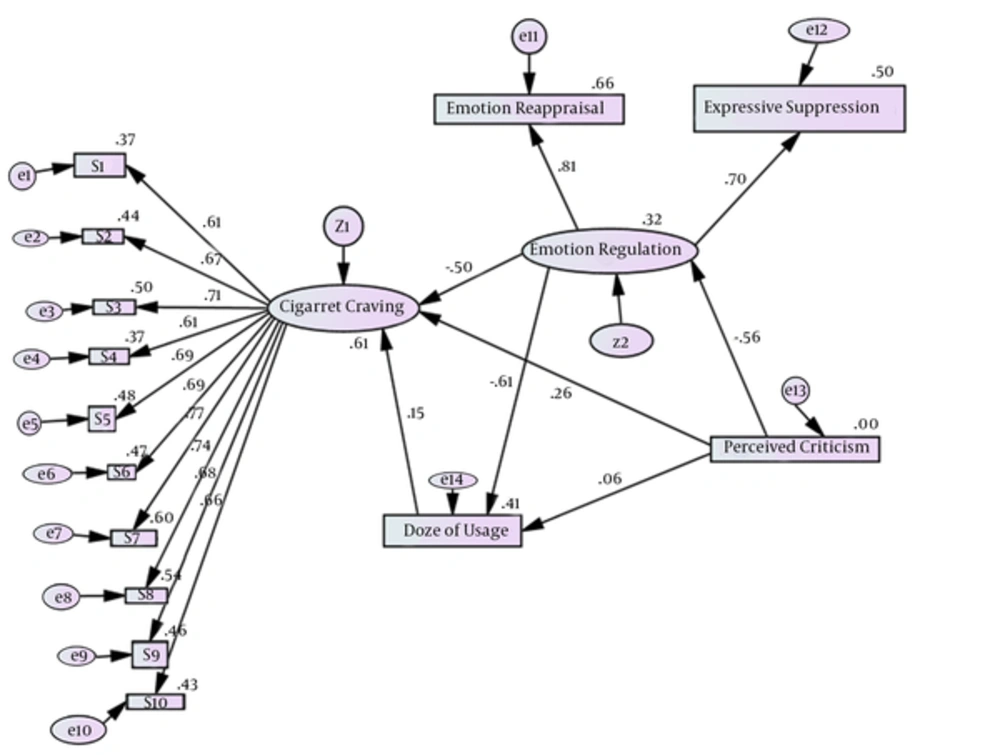
Figure 1.
Path Analysis Model of Explaining Cravings Towards Cigarette Smoking by the Variables Perceived Criticism, Dose of Usage and Emotion Regulation
Table 3.
Standard Regression Coefficients (Beta), A Critical Ratio (CR), P Value and Direct and Indirect Effects of Each Factor Related to the Modela
| The Variable Direction | Standard Regression Coefficient (Total Effect) | C.R. | P Value | Direct Effect | Indirect Effect |
|---|---|---|---|---|---|
| Perceived criticism on Cravings towards cigarette smoking | 0.59 | 4.4 | < 0.001 | 0.25 | 0.34 |
| Doze of usage on Cravings towards cigarette smoking | 0.14 | 2.3 | < 0.001 | 0.014 | - |
| Emotion regulation on Cravings towards cigarette smoking | -0.59 | -5.1 | < 0.001 | -0.50 | -0.09 |
| Perceived criticism on Emotion regulation | -0.56 | -9.9 | < 0.001 | -0.56 | - |
aGFI = 0.80; AGFI = 0.87; RMSEA = 0.05.
5. Discussion
The purpose of the present study was to examine the relationship between perceived criticism by parents, dose of smoking use, and emotional regulation on smoking tendency in students in Isfahan, Iran. The results of this study demonstrated that 61% of variance in smoking tendency among students could be explained by the given variables. Perceived criticism by parents could both directly and indirectly have a significantly positive relationship with smoking tendency through the emotional regulation and dose of smoking use. According to cognitive theory (29), perceived criticism and strict parenting practices are considered as detrimental factors in the development of obsessive tendencies such as tobacco use. Besides, studies have revealed that the impact of criticism by parents on smoking in adolescents can be affected by cognitive-emotional factors (26, 30) resulting in high-risk behaviors and cravings towards smoking (31).
Moreover; according to the results, the tendency to smoke cigarettes was at higher levels in students who had smoked greater numbers of cigarettes during their lifetime. In other words, the degree of autonomy in adolescents reduced as the result of their increased dosage. These findings were consistent with the results of the related studies in this field (8, 32-34).
According to the I-Change Model, as a cognitive model of smoking and substance abuse tendency (35), a combination of cognitions including attitudes, perceived social effects, perceived criticism from parents, and strict parenting practices has an impact on smoking tendency in adolescents; in addition, behaviors associated with smoking and substance abuse can be predicted. In line with the results of the present study, various investigations (36, 37) also have shown that criticism by parents as well as poor parenting throughout their childhood can be correlated with the tendency to smoke in adolescents in such a way that history of poor parenting throughout their childhood can predict nicotine dependence in adulthood and consequently, individuals with a higher dosage, are more inclined to smoke (38).
This study also indicated that emotional regulation was significantly and negatively related to the tendency to smoke in students. In accordance with other studies (39, 40) it was concluded that people who do not use adaptive emotional strategies might predict lower risks in their exposures to stimulants such as tobacco products due to their high levels of excitement and impulsivity; in addition, they have higher levels of tendency to use them (41). It seemed that sensation-seeking in students coincided with the theory of Bancroft et al. (42) due to the fact that it leads to a rise in risk-taking in order to gain pleasure in such a way that they turn to the use of tobacco products such as cigarettes or try other high-risk behaviors to meet their enjoyment and get rid of monotony. It also leads the students to underestimate the risks and negative consequences of these behaviors.
According to the researchers, individuals who use inefficient emotion-regulation strategies are more prone to show high-risk behaviors as a means to relieve their negative emotions compared to others. In the views of Romer (43), a tendency to have risky behaviors such as smoking is a way to reduce unpleasant emotions. Moreover, McLaughlin et al. (44) believed that individuals inevitably resort to undesirable behaviors to make themselves relieved when they cannot make use of problem-oriented and adaptive strategies to deal with their obsessive tendencies. Such behaviors can include smoking and substance abuse (15, 45, 46), inclination to suicidal thoughts (47), as well as aggressive behaviors (48).
The strength points of this study were related to path analysis of some influential psycho determinants on cravings towards smoking in adolescents. Moreover, findings from the current study have several implications for future research studies. In order to identify potential affecting mechanism of cigarette smoking among adolescents, it is recommended that more attention will be paid on the role of feelings, parental-rearing styles, and perceived social support in preventing adolescents from smoking.
Among the limitations of the present study, due to some difficulties encountered in data gathering, we did not have access to female students. Moreover, our findings were based on self-report responses, thus results must be interpreted cautiously.
5.1. Conclusions
This study showed the direct and indirect effects of perceived criticism on cravings towards smoking through emotion regulation and dose of usage. In fact, adolescents are not strong enough to regulate their emotions; in other words, they are somewhat dependent on others and if this situation is criticized, it can lead to conducting high risk behaviors such as smoking. According to the results, as providing some recommendations, implementing targeted interventions such as training parental skills, emotion regulation strategies and guidelines to effectively cope with educational stress can be beneficial in schools. In addition, given the adverse effects of smoking on health and well-being, it is essential to provide education to reduce smoking. In order to achieve this objective, the use of psycho-social health promoting models, by trained staff, can be useful. Furthermore, it is suggested to keep an eye on students’ psychological profiles occasionally and to provide psycho-social care accordingly in early stages of entering schools.