
1. Background
Early adolescence (age of 12 to 16 years) is a significantly risky developmental period for transitions to substance use and abuse (1, 2). Statistics show that over 90% of those, who have substance use disorders, started drug use under the age of 18 and more than half of them first experienced drugs when they were below 15 years of age (3). This necessitates further researches to investigate the causes of substance use in early adolescence.
To understand adolescent drug use patterns, researchers have investigated many factors at the personal, social, and environmental levels. Accordingly, behavior is not only the result of reaction to environmental stimuli but individuals are viewed as capable of thinking and forming an opinion in any circumstance, reflecting on the possible consequences of certain behaviors, and then deciding on the best action. One of the most common theories in this context is the Bandura’s (4) social cognitive theory. The social cognitive theory (SCT) assumes that behavior change is influenced by a complex interaction, which is referred to as ‘reciprocal determinism’, that occurs between personal factors, environmental factors, and attributes of one’s behavior itself.
Social cognitive theory identifies 4 types of social cognitive factors that appear to be important determinants of substance use behavior, including self-efficacy, positive outcome expectancies, negative outcome expectancies, and social influence (4).
Based on Bandura’s theory, it is clearly indicated that a strong ability to refrain from substance use (which is part of one’s self-efficacy), for example, not to be involved in smoking when others smoke or when they are under emotional stress, is related to a higher possibility of achieving and maintaining this refraining from use (5). Skutle and Klepp found that self- efficacy expectancies were negatively related to drinking behavior (6). The result of a survey on Iranian adolescents also showed the important role of self-efficacy in predicting substance use behavior (7, 8). A person with a high sense of self-efficacy regarding quitting smoking for example, is expected to be more capable of refusing cigarette offerings from friends (9).
An anticipated result of performing a specified behavior, which is defined as the outcome expectancy, is another factor in social cognitive theory, working in conjunction with self- efficacy to moderate behavior (10). People assume positive expectancies and attitudes towards substances through the process of observing or imitating positive statements or attitudes of their role models (11).
Another important factor contributing to drug use behavior is social influence (12). Family and peer relationships are important for adolescent drug use because both are principal groups, where attitudes and behaviors are learned. An individual learns to take drugs in small and informal groups, according to the social learning theory (13). Adolescents are likely to listen to and give priority to individuals, whom they look up to. If those individuals have attitudes favorable of drug use and use drugs themselves, adolescents are likely to imitate and internalize those attitudes and behaviors (14).
It has been supported that combined interventions that aim at these factor (positive outcome expectancies, negative outcome expectancies, social influence, and self-efficacy expectations) might be equally or even more effective compared to interventions that focus exclusively on one aspect (15, 16).
On the other hand, in spite of the importance of these factors in the substance use intervention, no relevant studies have been conducted in Iran. Accordingly, the present study was administered to provide the first evaluation of psychometric properties of the Farsi version of these scales and to examine whether these factors would substantially contribute to the explained variance in substance use behavior in Iranian adolescents.
2. Objectives
The aim of this research was to examine factorial validity and reliability of the Iranian version of social cognitive scales related to adolescent substance use behavior.
3. Patients and Methods
This study was a cross-sectional research, using a stratified, two-stage, cluster sampling based on the population of different areas of Isfahan city in Iran. For determining the sample size requirements for factor analysis, most researchers recommend using sample sizes of at least 200 or 5/10 cases per parameter. Although 12 to 18 years old was mentioned in the majority of textbooks as the period of adolescence, in the current study 14- to 18-year-old, according to the age of high school in Iran, were considered in this study. Based on the number of parameters, 720 females and males aged 14 to 18 completed the questionnaires in public places with trained interviewers that took approximately 25 minutes to complete. Consent was implied by completion of the questionnaires and gifts were given to all participants. The inclusion criteria were age range of 14 to 18 years and willingness to complete the questionnaire and the exclusion criteria included change of mind regarding completion of the questionnaire or doubt regarding the validity of the completed questionnaire. To prevent errors during the sampling process, questionnaires were completed on different days and hours of the week.
This study used 5 sub scales of European Drug Abuse Prevention (EUDAP) questionnaire in this regard, from the evaluation instruments Bank (EMCDDA) (“European monitoring centre for drugs and drug addiction,” 2012) (17), including self-efficacy, negative and positive outcome expectancies, and intention and peer influence, validity and reliability of which was established by multinational studies (18-20).
The Refusal self-efficacy scale, included 3 questions on the ability of a person to refuse drug consumption in situations like having parties with new people, stressful situations like school exams, and celebrations, measured on a Likert scale from unlikely to very likely Likert (scored 1 to 4), i.e. higher scores indicated greater self-efficacy. Cronbach’s alpha coefficient was computed as 0.85 (18).
The negative outcome expectancies scale included 6 questions, scored on a Likert scale with 4 options from strongly agree to strongly disagree. Cronbach’s alpha coefficient was calculated as 0.74 (18).
The positive outcome expectancies scale included 5 questions, scored on a Likert scale with 4 options from strongly agree to strongly disagree. Cronbach’s alpha coefficient was calculated as 0.78 (18).
3.1. The Peer Influence Scale
The peer influence scale consisted of perception of special behavior in closest friends (for example: liking school, doing well at school, smoking cigarettes, getting drunk, and using marijuana) with whom they spent most of their leisure time, that was measured by 5 questions scored from “non” to “all of them” and with inversion of 2 items (1 and 2); a higher score indicated greater perception of high risk behavior in friends. Cronbach’s alpha coefficient was calculated as 0.85 (18).
The intention scale was measured by 5 questions that assessed probability of next year’s substance use, including drinking alcoholic beverages, getting drunk, smoking marijuana or hashish, sniffing substances and taking other drugs in a 4 point Likert- type scale from unlikely to very likely and with inversion of the items; higher scores showed greater intention in use of substances. Cronbach’s alpha coefficient was calculated as 0.75 (18).
3.2. Procedure
A two-phase design was used for assessing psychometric properties of the questionnaire. Phase 1 consisted of a cultural and linguistic adaptation by an expert panel. With the assistance of bilingual translators, the questionnaire was translated and adapted to Farsi, according to the principles of Beaton et al. (21).
The content validity index (CVI) was determined by an expert panel consisting of 8 professors with a background in health education/promotion, respectively. Each item was rated with regards to its relevance, on a Likert type ordinal scale and the number 0.79 was considered as the criterion for retaining items and determining content validity ratio (CVR); each item was rated and the cut off point for acceptability was 0.85 (22, 23). Finally, to assess the difficulty and degree of comprehension of the questionnaire and check the face validity, a pilot test was implemented on the questionnaire after modification in a group of 40 adolescents.
In the second phase, a cross-sectional survey was conducted on 720 adolescents, whose construct validity was evaluated by performing item analysis, and exploratory and confirmatory factor analyses. To assess probable relationships among factors, a correlation test among factors was conducted.
3.3. Data Analysis
Descriptive statistics (average, standard deviation, asymmetry, and kurtosis) of the variables were calculated to verify whether the data fell within the normality of the statistics that allowed the confirmatory factor analysis (CFA). The Spss version 21 was used for calculations. The CFA was conducted using IBM SPSS AMOS 22.0 with a maximum likelihood estimate (MLE) (24). The first sample (calibration sample) was used to validate and modify the factor structure; the second sample (validation sample) was used to verify the stability of the factor structures developed from the calibration sample (WH, 2011). A number of goodness of fit indices (NFI, CFI, TLI, χ2/df, and RMSEA) were used in this study to investigate how well the data fitted the models tested (25) .Values below 5.0 in (χ2/df) indicated a good fit of the model, with a cutoff value of CFI and TLI greater than 0.90 and a cutoff value of RMSEA less than 0.05 (good fit) or between 0.05 and 0.08 (adequate fit) (26, 27).
Before completing the questionnaire, the study was approved by the committee of faculty members and ethics committee of Isfahan University of Medical Sciences, social assistance force, and drug coordinating council.
4. Results
Out of 720 completed questionnaires, 20 questionnaires were incomplete and 2 questionnaires were also eliminated due to a lack of consistency with other data, and a total of 698 questionnaires were analyzed. Overall, 47.9% of participants (334 individuals) were female and the others were male. Participants’ age ranged from 14 to 17 years (M = 15.6, SD = 1.1).
4.1. Content Validity
In the cultural adaptation phase, the third question of intention (smoking marijuana) was changed with the option “using opium and heroin” because of higher prevalence of opium use in Iran, and the fifth question (sniffing a substance (glue etc.) to get high) was removed because of the possibility of stimulating the curiosity of adolescents according to the specialized experts’ views. Other questions were approved. The mean content validity index (CVI) was 0.88, which was relatively high. The pilot study results indicated that the respondents had no problem comprehending the scales. The range of alpha-Cronbach coefficient for all scales in the pilot group ranged from 0.70 to 0.85.
4.2. Construct Validity
In the item analysis, ceiling and floor effects were observed in none of the items and corrected item-total correlation (CITC) for all items were above 3 (Table 1). In peer influence scale, 2 items were deleted because of imposing problems in normality (kurtosis was 25.4 and 26, consecutively) and the other questions were entered in the exploratory factor analysis.
Table 1.
Means and Standard Deviation, Cronbach’s Alpha and Model Fit Indices for Constructs
| Variables | Range (Number of Items) | Mean (SD) | α | (CITC) | CMIN | df | CMIN/df | TLI | CFI | RMSEA |
|---|---|---|---|---|---|---|---|---|---|---|
| Self -efficacy | 1 - 4 (4) | 12.5 (2.9) | 0.88 | 0.81 - 0.87 | 0.26 | 1 | 0.26 | 1 | 1 | 0.000 |
| Negative outcome expectancy | 1 - 4 (6) | 13.7 (5.2) | 0.89 | 0.63 - 0.78 | 0.26 | 8 | 3.3 | 0.98 | 0.99 | 0.05 |
| Positive outcome expectancy | 1 - 4 (5) | 14.7 (4.04) | 0.88 | 0.65 - 0.80 | 3.13 | 2 | 1.5 | 0.99 | 0.99 | 0.02 |
| Intention | 1 - 4 (5) | 8.3 (3.4) | 0.90 | 0.70 - 0.82 | 4.3 | 1 | 4.3 | 0.95 | 0.99 | 0.07 |
| Peer influence | 1 - 5 (4) | 12.2 (4.1) | 0.74 | 0.41 - 0.68 | 5.2 | 2 | 2.6 | 0.98 | 0.99 | 0.04 |
Abbreviation: χ2, chi-square; CFI, comparative fit index; NFI, normed fit index; TLI, tucker lewis index; RMSEA, root mean square error of approximation.
To examine the structural validity, principal component analysis (PCA) with a varimax rotation was applied (28). The Kaiser-Meyer-Olkin measure (0.841) and Bartlett’s test of sphericity (χ2 = 5666.4, df = 276 P value < 0.001) were computed in the calibration sample (n = 349); it was determined that the data in this sample was suitable for PCA. Five factors were extracted using the Varimax technique with a cut-off point of 0.4 and eigenvalues of 1.0, which could be accounted for a reasonably large proportion of the total variance of the substance use behavior in the study (71.1%) (Table 2).
Table 2.
Results of Exploratory Factor Analysis Extracted Factors, Eigen Values, Cronbach’s Alpha and Percentage of Predicted Variancea
| Item | Negative Outcome Expectancy | Intention | Positive Outcome Expectancy | Peer Influence | Self- Efficacy | |
|---|---|---|---|---|---|---|
| 1 | How likely is that each of the following would happen to you if you smoke cigarette or illegal substances in the next month?Get into trouble with police | 0.77 | ||||
| 2 | Have problems in school | 0.86 | ||||
| 3 | Get into trouble with parents | 0.79 | ||||
| 4 | Have problems with my friends | 0.82 | ||||
| 5 | Become an addict | 0.80 | ||||
| 6 | Have money problems | 0.76 | ||||
| 7 | How likely is it that you will be doing each of the following A YEAR FROM NOW? Smoke cigarette | 0.80 | ||||
| 8 | Drink alcoholic beverages (beer, wine, spirits) | 0.71 | ||||
| 9 | Sniff a substance (glue etc) to get high | 0.72 | ||||
| 10 | Smoke marijuana or hashish (pot, grass) | 0.86 | ||||
| 11 | Take illegal substances | 0.87 | ||||
| 12 | Feel more relaxed | 0.79 | ||||
| 13 | Have more fun | 0.81 | ||||
| 14 | Be more popular | 0.84 | ||||
| 15 | Forget my troubles | 0.90 | ||||
| 16 | Be more confident and outgoing | 0.80 | ||||
| 17 | When you answer this question, think about the friends with whom you spend most of your leisure time. How many of them smoke cigarettes? | 0.81 | ||||
| 18 | How many of them get drunk? | 0.80 | ||||
| 19 | How many of them use marijuana or other drugs | 0.64 | ||||
| 20 | 1) You and your best friend are at a party where you meet new people, and you feel you really want to get to know them. Someone offers you to get an Exe pill together. Your friend accepts. Do you? | 0.83 | ||||
| 21 | 2) You and some of your friends are studding hard for an important test. Some of your friends suggest you to take one Ritallin pill to stay awake for all night and learn better and take their self. Do you accept too? | 0.79 | ||||
| 22 | 3) You and the same friend are studying hard for an important test at school the day after. Both of you feel stressed and need to calm down. Your friend suggests a cigarette would help, and offers one. Do you accept? | 0.87 | ||||
| 23 | 4) The day after, you both pass the test, and feel now it is time to celebrate. Have still some pocket-money left, and the liquor store is nearby. Would you buy some alcohol (beer, wine) to celebrate? | 0.66 | ||||
| Eigenvalue | 6.3 | 4.4 | 2.9 | 1.9 | 1.3 | |
| % ofvariance | 26.4 | 18.4 | 12.2 | 8.3 | 5.6 | |
| Alpha-Cronbach | 0.89 | 0.88 | 0.90 | 0.88 | 0.74 |
aExtraction Method: Principal component Analysis, Applied Method: Varimax
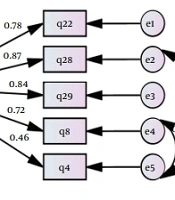
In confirmatory factor analysis, a 5-factor measurement model for the 5 constructs exhibited good factorial validity (Table 3) and confirmed the hypothesis in that item responses could be explained by the following categories, positive outcome expectancy, negative outcome expectancy, self-efficacy, and peer influence (Figure 1).
Table 3.
Model Fit Indices for First Order Measurement Model
| Variables | CMIN | df | CMIN/df | TLI | CFI | RMSEA |
|---|---|---|---|---|---|---|
| Self-efficacy | 522 | 144 | 3.6 | 0.94 | 0.94 | 0.06 |
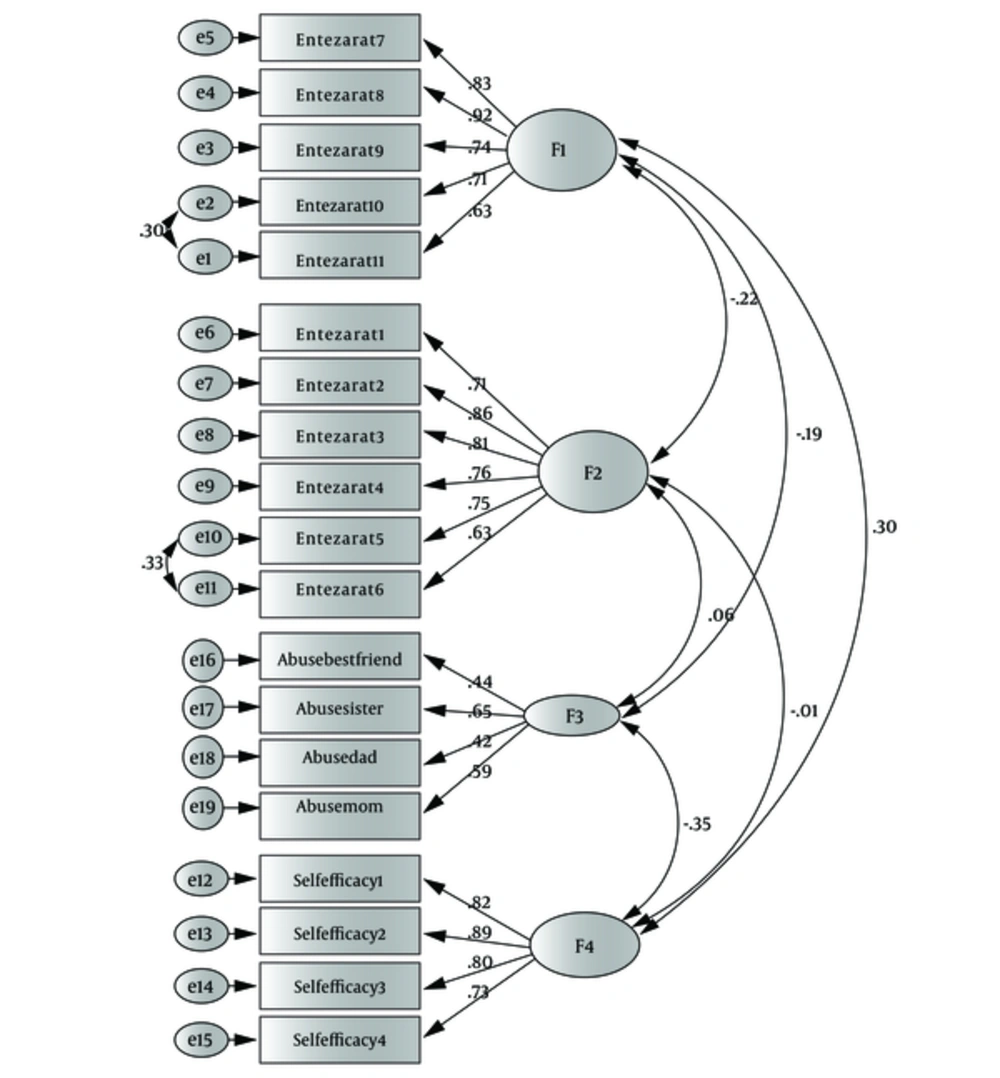
Figure 1.
F1: Positive outcome expectancy, F2: Negative outcome expectancy, F3: peer influence, F4: Self efficacy (x2 = 522, df = 144, x2/ df = 3.6, RMSEA = 0.06, CFI = 0.94, IFI = 0.94, NFI = 0.92).
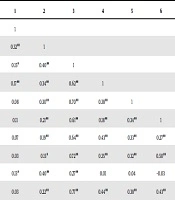
Correlation between all factors reached statistical significance (Table 4), although the correlation between positive and negative outcome expectancies with self-efficacy, peer influence, and intention did not bear a “large” effect.
Table 4.
Spearman’s Correlations Among Self-Efficacy, Positive Expectancy, Negative Expectancy, Self-Efficacy and Substance Use
| 1 | 2 | 3 | 4 | 5 | 6 | |
|---|---|---|---|---|---|---|
| Positive expectancy | 1 | |||||
| Negative expectancy | -0.16a | 1 | ||||
| Intention | -0.27a | -0.12a | 1 | |||
| Peer influence | -0.16a | 0.06 | 0.35a | 1 | ||
| Self-efficacy | 0.27a | -0.01 | 0.55a | 0.43a | 1 | |
| substance use | 0.18a | -0.14a | 0.25a | 0.40a | -0.30a | 1 |
aCorrelation is significant at the 0.01 level (2-tailed).
5. Discussion
In line with Bandura’s social cognitive theory (4, 30), this model incorporated 5 clusters of cognitive factors, including positive and negative outcome expectancies, peer influence, intention, and self-efficacy. A few studies have assessed the psychometric properties of these scales, in relevance with the substance use behaviors in Iranian adolescents. Accordingly, the purpose of the study was to assess cultural adaptation and examine the reliability, factorial validity, and predictive strength of the main construct of social cognitive theory in the substance use behaviors within a non-clinical sample of Iranian adolescents.
The translation and back-translation process was done in the first step to achieve semantic and cultural equivalence and strive for simplicity. Minor linguistic and stylistic problems were identified in the instructions, which were amended and simplified. No difficulties were found regarding the comprehension of the Persian version of questionnaire among a pilot group of adolescents. In construct validity, ceiling and floor effects were observed in none of the items and corrected item-total correlation (CITC) for all items was acceptable (31). Two items were deleted in the peer influence scale, because of the problem of normality. The EFA in the calibration sample showed appropriate loading and revealed a 23-item questionnaire with 5 factors (positive outcome expectancy, negative outcome expectancy, self-efficacy, peer influence, and intention for drug use). The factor analysis revealed that most of the items loaded substantially on the hypothesized model, in line with the original questionnaires (“European monitoring centre for drugs and drug addiction (EMCDDA)” 2012) (20).
The CFA related to the first order 5-factor measurement model in validation sample represented an acceptable fitness and confirmed construct validity, according to social cognitive theory (25). The five approved factors in this study accounted for 71.1% of the total variance, which is comparable to the standards of established models in applied psychology, and represented a clear improvement over psychological models of substance use behavior. Reliability analyses showed acceptable internal consistency and stability, which was consistent with Faggiano’s study (32).
Significant correlations among factors (Table 4) were designed to be one-dimensional measures consistent with the conceptualization of constructs within the social cognitive theory (SCT) (5) and Fishbein’s integrative model (33).
Negative and positive outcome expectancies, were found to respectively explain 26.4% and 12.2% of the variance in substance use behavior, which is similar to the percentages reported by (10% - 19%) and Goldman et al. (22%) (34). The study results showed a correlation between positive and negative outcome expectancies with other factors. This suggests that outcome expectancies may not be the most important factors contributing to substance use behavior. Nevertheless, it could be argued that positive and negative expectancies have indirectly affected substance use behavior.
According to the theories of reasoned action and planned behavior, people balance the possible pros and cons of a certain behavior and act according to the outcomes of this analysis (10). It has been suggested, though, that attitudes do not constitute the strongest predictive variable of an action, yet carry an indirect effect, affecting someone’s intent to act in a certain way (35).
Accordingly, it has been proposed that direct and indirect effects of outcome expectancy on substance use and other factors should be investigated in future studies.
Furthermore, the results of this study showed a closer correlation among negative outcome expectancy to substance use in comparison to positive outcome expectancies, which is in contrast to Forum, Alfonso and Parson’s studies (36, 37). The difference may be due to high number of non- ubstance users in the current study’s sample group. However, it is recommended to examine the relationship between positive and negative outcome expectancies of user and non-user groups in future studies.
The addition of 3 other social cognitive factor measures (self-efficacy, peer influence, and intention) nearly doubled the predictive strength of the model, adding 32.3% to the explained variance in substance use behavior, which is comparable with the standards of established models in applied psychology, and represents a clear improvement over psychological models of substance use behavior (38).
5.1. Conclusion
The results of this study showed that lower resistance self-efficacy and higher outcome expectancies were related to substance use behavior. Self-efficacy (especially resistance self-efficacy, in the case of substance use) and outcome expectancies constituted cognitive factors that according to the social cognitive theory affect substance use-related behavior.
To summarize, it has been established that overestimation of positive consequences, which is derived from substance use in comparison to negative ones, forms positive attitudes regarding use. This, combined with a sense of low resistance self-efficacy and overestimation of the number of peers, who are involved in the respective behavior, leads to intention and in turn to decision for substance use.
Finally, the results of the current study demonstrated that the present questionnaires are psychometrically appropriate for studies in Iran and have the potential to predict substance use behavior in adolescents.
5.2. Limitations
The current study had some limitations. Most significantly, the conclusions were limited by cross-sectional design use, and secondly, confidentiality could not be guaranteed since the questionnaires were completed by the public. Finally, the study relied exclusively on paper-and-pencil self-report measures. Although many of the variables are probably best measured via a self- report, there remains some concern about the validity of such measures, especially for behaviors like drinking and substance use and it would have been preferable to have a gold standard clinical interview or similar external validation measures.