
1. Background
The Internet has been found as one of the important sources of health information. Online information search is usually the beginning effort to seek diagnostic criteria and treatment of diseases (1). The internet advising system will grow as the essential means of health in the future (2). It presents an appropriate approach for improvement of health and efficient distribution of knowledge about taboo subjects, particularly in traditional cultures (3).
Sex addiction is unlike any other taboo issues and is a complicated one. It has been considered as either a guilt or a disease, depending on the religious or political viewpoint at the time (4). This uncontrollable, extreme, and problematic sexual behavior has been explained by applying several various descriptions including hypersexuality, sexual compulsion, sexual impulsivity, sexual addiction, and sexual dependency (5).
The prevalence of sex addiction is determined at around 3% to 6% of the general community, with a significantly higher proportion of males than females. High sex addiction rates are reported in special groups such as HIV affected patients and sexual offenders. Sex addiction may be more prevalent in homosexual and bisexual men (6). The private nature of sex and the stigma associated with these behaviors potentially cause these behaviors to remain hidden due to embarrassment or shame. Behaviors such as unrestricted sex living, masturbation, and sexual desire are forbidden, and according to spiritual and social perspectives, they are not moral and are judged as sinful (7).
There are few studies on sex addiction in Iran because the taboo nature of the subject (8). The prevalence rate of sex addiction and its outcomes in Iran and elsewhere is currently unknown (9). There are no FDA-approved medications for sex addiction (10). Various social barriers and limitations exist in seeking treatment for sex addiction (11). Thus, affected individuals may be further prone to explore for treating sex addiction through an internet search (12). Sex act, even if it is not complicated, is related to shame in the culture of Muslims, and the sex addicted might be less inclined to inquire therapy for sex addiction in religious cultures (13).
Anonymity associated with Internet facilitates can increase the online user’s feeling of comfort (14). Sex is the most frequently searched subject on the Internet (15). Despite the potential addictiveness of the Internet (16) and its relationship with online sexual behaviors (17), the Internet can be used for treatment related purposes toward sexual problems (18). These include the use of the Internet for seeking out sexually related websites for educational use (19), seeking out sex therapists (20), and seeking recovery in programs of anonymous self-help groups (21). Self-help groups, utilizing the Alcoholics Anonymous model (a successful support group for Alcoholism) to sexual behavior, have developed in many countries in recent years (22). sexaholics anonymous (SA) is a non-governmental organization (NGO) consisting of people whose main problem is sex (23). The members of this association share their experiences in regular open meetings and keep their recovery through 12-Steps and 12-Traditions (24).
In order to increase the hidden growing of sexual crime and help-seeking sex addicted individuals in Iran (25), it is necessary to identify the facilities that may impact treatment access amongst them. Treatment programs for sex addiction within the Iran health system remain limited (9); however, SA helps patients affected with sex addiction in Iran. Among the Muslim countries in the Middle East, Iran is the only country where SA is activated and its regular meetings are held. The 15th anniversary of SA's activities was celebrated in Iran, in 2018 (26). Despite the importance of the activation of this NGO in Iran, it is still not well known. Therefore, introduction of websites related to SA in Iran and improvement of their quality are important.
With regard to the importance of addictive disorders as well as the requirement for websites to provide up-to-date information about such disorders and inform patients how to prevent and treat them, the structure and content of these websites are extremely critical (27).
2. Objectives
The purpose of this paper was to evaluate the quality of available websites related to SA treatment and consultation about it to help identify sex addicted patients in Iran. Moreover, SA websites in Iran and other countries were compared.
3. Patients and Methods
The present descriptive cross-sectional study was designed and carried out in January, 2019. For the purpose of data collection, 42 research assistants selected from Iranian volunteer medical students in student research committees, chose websites through direct observation of each website and careful review of them. Our research assistants were medical students because they are capable of easily recognizing the content of health websites. All the respondents were routine internet users and familiar with the computer, the Internet and English language. First, for recognizing SA-related websites, Persian equivalences of four search terms (behavioral addiction, sex addiction, sex, treatment of sex addiction) were searched in Google and Yahoo because of their popularity among Iranian people. Finally, we found two Persian and four English websites related to SA.
The Website Quality Evaluation Tool (WQET) was designed to determine the overall web quality. The WQET evaluates eight criteria (content, functionality, being up-to-date, links, graphics, authority, coverage, and style) with 36 questions. In WQET, each question is scored in a scale of 1 to 7. The total score of quality was obtained from eight different criteria with scores ranging from 1 to 7 (1 - 2 weak, 3 - 4 moderate, 5 - 6 good, and 7 excellent) for the different existing sub-criteria. Three criteria including content, performance, and reliability were measured by doubling their privileges. The reason that these three criteria were doubled was that in this case, the content would refer to the content of thought, novelty and clarity of the content. Functionality means ease of use and search, and reliability refers to the credit of the creator or the backup organization.
Measuring these factors indicates the significance of the subject and the website quality experts' attention to quality. The maximum normalized scale was 82 for each website; in WQET, the lowest score is less than 50.
For the normalizing score, the following formula was used:
Score of website,
Where, X is the total score for each website and Y is the top score of one website. In addition, the normalized score was coded according to McInerney and Bird (2005). If the overall quality score of a website is between 71 - 82, the website is great and trustworthy. If the overall quality score of a website is between 64 - 70, it is acceptable and can be remembered. A website with a quality score between 57 - 63 is good but should be used cautiously. If a website has a quality score between 50 - 56, it may be useful in some cases, but the information it provides cannot be trusted without research and the website is only relatively good. Finally, a website with the score below 50 is inappropriate and its information is not sufficient and valid. The reliability of the current measurement instruments, Cronbach's alpha was 95%, shows very high reliability (28). The data were analyzed using SPSS V. 18 and Excel software. Comparisons between the variables were computed using one-way ANOVA and Duncan's multiple range test (post hoc). The level of significance was set at 0.05.
4. Results
The coding results of the six examined websites showed that “Sa.org” belonging to the SA International Central Office ranked first based on the WQET instrument. The coding results of the other websites in WQET were as follows: “Saa.recovery.org” was 81.57, “Saa.recovery.org.uk” was 80.93, “Saoz.net” was 74.75, “Sa-Iran.org” was 71.60 and “Saesfahan.ir” was 68.66. The first five websites were classified as excellent websites based on their scores, while the last website was classified as a very good website based on its score. Generally, the coding rates of the Persian websites were lower than those of their English counterparts. Figure 1 shows the ranking of the SA-related websites based on the normalized scores.
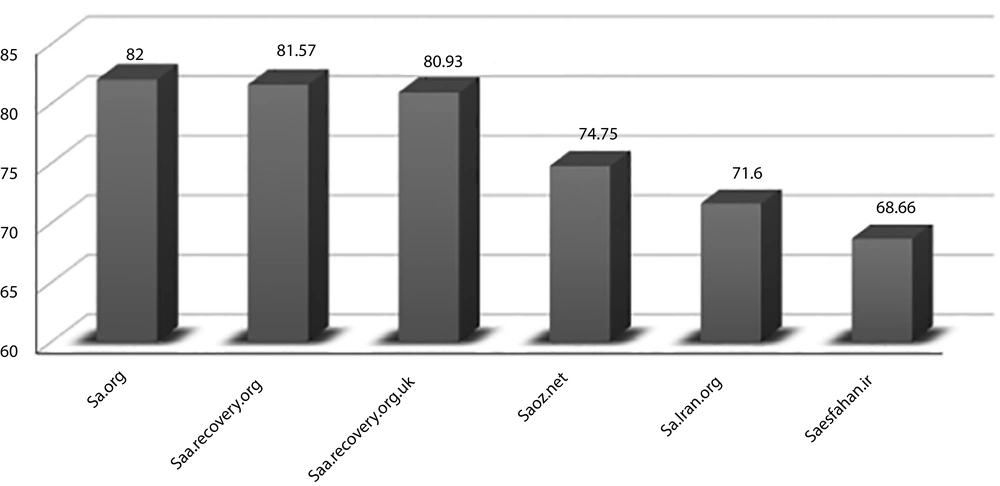
Figure 1.
Normalized scores of SA-related websites based on the WQET instrument
Since the data followed a normal distribution (based on the Shapiro-Wilks test), we used one-way ANOVA. There was no significant difference between the total quality scores of these websites (Table 1).
Table 1.
Total Scores of the Quality of the SA-Related Websitesa
| Websites | N | Mean | SD | F | P Value |
|---|---|---|---|---|---|
| Sa.org | 7 | 263.57 | 48.36 | 0.855 | 0.5210b |
| Saa.recovery.org | 7 | 262.20 | 90.13 | ||
| Saa.recovery.org.uk | 7 | 260.14 | 46.44 | ||
| saoz.net | 7 | 240.29 | 39.92 | ||
| Sa-iran.org | 7 | 230.14 | 30.88 | ||
| Saesfahan.ir | 7 | 220.71 | 50.43 |
aThe total scores and ANOVA results of the six examined websites based on the WQET scale.
bNot Significant.
Table 2 shows detailed results of the six examined websites based on the WQET instrument. A significant difference was found between the websites in terms of being up-to-date. However, no other statistically significant differences were found between the other sub-criteria.
Table 2.
Sub-Criteria Scores of the WQET Scale of the SA-Related Websitesa
| Criteria | Saa.recovery.org.ukb | Saoz.netc | Sa.orgd | Saa.recovery.orge | Sa-iran.orgf | Saesfahan.irf | F | P Value |
|---|---|---|---|---|---|---|---|---|
| Content | 71.14 ± 16.44 | 73.14 ± 16.40 | 72 ± 15.23 | 70.4 ± 19.15 | 63.14 ± 10.31 | 62.86 ± 10.20 | 0.594 | 0.705 |
| Functionality | 63.14 ± 13.20 | 54.86 ±6.48 | 62.29 ± 17.90 | 59.6 ± 19.41 | 53.71 ± 19.90 | 51.14 ± 21.53 | 0.505 | 0.771 |
| Being up-to-date | 15.36 ± 4.77 | 15 ± 3.95 | 16.14 ± 3.62 | 11.60 ± 7.60 | 8.43 ± 4.31 | 8.71 ± 4.46 | 3.829 | 0.007g |
| Links | 15.14 ± 3.33 | 12.29 ± 4.78 | 16.14 ± 3.62 | 15.2 ± 3.76 | 12.71 ± 2.43 | 12.57 ± 2.76 | 1.911 | 0.118 |
| Graphics | 23.86 ± 9.37 | 24 ± 8.90 | 31 ± 7.11 | 34.40 ± 28.89 | 28.86 ± 5.9 | 25.71 ± 5.88 | 0.721 | 0.612 |
| Authority | 38 ± 13.9 | 28.29 ± 6.77 | 30.71 ± 8.77 | 38.80 ± 12.29 | 28.29 ± 8.59 | 25.43 ± 8.22 | 1.961 | 0.110 |
| Coverage | 15.29 ± 3.03 | 14.14 ± 5.36 | 16 ± 3.91 | 13.40 ± 6.33 | 15.14 ± 4.77 | 14.14 ± 4.41 | 0.262 | 0.931 |
| Style | 17.71 ± 1.79 | 18.57 ± 2.57 | 18.86 ± 5.17 | 18.80 ± 6.30 | 19.86 ± 3.02 | 20.14 ± 3.07 | 0.381 | 0.858 |
aMean ± SD scores.
bLocation of Website: United Kingdom.
cLocation of Website: Australia.
dLocation of Website: United States and Canada.
eLocation of Website: United States.
fLocation of Website: Iran.
gSignificant differences were detected between the websites in terms of being up-to-date.
Table 3 shows comparison of the mean scores of being up-to-date from Table 2 using Duncan's multiple range test (post hoc).
Table 3.
Comparison of the Mean Scores of Being Up-to-Date Using Duncan's Multiple Range Testa
| Websites | Subset for Alpha = 0.05 | |
|---|---|---|
| 1 | 2 | |
| Sa-iran.org | 8.43 | |
| Saesfahan.ir | 8.71 | |
| Saa.recovery.org | 11.60 | 11.60 |
| saoz.net | 15.00 | |
| Saa.recovery.org.uk | 15.86 | |
| Sa.org | 16.14 | |
| Sig. | 0.264 | 0.123 |
aMeans for groups in homogeneous subsets are displayed. The harmonic mean of the group sizes is used.
5. Discussion
This is the first study to assess whether websites related to SA meet users’ information needs. The results showed that the quality of SA information on the websites was generally reliable based on the WQET instrument. The top websites were ranked as follows: www.sa.org, www.saa.recovery.org, www.saa.recovery.org.uk, www.saoz.net, www.sa-Iran.org, and www.saesfahan.ir. Internet users often do not go beyond the first page of their search results; therefore, they may overlook websites that provide high-quality information. In Google ranking of SA-related websites, the first website is www.sa.org whereas other high-quality websites are not indexed properly in Google and may be missed.
Based on the present findings, the quality of Persian SA-related websites is lower than that of English SA-related ones. Our results are in agreement with previous studies, as they showed that the mean total quality score of Persian websites on addiction was 64.57 according to the WQET instrument; therefore, the websites were ranked as “very good” on average. Lack of online services, such as chat rooms, was a restriction that reduced users’ satisfaction with Persian websites on addiction. In contrast, the scores of Persian addiction websites were low and moderate based on the Silberg and DISCERN instruments, respectively (29).
Several studies have highlighted the quality of web-based information about addiction. Evaluation of the quality of web-based information on cocaine (29), cannabis, and addiction (30) showed that the overall quality of websites for patients was weak, based on the “Health on the Net’’ (HON) and DISCERN instruments. Moreover, the quality evaluation of French websites on alcohol dependency revealed that the quality of these websites was almost poor, particularly regarding feasible therapies (31). The cause of discrepancy between our results and some previous research is the use of different tools. In fact, in recent years, many tools have become available for reviewing websites providing health information (32).
It is generally agreed that content quality is an important dimension of websites, which deals with characteristics of available information on websites. Comparison of the English websites with the Persian ones showed that the English websites obtained higher scores regarding the content sub-criterion. Many studies on consumer health information of websites showed significant drawbacks in their content, such as incomplete and inaccurate online health information. In this regard, Eysenbach et al. conducted a systematic review of characteristics of 79 studies evaluating the quality of health information on websites. Based on their findings, 70% of previous studies concluded that the quality of information on the Internet was low, 21% reported the neutral quality of information, and 9% reported more positive findings (27). The existing literature indicates that the content of online health information is hard to understand by the majority of people (33). We recruited individuals with professional medical background to evaluate the quality of SA-related websites and adjust their content with scientific data.
Our results are similar to those of previous studies, which showed major problems in updating the website information about treatments (29, 34). According to the present results, a significant difference was found between the English and Persian websites in terms of being update-to-date sub-criteria. The need for recording the date of information update is one of the most important criteria, which was neglected in the Persian SA-related websites. Generally, updating is an important facet of health information, as medical opinions and research findings evolve over time with the introduction of new treatments and information. It is important to keep patients up-to-date, especially when their condition is not well understood. Furthermore, people may assume that information available on websites is up-to-date. However, many websites do not satisfy the updating criterion. Persian SA-related websites need to document sources of their information, date of information production, and review date of online information updates.
The visual characteristics of a website, including its design and graphic content, attract users and encourage them to spend more time on the website and revisit it (30). The present findings showed that one of the strengths of English SA-related websites was the high quality of their graphic content and maps. In line with our research, Hung and Stones compared children’s eHealth design between Eastern and Western countries and reported the superiority of Western websites in terms of information design, multimedia design, and interface design; however, users’ needs were better represented in Eastern websites than in Western ones (31).
The present study had some limitations. First, it was preferable to use keywords selected by SA help-seeking patients for searching related websites, as they were not familiar with the medical terminology. Second, it was not possible to ask users about their satisfaction with the websites, since Iranian patients with SA tended to hide their problems due to fear of punishment and feeling of shame. This led to their unwillingness to participate in such studies. On the other hand, our study may be helpful as it presents a list of websites that provide the highest quality of information on SA. However, it should be noted that the Internet is continuously evolving and that the quality of websites may change over time or new high-quality websites may be developed. In future, it is recommended to determine whether culture can affect the quality of online websites and how it influences the quality assessment of these websites.
5.1. Conclusions
Based on evidence-based medicine, it is important to extend health-related websites. Moreover, it is essential to notify internet users about the quality of the information content and structure of health-related websites according to specialized quality measurement. In particular, in taboo topics such as sex, Iran as a closed religious society is not able to present sexual education, information, and guidance to its people. Anonymity while web browsing is an opportunity for Iranian people to search for their sexual problems and have freedom to express their requests and needs without embarrassment.