
1. Background
Metacognition includes knowledge, processes, and strategies that evaluate, monitor, or control cognition. Metacognitive beliefs and processes have a critical role in the formation and continuation of the concept of cognitive impairment (1). Studies showed that there is a significant positive correlation between cognitive deficiencies and performance in assignments (2, 3). Many of the foundations of online social networking sites such as Facebook and Twitter have become more and more attractive to the Internet users, causing these social networks to have quantitative and qualitative effects on people's social interactions (3).
One of the metacognitive models, within which one can study cognitive impairments, is “self-regulatory executive functions.” This model is presented to explain emotional disorders. In this model, Beck's schema theory, self-regulatory cognitive behavior and empirical studies are integrated into the process of information processing (4). Studies showed that using drugs and Internet addiction increases the likelihood of impulsivity and executive dysfunction among people (5, 6). For example, cocaine and heroin can affect memory consolidation by affecting the amygdala area (6). Given the Internet popularity increase in Iran, the number of Internet users in schools and universities is expected to reach 15 million per day. According to these statistics, more than 35% of Internet users are youth and the mean accuracy of using the Internet is 52 minutes per week, which reaches 57 minutes for 21 to 24-year-old people (7). The amount of time spent on social media sites may indicate habit formation rather than addictive features (8). Internet addiction is known as Internet troublesome to users and Internet disruption. Internet addiction and online games can affect mental health of the adolescent, and end in depression, sleep disorder, poor academic performance, low psychological well-being and loneliness. Internet addiction and online games are connected with physical health problems, overweightness, physical inactivity, musculoskeletal disorders and visual impairment (9). Moreover, excessive use of the Internet may have a negative effect on the socio-physical, psychosocial development of users (10). Studies on Internet addiction have increased drastically in recent years, since Internet use is a part of the daily lives of many people in the 21st century (11).
In our society of today, drugs have appeared as a problem or social issue (12). This social harm affects a large number of people and is increasingly in interaction with other social harms and becoming a threat to the foundation. Substance abusers lose the ability to adopt correct, rational, and fact-based behaviors without a proper understanding of their emotions (13). Over the past decades, the impact of drug abuse on cognitive abilities in addicts has been surveyed by many different clinical laboratories and basic sciences. Although it has long been known that alcoholism is associated with memory and learning deficits and appears to accelerate aging processes, the negative effects of chronic drug use on cognitive function in recent years have become evident during (14, 15).
In examining the relationship between metacognition and cognitive impairment among addicted people, Abolqasemi et al. found that components of cognitive trust and cognitive self-consciousness were the best predictors of cognitive impairment. The integration of common theoretical bases of motives for substance use and identification of substance-specific motives has promising potential for practical applications in interventions and treatment approaches (16). Investigating cognitions about the social consequences of substance use in individual social networks offers new approaches to interventions and investigating natural changes in substance use (17).
In a study comparing the cognitive and meta-cognitive abnormalities of addicted people with normal ones, Tabatabaee et al. showed a significant statistical difference between the components of cognitive impairment among addicted and healthy people. Additionally, the level of cognitive impairment was higher for addicted people compared to healthy people. In addition, meta-cognitive strategy components of thought control were less for drug addicted people compared to ordinary ones, which was statistically significant. In addition, metacognitive control strategies explain 14% of the variance of cognitive impairments of addicted people. It seems that meta-cognitive strategies of thought control have a significant role in the direction and continuation of addictive behaviors in addicted people by expediting the understanding of cognitive impairments (18).
Abuse of psychedelic drugs was associated with characteristics such as anxiety, anger, stress and concern. The results showed that metacognition may be the most important mediator of psychedelic substance abuse in people seeking treatment. Drugs and alcohol not only directly changed undesirable cognitive events, but they could affect the way the substances were used, the perception of knowledge and the transfer of less discomfort to subjects (19, 20).
By examining the role of cognitive, meta-cognitive and emotional variables in substance abuse behavior, Haji Alizadeh et al. concluded that drug abusers experienced more anxiety, depression and stress, and cognitively, more of them (compared to the control group) showed ineffective attitudes. Moreover, there was a significant relationship between four aspects of metacognition (cognitive trust, cognitive self-consciousness, positive beliefs, and beliefs related to uncontrollability of thoughts) with psychological outcomes (stress, anxiety and depression). Thus, it is possible to mediate the relationship between emotion and drug abuse through metacognition. These results may show the significant role of the meta-cognitive theory in understanding and treating substance abuse (21).
Fighting addiction calls for the recognition of all its aspects (economic, social, and so on). On the other hand, given the increasing number of Internet users in Iran, and to examine the role of cognitive impairment and meta-cognitive components in the signs of drug abuse and Internet addiction, conducting this study was essential. The main question of the study is whether the ineffective cognitive and metacognitive beliefs between drug addicted people and Internet addiction people are different from normal groups.
2. Objectives
The purpose of the study was to compare cognitive and metacognitive analysis impairments among three groups - drug addicted, Internet addicted and normal groups in uncontrollability of beliefs, positive beliefs, cognitive self-consciousness, cognitive trust, negative thoughts and cognitive impairment aspects.
3. Patients and Methods
The present research was an applied causal-comparative study. The population was composed of three groups: the first group were all undergraduate students studying at the Islamic Azad University of Varamin, Iran. The second group were all applicants with a bachelor's degree admitted to addiction clinic (self-introduced addicted soldiers deployed through the army subsidiary units to Milad Noor Kashan addiction camps), and the third group were all undergraduate students who obtained Internet scores above 50 in the Internet questionnaire.
Cohen’s formula was used to estimate the sample size in each group. According to Cohen's formula, the sample size for each group was 60, with the total sample size as 180 people in all three groups. In determining the sample size, due to the widespread population, the sample was selected randomly. Data were analyzed using one-way analysis of variance (ANOVA) and Scheffe’s post hoc applying SPSS V. 23 software at the significance level of 0.001.
3.1. Inclusion/Exclusion Criteria
Criteria for inclusion into groups:
- Undergraduate students at Varamin University for normal group and Internet addiction group
- The age range of students between 18 - 30 for all groups
- Selected individuals interested in participating in this study
- Have at least one drug addiction for drug addicted group and duration of drug addiction at least 6 months
- Students who use the Internet more than 36 hours per week for Internet addicted group.
Criteria for exclusion:
- Declare dissatisfaction to continue cooperation
3.2. Instruments
3.2.1. Metacognition Questionnaire (MCQ)
The questionnaire has 30 items. The responses are calculated according to a 4-degree Likert scale. The questionnaire has five sub-scales including positive beliefs about worries, negative beliefs about thought controllability and the dangers of concern, cognitive uncertainty, the need to control thoughts and meta-cognitive processes of cognitive self-consciousness. Its internal consistency was found in Wells' (1996) study: uncontrollability 0.84, positive beliefs 0.81, cognitive self-consciousness 0.75, cognitive trust 0.82, and the need to control negative thoughts 0.76 (22). Validity and reliability of the questionnaire were translated and performed by Shirinzadeh Dastgiri for the Iranian population (23). Cronbach's alpha coefficient for the whole scale in the Iranian sample is 0.91. For the subscales, uncontrollability, positive beliefs, cognitive self-consciousness, cognitive trust, and the need to control negative thoughts were 0.87, 0.86, 0.81, 0.80, and 0.71, respectively (24).
3.2.2. Cognitive Failure Questionnaire (CFQ)
The CFQ was created in 1982 by Broadbent et al. (25). The scale has 25 items and the subject will respond to these items at a 5-point scale (from never to ever). The questionnaire has four components: distractibility (9 items), labeled memory (7 items), blunders (7 items) and memory for names (2 items). Casale et al. in 2006 reported the Cronbach's alpha coefficient for a total scale score as 0.81 (17). In his review, Wallace et al. reported its Cronbach's alpha coefficient as 0.91, its internal consistency coefficient as 0.94 and test retest value as 0.82 (26).
3.2.3. Young's IAT
The questionnaire was developed in 1988 by Young and was widely welcomed in the field of online addiction testing (27). The questions of the test are based on DSM-IV-TR criteria for maladaptive gambling disorders, because Internet addiction is believed to resemble a gambling disorder. The questionnaire has 20 questions and determines whether excessive use of the Internet has affected the various aspects of a person's life or not. Each question has a Likert scale from 1 to 5. The reliability and validity of the questionnaire were reported by Alavi et al.: test retesting 0.82, internal consistency 0.88 and split-half 0.72, acceptable according to the results (28).
3.3. Ethical Considerations
Questionnaires were given to the samples anonymously. The participants were assured that the data from the questionnaire would be used in line with the objectives and hypotheses of the present study. Responding to the questionnaires was completely voluntary and free, so that people would quit if they did not want to participate in the research.
4. Results
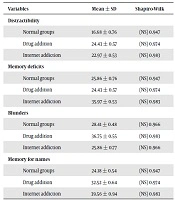
Table 1 shows the mean, standard deviation, and Shapiro-Wilk values of cognitive impairments in each of the three groups.
Table 1.
Mean and Standard Deviation, Shapiro-Wilk Values of the Components for Three Groups
| Variables | Mean ± SD | Shapiro-Wilk |
|---|---|---|
| Distractibility | ||
| Normal groups | 16.68 ± 0.76 | (NS) 0.947 |
| Drug addition | 24.43 ± 0.57 | (NS) 0.974 |
| Internet addiction | 22.97 ± 0.53 | (NS) 0.983 |
| Memory deficits | ||
| Normal groups | 25.86 ± 0.76 | (NS) 0.947 |
| Drug addition | 24.43 ± 0.57 | (NS) 0.974 |
| Internet addiction | 35.97 ± 0.53 | (NS) 0.983 |
| Blunders | ||
| Normal groups | 28.41 ± 0.48 | (NS) 0.966 |
| Drug addition | 36.75 ± 0.55 | (NS) 0.983 |
| Internet addiction | 25.86 ± 0.77 | (NS) 0.966 |
| Memory for names | ||
| Normal groups | 24.18 ± 0.54 | (NS) 0.947 |
| Drug addition | 32.52 ± 0.64 | (NS) 0.974 |
| Internet addiction | 39.56 ± 0.94 | (NS) 0.983 |
According to the results of Table 1, in all components of cognitive impairments such as distractibility, memory deficits, blunders, and memory for names, the highest cognitive impairments were related to the substance abuse group and the best performance was for the normal students.
ANOVA was used to analyze the hypothesis. Kolmogorov-Smirnov test and Levene’s test were used to test the hypotheses, which showed that data were normal and that homogeneity of variances was observed.
Table 2.
Results of Analysis of Variance (ANOVA) and Scheffe’s Post Hoc for Comparison of Uncontrollability Score in Three Groups
| Group | Mean ± SD | F | P Value |
|---|---|---|---|
| Addicted people | 24.43 ± 0.64 | 18.502 | < 0.001 |
| Internet addicted people | 19.75 ± 0.57 | ||
| Normal groups | 15.15 ± 0.53 | ||
| Scheffe’s Post Hoc Analysis | |||
| Group | Groups | Mean Difference | P Value |
| Normal groups | Addicted people | 9.28 | 0.001 |
| Internet addicted people | 4.60 | 0.001 | |
According to the results of Table 2, the level of significance is 0.001 and this value is smaller than the significance level of the criterion (P ≤ 0.01), and the F value is 18.502 and more than the table value with degrees of freedom (179 and 1). Thus, the research hypothesis regarding the difference in uncontrollability (beliefs about uncontrollable and hazardous worries) in all three groups is confirmed. The results also showed that the mean differences between normal group scores with drug addicted and Internet addicted people was significant.
Table 3.
Results of Analysis of Variance and Scheffe’s Post Hoc for Comparing the Score of Positive Beliefs in Three Groups
| Group | Mean ± SD | F | P Value |
|---|---|---|---|
| Addicted people | 18.43 ± 0.57 | 24.754 | < 0.001 |
| Internet addicted people | 21.97 ± 0.53 | ||
| Normal groups | 25.86 ± 0.76 | ||
| Scheffe’s Post Hoc Analysis | |||
| Group | Groups | Mean Difference | P Value |
| Normal groups | Addicted people | 3.89 | 0.001 |
| Internet addicted people | 7.43 | 0.001 | |
As is seen in Table 3, the research hypothesis regarding the difference in the component of positive beliefs in all three groups is confirmed. Moreover, Scheffe’s post hoc test was used to determine the difference. The results showed that the mean scores of normal groups with drug addicted people and those with Internet addiction with a significance level of 0.001 had a significant difference.
Table 4.
Results of Analysis of Variance and Scheffe’s Post Hoc for Comparing Cognitive Self-Consciousness Scores in Three Groups
| Group | Mean ± SD | F | P Value |
|---|---|---|---|
| Addicted people | 14.66 ± 0.76 | 16.544 | < 0.001 |
| Internet addicted people | 22.34 ± 0.57 | ||
| Normal groups | 29.90 ± 0.85 | ||
| Scheffe’s Post Hoc Analysis | |||
| Group | Groups | Mean Difference | P Value |
| Normal groups | Addicted people | 15.54 | 0.001 |
| Internet addicted people | 7.56 | 0.001 | |
As is seen in Table 4, the research hypothesis regarding the difference in cognitive self-consciousness in all three groups is confirmed. Moreover, Scheffe’s post hoc test was used to evaluate the difference. The results showed that the mean differences between normal group scores with addicted people and Internet addicted people was significant with a significance level of 0.001.
Table 5.
Results of ANOVA and Scheffe’s Post Hoc for Comparing Scores of Cognitive Impairments in Three Groups -Drug Addicted, Internet Addicted and Normal Groups
| Group | Mean ± SD | F | P Value |
|---|---|---|---|
| Addicted people | 84.09 ± 5.41 | 16.535 | < 0.001 |
| Internet addicted people | 76.27 ± 3.23 | ||
| Normal groups | 58.13 ± 4.73 | ||
| Scheffe’s Post Hoc Analysis | |||
| Group | Groups | Mean Difference | P Value |
| Normal groups | Addicted people | 25.96 | 0.001 |
| Internet addicted people | 18.14 | 0.001 | |
As is seen in Table 5, the research hypothesis regarding the difference in cognitive impairment in all three groups is confirmed. Moreover, Scheffe’s post hoc test was used to compare the difference between the two groups. The results showed that the mean scores of normal groups with drug addicted people and those with Internet addiction with a significance level of 0.001 had significant differences. Also, the other research results regarding the difference in cognitive trust and negative thoughts in all three groups was confirmed (P ≤ 0.01).
5. Discussion
The purpose of the study was to compare cognitive and metacognitive impairments among the three groups of addicted people, Internet addicted people, and normal groups. The results showed a significant difference in uncontrollability (beliefs about worries being uncontrollable and hazardous) among addicted people and Internet addicted people and normal groups. These results were in line with those of Wells' Meta-cognitive theory of executive performance and the contribution of thought control and cognitive self-consciousness could predict substance addiction and addiction disorder (22). In explaining the results, one can state that the people with substance addiction disorder experience emotional disturbances due to their meta-cognitive beliefs (such as meta-cognitive beliefs about controlling thoughts or negative meta-cognitive beliefs, and so on) and suffer emotional disturbance. These metacognitive beliefs make these people suffer cognitive-attentional syndrome in difficult situations. With the activation of cognitive-attentional syndrome, due to meta-cognitive beliefs, the strategies to overcome substance like addiction are activated. Hence, the context is provided for the continuation of drug dependence disorders in patients more than before. Cohen's studies showed that intellectual deficits are one of the causes for creating social and interpersonal problems, such as drug addiction and Internet addiction. Uncontrollability is a cognitive impairment including attention disorder (for example, failure in perception) and memory (recall failure) and motor function (motor deficiency). Moreover, cognitive impairments include labeled memory, distractibility, blunders, and (memory for) names (4). Moreover, the difference in positive thoughts of addicted people and Internet addicted people with normal groups was confirmed. The results are consistent with those of Shafii-Sang-Atash et al., Abolqasemi et al., Mecacci and Rigi, and Haji Alizadeh et al. (15-17, 21). Among the other results of the study were the differences between the addicted people and Internet addicted people with normal groups in cognitive self-consciousness. In explaining the above findings, based on the theory of cognitive impairment, including attention disorder (for example, failure in perception) and memory (failure in failure recall) and motor function (motor deficiency), it should be noted that cognitive impairments include labeled memory, distractibility, blunders, and (memory for) names (4). Cognitive impairment is related to how to learn tough events, short-term memory capacity, and decline in cognitive consciousness (29). The results showed that people with drug abuse and excessive Internet use get lower scores in cognitive self-consciousness. Cognitive impairment is known as failure in doing things that can normally be done in normal state. In other words, cognitive impairment is a set of cognitive errors coming from the cognitive neglect of individuals. Moreover, Martin believes it to be the cognitive failures, cognitive mistakes, or errors that a person should have the capacity to do (30).
According to the results, one can state that the combined factors “meta-cognitive beliefs”, “thought control” and “cognitive self-consciousness” are important in the vulnerability to drug addiction disorders. Thus, appropriate interventions and therapy programs can correct these meta-cognitive factors and make it possible to reduce drug addiction. It is suggested that future researchers select and sample other drug addiction centers to confirm and support these results, so that the role and contribution of meta-cognitive beliefs in drug addiction disorders and the Internet addiction can be further examined. Additionally, other important variables in drug and Internet addicted people should be measured simultaneously. Another action in later studies can be the use of longitudinal research and interventions to examine the role of ineffective meta-beliefs in the context and continuity of drug dependence or Internet disruption.
5.1. Conclusions
The purpose of the study was to compare cognitive and metacognitive analysis impairments among three groups -drug addicted, Internet addicted and normal groups. Results showed significant differences among the three groups of people - drug and Internet addicted people with normal groups -in uncontrollability, positive beliefs, cognitive self-consciousness, cognitive trust, negative thoughts and cognitive impairment aspects. The results showed that negative and automatic beliefs in drug and Internet addicted people are significantly higher than those of normal groups. The existence of such metacognitive beliefs may show differences in coping skills. Overall, disruptive meta-cognitive beliefs weaken coping skills, form cognitive interactions (unreasonable combat-behavioral beliefs), and ineffective behaviors and pave the path for drug addiction. Thus, specific cognitive interventions (e.g. challenging irrational beliefs and weakening self-efficacy of use and enhancing the self-efficacy of substance use refusal) and behavioral interventions (like the development of non-pimpairmentacological behaviors for dealing with cognitive states) can be beneficial and effective in coping with impaired beliefs for addicted people. The present study has some limitations that should be taken into account. Among these limitations was using questionnaires and the time limit in the implementation of the study. Therefore, it is suggested that the research be done in a wider time span to increase the sample size to increase the reliability of the results.