
1. Background
One of the major problems of global health is the increased prevalence of antibiotic resistance of pathogens in various human and animal populations. The main factor in increasing the resistance of pathogenic bacteria is excessive use of antibiotics, which leads to the emergence and release of resistant species and genes (1).
Nowadays, using new treatments such as herbal medicines is noticeable due to their less complications. Helicobacter can be present in the mucosal cortex of the gastric mucosa, as well as in the modified mucosa similar to the gastric mucosa that appears in the duodenum. It also has the ability to colonize in the esophagus and may play a role in wounding or inflammation (2, 3).
One of the important characteristics of this bacterium is the production of a large amount of urease enzymes. It has been shown that urea is an important virulence factor in bacteria that can contribute to colonization of the bacteria in the gastric mucus and creation of wound. Helicobacter pylori infection is a worldwide outbreak and occurs in all age groups. The prevalence of H. pylori differs from region to region, and largely depends on the general living standards in each region. Helicobacter pylori has a rotating and creeping motion, and it moves better and faster in viscous environments such as gastric mucus (4-6). H. pylori is a cause of gastritis and peptic ulcer disease and a risk factor for gastric cancer and lymphoid B-cell lymphoma in the gastric mucous membrane (7).
Infection with this bacterium has a high prevalence. In some countries, 69% of people in the age range of 16 - 69 years and 79.2% of people in the age range of 46 - 55 years are infected with H. pylori (8, 9). Although the transmission route is not known accurately, the bacteria are transmitted through the use of unwashed or uncooked vegetables whose soil is fed with human stools or through contaminated water and even tooth and mouth plaques (8, 9).
Using multiple antibiotics increases the amount of removal and reduces the risk of resistance (10). The dosage of antibiotics used to treat H. pylori is more than that used for other infections (11).
Antibiotics, inhibitors of gastric acid secretion, H2 blockers, and bismuth salts are the drugs of choice in the treatment of H. pylori, which are used in combination. However, despite the existence of drug treatments, the eradication of this bacterium is still a serious challenge, so that the failure rate of the mentioned treatments due to drug resistance is 5% - 20%. Furthermore, despite the complete cure of the disease, it recurs in many cases (12-14).
Glycosylated is one of the oldest medicines Abu Ali Sina has included in his book with a lot of therapeutic properties. The most important ingredient in licorice is glycyrrhizin; and glycosylated from saponins is 50 times sweeter than sugar. It is soluble in water and alcohol in high amounts, and its amount is intermittent and depends on the type of plant and climatic conditions of the growing area (15, 16).
A glycosylated decoction is used in the treatment of neurological cough, inflammation of the teat, colic, constipation, gastritis, gastric and duodenal ulcers, air swallow, intestinal bloating, and intestinal spasm (17).
Salvia officinalis, from the mint family, is an herbaceous plant with straight stems about 80 - 50 cm high. The leaves of this plant are opposite and light green. The flowers are bluish purple, pink, or sometimes white, grouped in the upper parts of the stem and spaced apart. The scientific name of this plant is derived from the Latin word salvara meaning healing, which refers to the many medicinal properties of this plant. This plant is the most valuable type of dark peppermint medicine (18, 19)
Some compounds S. officinalis include essential oil (alpha and beta thujone, cineole, camphor, salviatannin, etc.), flavonoids (apigenin, luteolin, genkwanin, etc.), terpenoids (ursolic acid, picrosalvin, rosmanol, safficinolide, etc.), and phenolic acids (rosmarinic acid, chlorogenic acid, ferulic acid, caffeic acid, etc.) (18, 19).
2. Objectives
The purpose of this study was to isolate H. pylori strains and investigate the antimicrobial effects of ethanol extracts of G. glabra and S. officinalis on them.
3. Methods
3.1. Collection, Identification, and Extraction of Ethanolic Extract
Fresh leaves of G. glabra and S. officinalis plants (Figure 1) were collected from Zabol City in Iran and identified by a botanist from the University of Zabol. The powder of the plant leaf was mixed with organic solvents of ethanol (100%) and stirred regularly for 24 h in a shaker incubator. Watman paper no.: 1 was used to remove large plant parts, and the resulting solution was transferred to a rotary machine to remove excess solvent. The solution was then incubated at 40°C for 48 to 72 h to obtain a dry powder from the extract. This powder was stored in dark glass containers at -4°C until use (20).
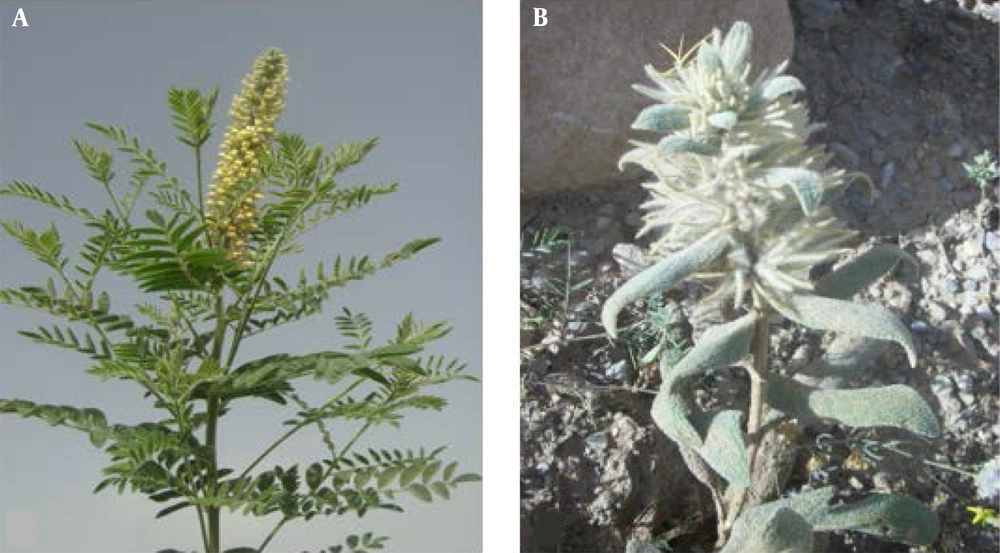
Figure 1.
Appearance characteristics of Glycyrrhiza glabra (A) and Salvia officinalis (B) plants
3.2. Isolation of Helicobacter pylori
A cross-sectional study was performed. A biopsy was obtained from the endometrium of the stomach with endoscopy. The necessary equipment and environments were transferred to the endoscope. The culture of biopsy specimens was carried out on Columbia enriched agar, with 5% sheep blood, 7% serum, vancomycin, and trimethoprim under microaerophilic conditions at 37°C. Suspected colonies of H. pylori were tested for biochemical oxidase, catalase, and urease.
3.3. Pattern of Drug Resistance
Disc diffusion method was used to determine the sensitivity of isolated H. pylori to antibacterial compounds. First, the colonies were transferred to McFarland’s 0.5 Muller Hinton fluid. Then, they were cultured on a culture medium of enriched Muller Hinton agar with 7% sheep blood, and at the same time, antibiotic-containing disks purchased from Padtan Teb Company were placed on the medium. After 5 days of incubation at 37°C and microaerophilic conditions, the diameter of the H. pylori non-growth inhibition was determined. Four antibiotic disks, including metronidazole, tetracycline, amoxicillin, and clarithromycin were used to test the antibiogram.
Unfortunately, we could not use the standard strain of H. pylori due to shipment problems. Although we re-ordered and later received healthy samples, we no longer used the standard sample because the conditions of the test were different.
The minimum inhibitory concentration (MIC) and minimum bactericidal concentration (MBC) of plant ethanolic extracts were determined against H. pylori
4. Results
In this study, 50 (62.5%) samples of H. pylori were detected from 80 biopsy specimens. The results showed that 30 (60%) cases were metronidazole-resistant, 15 (30%) were amoxicillin-resistant, 12 (24%) were tetracycline-resistant, and 2 (4%) were clarithromycin-resistant.
The results of G. glabra plant ethanolic extract showed that the lowest MIC against H. pylori was 3.1 mg/mL (five strains were inhibited), while the highest MBC was equal to 100 mg/ms (six strains were inhibited).
The lowest lethal concentration was equal to 0.62 mg/mL, in which four strains were killed, while the highest lethal concentration was equal to 200 mg/mL, in which one strain was killed in this concentration (Table 1).
Table 1.
MIC/MBC Ethanolic Extract of Glycyrrhiza glabra against Helicobacter pylori
| Bacterial Code | MIC/MBC | Bacterial Code | MIC/MBC |
|---|---|---|---|
| 1 | 12.5 - 25 | 26 | 3.1 - 6.25 |
| 2 | 50 - 100 | 27 | 100 - 100 |
| 3 | 6.25 - 12.5 | 28 | 3.1 - 6.25 |
| 4 | 50 - 100 | 29 | 12.5 - 25 |
| 5 | 25 - 50 | 30 | 12.5 - 25 |
| 6 | 12.5 - 25 | 31 | 6.25 - 12.5 |
| 7 | 100 - 100 | 32 | 50 - 100 |
| 8 | 6.25 - 12.5 | 33 | 25 - 50 |
| 9 | 6.25 - 12.5 | 34 | 12.5 - 25 |
| 10 | 25 - 50 | 35 | 3.1 - 6.25 |
| 11 | 12.5 - 25 | 36 | 6.25 - 12.5 |
| 12 | 12.5 - 25 | 37 | 6.25 - 12.5 |
| 13 | 100 - 100 | 38 | 12.5 - 25 |
| 14 | 12.5 - 25 | 39 | 100 - 100 |
| 15 | 12.5 - 25 | 40 | 6.25 - 12.5 |
| 16 | 6.25 - 12.5 | 41 | 100 - 100 |
| 17 | 3.1 - 6.25 | 42 | 3.1 - 6.25 |
| 18 | 12.5 - 25 | 43 | 12.5 - 12.5 |
| 19 | 50 - 100 | 44 | 25 - 50 |
| 20 | 6.25 - 12.5 | 45 | 6.25 - 12.5 |
| 21 | 50 - 100 | 46 | 100 - 200 |
| 22 | 50 - 100 | 47 | 12.5 - 25 |
| 23 | 12.5 - 25 | 48 | 50 - 100 |
| 24 | 25 - 50 | 49 | 50 - 100 |
| 25 | 12.5 - 25 | 50 | 6.25 - 12.5 |
The results of S. officinalis plant ethanolic extract showed that the lowest MIC against H. pylori was equal to 3.1 ppm (12 strains were inhibited), while the highest MBC was 50 ppm (one strain was inhibited) (Table 2).
Table 2.
MIC/MBC Ethanolic Extract of Salvia officinalis Against Helicobacter pylori
| Bacterial Code | MIC/MBC | Bacterial Code | MIC/MBC |
|---|---|---|---|
| 1 | 12.5 - 25 | 26 | 3.1 - 6.25 |
| 2 | 50 - 100 | 27 | 12.5 - 25 |
| 3 | 6.25 - 12.5 | 28 | 3.1 - 6.25 |
| 4 | 3.1 - 6.25 | 29 | 12.5 - 25 |
| 5 | 3.1 - 6.25 | 30 | 12.5 - 25 |
| 6 | 12.5 - 25 | 31 | 6.25 - 12.5 |
| 7 | 6.25 - 12.5 | 32 | 6.25 - 12.5 |
| 8 | 3.1 - 6.25 | 33 | 12.5 - 25 |
| 9 | 6.25 - 12.5 | 34 | 3.1 - 6.25 |
| 10 | 3.1 - 6.25 | 35 | 3.1 - 6.25 |
| 11 | 12.5 - 25 | 36 | 6.25 - 12.5 |
| 12 | 6.25 - 12.5 | 37 | 6.25 - 12.5 |
| 13 | 12.5 - 25 | 38 | 12.5 - 25 |
| 14 | 12.5 - 25 | 39 | 12.5 - 25 |
| 15 | 6.25 - 12.5 | 40 | 6.25 - 12.5 |
| 16 | 6.25 - 12.5 | 41 | 6.25 - 12.5 |
| 17 | 3.1 - 6.25 | 42 | 3.1 - 6.25 |
| 18 | 12.5 - 25 | 43 | 12.5 - 12.5 |
| 19 | 12.5 - 25 | 44 | 3.1 - 6.25 |
| 20 | 6.25 - 12.5 | 45 | 6.25 - 12.5 |
| 21 | 6.25 - 12.5 | 46 | 12.5 - 25 |
| 22 | 6.25 - 12.5 | 47 | 12.5 - 25 |
| 23 | 12.5 - 25 | 48 | 6.25 - 12.5 |
| 24 | 3.1 - 6.25 | 49 | 6.25 - 12.5 |
| 25 | 12.5 - 25 | 50 | 6.25 - 12.5 |
5. Discussion
Glycosylated is a well-known plant in the treatment of inflammation and gastrointestinal ulcers. The effect of this plant in the treatment of gastrointestinal disorders is due to its anti-inflammatory effects and anti-H. pylori properties (21, 22).
Due to the biological effects of this plant, a large amount of the plant is harvested annually from different areas of Iran and exported to other countries. In the central and southern regions of the country, the plant is on the verge of extinction, and the attention of producers has been focused on the northern and northwestern regions of the country.
Since one of the major uses of the plant is its anti-H. pylori properties, so it is important to study the best habitat of the plant. In our study, 30 (60%) cases were metronidazole-resistant, 15 (30%) were amoxicillin-resistant, 12 (24%) were tetracycline-resistant, and 2 (4%) were clarithromycin-resistant.
In most studies in Iran, resistance is reported to be between 60% and 70% for metronidazole (23). The rate of resistance to metronidazole, amoxicillin, clarithromycin, and furazolidonein in H. pylori isolates was 95%, 35%, 71%, and 54.16%, respectively (24, 25). The rate of resistance to metronidazole and clarithromycin was 72.6% and 64%, respectively, in H. pylori (26). The results of a study by Megraud (27) showed that resistance to amoxicillin is either depleted or less than 1%, indicating that no problem has yet arisen, and resistance to tetracycline is very low or not even high in most countries (27, 28).
Other cases have been reported in Spain (0.7%), the UK (0.5%), and Hong Kong (0.5%) but also at a higher rate (5.3%) in Korea (11). The spread of H. pyloric resistance to metronidazole varies from 20% to 40% in Europe and the United States, with one exception in northern Italy (29). In contrast, the spread rate in Japan is very low (9% - 12%) (30).
It is well known that the spread of this disease is 50% - 80% in developed countries, for example 76.3% in Mexico (31). The predominance of H. pylori protection to metronidazole varies from 20% to 40% in Europe and the USA, with one difference in Northern Italy (14.9%) (29). The overall resistance of metronidazole in Europe was 33.1%, with no significant variation in northern and southern Europe. However, a significantly lower prevalence occurred in Central and Eastern Europe (31). There is a higher spread in developed countries, for example, 50% - 80% in Mexico (76.3%) (32). The spread of metronidazole perseverance is lower in Japan (9% - 12%) (33), and the spread of the disease in Canada is between 18% - 22% (33).
O’Connor’s study examined 2,028 patients, 98 of whom were women. The results showed that in 219 patients, colonies that were cultured were identified. Thirty-seven previous targets in the treatment of eradication. O’Connor’s study examined 2,028 patients, 98 of whom were women. The results showed that a total of 31.5% of the patients had strains resistant to metronidazole (MTZ), and 13.2% of the patients were noted to have strains resistant to clarithromycin (CLA). About 8.6% of the patients had strains resistant to both the agents. Clarithromycin (CLA) resistance was 9.3% in those who had no prior eradication therapy compared with 32.4% of those who had. Clarithromycin (CLA) resistance increased from 3.9%, among treatment-naive patients in 1997, to 9.3% in our study. Metronidazole (MTZ) resistance was 29.1% in the treatment-naive population. In 1997, metronidazole (MTZ) resistance in the treatment-naive cohort was 27.1%. Metronidazole (MTZ) resistance was more likely to occur in females (35.4 vs. 28.5%) than in males (34).
The antibacterial and synergistic properties of Zataria multiflora, Salvia verticillata, and Froriepia subpinnata ethanolic extracts on caries-causing bacteria have been investigated and it has been concluded that the MIC for aloe vera extract was 3.12 - 6.25 mg/mL, purple sage extract was 3.12 - 25 mg/mL, and for pomegranate extract was 12.5 - 25 mg/mL. Examination of the inhibitory effects of the extracts showed that, in general, Zataria multiflora extract had stronger antibacterial properties than purple sage and pomegranate extracts, and Pectobacterium showed more sensitivity to Pseudomonas. Fractional inhibitory concentration (FIC) study showed that in the studied bacteria, the combined use of purple sage extract and pomegranate extract had better results than other combined extracts (35). In the present study, S. officinalis had better results than G. glabra.
5.1. Conclusions
The results of current study showed that anti-H. pylori activity was related to licorice ethanolic extract. According to the findings of this study, investigating the effect of diet on patients with H. pylori infection is important.