1. Background
Toxoplasma (T.) gondii is a member of Apicomplexa (1). It is an obligate intracellular parasite and proliferates inside host cells as well as macrophages (2). Toxoplasma gondii infects more than 60% of the population worldwide (3). It can infect almost all warm-blooded creatures such as, human, animals, birds and marine mammals (4). Toxoplasma gondii is able to pass both sexual and asexual parts of its life cycle in feline (cat) as the final host, and a wide spectrum of warm-blooded vertebrate hosts including humans as intermediate hosts (5). The parasites pass through the placenta, blood transfusions, infected needles, vegetables contaminated with oocysts and undercooked meat and its’ products (6). Increased human contact with domestic animals and wildlife can raise Toxoplasma infections. Interestingly, due to infection in marine mammals, toxoplasmosis is a prevalent water-borne disease in humans around the world (7, 8). About 38 strains of T. gondii have been isolated from different hosts around the world, amongst them, 10 strains have been pathogenic with basically the same genotype (9). Toxoplasma gondii has three genetic lineages namely; type 1, 2 and 3, type 2 being more common in human infections (10). It can cause opportunistic infections in humans and animals, yet in immunocompetent individuals almost all infections are asymptomatic infections. Toxoplasma gondii is the third major cause of food-related deaths in the United States (11). Leishmaniasis caused by a protozoan parasite of the genus Leishmania belongs to the family of trypanosomatidae. It inoculates to the skin by the bite of infected Phlebotomine sand fly (12). More than 20 different species of the genus Leishmania are known pathogens for humans (13), and about 90% of CL in the world is caused by Leishmania major. Almost all cases occur in Afghanistan, Iran, Iraq, Sudiaarabia, Syria, Algeria, Brazil and Peru (14).
2. Objectives
The main objective of the present study was to determine whether there is any correlation between these two protozoan infections and the intensity of the high prevalence of co-infection.
3. Methods
All the case and control samples (80 individuals) were collected from suspected patients that had referred to the Isfahan dermatology and Leishmaniasis research center from August to November 2014. About 2 mL of venipuncture blood was taken from each case and control group members, serum was separated and stored at -20°C until the enzyme linked immunosorbent assay (ELISA) tests for detecting the anti -T. gondii specific IgM and IgG antibodies. The anti-Toxoplasma specific IgM and IgG were assessed using ELISA kits (EUROIMMUN, Lubeck, Germany). The procedure was performed according to the manufacturer’s protocol.
3.1. Statistical Methods
Logistic Regression and Chi square statistical methods for analysis were performed by the SPSS 16 software.
4. Results
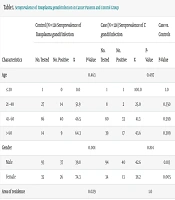
Various statistics derived from the data are presented in Tables 1 - 3. Overall, 27 (33.8%) cases in the control group and 33 (41.3%) patients with CL were positive for Toxo-IgG. The seroprevalence of Toxo-IgG was not significantly different between the two case and control groups (P = 0.414). In Toxo-IgG positive cases, including 28 (35%) males and 32 (40%) females, there was no significant difference between different genders (P = 0.624). All subjects were found to be Toxo-IgM negative. The logistic regression analysis showed that there was no significant relationship between the IgG positivity (P = 0.638, OR = 0.868) and age (P = 0.678, OR = 0.997) and gender (P = 0.437, OR = 0.788) in the control group and CL patients. In this study, the mean age of Toxo-IgG positive patients was 33.13 ± 13 years and in case of Toxo-IgG negative, the mean age was 26.8 ± 10 years.
Table 1.
The Correlation Between Toxoplasma gondii IgG and Gender in Patients with Cutaneous Leishmaniasis
| CL Patients | Total | ||
|---|---|---|---|
| Positive (N) | Negative (N) | ||
| Toxo*IgG* | 33 | 47 | 80 |
| Gender | |||
| Male | 15 | 25 | 40 |
| Female | 18 | 22 | 40 |
| Control Group | Total | ||
|---|---|---|---|
| Positive (N) | Negative (N) | ||
| Toxo*IgG* | 27 | 53 | 80 |
| Gender | |||
| Male | 13 | 27 | 40 |
| Female | 14 | 26 | 40 |
Abbreviation: N, number.
aP ≤ 0.05 is significant.
bP value (Toxo*IgG*) = Chi square = 0.414; P value (Toxo*IgG*) = Logestic Regression = 0.638; P value (Gender) = Chi square = 0.624; P value (Gender) = Logestic Regression = 0.437.
Table 3.
| Age Group | CL Patients Group | Control Group | ||
|---|---|---|---|---|
| Toxo-IgG | Toxo-IgG | |||
| Positive | Negative | Positive | Negative | |
| 5 - 14 | 0 | 4 | 0 | 4 |
| 15 - 24 | 8 | 12 | 5 | 15 |
| 25 - 34 | 9 | 15 | 7 | 13 |
| 35 - 44 | 9 | 10 | 8 | 12 |
| 45 - 54 | 6 | 7 | 7 | 9 |
aP ≤ 0.05 is significant.
bP value (age) = Logestic Regression = 0.678.
5. Discussion
The average seroprevalence of toxoplasmosis is about 36% in Iran. It spreads with maximum and minimum seropositivity for serum anti Toxoplasma IgG with 70% in northern and 15% in southeastern regions of Iran, determined using the ELISA technique, respectively. This is about 45% in Isfahan city Iran (15). Isfahan has been the most important location for zoonotic CL in Iran. These highly prevalent toxoplasmosis and CL, suggest that there is a probable relationship between these two prevalent parasitic protozoan infections (16).
The present study was designed and conducted to assess any positive or negative probable relationship between the two current and important parasitic diseases in Isfahan.
There are many documents and reports on the interaction and co-infections of two or more parasitic infections in the literature for example, a study on co-infection of T. gondii and Toxocara spp. conducted by Jones, that found a positive correlation between Toxocara spp. and T. gondii seroprevalence (17). In another study it was shown that there is a significant direct relationship between the high prevalence of Toxoplasma infection and schizophrenia (18). There are some studies on T. gondii as a risk factor for some other infective and even non-infective diseases due to the opportunistic property of this parasite. In a study performed by Shirbazou et al. they investigated the role of T. gondii as a risk factor for diabetes due to presence of toxoplasma in pancreatic beta cells and their distraction. They found that the prevalence of anti-Toxoplasma IgG antibodies in people with diabetes is about 2 times higher compared to healthy controls (19). Mohraz showed the high risk of toxoplasmic encephalitis in patients with Acquired Immunodeficiency Syndrome (AIDS) due to co-infection of T. gondii and Human Immunodeficiency Virus (HIV) in these patients in Iran (20). In another study by Sundar, he showed a significant positive correlation between kala azar and toxoplasmosis in India (21). In a research, conducted in Norway by Kapperud, he found that T. gondii is a risk factor for miscarriage in pregnant women (22). Romano showed that people with Chlamydia trachomatis infection get better after infection with T. gondii due to consumption of cholesterol by Toxoplasma, which is essential for Chlamydia trachomatis (23). In some, studies the seroepidemiology of Toxoplasma infection with some other parasitic infections was evaluated. In a study by Cardia et al. in Brazil on the prevalence of IgG antibodies against Toxoplasma in cats with seropositivity to CL, a relationship was found with the cats’ age and race (24). In another study conducted in Santiago, on mice with and without T. gondii infection, it was demonstrated that CL infection was lower in non-infected mice and they had a longer life (25). Although our research results didn't show a relationship between the two parasitic protozoan infections, we don't refuse the presence of a probable relationship between these two infections. This may indicate the need for more samples, and consideration of some side agents as the Leishmania and Toxoplasma species and the time post infection in CL patients. Therefore, we recommend a new study with more individual patients. In addition, we should control other agents, which may interfere with the results.
Our findings showed that there isn’t any significant relationship between the prevalence of toxoplasmosis and cutaneous Leishmaniasis. Furthermore, the prevalence of Toxoplasma antibodies in patients with cutaneous Leishmaniasis by age and gender was almost equal and a relationship was not found.