1. Background
The Fusarium oxysporum that is one of the most important Fusarium species does not show sexual reproduction. Crown and root rot caused by these fungi are reported (1). The species were isolated from several European countries, Asia, Africa and North America (2). In Iran, for the first time in 1964, the causal agent was isolated from melon in Mashhad (3). Although the fungi is an option, due to practical difficulties including non-target effects, high cost and environmental and health threatening risks, it is not at least always preferred (4). The growing popularity of organic production requires the development and adoption of other methods to control fungi diseases.
Iran has a long history of traditional medicine with recent academic facilities. At present, there is little evidence on the antimicrobial properties of herbal medicines under review against F. oxysporum.
2. Objectives
The current study aimed to investigate the potential antifungal activity of aqueous extracts of herbal medicines collected from Sistan region, Iran, against F. oxysporum to verify possible inhibitory effects.
3. Methods
3.1. Plant Material
Different herbal tissues of various species used in traditional medicine (Table 1) were collected from Sistan region, Iran, in 2016.
Table 1.
List of Herbal Medicines Used in the Research
| Species | Family | Organ Used |
|---|---|---|
| Mentha spicata | Lamiaceae | leaf |
| Glycyrrhiza glabra | Fabaceae | leaf |
| Rosmarinus officinalis | Lamiaceae | leaf |
| Peganum harmala | Zygophyllaceae | leaf |
3.2. Preparation of Plant Extracts
After collecting the plants, they were dried at 25°C. To prepare the extracts, 10 g dry powder of the plants was placed in a liter flask containing 100 mL of 96% ethanol. Extracts of Peganum harmala, Glycyrrhiza glabra, Mentha spicata and Rosmarinus officinalis were prepared using a rotary device (5).
3.3. Fungal Strain
3.4. Minimal Inhibitory Concentration and Minimum Fungicidal Concentration
A microplate method was utilized to determine MIC values of the herbal extracts (8). The extracts were diluted ranging from 1/1 to 1/64 of crude extract. In each well, 100 microliters of each dilution of the extract with 10 microliter of the spore suspension (1 × 10⁶ mL-1 spores) were mixed. Microplates were incubated for 72 hours at 28°C. The MIC was measured by microplate reader at 595 nm and was determined by comparing the growth in the control wells. The MIC was defined as the lowest concentration of the extract that inhibits the growth of more than 90% at 72 hours as compared to that of the control.
4. Results
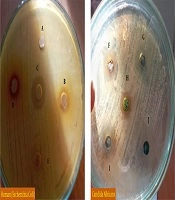
The effect of different concentrations of herbal extracts on F. oxysporum is summarized in Table 2. Thirteen ethanol extract dilutions (ranging from 1/1 to 1/32) inhibited the growth of F. oxysporum more than 90%. The ethanol extract of G. glabra performed in 1/32 dilution showed growth inhibition at low concentrations.
Table 2.
Antifungal Activity of Various Dilutions of Ethanolic Herbal Extractsa
| Plant Species | Ethanolic Herbal Extract | ||||||
|---|---|---|---|---|---|---|---|
| 1/1 | 1/2 | 1/4 | 1/8 | 1/16 | 1/32 | 1/64 | |
| Peganum harmala | + | + | - | - | - | - | - |
| Glycyrrhiza glabra | + | + | + | + | + | + | - |
| Menthaspicata | + | + | - | - | - | - | - |
| Rosmarinus officinalis | + | + | + | - | - | - | - |
a+, growth inhibition ≥ 90%; -, growth inhibition < 90%.
MIC and MFC were performed for ethanol extract of each of the two species. Table 3 shows MIC and MFC of active herbal extracts. Of the total extracts, four showed inhibitory effects on fungi and two showed no activity.
MIC values ranged 6.25 - 50 ppm and MFC values ranged 12.5 - 100 ppm. The ethanol extract of G. glabra showed the lowest MIC (6.25 ppm), while the ethanol extract of R. officinalis had the highest MIC (50 ppm). MBC of the alcoholic extract of G. glabra had the highest inhibitory effects on F. oxysporum at 12.5 ppm (Table 3).
Table 3.
Minimal Inhibitory Concentration and Minimum Fungicidal Concentration of Ethanolic Herbal Extracts Against Fusarium oxysporuma
| Plant Species | MIC | MFC |
|---|---|---|
| Peganum harmala | 100 | Nf |
| Mentha spicata | 100 | Nf |
| Glycyrrhiza glabra | 6/25 | 12/5 |
| Rosmarinus officinalis | 50 | 100 |
a-, no inhibitory activity; Nf, no fungicidal activity.
5. Discussion
The antifungal effects of G. glabra extract, and its active constituent glabridin, on antibiotic-resistant Candida albicans species were studied in different studies (9). The current research showed antifungal effects of G. glabra extracts on C. albicans species. The inhibitory effects of glycyrrhetinic acid derived from G. glabra on Candida spp. were evaluated in different studies and the results showed the efficiency of the combination (10). The researches indicated that G. glabra can inhibit the growth of Aspergillus parasiticus and prevent the production of aflatoxin (11). Another research reported that the methanol extract of G. glabra had high fungicidal effects on Chaetomium funicola and Arthrinium sacchari (12).
In addition, Glycyrrhiza species include glycyrrhizin, which prevents protein synthesis in bacteria (13). A study indicated the antipseudomonal activity of G. glabra and one of its compounds (14). The inhibitory effect of G. glabra on Helicobacter pylori was studied in-vitro and indicated that it can have effects similar to those of metronidazole (15). Another research also indicated the inhibitory effects of G. glabra extract on H. pylori (16). Some Glycyrrhiza species, e g, G. glabra, inhibit the growth of some Gram-negative bacteria such as Shigella spp. and Salmonella spp. (17). Glycyrrhizin also showed anti-viral and anti-tuberculosis properties (18, 19).
5.1. Conclusion
The results of the current research showed antifungal activities of herbal medicines against F. oxysporum. In particular, G. glabra extract presented bioactive compounds effective to inhibit the growth of F. oxysporum.