
1. Background
Familial Mediterranean fever (FMF) is an autosomal recessive disorder characterised by recurrent fever, peritonitis, pleuresy, and arthritis, which occur as a result of the inflammation of serous membranes (1). The most severe complication of the disease is amyloidosis and renal failure that occur as the patient ages (2). The clinical process can be controlled with early diagnosis of the disease. However, it is not easy to diagnose FMF disease since there are no significant clinical symptoms (3). The disease is prevalent among non-Ashkenazi Jews, Arabs, Armenians, Turks, and other societies of the Mediterranean origin, as well as non-Jewish Caucasians, Indians, and Chinese (4, 5). Three hundred and seventeen mutations and polymorphisms have been determined so far with regard to FM (6). The FMF distribution ratio in Anatolia is approximately 1/400. The most widespread mutations among Turks are M694V, M680I, V726A, R761H, and E148Q (7). The disease symptoms mostly emerge before the age of 20, and the period of attack varies between 12 and 72 hours. There are no symptoms between the attacks, but inflammation may continue (8). The gene that causes familial Mediterranean fever was first defined in 1997. International and French FMF organizations have reported that the gene that codes the pyrin/marenostrin protein in the 16th chromosome is related to FMF. The gene that causes familial Mediterranean fever was defined as the Mediterranean Fever (MEFV) gene. Organizations have reported that M694V, M694I, M680I, and V726A mutations exist in 85% of the patients (9, 10). Studies on the FMF mutation type and carrier frequency carried out in different regions of Turkey have shown that mutation frequencies differ. In this study, we aimed to assess the distribution and frequency of genetic mutations and the relationship between clinical findings and mutation in patients in the 1 - 17 years age group whose genetic analysis and the pre-diagnosis of FMF were performed in the Marmara region of Turkey.
2. Methods
2.1. Study Population
This retrospective single-centre study was carried out in a training and research hospital for child health and diseases clinic in Istanbul. Of those whose data could be retrieved, 150 patients, among 253 patients who applied to the child health clinic between August 2013 and August 2015 and whose MEFV gene mutation analysis was carried out were included in the study. The MEFV gene mutation analysis results of the patients were scanned retrospectively. In mutation analyses using multiplex polymerase chain reaction (PCR), it was observed that exon 2 v 10 of the MEFV gene was amplified. The mutations were termed heterozygous, homozygous, and compound and complex heterozygous. Heterozygous patients were confirmed by sequence analysis. Exons 2, 3, 5 and 10 were sequenced by using GML SeqFinder Sequencing System MEFV kit with Sanger sequence technology.
The patients’ age, gender, presenting complaint, age of the complaint onset, the age at which the disease was diagnosed, whether they received treatment, complaints of mother, father and sibling, kinship level of the mother and father, and the hometown of the parents were taken from the files and recorded in the forms. The Tel-Hashomer criteria were used in the diagnosis of FMF. A definite diagnosis can be made in the presence of two major criteria or one major together with two minor criteria, while a possible diagnosis can be made in the presence of one major and one minor criterion (11).
2.2. Statistical Analyses
The NCSS (number cruncher statistical system) 2007 (Kaysville, Utah, USA) software was used for the statistical analyses. When assessing the study data, the conformity of qualitative data to normal distribution in addition to descriptive statistical methods (mean, standard deviation, frequency, percentage, minimum, maximum) were tested using student t-test. Statistical significance was accepted as P < 0.05.
3. Results
The age range of the cases was 1 - 17, with an average of 9.37 ± 4.43 years; the average age of the complaint onset was 8.77 ± 4.20 years. Of the cases, 52% (n = 78) was female and 48% (n = 72) male. The demographic characteristics of our patients are summarised in Table 1. The distribution of homozygous, heterozygous genes, and the allele frequency of patients are shown in Table 2, and the descriptive properties according to genetic mutation of patients are summarized Table 3.
Table 1.
Demographic Characteristics of the Patients
| Variables | Min-Max | Mean ± SD |
|---|---|---|
| Age, y | 1 - 17 | 9.37 ± 4.43 |
| Age at complaint onset, y | 1 - 17 | 8.77 ± 4.20 |
| No. | % | |
| Gender | ||
| Female | 78 | 52.0 |
| Male | 72 | 48.0 |
| Consanguinity | 35 | 23.3 |
| Patient complaints | ||
| Abdominal pain | 67 | 44.7 |
| Arthralgia | 30 | 20.0 |
| Fever | 25 | 16.7 |
| Chest pain | 2 | 1.3 |
| Other | 30 | 20.0 |
| Those who received treatment | 19 | 12.7 |
| Mutation (+) | 90 | 60.0 |
Table 2.
Distribution of Homozygous, Heterozygous Genes and Allele Frequency
| Mutation | Heterozygous | Homozygous | Number of Alleles | Allele Frequency | ||
|---|---|---|---|---|---|---|
| No. | % | No. | % | |||
| M694V | 24 | 29.3 | 3 | 37.5 | 30 | 21.9 |
| M680I(G/C) | 4 | 4.9 | 0 | 0 | 4 | 2.9 |
| V726A | 7 | 8.5 | 0 | 0 | 7 | 5.1 |
| R202Q | 39 | 47.6 | 6 | 75.0 | 51 | 37.2 |
| E148Q | 30 | 36.6 | 1 | 12.5 | 32 | 23.4 |
| M694I | 1 | 1.2 | 0 | 0 | 1 | 0.7 |
| A744S | 2 | 2.4 | 0 | 0 | 2 | 1.5 |
| R761H | 3 | 3.7 | 0 | 0 | 3 | 2.2 |
| F479L | 2 | 2.4 | 0 | 0 | 2 | 1.5 |
| E167D | 1 | 1.2 | 0 | 0 | 1 | 0.7 |
| R408Q | 2 | 2.4 | 0 | 0 | 2 | 1.5 |
| G304R | 2 | 2.4 | 0 | 0 | 2 | 1.5 |
Table 3.
Descriptive Properties According to Genetic Mutation
| Varibales | Mutation (-) | Mutation (+) | P Value |
|---|---|---|---|
| mean ± SD | mean ± SD | ||
| Age, y | 9.48 ± 4.57 | 9.29 ± 4.35 | 0.793 |
| Begining of the symptoms, y | 9.10 ± 4.36 | 8.56 ± 4.10 | 0.439 |
| No. (%) | No. (%) | ||
| Gender | 0.205 | ||
| Female | 35 (44.9) | 43 (55.1) | |
| Male | 25 (34.7) | 47 (65.3) | |
| Homeland | 0.588 | ||
| East Anatolian | 35 (44.3) | 44 (55.7) | |
| Middle Anatolia | 3 (23.1) | 10 (76.9) | |
| North Anatolian | 19 (39.6) | 29 (60.4) | |
| South Anatolian | 2 (40.0) | 3 (60.0) | |
| West Anatolian | 1 (20.0) | 4 (80.0) | |
| Consanguinity | 0.049 | ||
| (-) | 51 (44.3) | 64 (55.7) | |
| (+) | 9 (25.7) | 26 (74.3) | |
| Complaint to the mother | 0.006 | ||
| (-) | 60 (100.0) | 80 (88.9) | |
| (+) | 0 (0.0) | 10 (11.1) | |
| Complaint to the father | 0.022 | ||
| (-) | 60 (100.0) | 82 (91.1) | |
| (+) | 0 (0.0) | 8 (8.9) | |
| Complaint to siblings | 0.359 | ||
| (-) | 56 (93.3) | 80 (88.9) | |
| (+) | 4 (6.7) | 10 (11.1) |
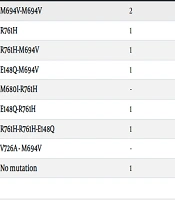
Upon examining the genotype distributions, the wild type can be observed in 40%, heterozygous type in 36.7%, homozygous in 5.3%, compound heterozygous in 12.7%, and complex heterozygous in 5.3%. The rate of the disease among 150 people was 23.3%, while the carrier rate was 36.7% (Table 4).
Table 4.
Distribution of Genotype Frequencies
| Varibales | Genotype (n = 150) | Frequencies (%) |
|---|---|---|
| Heterozygous (n = 55) | ||
| A744S | 1 | 0.7 |
| E148Q | 16 | 10.7 |
| E148V | 1 | 0.7 |
| G304R | 1 | 0.7 |
| M680I | 1 | 0.7 |
| M694V | 9 | 6.0 |
| R202Q | 22 | 14.7 |
| R761H | 2 | 1.3 |
| V726A | 2 | 1.3 |
| Homozygous (n = 8) | ||
| E148Q homo | 1 | 0.7 |
| M694V homo | 1 | 0.7 |
| M694V homo, R202Q homo | 2 | 1.3 |
| R202Q homo | 4 | 2.7 |
| Compaund heterozygous (n = 19) | ||
| Comp. E148Q, M680I | 1 | 0.7 |
| Comp. E148Q, M694V | 1 | 0.7 |
| comp. E148Q, F479L | 1 | 0.7 |
| comp. M694V, R761H | 1 | 0.7 |
| E148Q, R202Q | 4 | 2.7 |
| F479L, E167D | 1 | 0.7 |
| M680I, V726A | 1 | 0.7 |
| M694V, E148Q | 1 | 0.7 |
| M694V, R202Q | 6 | 4.0 |
| R202Q, E148Q | 1 | 0.7 |
| V726A, A744S | 1 | 0.7 |
| Complex heterozygous (n = 8) | ||
| E148Q, M694V, M694I | 1 | 0.7 |
| E148Q, V726A, P369S, R408Q | 1 | 0.7 |
| G304R, R202Q, M694V | 1 | 0.7 |
| M694V, R202Q, E148Q | 1 | 0.7 |
| M694V, R202Q, M680I(g > c) | 1 | 0.7 |
| M694V, R202Q, V726A | 1 | 0.7 |
| M694V, V726A, R202Q | 1 | 0.7 |
| P369S, R408Q, R202Q, E148Q | 1 | 07 |
Upon examining the distribution of the genotypes by complaints, abdominal pain was observed in 48.1% of the patients with the M694V genotype, arthralgia in 18.5%, and fever in 18.5%. Abdominal pain was observed in 41.9% of those with E148Q genotype, arthralgia in 25.8%, and fever in 19.4%. Abdominal pain was observed in 44.4% of those with R202Q genotype, arthralgia in 22.2%, and fever in 13.3%. Abdominal pain was observed in 57.1% of those with V726 genotype, and fever in 14.3% (Table 5).
Table 5.
Genotype Distribution by Complaints
| Varibles | No. | Abdominal pain | Arthralgia | Fever | |||
|---|---|---|---|---|---|---|---|
| No. | % | No. | % | No. | % | ||
| M694V | 27 | 13 | 48.1 | 5 | 18.5 | 5 | 18.5 |
| M680I | 4 | 0 | 0 | 1 | 25 | 0 | 0 |
| V726A | 7 | 4 | 57.1 | 0 | 0 | 1 | 14.3 |
| R202Q | 45 | 20 | 44.4 | 10 | 22.2 | 6 | 13.3 |
| E148Q | 31 | 13 | 41.9 | 8 | 25.8 | 6 | 19.4 |
| M694I | 1 | 0 | 0 | 0 | 0 | 1 | 100 |
| A744S | 2 | 2 | 100 | 0 | 0 | 0 | 0 |
| R761H | 3 | 1 | 33.3 | 0 | 0 | 1 | 33.3 |
| F479L | 2 | 1 | 50 | 0 | 0 | 1 | 50 |
| E167D | 1 | 0 | 0 | 0 | 0 | 1 | 100 |
| R408Q | 2 | 0 | 0 | 1 | 50 | 1 | 50 |
| G304R | 2 | 1 | 50 | 1 | 50 | 0 | 0 |
4. Discussion
Familial Mediterranean fever is an autosomal recessive inflammatory disease prevalent among the Turks, Armenians, Jews, and Arabs (12). While FMF is observed at a rate of 1/1000 in Turkey, the carrier rate is 1/5 (12, 13). FMF is a childhood disease that generally shows its symptoms between the ages of 5 and 15 years (14). Majeed et al. (15) reported that FMF starts before the age of 10 in approximately 80% of the patients, while Gedalia et al. (16) reported that the disease starts before the age of 10 in 60% of patients. In their study, Mimouni et al. (17) reported the onset age of the disease in Turks to be 12.3 years. In our study, the onset age of FMF was determined to be averagely 8.77 years.
The Turkish FMF study group reported that FMF is 1.2 times more in male patients than female patients (10). Majeed et al.’s study (15) comprised 54% female and 46% male patients. In our study, 52% of the patients are female and 48% male, which is consistent with the studies reported. In the study featuring the Turkish FMF study group, 18.9% of the parents had consanguineous marriage (10). The ratio of consanguineous marriage in our study was 23.3%.
There are no precise diagnostic physical examinations or laboratory findings in FMF. Fever and abdominal pain are the most prevalent symptoms (10, 18). The complaints by frequency order in the Turkish FMF study group were reported to be abdominal pain (93%), fever (91.3%), arthritis (58.3%), and chest pain (4%) (10). In another study, it was reported that abdominal pain and fever were on the top of the presenting complaints (19). Fever (100%), abdominal pain (82%), chest pain (43%), and arthritis (37%) were detected in most Arabs (20). The most frequent symptoms in those of Jewish origin were fever (100%), abdominal pain (95%), and arthritis (77%) (21). The most frequent symptoms in Armenians were fever (100%), abdominal pain (96%), chest pain (87%), and arthritis (37%) (22). In our study, the most frequent reasons were abdominal pain (44.7%), arthralgia (20%), fever (16.7%), chest pain (1.3%), and other reasons (20%). In compliance with the previous studies, it was observed in our study that abdominal pain is the most frequent complaint.
While the etiology of FMF is not fully known, the ethnic origin, genetic predisposition, and environmental factors may be responsible for pathogenesis (23). Currently, there are 317 mutations in the MEFV gene (6). Five mutations have been defined as the most frequent reason for the disease; these are four mutations in the 10th exon (M680I, M694V, M694I, V726A) and one (E148Q) mutation in the 2nd exon (5). It is believed that homozygous M694V mutation causes a severe clinical course and the development of amyloidosis (24).
R202Q was first defined by Bernot in 1998, and it is believed that it can be a prevalent polymorphism. It has been reported that to emerge the disease symptoms, the R202Q gene change should be accompanied by a mutation related to the disease, and this change is significant for a diagnosis (25). While R202Q (37.2%) was observed to be the mutation with the highest frequency, this was followed by E148Q (23.4%), M694V (21.9%), V726A (5.1%), M680I (2.9%), R761H (2.2%), A744S, F479L, R408Q, G304R (1.5%), M694I, and E167D (0.7%). In the study carried out in Turkey by the FMF study group in 2005, M694V (51.4%), M680I (14.4%), V726A (8.6%) were found to be most prevalent in the patients whose gene mutation analysis was performed (10, 26). In our study, R202Q mutation was identified as the most common mutation. In the study by Caglayan et al. (27), M694V (32%) was the most frequent mutation on the basis of alleles, followed by E148Q (20.6%), V726A (17%), M680I(G/C) (14.5%), and P369S (10.8%) mutations. In our study, while the E148Q mutation was the second most frequent at a rate of 23.4%, M680I (G/A) and I692del mutations were not determined.
In the study by Demirkaya et al. (28) consisting of 330 patients, M694V was observed at a rate of 50%, M680I at a rate of 14.1%, V726A at a rate of 9.70%, and the E148Q point mutation was observed at a rate of 1.37%; the prevalence ranking of the mutations was different from our study. In another study performed by Dundar et al. (29), the allele frequency was reported to be M694V 14.68%, M680I (G/C) 7.62%, E148Q 5.15%, and V726A 4.76%. In a study carried out on 153 FMF patients in Syria, the most prevalent mutations were in order of frequency, M694V (36.5%), V726A (15.2%), E148Q (14.5%), M680I (G/C) (13.2%), and M694I (10.2%) (30). In our study, the V726A mutation was in fourth place, and one M694I mutation was determined.
In their study consisting of 2067 patients around Kayseri (30) found that M694V was 50.50%, M680I was 21.26%, E148Q was 19.86%, V726A was 15.34%, and R761H was 4.4%. The M680I mutation was found to be in fifth place in our study. In their study carried out on 524 patients in Iran, Bonyadi et al. (31) found that the most prevalent mutation was M694V at a rate of 42.4%, followed by V726A at a rate of 17%, E148Q at a rate of 16.2%, M680I at a rate of 15.2%, and R761H at a rate of 4.7%. All patients in the group of this study carried out in Iran consist of Azeri Turks. In our study, E148Q mutation came before the M694V mutation in the frequency ranking. V726A mutation ranked in fourth place.
In our study, the R202Q mutation was determined to be the most frequen, different from other studies. The complaints that accompany R202Q, E148Q, and M694V mutations most frequently were abdominal pain, arthralgia and high fever, which is consistent with the literature (32, 33).
Finally, it was determined that the most frequently observed mutation in our study was R202Q, followed by E148Q. Our region receives intense migration from all Anatolian regions. For this reason, we think that the results of our work are important in terms of collectively reflecting the data of our country.