1. Background
Familial Mediterranean Fever (FMF); is an autosomal recessive hereditary chronic disease characterized with fever and inflammation of the serous membranes (1). Amyloidosis, the most severe complication of FMF; is a group of diseases that are a consequence of abnormal protein deposits in various tissues. In FMF, amyloid deposits are mostly seen in kidneys. In addition, it can be seen in the gastrointestinal tract, liver, spleen and even heart (2). Amyloid deposition in the gastrointestinal tract symptoms include diarrhea, steatorrhea, constipation or pseudo-obstruction not responding to pro-motility agents.
Today, the diagnosis of amyloidosis is performed by renal and/or colon mucosal biopsy (3). Late diagnosis, delays in treatment after diagnosis, irregular use of colchicine and carrying MEFV gene mutation are known risk factors.
The Rome III questionnaire was first introduced in 2006, for the diagnosis and classification of functional diseases in the gastrointestinal tract in children. Functional and intermingled gastrointestinal diseases can be distinguished and diagnosed with this questionnaire (4).
Anorectal manometry is the most commonly used technique to determine the functions and localizations of internal and external sphincters in the rectum (5, 6). There are many studies on anorectal manometry performed on adult patients in the literature, while studies on children are very limited and its reliability is low. There is no universal reference range for anorectal manometry test results in the pediatric age group. Furthermore, there are no adult or pediatric studies showing the possible effect of amyloidosis with gastrointestinal involvement on anorectal functions.
2. Objectives
The purposes of the present study were to assess the probable effects of amyloid deposition in colonic mucosa on anorectal manometry testing, to detect the anorectal manometric differences in patients with potential risk factors for amyloidosis and to evaluate the use of the standard pediatric gastrointestinal functional assessment method, Rome III questionnaire in children with FMF.
3. Methods
The files of 1800 patients diagnosed with FMF according to Tell-Hashomer criteria and genetic mutation results who were treated and followed up in Pediatric Rheumatology Clinic were screened according to age, amount of proteinuria and FMF genetic analysis. This study was conducted in compliance with the 2008 Declaration of Helsinki and by the approval of Ethics Committee of Göztepe Training and Research Hospital, Medeniyet University (date/number: 28.Jan.2014/0015). Informed consent was obtained from the parents of patients included in the study.
The criteria for inclusion of patients in the study were; volunteering patients and the patient’s parents, minimum 8 years of age maximum 18 years of age, absence of anorectal malformation, absence of past anorectal surgical procedures, absence of mental retardation and inflammatory bowel disease.
The criteria for exclusion of patients from the study; the patient’s parent or patient was not voluntary, patients were younger than 8 years of age, over 18 years of age, had anorectal malformation, inflammatory bowel disease, hypothyroidism, parasitic infection, anal fissure and discordance to anorectal manometry test.
Gastrointestinal complaints of the patients, comorbidities, age when the patient was diagnosed, medications used, presence of family relatives diagnosed with FMF, results of genetic tests for FMF, amount of proteinuria, colchicine use patterns were inquired.
Predisposing factors for build-up of amyloid deposits were identified as presence of M694V homozygous mutation, high proteinuria level and irregular colchicine use. Patients were grouped according to presence/absence of M694V homozygous mutation, proteinuria above and below 10 g/m2/h and regular/irregular use of colchicine.
Patients diagnosed with FMF were subjected to Rome III questionnaire, underwent anorectal manometry test and rectal suction biopsy.
The Rome III questionnaire was conducted face-to-face with the patients and their parents. Following the interview, the anorectal manometry test was performed. Dyno3000 (Dyno Smart, Menfis, Italy) software and hardware were used for all patients. An Ischia (Menfis, Italy) 8-channel water-perfused anorectal manometry catheter was used. The results of the anorectal manometry study performed by Sunil Kumar et al on 30 healthy children were adopted as reference range (7).
After anorectal manometry test, rectal mucosa was biopsied using c-Erb2 (Aus systems, Australia) rectal suction biopsy kit. All tissue samples were examined by the same pathologist, who was blinded to patient characteristics. Congo Red and Crystal Violet staining were performed to detect amyloid deposition. Red staining around the vessel as seen in the light microscope with Congo Red, and double refraction of light with polarization filter in the positive stained areas were considered to be positive. The results were evaluated statistically compared to each other.
NCSS (Number Cruncher Statistical System) 2007 & PASS (Power Analysis and Sample Size) 2008 Statistical Software (NCSS LLC, Kaysville, Utah, USA) were employed for statistical analysis. Kruskal Wallis test was used for comparison of the three groups and Mann Whitney U test was used for the evaluation of two groups of data. Fisher’s exact test and Fisher-Freeman Halton test were used to compare qualitative data.
4. Results
Of the 27 patients evaluated in the study; 17 were female (63%), 10 were male (37%). The mean age was 12.15 ± 2.40 (8.70 - 17.45) years.
There was an additional disease in 4 (14,8%) of the cases. Additional diseases respectively; included allergic asthma, gastroesophageal reflux, glucose-6-phosphate dehydrogenase deficiency and essential hypertension.
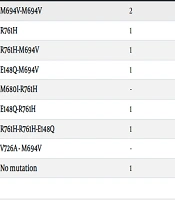
Genetic examination revealed genetic mutation in 26 patients and no mutation was detected in one patient. Homozygous and heterozygous mutations were identified in 70.4% and 25.9% of patients respectively. M694V homozygous gene mutation was detected in 5 (18.5%) patients.
The mean proteinuria of the patients was 15.80 ± 27.06 g/m2/h. In 9 patients (33.3%) proteinuria was 10 g/m2/h or higher. No statistically significant difference was found in terms of mean age, sex and presence of M694V homozygous mutation between 9 cases with proteinuria rate at or above 10 g/m2/h (P > 0.05) and 18 cases with no proteinuria identified. 7 out of 9 the patients (77.8%) had first-degree relatives with FMF. 6 of the 18 patients (33.3%) had a family history. Family history rate was found to be significantly higher in patients with proteinuria greater than 10 g/m2/h (P < 0.05).
Rectal mucosa biopsies were examined and was noted in 2 patients (7.4%), while no deposition was found in 25 patients (92.6%). M694V homozygous mutation was found in the genetic diagnosis of patients with amyloid deposition. Both patients with amyloid deposition had regular drug use and family history. M694V homozygous gene mutation was found to be significantly higher in patients with positive rectal mucosal biopsy (P < 0.05).
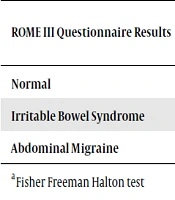
The gastrointestinal system complaints of the patients were questioned. 11 patients (40.7%) had gastroenteritis and 6 patients (22.3%) had constipation. In 10 (37%) patients, there was no gastrointestinal complaints. According to the Rome III questionnaire, 19 (70.4%) patients were normal. Five (18.5%) patients had irritable bowel syndrome and 3 (11.1%) had abdominal migraine. No statistically significant difference was found between the results of the Rome III questionnaire by age, sex, presence of M694V homozygous mutation and proteinuria (P > 0.05) (Table 1).
Table 1.
Evaluation of Rome III Questionnaire Results with Respect to M694V Homozygous Gene Mutation
| ROME III Questionnaire Results | M694V Homozygous Gene Mutation, No. (%) | Pa | |
|---|---|---|---|
| No | Yes | ||
| Normal | 16 (72.7) | 3 (60.0) | 0.759 |
| Irritable Bowel Syndrome | 4 (18.2) | 1 (20.0) | |
| Abdominal Migraine | 2 (9.1) | 1 (20.0) | |
aFisher Freeman Halton test
According to the Rome III questionnaire, gastrointestinal system complaints were present in all cases with irritable bowel syndrome and abdominal migraine, which was significantly higher than those in the normal group (P < 0.05). There was no statistically significant difference between the rectal mucosa biopsy and Rome III questionnaire results (P > 0.05) (Table 2).
Table 2.
Evaluation of Rectal Mucosa Biopsy Results According to the Rome III Questionnaire
| Rectal Mucosa Biopsy Result | Rome III Questionnaire Results, No. (%) | Pa | ||
|---|---|---|---|---|
| Normal (N = 19) | Irritable Bowel Syndrome (N = 5) | Abdominal Migraine (N = 3) | ||
| Yes | 0 | 1 (20) | 1 (33.3) | 0.078 |
| No | 19 (100) | 4 (80) | 2 (66.7) | |
aFisher Freeman Halton test
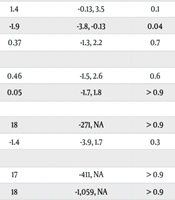
The mean sphincter pressure at rest measured in the anorectal manometry test was 71.84 ± 24.93 mmHg. 3 cases (11.1%) were within the reference range, while 24 (88.9%) were out of the reference range. No statistically significant difference was found between the results of anorectal manometry tests in patients with and without M694V homozygous mutation (P > 0.05). In 19 patients with predisposing factors, the rate of increase in resting pressure was 2.42 ± 0.77 fold, whereas in 8 patients, in whom no predisposing factors were identified, the increase was 3.67 ± 1.78 fold. The rate of increase in resting pressure was significantly lower between the two groups (P < 0.05). There was a statistically significant relationship between the detection volume of rectoanal inhibitory reflex (RAIR) and predisposing factors (P < 0.05). RAIR was found to be lower in patients with predisposing factor, and higher levels of RAIR were found to be statistically significant in patients without predisposing factor (P < 0.05).
No significant difference was found between the results of the Rome III questionnaire and rectal mucosa biopsy results and predisposing factors (P > 0.05).
5. Discussion
FMF is an autosomal recessive hereditary chronic disease characterized with episodes of fever, serositis and abdominal pain which are seen in at least 80% of patients. Amyloidosis, the most severe complication of FMF, is a group of diseases that are a consequence of abnormal protein deposits in various tissues and these abnormal proteins, called amyloid fibrils, impair the function of tissues and organs (1, 8-10).
Amyloid deposition may be correlated with genotype. M694V homozygous mutation is a known risk factor for amyloid deposition (11-15). In our study, amyloid deposition was shown in rectal mucosal biopsies in 2 out of 5 (40%) patients with M694V homozygous mutation. Although the number of patients in the group was limited, statistically higher rate amyloid deposition in patients with M694V homozygous for the mutation was still demonstrated, in line with the literature.
Kidneys are the most commonly involved organs in secondary amyloidosis cases. Increased amount of proteinuria is a risk factor for renal amyloidosis. In this study, albeit at varying levels proteinuria was present in all patients. Even though the number of patients enrolled in our study is insufficient for comparison, the amount of proteinuria at the severity of nephrotic syndrome should concern clinicians about amyloid deposition.
While the diagnostic sensitivity of renal biopsy for amyloid is 90% - 95%, the sensitivity of rectal mucosa biopsy is 75% - 85% (3). In our study, rectal mucosa biopsies were collected from 27 patients and amyloid deposition was detected in 2 of them. The main reasons for low rate of detecting amyloid deposition include the small size of the patient population, the majority of patients with proteinuria - that is not at nephrotic syndrome severity - and the lower sensitivity of rectal mucosa biopsy compared to renal biopsy. Since no renal biopsy was performed in our study, the sensitivity of rectal mucosa biopsy cannot be assessed. Colchicine is the only effective modality for treatment and prevention of FMF induced amyloidosis. Irregular use of colchicine is one of the predisposing factors for amyloid deposition. When we evaluate the factors leading to amyloid deposition such as M694V homozygous gene mutation, high amount of proteinuria and irregular drug use, it is easier to predict the presence of amyloid deposition. We believe that if the study group is expanded, the percentage of patients with amyloid deposition will increase for patients who already have predisposing factors identified.
Anorectal manometry shows the pressure, length and motility of the anal canal. The technique used for pressure measurements during anorectal manometry should be indicated. Since there are very few studies in the pediatric age group and the remarkable differences in the techniques and catheters used in the studies, standardization of normal values based on age and gender is quite difficult (16).
The results of the anorectal manometry study performed by Kumar et al were adopted as reference range in our evaluation of anorectal manometry test results (7). There is no previous anorectal manometry test in patients with FMF in literature. The value of internal sphincter pressure at rest, which enables the evaluation of its function, was found to be within the reference range in 3 patients and out of the range in 24 patients. In our study, the resting pressures of patients with amyloid deposition were above the reference range. While the mean age of the reference study was 3.9 years, the mean age of the patients in our study was 12 years. The higher resting pressure averages found in our study, compared to the reference range, can be attributed to the high average age of our study group.
There was no statistically significant difference in the anorectal manometry test results of 5 patients with M694V homozygous mutation and 22 patients without mutation. The small number of patients with M694V homozygous mutation in our study, may have had an effect on the outcome. Therefore, different results can be obtained in larger cohorts.
Comparison of anorectal manometry results of patients with respect to increased proteinuria levels revealed no significant difference due to proteinuria amount. However, it should be noted that there were only 2 patients with proteinuria at nephrotic syndrome severity in this study. As a matter of fact, amyloid deposition was shown in these two patients. Therefore, anorectal manometry tests to be performed in large patient cohorts with proteinuria at the severity of nephrotic syndrome are likely to produce significantly different results due to amyloid deposition.
No statistically significant difference was found in the anorectal manometry tests of 5 patients using colchicine irregularly and 22 patients using colchicine regularly. Two patients with amyloid deposition had regular drug use. In one study, it was reported that the time required for renal amyloid deposition may be as long as 14 years (17). The mean time from diagnosis to the date of study was 3.8 years for patients with irregular drug use. Therefore, it was not possible to detect proteinuria at nephrotic syndrome severity or amyloid deposition at the time when the patients were evaluated.
In patients with predisposing factors for amyloid deposition, lower volumes were sufficient for triggering RAIR. Although amyloid deposition has been shown for only two patients in this group, internal sphincter sensitivity can be considered to be high in patients with predisposing factors.
Defecation control is managed as a reflex in the first year of life, and by cortical control from the second year and onwards. The “push and strain” test which is an indicator of the external sphincter function, shows increased pressure in the gauge in rectum and decrease in the pressure gauges in the sphincter. An increase in pressure rather than the expected decrease in the rectum pressure is called paradoxical contraction or dyssynergic defecation. Evaluation of our study group between 12 patients with paradoxical contraction and 15 patients without paradoxical contraction revealed no correlation with gastrointestinal system complaints. Evaluation of patient groups by Rome III questionnaire results also showed no significant difference with respect to paradoxical contraction between the patients who were diagnosed or ruled out by the Rome III questionnaire.
Paradoxic contraction includes patients with functional constipation and/or encopresis or soiling. The common characteristic of all these diseases is constipation. In our study, 64.7% of 12 patients with paradoxical contraction had gastroenteritis as a gastrointestinal system complaint. We believe that the high rate of gastroenteritis is due to colchicine use. As there were only 2 patients with both constipation and paradoxical contraction, statistical significance could not be ascertained.
The most up-to-date and only symptom-focused questionnaire used to evaluate gastrointestinal complaints in children is the Rome III questionnaire but there is no study on the standardization of abdominal pain and the prevalence of gastrointestinal disorders in FMF patients. In one study Rome III questionnaire was used to inquire abdominal pain in patients with FMF, irritable bowel syndrome was found to be 18% which has no statistically significant difference compared to the healthy control group (10.7%) (18). When the referred study is considered, it can be said that the prevalence of irritable bowel syndrome in patients with FMF is the same as that of healthy population. However, the inability to set statistical significance due to the limited number of patients in our study makes it difficult to draw a conclusion.
In many studies, abdominal migraine rates were reported in varying rates (1.9%, 1%, 5%) according to the Rome III questionnaire (4, 19, 20). In our study, 11.1% of patients had abdominal migraine. One of the main reasons for the apparently high rate of abdominal migraine compared to the healthy population is that the abdominal pain experienced by the patients during the episode includes abdominal migraine-like findings.
5.1. Conclusion
Amyloidosis can be seen due to various environmental factors, regardless of age, even when colchicine is regularly used. Amyloid deposits may affect bowel motility. Despite the presence of potential risk factors, the number of patients with amyloid deposition in the gastrointestinal tract was less than expected. This can be explained by the fact that the time from diagnosis to treatment in children is shorter compared to adults. Although it has been shown that RAIR can be detected at lower pressures in patients with predisposing factors for amyloid deposition, the clinical significant of this finding is unclear. Since the Rome III questionnaire showed findings consistent with functional abdominal pain disease in one third of the patients, independent of FMF, it was found that the application of this questionnaire in patients with FMF could be misleading.