
1. Background
Constipation is one of the most common complaints in children, which includes 1-3% of pediatric outpatient refers and 10 - 25% of pediatric consultations at hospitals (1). Its highest prevalence is during the preschool years (2). It is defined generally as the passage of large caliber or hard stool or a stool frequency less than three times per week or a kind of painful defecation (3).
Functional constipation is responsible for more than 95% of cases of constipation in healthy children aged one year and older and is particularly common among preschool-aged children. Functional constipation refers to constipation for a month or longer period without any organic etiologies (4). This definition is known by the "ROME IV" diagnostic criteria, which requires at least two of the six following symptoms: stool frequency of fewer than three spontaneous bowel movements per week, lumpy or hard stools for at least 25% of defecation attempts, straining for more than 25% of defecation attempts, the sensation of anorectal obstruction or blockage for at least 25% of defecation attempts, the sensation of incomplete defecation for at least 25% of defecation attempts, and manual maneuvering required to defecate for at least 25% of defecation attempts, after excluding organic causes by a complete evaluation (5, 6). Due to delayed or inadequate intervention, functional constipation will lead to stool holding, fecal impaction, and finally, it would result in psychological problems and poor quality of life (2).
Guidelines on functional constipation recommend digital rectal examination (DRE) when constipation is suspected. However, DRE is a painful and unpleasant examination, and sometimes it is hard for children or their parents to tolerate (7). Moreover, DRE is not recommended for overweight children and those with a history of sexual abuse or trauma (8). Thus, a suitable alternative examination would be very much appreciated.
One of the hypothesized alternatives of DRE is the measurement of the diameter of the rectal ampulla (DRA). The rectal ampulla is the upper part of the rectum above the levator ani muscle and is enlarged in chronic constipation (9). Diagnosis of megarectum by ultrasonography would differentiate children with constipation from those with dysfunctional defecation (10).
2. Objectives
In this research, we evaluated the utilization of ultrasonography to measure the DRA as an alternative to DRE for diagnosis and monitoring of functional constipation.
3. Methods
Our research was a prospective cross-sectional study, which was performed on children under 14 years old with functional constipation who were referred to the gastrointestinal clinic of Mofid Children Hospital from March 2019 to March 2020, of whom 94 patients were selected. Demographic data and medical history of patients were collected by interviewing either themselves or their parents.
The exclusion criteria included the presence of any comorbidities, such as hypothyroidism, heart diseases, Hirschsprung, and neurological and psychological disorders (e.g., spina bifida, mental retardation, anorexia nervosa, etc.).
Patients’ data, including sex, age, height, weight, body mass index (BMI), frequency of symptoms, duration of fecal incontinence, and history of stool softener medications, were noted in a pre-prepared questionnaire. Additionally, DRA was evaluated by DRE and an abdominal 2D sonography (Medison Accuvix V10) by a Samsung H60 sonography device, both in one session. The patients were burdened with no additional costs.
DRE was performed by only one physician for all cases (a specialist in pediatrics gastroenterology) by gently inserting the lubricated index finger into the anus. A professional radiologist also performed abdominal sonography for all children by measuring the axial cut of rectal shadow behind the half-full bladder 2 cm above the symphysis pubis.
Afterward, a suitable modifying diet and stool softeners were prescribed for each patient. Patients were examined by both DRE and ultrasonography after a conventional stool softener treatment.
The relationship between demographic data and physical examination results with DRE and DRA measures and also the difference in DRA before and after treatment were evaluated.
This study was approved by the Ethics Committee of Shahid Beheshti University of Medical Sciences (1398.083.IR.SBMU.MSP.REC). Informed consent was obtained from the children's parents. Confidentiality of the information was respected at all stages of the study.
Statistical analysis was performed using SPSS 23.0 (Illinois, USA). Descriptive statistics were reported by mean and standard deviation for quantitative variables and frequency and percentage for qualitative variables. Analysis was done using t-test, paired t-test, independent t-test, and one-way variance analysis (ANOVA). Logistic regression modeling was used for evaluation of the relationship between independent and dependent variables and modifying confounding effects of confounder variables. A P < 0.05 was considered statistically significant for all analyses.
4. Results
Ninety-four patients with functional constipation were included, of whom 41 patients were female (44%), and 53 patients were male (56%). ROME IV criteria were used for the diagnosis of functional constipation. The most frequent symptoms were as follows, respectively: hard stool (96.8%), painful defecation (95.7%), less than two defecations per week (62.8%), and feeling of incomplete defecation and stool residue in the rectum (58.5%).
Table 1 presents the patients’ demographic data and characteristics.
Table 1.
Descriptive Characteristics of Patients with Functional Constipation
| Demographic Characteristics | Means ± SD (Minimum, Maximum) |
|---|---|
| Age (y) | 5.50 ± 3.24 (0.9, 14) |
| Height (cm) | 110.44 ± 23.10 (70, 168) |
| Weight (kg) | 20.84 ± 12.38 (8.5, 75) |
| Weight classification was performed based on BMI Z-Score | |
| Normal (-2 ≤ BMI Z-Score ≤ 1) | 57 (60.6) |
| Risk of overweight (1 < BMI Z-Score ≤ 2) | 16 (17) |
| Overweight (2 < BMI Z-Score ≤ 3) | 9 (9.6) |
| Wasted (-3 ≤ BMI Z-Score ≤ -2) | 7 (8.5) |
| Severe wasted (BMI Z-Score < -3) | 4 (4.3) |
| ROME IV diagnostic criteria indicators | |
| Hard stool | 90 (95.7) |
| Hard and thick stool | 91 (96.8) |
| Incomplete defecation | 55 (58.8) |
| Once a week or less fecal defecation | 59 (62.8) |
| Stool retention | 30 (31.9) |
| Fecal incontinence at least once | 18 (19.1) |
| Frequency distribution of fecal incontinence (reported in 35 patients) | |
| Rarely | 2 (2.1) |
| Occasionally | 15 (16) |
| Every day | 16 (17) |
| Every day and night | 2 (2.1) |
Sixty patients (63.8%) had no history of taking stool softener medication, and 34 patients (36.3%) had used stool softener. DRE was performed for each patient and in 33 patients (35.1%) was normal. Large stool mass was identified in 61 patients (64.9%).
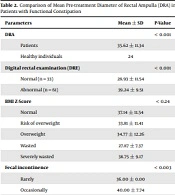
Comparison of the average DRA in patients and healthy individuals, the relationship between pre-treatment DRA and the findings of DRE, patients’ BMI Z-Score, stages of fecal incontinence, and history of stool softener medication are shown in Table 2.
Table 2.
Comparison of Mean Pre-treatment Diameter of Rectal Ampulla (DRA) in Patients with Functional Constipation
| Parameters | Mean ± SD | P-Value |
|---|---|---|
| DRA | < 0.001 | |
| Patients | 35.62 ± 11.34 | |
| Healthy individuals | 24 | |
| Digital rectal examination (DRE) | < 0.001 | |
| Normal (n = 33) | 28.93 ± 11.54 | |
| Abnormal (n = 61) | 39.24 ± 9.51 | |
| BMI Z-Score | < 0.24 | |
| Normal | 37.14 ± 11.54 | |
| Risk of overweight | 33.81 ± 11.41 | |
| Overweight | 34.77 ± 12.26 | |
| Wasted | 27.87 ± 7.37 | |
| Severely wasted | 38.75 ± 9.17 | |
| Fecal incontinence | < 0.003 | |
| Rarely | 36.00 ± 0.00 | |
| Occasionally | 40.00 ± 7.74 | |
| Every day | 41.31 ± 8.51 | |
| Every day and night | 52.00 ± 0.00 | |
| Consumption of stool softener medication | < 0.083 | |
| Fecal incontinence | 41.50 ± 9.37 | |
| No fecal incontinence | 35.07 ± 11.55 | |
| No consumption of stool softener medication | < 0.001 | |
| Fecal incontinence | 40.46 ± 6.30 | |
| No fecal Incontinence | 31.57 ± 11.89 |
Based on statistical analysis, DRA was significantly wider in patients with large stool mass than in patients with a normal digital rectal exam (P < 0.001). Moreover, there was a significant statistical relationship between fecal incontinence and pre-treatment DRA. Evaluation of the data showed that by increasing the severity of fecal incontinence, the average DRA in patients increased significantly (P < 0.003).
The size of the rectal ampulla was abnormal in all cases of functional constipation and simultaneous fecal incontinence. However, the size of the rectal ampulla was abnormal in 69% of those with no fecal incontinence; 31% had normal size rectal ampulla.
DRA before and after treatment was measured. The average pre-treatment DRA was 38.79 ± 10.17 mm, and the average post-treatment DRA was 29.08 ± 9.43 mm, and there was a significant statistical difference between the patient’s DRA before and after treatment (P < 0.001).
In order to control the confounding effect of the variables, statistical modeling was performed using logistic regression. Thus, the variables were divided into normal (lower than 30 mm) and abnormal (30 mm and more) groups, using the normal cut-off point in children without constipation (11). The modeling results are shown in Table 3.
Table 3.
Factors Related to the Pre-treatment Diameter of Rectal Ampulla (DRA) in Patients with Functional Constipation
| Independent Variables | Crude | Adjusted | ||
|---|---|---|---|---|
| OR (95% CI) | P-Value | OR (95% CI) | P-Value | |
| Age | 1.65 (1.21 - 2.24) | 0.001 | 1.67 (1.11 - 2.53) | 0.01 |
| Sex | ||||
| Female | ||||
| Male | 2.42 (0.84 - 6.90) | 0.1 | 4.18 (0.70 - 24.92) | 0.11 |
| BMI Z-Score | ||||
| Normal | ||||
| > Normal | 0.56 (0.12 - 2.4) | 0.44 | ||
| < Normal | 0.59 (0.18 - 1.89) | 0.37 | ||
| Digital rectal examination (DRE) | ||||
| Normal | ||||
| Abnormal | 7.28 (2.3 - 23.01) | 0.001 | 7.03 (1.24 - 39.73) | 0.02 |
| Duration of constipation | 1.03 (1 - 1.07) | 0.04 | ||
| History of taking stool softener medication | ||||
| No | ||||
| Yes | 3.44 (0.91 - 12.91) | 0.05 | ||
| Symptoms | ||||
| 2 symptoms | ||||
| 3 and 4 symptoms | 1.37 (0.26 - 7.18) | 0.7 | 3.1 (1.07 - 5.50) | 0.04 |
| 5 and 6 symptoms | 4.5 (0.41 - 48.53) | 0.21 | 2.33 (0.41 - 35.52) | 0.54 |
According to the adjusted model, age (OR = 1.67, 95%CI: 1.11 - 2.53, P = 0.01), DRE (OR = 7.03, 95%CI: 1.24 - 39.73, P = 0.02), and constipation (3,4 criteria, OR = 1.37, 95%CI: 1.07 - 5.50, P = 0.04) were correlated with pre-treatment DRA.
Evaluation of DRE results in the adjusted model showed that the risk of abnormal DRA in ultrasound was seven times larger in patients with fecal mass in DRE than in patients with empty rectum in DRE, and these correlations were also statistically significant (P < 0.05).
The relationship between constipation and DRA adjusted model showed that the risk of abnormal DRA was 3.1 times larger in patients with three and four symptoms than in patients with two symptoms and this relationship was statistically significant (P < 0.05). However, this risk was 2.3 times higher in patients with five and six symptoms than in patients with two symptoms, which was not statistically significant.
To evaluate the accuracy of modeling and predictive value of the model, pairing criteria and the appropriateness of the logistic model were assessed. The Hosmer and Lemeshow test value was 0.45, and the standard was set. The area under the receiver operating characteristic (ROC) curve was 0.87, which means that the predictive value of the model was ideal and was equal to 0.87.
DRA of the patients with functional constipation (35.62 ± 11.34) was significantly larger than that of the normal population (P < 0.001). Moreover, we studied the relation between the severity of functional constipation (based on the number of symptoms) and DRA. Patients with three or four symptoms of ROME IV criteria showed a 37% more chance of being at the risk of abnormal DRA than the patients with two symptoms. The patients with five or six symptoms of ROME IV criteria were at risk of abnormal DRA, 4.3 times more than those with two symptoms. These numbers were calculated to be 3.1 and 2.3, respectively, when an adjusted model was used. However, the difference was not statistically significant for the patients with five or six symptoms.
The mean duration of functional constipation was 28.45 ± 25.52 months. According to the crude model, an increase in the duration of functional constipation by a month increased the risk of abnormal DRA by 3%. However, this association was not statistically significant, considering the adjusted model.
A history of stool softener medication was found in 34 patients (36.2%). These patients were at 3.4 times more risk of abnormal DRA in comparison with those who had not used the stool softener medication. Also, 35 patients (37.2%) had fecal incontinence, and a positive association was observed between fecal incontinence and an abnormal DRA. All patients with fecal incontinence had an abnormal DRA, whereas 69% of patients without fecal incontinence had an abnormal DRA. The average DRA in the patients with an abnormal DRE was 9.71 mm more than DRA in patients with normal DRE. Moreover, the risk of abnormal DRA in patients with an abnormal DRE was seven times more than in those with normal DRE (P < 0.05).
To summarize the results, DRA was significantly wider in patients with large stool mass in DRE than in patients with normal DRE. Moreover, there was a significant statistical relationship between fecal incontinence and pre-treatment DRA. The average DRA in patients increased significantly by increasing the severity of fecal incontinence. Additionally, there was a significant statistical difference between the patients’ DRA before and after treatment. Evaluation of DRE results in the adjusted model showed that the risk of abnormal DRA in ultrasound was seven times higher in the patients with fecal mass in DRE than in patients with empty rectum in DRE, and these correlations were also statistically significant. Finally, the relationship between constipation and DRA in the adjusted model showed that the risk of abnormal DRA was 3.1 times larger in patients with three and four symptoms than in patients with two symptoms and this relationship was statistically significant.
5. Discussion
Constipation is among the leading causes of visits to pediatric gastroenterology clinics, and about 90% of cases can be categorized as functional constipation (2). DRE is one of the most frequently used examinations, which could be unpleasant, painful, or sometimes contraindicated; therefore, a suitable alternative examination would be needed in some cases.
Ninety-four patients diagnosed with functional constipation entered our research, of whom 51 cases (60.6%) had the normal BMI Z-Score range, while 25 cases (26.6%) had higher BMI Z score than normal, and 12 cases (12.8%) had lower BMI Z-Score than normal.
Several studies have studied ultrasonographic techniques measuring rectal diameter to diagnose functional constipation in children. However, many of them have proposed ultrasonographic techniques as the initial technique to be done in cases of constipation. They claim that ultrasonography in functional constipation provides important clinical information and also determines the location of fecal retention (9, 12).
There is no consensus on how the DRA and demographic or examination characteristics of patients are related. Karaman et al. demonstrated that there is a significant positive correlation between age, height, and weight of the patients with their DRA (13). Moreover, Bijos et al. stated that the DRA would increase with increasing age (14). However, Doinger et al. rejected any significant correlation between the DRA and age, sex, height, weight, and BMI of the patients (15).
Similar to the results of Bijos et al., (14) we found a significant positive association between age and DRA results. For every one year increase in age, the chance of abnormal DRA would increase by 65%. By modifying the confounder variables’ effects, this chance was recalculated to be 67%, and the difference was statistically significant (15).
We found no statistically significant relationship between DRA and sex or BMI. Although in both crude and adjusted models, the chance of abnormal DRA was larger in males in comparison with females, the difference was not statistically significant. Also, we found that the patients with BMI Z-Score above and below the normal range had a 56% and 59% lesser chance of abnormality in the DRA, respectively. We found them statistically insignificant, and this could be interpreted as the effects of confounder variables.
DRA in patients with functional constipation is significantly larger than in healthy populations (9, 10, 16). We found that the DRA of the patients with functional constipation (35.62 ± 11.34) was significantly larger than the normal population (P < 0.001). We also demonstrated that the risk of abnormal DRA in patients with an abnormal DRE was seven times more than in those with normal DRE (P < 0.05). Such conclusions have also been reported by other researchers (13, 17, 18).
It has been shown that after one month of treatment, the DRA of the patients reduced significantly in comparison with the initial assessments (before treatment: 38.79 ± 10.17, after treatment: 29.08 ± 9.43). However, there was still a significant difference between the DRA of treated patients and the normal population, which is consistent with the results of Karaman et al. (13).
Momeni et al. concluded that the rectal wall in children with constipation is thinner, and the rectal ampulla is larger in comparison with those without constipation. They also demonstrated no significant difference between the two genders. They finally claimed that DRA measurement is useful in the diagnosis of constipation (18). This study was compatible with ours.
Klijn et al. reported that measurement of the transverse DRA by abdominal sonography provides physicians with alternative data to diagnose cases with functional constipation (9). Moreover, Joensson et al. concluded that transverse rectal diameter would be a valuable index for identifying rectal impaction and could be an alternative for DRE. They also reported a larger rectal diameter in constipated children compared to healthy ones. They finally claimed that the rectal diameter would be reduced after treatment (17).
Modin et al. evaluated the time of defecation and its effects on the rectal diameter in constipated children. They found no diurnal changes in rectal diameter, while they found a meaningful relationship between defecation and rectal diameter in both healthy and constipated children during maintenance treatment. They finally concluded that if the patient has signals of defecation, the sonographic measurement should be postponed (19). This issue was not considered in our study.
Burgers et al. concluded that DRE should be replaced by ultrasonography measurement of DRA because it is noninvasive, accurate, and reliable. This study evaluated the rectal filling state with DRE and abdominal sonography in children and analyzed the agreement between DRE results and transabdominal ultrasound reports (20). Their results are consistent with ours.
One of the limitations of our study was the short duration of the study and the small number of people included in the study. Obviously, allocating more people and time to achieve accurate and reliable results can be helpful. Another limitation was performing the study in a pediatrics center, and similar studies should be done in different centers and on larger sample sizes.
Future studies with a larger sample size and also with a large control group should be considered in order to detect the most reliable alternative with an acceptable positive predictive value.
5.1. Conclusions
DRE is an unpleasant examination for constipation in pediatrics, and an alternative examination is appreciated. This study indicated the association between functional constipation and an abnormal DRA. Furthermore, we demonstrated that determination of the DRA by ultrasonography can be a suitable diagnostic modality for a functional constipation diagnosis, and DRE can be replaced by ultrasonography. However, more accurate studies with larger sample sizes are required in order to determine the cut-off point of diagnosis of functional constipation.