
1. Background
Liver transplantation (LT) has given many children with end-stage liver disease a chance to reach adolescence and adulthood. The LT recipients require lifetime immunosuppressive therapy to avoid rejection. The favorable intermediate and long-term outcomes of this life-saving procedure depend on properly dosed and regularly dispensed maintenance immunosuppression. Non-adherence to immunosuppressive therapy is highly prevalent in the pediatric population and is significantly associated with higher rates of medical complications, including late acute rejection, re-transplantation, poor health-related quality of life, higher medical costs, and eventually increased mortality secondary to chronic rejection (1, 2).
Medication adherence changes over time and is affected by personal, social, and environmental factors. Sociodemographic factors are known as predictive factors of post-liver transplantation adherence. Age has a significant relationship with immunosuppressive medication adherence. Adolescents are prone to higher rates of medical non-adherence than their younger or older counterparts (3-5). Several factors are associated with non-adherence, such as patients' characteristics, intricacy of post-transplant drug regimen, adverse effects of medication, drug dose shifting, drug cost, pre-transplant factors, deficiency in social support systems, and post-transplant anxiety (6, 7).
2. Objectives
To the best of our knowledge, no study has assessed medicine adherence among pediatric liver transplant recipients in Iran. Therefore, we aimed to assess medication non-adherence among pediatric LT recipients and disclose the potential risk factors in the main pediatric liver transplant center in Iran.
3. Methods
We conducted a cross-sectional, questionnaire-based study among pediatric liver transplant recipients in Shiraz from December 2018 to the end of August 2020. Inclusion criteria were recipients of LT, age over 6 months but under 20 years, candidates for immunosuppressive medications, a follow-up at the LT clinic, and willingness to participate in this study from December 2018 to August 2020. A total of 157 pediatric LT recipients were found eligible and enrolled. The data were gathered by a face-to-face interview during which patients' demographic, socioeconomic, and clinical characteristics, including immunosuppress regimens, were collected. The response rate was 100% in this study owing to the strong patient-physician relationship in the post-liver transplant setting. Medication adherence was assessed using a validated Morisky 8-item Medication Adherence Questionnaire (MMAS-8). The questionnaire items are categorized into "High" (score = 8), "Medium" (score 6 to < 8), and "Low" (score < 6) adherence groups. The validity and reliability of the Persian version of MMAS-8 have been assessed previously (8, 9).
3.1. Ethical Approval
The study protocol was approved by the Ethics Committee of Shiraz University of Medical Sciences (IR.SUMS.REC.1397.462). Written informed consent was obtained from all the parents of the study participants before entering the study.
3.2. Statistical Analysis
Data were presented as mean ± standard deviation (SD) for continuous and number (%) for categorical variables. Analysis of Variance (ANOVA) for continuous and chi-square for categorical variables were used for comparing the variables by adherence levels. The Statistical Package for Social Sciences (SPSS) for Windows, Version 16.0. Chicago, SPSS Inc. was used for analyses. A P-value of < 0.05 was considered significant.
4. Results
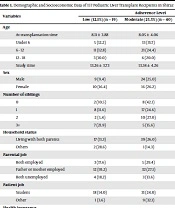
A total of 157 patients participated in this study. The children's mean age was 12.73 ± 4.02 years. There were 96 (61.1%) boys and 61 (38.9%) girls. Demographic and socioeconomic data were compared among the three subgroups, and the results are summarized in Table 1. According to the Morisky adherence scores, 12.1% (n = 19), 25.5% (n = 40), and 62.4% (n = 98) had low, moderate, and high adherence to their medical regimens, respectively. There were no gender differences in the three adherence groups (P = 0.378). One hundred and fifty (95.5%) lived with both parents. Also, there was a significant difference in adherence rate by the education level of the person responsible for supporting the children's medication intake, so the adherence rate was higher in the illiterate/elementary educational group than in the university group (P = 0.031). A low adherence rate was significantly higher in families needing economic support than those without it (P = 0.031).
Table 1.
Demographic and Socioeconomic Data of 157 Pediatric Liver Transplant Recipients in Shiraz
| Variables | Adherence Level | P-Value | ||
|---|---|---|---|---|
| Low (12.1%) (n = 19) | Moderate (25.5%) (n = 40) | High (62.4%) (n = 98) | ||
| Age | ||||
| At transplantation time | 8.11 ± 3.88 | 8.05 ± 4.06 | 9.32 ± 4.17 | 0.184 |
| Under 6 | 5 (12.2) | 13 (31.7) | 23 (56.1) | 0.791 |
| 6 - 12 | 11 (12.8) | 21 (24.4) | 54 (62.8) | |
| 12 - 18 | 3 (10.0) | 6 (20.0) | 21 (70.0) | |
| Study time | 13.26 ± 3.73 | 13.34 ± 4.26 | 12.38 ± 3.98 | 0.376 |
| Sex | 0.378 | |||
| Male | 9 (9.4) | 24 (25.0) | 63 (65.6) | |
| Female | 10 (16.4) | 16 (26.2) | 35 (57.4) | |
| Number of siblings | 0.227 | |||
| 0 | 2 (10.5) | 8 (42.1) | 9 (47.4) | |
| 1 | 8 (11.6) | 17 (24.6) | 44 (63.8) | |
| 2 | 2 (5.4) | 10 (27.0) | 25 (67.6) | |
| 3+ | 7 (21.9) | 5 (15.6) | 20 (62.5) | |
| Household status | 0.361 | |||
| Living with both parents | 17 (11.3) | 39 (26.0) | 94 (62.7) | |
| Others | 2 (28.6) | 1 (14.3) | 4 (57.1) | |
| Parental job | 0.514 | |||
| Both employed | 3 (17.6) | 5 (29.4) | 9 (52.9) | |
| Father or mother employed | 12 (10.2) | 32 (27.1) | 74 (62.7) | |
| Both unemployed | 4 (18.2) | 3 (13.6) | 15 (68.2) | |
| Patient job | 0.264 | |||
| Student | 18 (14.0) | 31 (24.0) | 80 (62.0) | |
| Other | 1 (3.6) | 9 (32.1) | 18 (64.3) | |
| Health insurance | ||||
| Base | 0.307 | |||
| Yes | 19 (12.5) | 40 (26.3) | 93 (61.2) | |
| No | 0 (0) | 0 (0) | 5 (100) | |
| Supplementary | 0.878 | |||
| Yes | 2 (16.7) | 3 (25.0) | 7 (58.3) | |
| No | 17 (11.7) | 37 (25.5) | 91 (62.8) | |
| Parental education level | 0.031 | |||
| Illiterate/elementary | 0 (0) | 4 (13.8) | 25 (86.2) | |
| Diploma & under diploma | 16 (16.5) | 25 (27.5) | 51 (56.0) | |
| University | 4 (12.1) | 9 (27.3) | 20 (60.6) | |
| Patient education level | 0.474 | |||
| Illiterate/elementary | 10 (11.9) | 20 (23.8) | 54 (64.5) | |
| Under diploma | 7 (12.7) | 12 (21.8) | 36 (65.5) | |
| Diploma & university | 2 (12.5) | 7 (43.8) | 7 (43.8) | |
| Family income (per 1 million Tomans) | 0.821 | |||
| < 1 | 6 (13.0) | 11 (23.9) | 29 (63.0) | |
| 1 to 1.5 | 4 (10.0) | 9 (22.5) | 27 (67.5) | |
| > 1.5 | 8 (13.6) | 18 (30.5) | 33 (55.9) | |
| Economic support status | 0.031 | |||
| Yes | 3 (27.3) | 0 (0) | 8 (72.7) | |
| No | 14 (9.8) | 39 (27.3) | 90 (62.9) | |
| Person responsible for supporting the children's medication-taking | 0.546 | |||
| Patient | 4 (8.5) | 14 (29.8) | 29 (61.7) | |
| Family | 15 (13.6) | 26 (23.6) | 69 (62.7) | |
The medical factors according to different levels of adherence are summarized in Table 2. The most common causes of liver diseases in this population were genetic and metabolic diseases (44.6% of participants). However, indications for liver transplants were not significantly different in the subgroups. Receiving medication instruction and interval from transplant were significantly associated with adherence subgroups, so those in the high-adherence subgroups were more frequently recipients of medication instructions (P = 0.020) and had a shorter interval from transplantation (P < 0.001). A total of 128 children (85.3%) had no comorbidities, but 105 (66.87%) had experienced hospitalization after liver transplantation. The distribution of the need for subsequent hospitalization and comorbidities was not different by adherence subgroups (P > 0.05).
Table 2.
Medical Variables Among 157 Pediatric Liver Transplant Recipients in Shiraz
| Variables | Adherence Level | P-Value | ||
|---|---|---|---|---|
| Low (n = 19) | Moderate (n = 40) | High (n = 98) | ||
| Follow-up time after transplant, y | 5.15 ± 3.82 | 5.29 ± 3.64 | 3.06 ± 2.54 | < 0.001 |
| Distance to center, min | 982 ± 681 | 571 ± 454 | 791 ± 671 | 0.054 |
| Comorbidities | 0.428 | |||
| Yes | 4 (18.8) | 3 (13.6) | 15 (68.1) | |
| No | 15 (11.7) | 32 (25.0) | 81 (62.3) | |
| Receiving medication instruction | 0.020 | |||
| Yes | 18 (12.8) | 31 (22.0) | 92 (65.2) | |
| No | 1 (6.2) | 9 (56.2) | 6 (37.5) | |
| Indication for liver transplantation | 0.479 | |||
| Cryptogenic | 3 (15.0) | 4 (20.0) | 13 (65.0) | |
| Genetic-metabolic diseases | 4 (5.7) | 21 (30.0) | 45 (64.3) | |
| Autoimmune liver diseases | 2 (15.4) | 3 (23.1) | 8 (61.5) | |
| Biliary atresia/PFIC | 7 (20.0) | 9 (25.7) | 19 (54.3) | |
| Others | 3 (15.8) | 3 (15.8) | 13 (68.4) | |
| Hospitalization after liver transplantation | 0.250 | |||
| Yes | 15 (14.3) | 29 (27.6) | 61 (58.1) | |
| No | 4 (7.7) | 11 (21.2) | 37 (71.2) | |
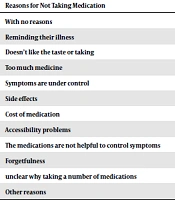
Non-adherence reasons are listed in Table 3. Based on patient statements, too much medicine, cost, accessibility, forgetfulness, and reminding their illness were significantly different among the three levels of adherence (P < 0.050). The presence of any of these factors was associated with a higher rate of low adherence.
Table 3.
Self-reported Reasons for Medication Non-adherence Among 157 Pediatric Liver Transplant Recipients in Shiraz
| Non-adherence Reasons | Total | Adherence Level | P-Value | ||
|---|---|---|---|---|---|
| Low (n = 19) | Moderate (n = 40) | High (n = 98) | |||
| With no reasons | 0.079 | ||||
| Yes | 3 | 1 (33.3) | 2 (66.7) | 0 (0) | |
| No | 154 | 18 (11.7) | 38 (24.7) | 98 (63.6) | |
| Reminding their illness | < 0.001 | ||||
| Yes | 22 | 9 (40.9) | 12 (54.5) | 1 (4.5) | |
| No | 135 | 10 (7.4) | 28(20.7) | 97 (71.9) | |
| Taste bad | - | ||||
| Yes | 0 | ||||
| No | 157 | 19 (12.1) | 40 (25.5) | 98 (62.4) | |
| Too much medicine | 0.009 | ||||
| Yes | 3 | 2 (66.7) | 1 (33.3) | 0 (0) | |
| No | 154 | 17 (11.0) | 39 (25.3) | 98 (63.6) | |
| Symptoms are under control | 0.229 | ||||
| Yes | 1 | 0 (0) | 1 (100) | 0 (0) | |
| No | 156 | 19 (12.2) | 39 (25.0) | 98 (62.8) | |
| Medications side effects | - | ||||
| Yes | 0 | ||||
| No | 157 | 19 (12.1) | 40 (25.5) | 98 (62.4) | |
| Cost of medications | 0.029 | ||||
| Yes | 4 | 1 (25.0) | 3 (75.0) | 0 (0) | |
| No | 153 | 18 (11.8) | 37 (24.2) | 98 (64.1) | |
| Accessibility problems | < 0.001 | ||||
| Yes | 4 | 3 (75.0) | 1 (25.0) | 0 (0) | |
| No | 153 | 16 (10.5) | 39 (25.5) | 98 (64.1) | |
| Medications do not help control symptoms | - | ||||
| Yes | 0 | ||||
| No | 157 | 19 (12.1) | 40 (25.5) | 98 (62.4) | |
| Patient forgets | < 0.001 | ||||
| Yes | 34 | 17 (50.0) | 16 (47.1) | 1 (2.9) | |
| No | 123 | 2 (1.6) | 24 (19.5) | 97 (78.9) | |
| Unclear why taking medications | - | ||||
| Yes | 0 | ||||
| No | 157 | 19 (12.1) | 40 (25.5) | 98 (62.4) | |
| Miscellaneous causes a | < 0.001 | ||||
| Yes | 6 | 4 (66.7) | 1 (16.7) | 1 (16.7) | |
| No | 151 | 15 (9.9) | 39 (25.8) | 97 (64.2) | |
a Includes: Failure to take medication due to stubbornness, boredom, long time of medication use
5. Discussion
Medication adherence is a significant cause of graft rejection, post-transplantation morbidity, poor health-related quality of life, and increased healthcare costs in transplant settings. Medication adherence may not routinely be evaluated in the clinical care of organ recipients in all centers, making it an important neglected issue in LT recipients. Adolescents are more susceptible to medication non-adherence, and the consequences of non-adherence remain with them for a long time (10, 11).
We found that 12% and 25.4% of the LT recipients belonged to low and moderate adherence groups, respectively. Two systematic reviews reported a wide adherence level of 27 to 94% among LT children and adolescents (4, 12). Differences in methodology, data collection, practice patterns, and cultural variations may partly explain such a wide variation.
In our study, we found that medication instruction, economic support status, parental educational level, and follow-up time after transplant significantly differed among the three adherence groups, highlighting the targets for intervention.
Other studies reported low socioeconomic status as a risk factor for non-adherence among organ transplant recipients (10, 13, 14). However, a study from Kuwait showed that adherence to nutritional modification was not increased with rising income levels among renal transplant recipients. Other factors, such as lack of family support, less access to tasty food, and irregular follow-up, seem to contribute to this result (15). Another study reported that family income had no association with medication adherence after transplant (16).
In our study, patients whose parents were unemployed had a higher level of adherence.
Also, those with more educated parents had less adherence than illiterate parents. The reverse relationship between education and medication adherence was reported previously, attributing to greater trust in medical instruction among patients with lower education (17).
In our study, household status (living with parents) did not make any remarkable difference in adherence. Other studies showed that in the case of living with a single parent, family disturbance might result in medication non-adherence and, consequently, poor health outcomes (12, 14). The role of the family is most prominent in the adolescents' development period; the adolescents whose parents supervised and supported them in the medication-taking experience achieved higher adherence (18). Most transplanted children in our study lived with both parents, which could be a reason for the lack of difference among the three levels of adherence. However, no single factor consistently influenced medication compliance.
We did not find any differences in age between the adherence subgroups since most of our subjects were adolescents. The older age of pediatric patients was a risk factor for non-adherence (12). The age of 12 is the transitional age for the responsibility of taking medication, which is also a crucial time for adolescents' psychological and physiological development. Nevertheless, the ability to follow treatment plans for a long time without the help of the family is limited in adolescents. Therefore, non-adherence is high among adolescents with liver transplantation (4, 12).
Our study identified forgetfulness, cost, and the number of medications as non-adherence reasons, which is in the same line with other studies (19, 20). However, convincing patients with chronic diseases to take medicine for a life-long period without forgetting a dose is still challenging for the health system (21).
Time since transplantation significantly differed among the three adherence groups; this aligns with the results of other studies (22, 23). The frequency of clinical visits and drug adherence declines over time in organ transplant recipients. Proper adherence at the beginning will not guarantee adherence in the future; especially without proper monitoring, assessment, and intervention, the probability of persistent non-compliance increases over time (10, 24) although non-adherence is a dynamic process and can happen as single episodes or frequently occur over time (25). Therefore, monitoring of patients' adherence should be considered in every clinical visit, and telephone follow-up should be done in the intervals of clinical visits.
This survey, just like other cross-sectional studies, has some intrinsic limitations. We performed our study in a single-center outpatient clinic with findings that may not extrapolate to other settings; however, pediatric LT is merely performed in Shiraz Transplant Center in Iran, providing a unique situation to study a diverse population from different parts of the country in a single clinic. Selection and recall bias might have contaminated our findings. Moreover, it should be noted that our results are based on self-reported data, which may be subject to social desirability bias. Our findings revealed a low likelihood of non-adherence in our clinic associated with identifiable potential etiologies, which can be the target of quality improvement interventions to improve adherence and outcomes. To the best of our knowledge, this is the first study that evaluated the adherence level to medications among pediatric liver transplant recipients in Iran, making this study unique and valuable. On the other hand, screening for non-adherence could promote the implementation of interventions that improve self-care, adherence, and outcome.
5.1. Conclusions
The medication adherence rate in this study was similar to those of other studies. Non-adherent pediatric transplant recipients are susceptible to post-transplant complications and rejection, so we suggest interventions to reduce non-adherence among such patients. Interventions on the risk factors may improve medical regimen adherence and decrease adverse events. We suggest a text messaging reminder intervention or mobile application for reducing forgetfulness and motivating children to have regular clinical visits. We also recommend the preparation of supportive packages to decrease economic problems.
Understanding obstacles to medication adherence is essential for policymakers and clinicians in planning interventions and communicating with adolescents about their treatment. On the other hand, special training courses should be held for adolescents and their parents to prepare them for the transition of treatment responsibilities and self-management.