
1. Background
Infantile colic represents a significant challenge for infants during the initial three months following birth (1). This condition is common, affecting around 20% of infants in Western societies within the first three months postpartum (2-4). Similarly, in Iran, the prevalence is reported to be 20% according to the Wessel criteria (5). The benign yet significant impact of colic calls for prompt diagnosis and management to mitigate associated issues such as family anxiety, premature cessation of breastfeeding, overfeeding, strained parent-child relationships, and the risk of child abuse (6-8).
The long-term consequences of infantile colic include behavioral issues, sleep disturbances, and episodes of wheezing. Studies have linked colic to hyperactivity, a decrease in IQ at preschool age, and the development of asthma or atopic conditions in childhood (9-12). Several etiological factors have been investigated, ranging from parental mental health to intestinal disturbances, lactase deficiency, and reflux (13-22).
Migraine, a neurological condition marked by an increased sensitivity to stimuli, affects roughly 10 to 12% of the population, with women being three times more likely to suffer from it (23-25). It is crucial to acknowledge that migraines can occur at any age, including childhood, challenging the previous belief that migraines commence only around puberty (26). Genetic factors are believed to contribute significantly, as demonstrated by the more than doubled risk of infantile colic in the offspring of mothers with migraines (22, 27). Additionally, the repercussions of infantile colic may persist beyond infancy. Recent studies have indicated possible long-lasting effects, such as an elevated risk of childhood functional gastrointestinal disorders (FGIDs) (9) and a greater chance of recurrent abdominal pain in adolescence (13). These insights underscore the need to comprehend the enduring influence of infantile colic and its possible link to various health outcomes across childhood and adolescence.
Focusing specifically on maternal migraines and their correlation with infantile colic, this study narrows down the research question, thereby enhancing its potential to yield significant insights and adding to the body of knowledge by exploring a particular facet of the connection between maternal health and infantile colic. The evidence suggests that infantile colic might act as an early indicator of migraine tendencies in life (28).
2. Objectives
Given the significant prevalence of this condition and the impact of infantile colic on both infants and their parents' lives, the current study was conducted to explore the relationship between maternal migraines and infantile colic, with the objective of identifying the factors contributing to its occurrence.
3. Methods
3.1. Study Design and Sample
This case-control study was carried out in 2022 at the pediatric clinic of Rafsanjan University of Medical Sciences, focusing on infants under the age of 4 months who were referred to the clinic for colic. Drawing from the research conducted by Kaymaz et al. (27), the determined sample size was 154, divided equally with 77 participants in each group. This decision was based on the estimated prevalence of infantile colic in the case group (P1 = 31%) and in the control group (P2 = 12%), with
Sampling was conducted using the convenience sampling method, and the case group (infants with colic) and the control group (normal infants) were matched for age and gender through individual matching.
3.2. Data Collection
The data collection instrument was a checklist developed by the researcher, encompassing details such as the ages of the mother and infant, the infant's gender, gravidity, gestational age, birth weight, feeding type (breastfeeding, formula feeding, and mixed feeding), and history of migraines in both parents, along with questions regarding the mother's migraine symptoms based on the International Headache Society (IHS) criteria.
For the case group, inclusion criteria included a pediatrician's confirmation of infantile colic according to the Wessel criteria, being under 4 months of age, and parents' willingness and informed consent to participate. The control group's inclusion criteria were being younger than 4 months and obtaining informed consent from the parents. Exclusion criteria for both groups included underlying diseases (based on self-report), otitis media or urinary tract infections (confirmed by urine analysis and culture) (29), low birth weight, prematurity, diarrhea, persistent abdominal distension, vomiting, growth retardation, and refusal to participate in the study. Following the Rafsanjan University of Medical Sciences Ethics Committee's approval and the acquisition of necessary permissions, mothers of eligible infants were selected, and the checklist was completed.
3.3. Measures
Migraine diagnosis adhered to IHS criteria, requiring a history of at least five headache episodes with specific characteristics lasting from 4 to 72 hours, featuring at least two of four symptoms (unilateral location, pulsating quality, moderate or severe intensity, exacerbation by or causing avoidance of routine physical activity) and accompanied by nausea, vomiting, or sensitivity to light and sound (30). Colic was diagnosed using the Wessel criteria, which entail crying for more than 3 hours a day, more than 3 days a week, for over 3 weeks, although the latter requirement is often disregarded as parents typically seek medical advice before reaching the three-week mark (31).
3.4. Ethics Considerations
All parents of the participating patients completed an informed consent form prior to the study. The ethics approval number is IR.RUMS.REC.1400.249 was granted by the Ethics Committee of the Rafsanjan University of Medical Sciences, Rafsanjan, Iran. All methods employed in this study comply with the Declaration of Helsinki.
3.5. Statistical Analysis
Data collected were analyzed using SPSS software, version 24. Results for quantitative data are presented as "mean ± standard deviation" and "range," while qualitative data are reported as "number (percentage)." The independent two-sample t-test was utilized to compare the means of quantitative variables between the two groups. Additionally, the chi-square test was employed to compare the frequency distribution of qualitative variables between the groups. A multivariate stepwise logistic regression model was developed for factors related to infantile colic, with the association of independent predictors with infantile colic reported in the final model as odds ratios (OR) with 95% confidence intervals (CI). The model's discrimination was assessed using the c statistic, equivalent to the area under the ROC curve. Model calibration was estimated using the Hosmer-Lemeshow (HL) goodness-of-fit statistic (with higher p-values indicating better fit to the observed data). Variables were included in the multivariate model if their P-value in the univariate analysis was ≤ 0.20. The normality of the distribution of quantitative variables' frequencies was verified using the Kolmogorov-Smirnov non-parametric test and by assessing skewness and kurtosis indices, with no violation of this assumption observed (P > 0.05). A significance level of 0.05 was adopted for the tests.
4. Results
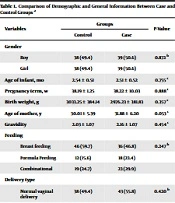
In the study, which included 154 infants, the average age was 2.53 ± 0.51 months, with an equal gender distribution of 50% boys, and the average birth weight was 3004.74 ± 382.81 grams. Breastfeeding was the main feeding method for 53.2% of the infants, 19.5% were formula-fed, and the rest received mixed feeding. The average age of the mothers was 30.95 ± 5.87 years, with a mean gestational age of 38.21 ± 1.14 weeks and an average gravidity of 2.09 ± 1.07. Normal vaginal delivery (NVD) was the method of birth for 52.6% of the deliveries. Furthermore, 34.4% of mothers reported having a history of migraine, and 47.4% of the infants had a family history of migraine. Importantly, the occurrence of a family history of migraine was significantly more common in the case group than in the control group (59.7% vs. 35.1%, P = 0.002), as shown in Table 1.
Table 1.
Comparison of Demographic and General Information Between Case and Control Groups a
| Variables | Groups | P-Value | |
|---|---|---|---|
| Control | Case | ||
| Gender | |||
| Boy | 38 (49.4) | 39 (50.6) | 0.872 b |
| Girl | 38 (49.4) | 39 (50.6) | |
| Age of infant, mo | 2.54 ± 0.51 | 2.51 ± 0.52 | 0.755 c |
| Pregnancy term, w | 38.19 ± 1.25 | 38.22 ± 10.03 | 0.888 c |
| Birth weight, g | 3033.25 ± 384.14 | 2976.23 ± 381.83 | 0.357 c |
| Age of mother, y | 30.01 ± 5.39 | 31.88 ± 6.20 | 0.053 c |
| Gravidity | 2.03 ± 1.07 | 2.16 ± 1.07 | 0.454 c |
| Feeding | |||
| Breast feeding | 46 (59.7) | 36 (46.8) | 0.247 b |
| Formula feeding | 12 (15.6) | 18 (23.4) | |
| Combinational | 19 (24.7) | 23 (29.9) | |
| Delivery type | |||
| Normal vaginal delivery | 38 (49.4) | 43 (55.8) | 0.420 b |
| Cesarean delivery | 39 (50.6) | 34 (44.2) | |
| Family history of migraine | 27 (35.1) | 46 (59.7) | 0.003 b |
a Values are expressed as mean ± SD or No. (%).
b Chi-square test and significance level is 0.05.
c Independent t-test and significance level is 0.05.
The findings showed a significantly higher prevalence of maternal migraine history in infants with colic, with an odds ratio of 6.17 (95% confidence interval [CI] 2.73 – 14.44), compared to the control group (53.2% vs. 15.6%, P < 0.001). Additionally, upon stratification by maternal age, infant age, and the infant's gender, the case group consistently demonstrated a significantly greater frequency of maternal migraine history than the control group, as outlined in Table 2.
Table 2.
Comparison of Mother's History of Migraine Between Infants in the Case and Control Groups
| Variables | Total (N = 154) | Case (N = 77) | Control (N = 77) | Odds Ratio (95% Confidence Interval) | P-Value a |
|---|---|---|---|---|---|
| Maternal migraine | 6.17 (2.73 - 14.44) | < 0.001 | |||
| No | 53 (34.4) | 41 (53.2) | 12 (15.6) | ||
| Yes | 101 (65.6) | 36 (46.8) | 65 (84.4) | ||
| Age group of mother | |||||
| Under 30 years old | 4.80 (1.40 - 17.71) | 0.004 | |||
| With maternal migraine | 20 (27.8) | 14 (45.2) | 6 (14.6) | ||
| Without maternal migraine | 52 (72.2) | 17 (54.8) | 35 (85.4) | ||
| More than 30 years old | 7.11 (2.26 - 24.49) | < 0.001 | |||
| With maternal migraine | 33 (40.2) | 27 (58.7) | 6 (16.7) | ||
| Without maternal migraine | 49 (59.8) | 19 (41.3) | 30 (83.3) | ||
| The age group of Infant | |||||
| Under 2 months | 13.53 (3.15 - 78.76) | < 0.001 | |||
| With maternal migraine | 24 (35.3) | 21 (58.3) | 3 (9.4) | ||
| Without maternal migraine | 44 (64.7) | 15 (41.7) | 29 (90.6) | ||
| More than 2 months | 3.81 (1.34 - 11.21) | 0.005 | |||
| With maternal migraine | 29 (33.7) | 20 (48.8) | 9 (20.0) | ||
| Without maternal migraine | 57 (66.3) | 21 (51.2) | 36 (80.0) | ||
| Gender | |||||
| Boy | 15.18 (4.04 - 67.27) | < 0.001 | |||
| With maternal migraine | 29 (37.7) | 25 (64.1) | 4 (10.5) | ||
| Without maternal migraine | 48 (62.3) | 14 (35.9) | 34 (89.5) | ||
| Girl | 2.82 (0.93 - 8.93) | 0.041 | |||
| With maternal migraine | 24 (31.2) | 16 (42.1) | 8 (20.5) | ||
| Without maternal migraine | 53 (68.8) | 22 (57.9) | 31 (79.5) |
a Chi-square test and significance level is 0.05.
Multivariable stepwise logistic regression pinpointed predictors of infantile colic. The initial analysis, which included all variables such as the infant's age and gender, the mother's age, type of delivery, gravidity, gestational age, birth weight, type of feeding, maternal history of migraine, and family history of migraine, found that only maternal age, maternal history of migraine, and family history of migraine had a P-value of ≤ 0.20. These variables were then included in the multivariate regression model. Despite significant associations in univariate analysis between maternal history of migraine, maternal age, and family history of migraine with infantile colic, the multivariate model—after adjusting for maternal age and family history of migraine—showed that a maternal history of migraine independently increased the risk of infantile colic fivefold (OR = 5.008, 95% CI: 2.258 – 11.104, P < 0.001), as reported in Table 3.
Table 3.
Logistic Regression for Determining the Predictive Factors of Infantile Colic a
| Variables | Unadjusted Regression Analysis | Adjusted Regression Analysis | ||||||
|---|---|---|---|---|---|---|---|---|
| Odds Ratio | 95% Confidence Interval | P-Value | Odds Ratio | 95% Confidence Interval | P-Value | |||
| Upper Limit | Lower Limit | Upper Limit | Lower Limit | |||||
| Mother's age | 1.057 | 1.000 | 1.118 | 0.050 | 1.040 | 0.978 | 1.107 | 0.210 |
| History of maternal migraine | 6.169 | 2.881 | 13.209 | < 0.001 | 5.008 | 2.258 | 11.104 | < 0.001 |
| History of family migraine | 2.748 | 1.430 | 5.280 | 0.002 | 1.674 | 0.810 | 3.458 | 0.164 |
a The model is adjusted based on the variables of the mother's age and family history of migraine.
5. Discussion
The findings of this study indicate a significant association between the history of maternal migraine and infantile colic, with a notably higher prevalence of maternal migraines observed in infants suffering from colic compared to those without. Similarly, a family history of migraines was significantly more common in infants with colic. These outcomes align with the systematic review by Firooz et al., which identified maternal history of migraine as a key predisposing factor for infantile colic (32). Abbasi et al. explored the link between infantile colic and parental migraines in infants aged 4 to 12 weeks, finding that histories of parental (either father or mother) and specifically maternal migraines were significantly more prevalent in infants with colic, echoing the results of our study (33). Additionally, research has shown that mothers with migraines are over twice as likely to have offspring with colic (22), and further studies have confirmed the linkage between maternal migraine and infantile colic. Notably, an increase in infantile colic rates was associated with prophylactic iron supplementation during pregnancy and a higher incidence of postpartum depression among mothers. Gynecological factors, such as a history of migraines, premenstrual symptoms, dysmenorrhea, and an increased pre-pregnancy body mass index, were highlighted as significant factors in the development of infantile colic (27). The age-specific pattern in infants suggests colic may reflect a progressive neurological process (34). Retrospective studies have also found a correlation between infantile colic and the later development of migraines in childhood or adolescence (35). The link between migraine and infantile colic may be explained by a genetic predisposition to migraines and the infant's brain's heightened sensitivity to external stimuli, manifesting as excessive crying (22).
Crying, as part of a neurodevelopmental process, may intensify during the first weeks of life but tends to decrease as the infant's perceptual abilities and brain's processing capacity improve (36). A prospective cohort study in Finland demonstrated that infants with a history of colic were more likely to develop migraines without aura by age 18 (37), suggesting that, given the genetic basis of migraines, infantile colic could be an early indicator of migraines in life (28). Gelfand et al. conducted studies in 2019 and 2012 where, in the former, a frequency of maternal headaches of 15 or more days per month was significantly linked to an elevated risk of infantile colic, though a similar association was noted for paternal migraines (38, 39). An earlier study, consistent with our findings, showed that maternal migraines were associated with an increased risk of infantile colic, thereby reinforcing the notion of a genetic predisposition to migraines and suggesting that infantile colic might be an early manifestation of migraines (40).
Contrary to our findings, Ali did not observe a significant difference in maternal or paternal migraine prevalence between colic and non-colic children, thus not identifying a specific risk factor for infantile colic in their study (41). However, their results align with ours regarding the lack of significant differences in gender, delivery type, and infant feeding patterns between infants with and without colic. The disparities between these studies could stem from variations in sample size, demographic characteristics, and data collection methodologies. Conversely, Kaymaz et al. aimed to identify perinatal maternal risk factors for infantile colic in Turkey and found that infants of mothers who took iron supplements during pregnancy were more prone to colic. The case group exhibited a higher incidence of postpartum depression. The study also noted significant associations between the development of infantile colic and maternal migraines, premenstrual symptoms, dysmenorrhea, and a high pre-pregnancy body mass index (27).
Hence, it appears that a variety of factors influence infantile colic, as suggested by different studies. It is essential to consider these variables for a more accurate assessment of the relationship between maternal migraines and infantile colic. In our study, after adjusting for maternal age and family history of migraine, a maternal history of migraine was found to increase the risk of infantile colic fivefold. It is important to remember that the odds ratio more significantly indicates the strength of an association than its precise magnitude, warranting cautious interpretation of the results.
Prescribing medication for maternal migraines during pregnancy and lactation should be approached with caution due to potential risks to the fetus or breastfeeding infant. A thorough understanding of the severity of maternal migraines and consideration of other covariables can offer a more complete perspective on their relationship with infantile colic. Genetic counseling and preventive measures may be advantageous for families with a migraine history. Supporting mothers through stress-reduction techniques and promoting a healthy lifestyle could improve maternal well-being. Future studies with larger sample sizes could improve the generalizability of findings.
5.1. Limitations
This study's limitations include limited sample size, which affects the generalizability of the findings, and the possibility that mothers suffering from migraine-related photophobia might overreport their infants' crying, potentially skewing colic diagnoses. Furthermore, this research did not examine factors such as the severity of maternal migraines or the presence of mood disorders in parents. To overcome these limitations, future research should utilize a validated instrument to measure the duration and intensity of infants' crying accurately and account for confounding factors like maternal medication use, patient ethnicity, and dietary practices. Given the complex nature of infantile colic, it is essential for future studies to explore a range of variables, including psychological and physical factors, medication use, socioeconomic status, maternal diet, and exposure to smoking at home. Although a more substantial sample size would have enhanced the study's robustness, the nature of this research and the recognized limitations necessitate caution in conclusively linking maternal migraines to infantile colic.
5.2. Conclusions
The findings of this study indicate a statistically significant link between maternal migraines and infantile colic, proposing that maternal migraines may be considered a risk factor for colic in infants.