
1. Background
The concept of unmet health needs, as defined by Carr and Wolfe, denotes the disparity between required healthcare and the actual provision of health services (1). Globally, untreated caries in permanent teeth ranked as the most widespread condition, while untreated caries in deciduous teeth ranked 10th in prevalence in 2010 (2). The burden of untreated oral conditions increased to 3.09 billion people globally in 2019 (3).
Africa and Southeast Asia had a higher prevalence of unmet dental treatment needs (DTN) than other World Health Organization regions, with rates of 58.9% and 72.3%, respectively (4). In 2017, nearly half of South Korea’s population (43.9%) reported unmet DTN (5). Based on data from the 2017 - 2020 National Health and Nutrition Examination Survey, the prevalence of untreated caries in the adult population of the United States was 21.3% (6). According to Canada’s 2007 - 2009 national report, 20% of the population had unmet DTN (7), and 32% of elementary school students in Vancouver required interventional treatment (8).
However, the incidence of unmet DTN in Iran exceeds the aforementioned figures. In Mashhad, Iran, 95.3% of primary school children required dental treatment, particularly in permanent first molars, with fissure sealant application and filling identified as the most essential forms of DTN (9). Despite this report, no data are currently available on unmet DTN in Iran.
Untreated dental diseases can lead to problems with eating, speaking, and sleeping, thereby directly affecting oral health-related quality of life (10). These oral and dental health problems pose substantial economic and social challenges, particularly in developing countries with limited access to preventive dentistry practices (11). Moreover, when addressing these treatment needs, families encounter various barriers, including inadequate insurance coverage, a shortage of service providers, and children’s apprehension toward dental procedures (12-14).
To address these challenges, the Ministry of Health in Iran implemented a national oral health promotion program in 2015. This initiative sought to assess the dental health and treatment needs of elementary school students. Parents were notified about their children’s DTN and were directed to urban and rural health centers for general treatments, such as extraction, restoration, and fissure sealant. Alternatively, they could seek specialized treatments, such as pulp therapy for their children’s permanent first molars, at the school of dentistry, with financial coverage through insurance services.
2. Objectives
The current study was designed to assess unmet and new DTN and their underlying causes among 10 - 12-year-old Iranian children in Babol after 3 years of implementing the national oral health promotion program.
3. Methods
The present study received approval from the ethics committee of Health Research Institute at Babol University of Medical Sciences (reference code: IR.MUBABOL.HRI.REC.1397.191). Parents of the children involved in the study were informed about the scientific goals of the research. They were also made aware of the voluntary nature of participation and their right to withdraw from the study at any time. Additionally, only children with informed consent forms were included in the evaluation.
Based on findings from the initial examination conducted in 2015 (15), the prevalence of DTN was approximately 80%. With a desired study accuracy of 95% (α = 0.05), a sample size of 254 students was determined. The study participants were selected from individuals enrolled in the Ministry of Health’s oral health promotion plan in 2015, drawn from six elementary schools using a random stratified method proportional to each school’s population relative to the total number of students. Subsequently, after a 3-year interval, 254 of the same students were randomly selected for re-examination.
Examinations followed World Health Organization (WHO) criteria for dental caries using the DMFT index and were carried out by two senior dentistry students who underwent training and clinical calibration under the supervision of academic members from the Community Oral Health Department at the School of Dentistry. The assessments were conducted using a dental mirror and dental explorer in well-lit environments at various schools. The inter-examiner agreement coefficient exceeded 80%.
Treatment needs were classified as follows: (1) need for extraction, which included teeth deemed non-treatable; (2) need for specialty treatment (pulp therapy), which included teeth requiring treatment at the second or third level of prevention and not available through general dentistry at health centers; (3) need for restoration, which referred to teeth not requiring pulp therapy; and (4) need for fissure sealant, which included teeth requiring fissure sealant application. Assessments were also conducted to determine whether individuals were caries-free or needed scaling.
Parents were asked to complete a checklist to identify the reasons preventing them from visiting a dentist and to clarify the causes of their children’s unmet DTN during the 3-year period. Based on the data from both previous and current examinations, the numbers of unmet and new DTN among participants, as well as unmet and new DTN specifically related to first permanent molars, were recorded.
The data were analyzed using SPSS software version 26. Unmet DTN were compared by gender and age using the chi-square test. A multiple linear regression model was used to examine the influence of reported barriers on unmet DTN, adjusting for gender and age. Regression coefficients (B), 95% confidence intervals (CIs), and P-values were reported. The significance level was set at P < 0.05.
4. Results
Figure 1 illustrates the patient selection process and the distribution of DTN
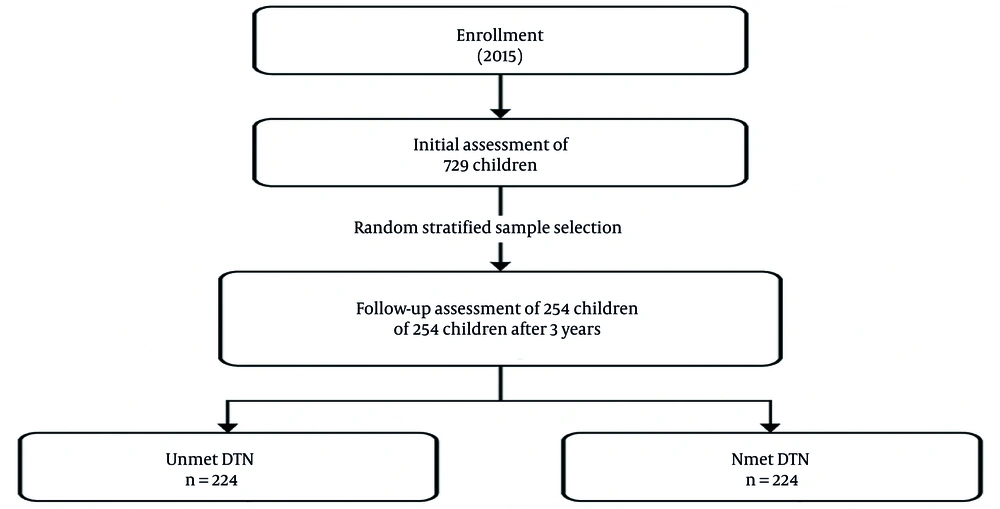
Figure 1.
Patient selection process and distribution of dental treatment needs.
Table 1 displays the frequency of children with unmet or new DTN. Of the 254 students assessed (50% girls; 22% 10-year-olds, 56% 11-year-olds, and 22% 12-year-olds), a total of 224 students (88.2%) had unmet DTN in both primary and permanent teeth, with a higher prevalence among boys (P = 0.022). However, no significant difference in unmet DTN was observed according to age (P = 0.313). Additionally, 48.1% of students had unmet DTN in their primary teeth, and this proportion decreased with increasing age (P = 0.001).
Table 1.
Frequency of Children With Unmet or New Dental Treatment Needs (DTN) of All Teeth and Permanent First Molars by Age and Gender Among 10 - 12-Year-Old Students in Babol, Iran a
| Teeth | Type of DTN | Total | Age 10 y | Age 11 y | Age 12 y | P-Value | Boy | Girl | P-Value |
|---|---|---|---|---|---|---|---|---|---|
| All teeth | Unmet | 224 (88.2) | 53 (91.4) | 123 (89.1) | 48 (82.8) | 0.3 | 117 (92.9) | 107 (83.6) | 0.02 |
| All teeth | New | 224 (88.2) | 53 (91.4) | 117 (84.8) | 54 (93.1) | 0.2 | 110 (87.3) | 114 (89.1) | 0.7 |
| Permanent first molars | Unmet | 209 (82.3) | 45 (77.6) | 116 (84.1) | 48 (82.8) | 0.6 | 105 (83.3) | 104 (81.3) | 0.7 |
| Permanent first molars | New | 180 (70.9) | 39 (67.2) | 98 (71) | 43 (74.1) | 0.7 | 87 (69) | 93 (72.7) | 0.5 |
a Values are presented as No. (%) unless otherwise indicated.
Among the subjects, 224 (88.2%) had new DTN in both primary and permanent teeth. However, no significant difference in new DTN was observed according to age (P = 0.178) or gender (P = 0.664).
Regarding permanent first molars, 82.3% of participants had unmet DTN, and 70.9% had new DTN. However, no significant difference in the frequency of these needs was observed according to age or gender.
Table 2 presents the frequency of children with various unmet or new DTN in all teeth or permanent first molars. The most common unmet and new DTN in all teeth and permanent first molars were fissure sealant therapy and restorative treatment, respectively.
Table 2.
Frequency of Students With Unmet or New Dental Treatment Needs (DTN) of All Teeth and Permanent First Molars by Different Needs Among 10 - 12-Year-Old Students in Babol, Iran a
| Teeth | Need Type | Extraction | Pulp Therapy | Restorative | Fissure Sealant |
|---|---|---|---|---|---|
| All teeth | Unmet DTN | 10 (4) | 103 (40.6) | 129 (50.8) | 169 (66.5) |
| All teeth | New DTN | 55 (21.7) | 74 (29.1) | 159 (62.6) | 114 (44.9) |
| Permanent first molars | Unmet DTN | 0 (0) | 7 (2.8) | 97 (38.2) | 168 (66.1) |
| Permanent first molars | New DTN | 6 (2.4) | 26 (10.3) | 124 (48.9) | 60 (23.7) |
a Values are presented as No. (%) unless otherwise indicated.
Figure 2 illustrates the average number of all teeth and permanent first molars with unmet or new DTN categorized by different needs among the examined children.
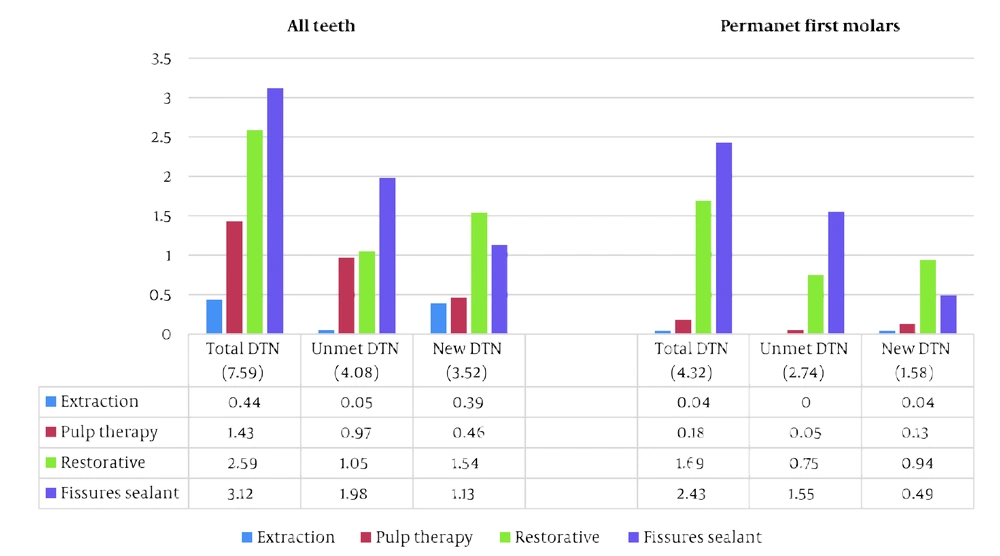
Figure 2.
Average number of teeth with unmet or new dental treatment needs (DTN) by different needs among 10 - 12-year-old students in Babol, Iran
After the 3-year follow-up, among all examined teeth, 1026 teeth had unmet DTN, averaging 4 teeth per person, and 893 teeth had new DTN, averaging 3.5 teeth per person. Additionally, 696 first permanent molars, averaging 2.7 teeth per person, had unmet DTN, and 401 first permanent molars, averaging 1.6 teeth per person, had new DTN.
The percentage of caries-free children increased from 2% to 4%, while the proportion of those requiring scaling increased from 26% to 55% after the 3-year follow-up.
Among parents, 234 completed the checklists, yielding a response rate of 92.1%. In total, 166 parents (70.9%) indicated that it was challenging for them to visit the dentist when their children had dental problems, with no significant difference observed between boys and girls (P = 0.845).
The predominant barriers reported by parents were high dental treatment costs (56%), followed by children’s fear of dental treatment (13.7%) and lack of availability and limitations of public dental services (13.2%). In the regression model, high dental treatment costs remained a significant barrier (B = 0.73; 95% CI, 0.07 - 1.39; P = 0.03).
5. Discussion
The findings revealed that 88% of children, or 9 of every 10, had unmet and new DTN 3 years after their last examination. The most common types of DTN were fissure sealant, restorative treatment, pulp therapy, and tooth extraction, in that order. On average, each child had 4 teeth with unmet DTN and 3.5 teeth with new DTN.
These results suggest that the children in the current study had a significantly higher rate of unmet DTN than those in countries with more developed healthcare systems. The observed frequency of children with unmet and new DTN in this study, representing a sample from a small city in Iran, raises concerns about a potentially substantial future burden of dental problems for the national healthcare system.
Findings from a previous similar study conducted in Mashhad, Iran, in 2010 (9), align with the results of the current study, indicating a high prevalence of unmet and new DTN specifically in first permanent molars. In contrast to communities with developed healthcare systems, where the caries prevalence rate of first permanent molars has ranged from 48% to 61% (16-19), more than 80% of subjects in our study had unmet DTN, and more than 70% had new DTN in their first permanent molars. These findings underscore the urgency of addressing oral health disparities and implementing effective preventive and treatment measures in these regions.
The prevalence of unmet DTN among American children aged 6 - 11 years decreased from 24.5% for primary teeth to 8% for permanent teeth, potentially due to the transition from primary to permanent dentition (
Unmet DTN not only directly affect oral health-related quality of life (10) but also impose a financial burden, which is a significant predictor of unmet oral and dental treatment needs (13, 14, 20). The findings of the present study also showed that most parents experienced challenges in taking their children to the dentist for dental problems. More than half cited the high costs of dental services as the primary obstacle, followed by children’s fear of dentists and limited access to government services. This issue extends beyond our study and echoes a pattern observed in developed countries. Abdelrehim et al. reported that 34% of Ontarians in 2014 avoided visiting a dental professional in the previous 3 years due to cost, a notable increase from 22% in 2003 (21). Subsidized care programs, particularly those targeting low-income families, along with child-friendly and fear-reduction interventions, such as behavior management and sedation dentistry, could help mitigate barriers to treatment.
To tackle these recognized obstacles, the Ministry of Health in Iran implemented a national oral health promotion program targeting primary school children. Initially, dental health assessments of all Iranian elementary students were conducted by dentists at schools and health centers. Subsequently, health centers in rural areas, along with selected health centers in urban areas, were empowered to deliver complimentary prevention-focused dental care. Services included fissure sealant application and non-invasive fillings for permanent teeth, specifically for first permanent molars, with uptake rates estimated at less than 50% based on follow-up evaluations.
Despite the successful implementation of the needs assessment plan nationwide, the provision of dental care at health centers encountered several barriers. These challenges included restricted financial support from the Ministry of Health, limited enthusiasm among health center dentists to participate in the plan, inadequate information reaching families, suboptimal quality of certain dental procedures, and insufficient emphasis on prevention-based dental care at health centers.
The notable prevalence of unmet DTN among the children in this study indicates a failure of the national oral health promotion plan to address students’ dental care needs over a 3-year period. These findings were communicated to regional health authorities, with recommendations to expand preventive services, increase dentist participation in national programs, and improve access for underserved populations. To more accurately assess the effectiveness of this national initiative, future evaluations should incorporate data from a broader range of regions across Iran.
One key limitation of this study is its relatively small sample size, drawn from a single geographic area, which may limit the generalizability of the findings. Future research should include control groups and involve larger, more diverse populations across multiple regions to enhance external validity and better isolate the effects of interventions, such as national health plans.
Additionally, parental self-reports, although valuable, may be influenced by recall or social desirability bias. No direct comparison with clinical records was conducted in this study, which limits the ability to objectively validate reported barriers. Researchers should interpret these findings with caution. Future studies should cross-validate parental reports with children’s clinical records and treatment logs from health centers to improve the accuracy of barrier identification.
Nearly all children under study exhibited unmet and new DTN after the 3-year follow-up, emphasizing the need for enhanced follow-through in oral healthcare programs. The primary unmet and new DTN centered on fissure sealant and restorative treatment. These results underscore a substantial disparity between the identified needs during assessments and the oral healthcare plans that were implemented. Clinicians should be encouraged to prioritize early preventive care, especially for first permanent molars, and advocate for improved access to affordable dental services. School-based dental programs and enhanced communication with parents may also help mitigate treatment gaps.