
1. Background
Puberty is a multidimensional process characterized by a growth surge and physical maturation. It begins with the appearance of secondary sexual characteristics and culminates in the cessation of height growth and the attainment of reproductive ability (1). Generally, the first sign of puberty in females is breast growth (thelarche), followed by pubic hair growth (pubarche), and eventually the onset of menstruation (menarche). During puberty, adolescents experience a rapid and significant increase in height and weight, commonly referred to as a growth spurt (2). In girls, this growth spurt typically occurs in early puberty, peaking at stages 2 - 3 of thelarche and almost always preceding menarche (1, 3).
During early puberty, height growth is driven by the elongation of long bones. The hormonal regulation of the growth spurt and changes in body composition during puberty result from the interaction of growth hormone, sex steroids, leptin, and gonadotropins (4, 5). Although the timing, duration, and intensity of growth spurts vary among individuals and populations, it is generally observed that the onset of growth spurts occurs at an average age of 11 to 12 years (6). The reported maximum height gain after menarche varies across different racial and ethnic groups of adolescent females (7, 8). Several factors influence height growth after menarche, including race and ethnicity, socioeconomic status, parental height, age of menarche, and height at the onset of menstruation (7, 9, 10). However, these findings are often limited to specific ethnic groups and cannot be generalized due to the significant role of race and ethnicity in this context.
Additionally, the literature presents conflicting findings regarding the association of these factors with final adult height. While most studies suggest that an earlier age of menarche is associated with a lower final adult height, some studies report contradictory findings (10-13). A study conducted in Iran indicated a relationship between height potential and the stages of thelarche and pubarche in adolescents (14).
Short stature can negatively impact body image, self-confidence, and quality of life for both men and women (15, 16). In Iran, as in many other countries, the age of menarche has decreased in recent years, likely due to increasing Body Mass Index (BMI), improved socioeconomic conditions, and reduced physical activity (17, 18). Consequently, more parents are visiting endocrinology clinics with concerns about the cessation of height growth following their daughters' first menstruation (19). Many parents inquire whether their daughters' height will continue to increase after menarche and may even request interventions to delay the onset of menstruation to promote greater adult height.
2. Objectives
This study was conducted to investigate the average height growth of Iranian girls after their first menstruation.
3. Methods
3.1. Study Design
The present analytical cross-sectional study was conducted to investigate height increase after menarche. The medical records of female adolescents who attended pediatric endocrinology clinics at the time of menarche, between 2001 and 2018, with concerns about post-menarche height, were reviewed. After obtaining parental consent, the necessary information was extracted from the participants' medical records. This included demographic data, birth weight, birth order, height, weight, BMI, breast development and pubic hair stage according to Tanner's sexual maturity ratings (SMRs), and the amount of height increase up to three years after the first menstruation.
3.2. Study Area
The current study was conducted in the outpatient pediatric endocrinology clinics of Hamadan, a city located in western Iran.
3.3. Study Population
This study included all female teenagers who visited pediatric endocrinology clinics in Hamadan either at the time of menarche or within one month after menarche and were followed up for three years. Girls whose growth had completed and who did not experience any height increase within one year after the three-year follow-up period were included. Exclusion criteria were lack of consent from patients or their parents to participate in the study, incomplete medical records, presence of chronic diseases, or the use of medications that could affect growth, such as corticosteroids or growth hormone. Additionally, girls who experienced precocious puberty and had their menarche before the age of 10 years were excluded from the study.
3.4. Sampling Method
Convenience sampling was employed, and all eligible patients were included in the study.
3.5. Statistical Analysis
The statistical package for the social sciences (SPSS) version 26 (Chicago, IL, USA) was used for data analysis. The mean, minimum, maximum, and standard deviation were calculated to describe quantitative variables, while percentages and frequencies were used to describe qualitative variables. The Kolmogorov-Smirnov test was employed to assess the normality of the height change variable distribution, which was found to be non-normal. Consequently, nonparametric tests were utilized. The Spearman correlation test was applied to evaluate the correlation between height change and other continuous variables. Additionally, the Kruskal-Wallis test was conducted to identify significant differences between various groups. When significant differences were observed in the Kruskal-Wallis test, Dunn's test was performed to determine which specific groups differed significantly from one another. A P-value less than 0.05 was considered statistically significant.
4. Results
Ninety-one adolescent girls participated in the study. The average age at menarche was 11.93 ± 1.27 years. The mean height, weight, and BMI at menarche were 150.43 ± 4.38 cm (range 142 - 163 cm), 43.84 ± 6.58 kg (range 31 - 64 kg), and 19.38 ± 2.71 (range 14 - 26.8), respectively. Three years after menarche, the mean height, weight, and BMI were 158.31 ± 4.79 cm (range 147 - 173 cm), 53.48 ± 8.24 kg (range 37.5 - 76 kg), and 21.27 ± 2.9 (range 16.4 - 30.1), respectively. The average height increase over the three years following menarche was 7.98 ± 3.47 cm (range 2 - 19 cm). These results represent unadjusted estimates. The frequencies of height-for-age and weight-for-age percentiles at the time of menarche are illustrated in Figure 1.
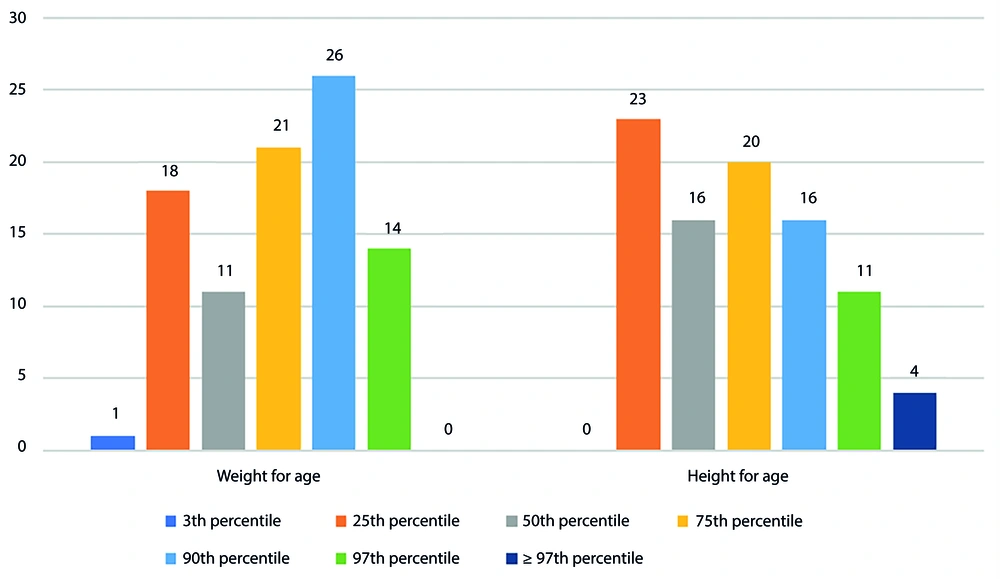
Figure 1.
Frequencies of each height for age and weight for age percentiles at the time of menarche
The sexual maturity rating (SMR), or Tanner Scale, was used to stage secondary sexual characteristics (20). For pubic hair growth, 13 girls (4.3%) were at stage 3, 65 girls (71.4%) were at stage 4, and 13 girls (14.3%) were at stage 5. For breast development, 8 girls (8.8%) were at stage 3, 69 girls (75.8%) were at stage 4, and 14 girls (15.4%) were at stage 5.
Table 1 shows the relationships between height growth after menarche and the following variables: age, height, weight, and BMI at the onset of menarche, birth weight, birth order, and number of family members.
Table 1.
Spearman Correlation Between Height Growth After Menarche and Various Variables
| Independent Variables | Spearman's ρ | P-Value |
|---|---|---|
| Age of menarche | -0.397 a | < 0.001 b |
| Weight | 0.152 | 0.154 |
| Height | -0.301 a | 0.004 b |
| BMI | 0.152 | 0.154 |
| Birth weight | 0.101 | 0.341 |
| Birth order | -0.050 a | 0.638 |
| Number of family members | -0.039 a | 0.714 |
Abbreviation: BMI, Body Mass Index.
a Negative Spearman ρ indicates negative monotonic relationship.
b The P-values < 0.05 were considered significant.
Our study demonstrated a significant inverse correlation between post-menarche height growth and both the age of menarche (P < 0.001) and height at the onset of menarche (P = 0.004). No statistically significant relationship was identified between height growth and other variables, as shown in Table 1.
We conducted a nonparametric Kruskal-Wallis test to compare height growth across different stages of pubarche and thelarche. However, the analysis did not reveal any statistically significant differences in height growth between the stages of pubarche (P = 0.205) or thelarche (P = 0.623).
Additionally, the Kruskal-Wallis test was employed to compare post-menarche height growth across various height and weight percentiles at the time of menarche. The analysis revealed statistically significant differences in post-menarche height growth between the height percentiles (P = 0.023) and weight percentiles (P = 0.027). Dunn's test was subsequently conducted to identify specific groups with significant differences.
The results indicated that post-menarche height growth was significantly lower in the 25th height percentile group compared to the 75th percentile (P = 0.033) and the 90th percentile (P = 0.022) (Figure 2). Similarly, height growth after menarche was significantly lower in the 25th weight percentile group compared to the 50th (P = 0.039), 75th (P = 0.025), 90th (P = 0.001), and 97th percentiles (P = 0.002) (Figure 3).
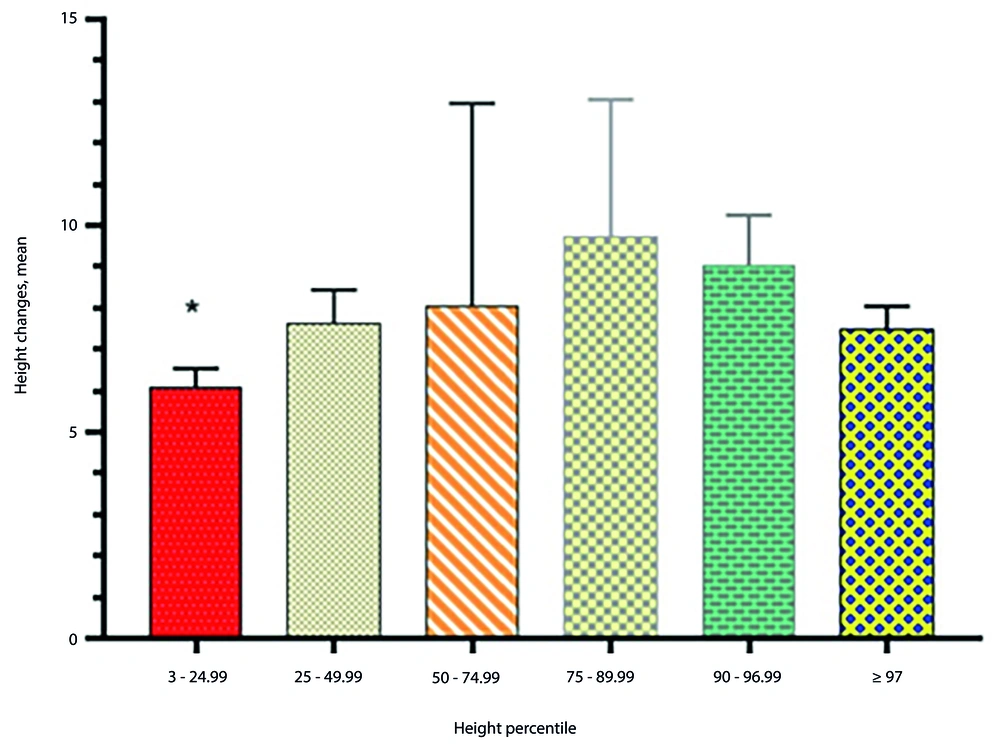
Figure 2.
Post-menarche height growth across height percentiles at the time of menarche. * Indicates that the height increase after menarche was significantly lower in the 25th height percentile group compared to the 75th and 90th percentiles.
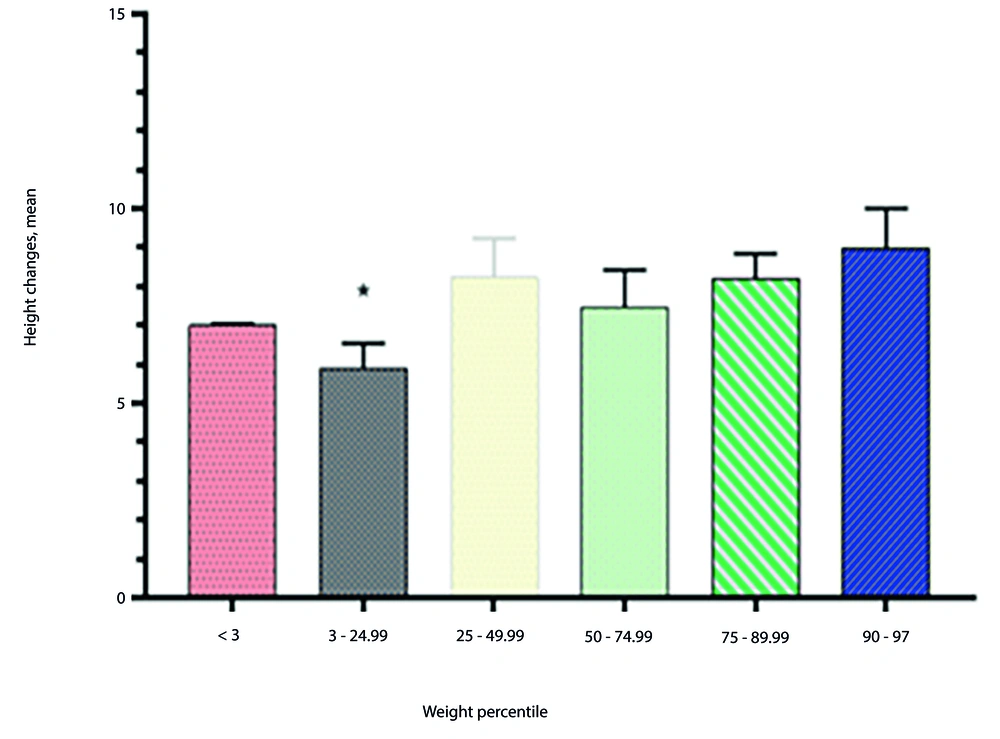
Figure 3.
Post-menarche height growth across weight percentiles at the time of menarche. * Indicates that the height increase after menarche was significantly lower in the 25th weight percentile group compared to the 50th, 75th, 90th, and 97th percentiles.
5. Discussion
In this study, we evaluated post-menarche height growth in adolescents and examined its correlation with various factors. The mean age of menarche among participants in our study was slightly lower than the average age reported for Iranian girls in other studies (18). This difference may be attributed to the fact that parents referred their daughters to the endocrinology clinic due to concerns about early menarche.
Our findings indicated that the mean height at menarche for the participants was 150.43 ± 4.38 cm. Other studies have reported a greater mean height at menarche for Iranian girls. For example, a study involving 400 students in eastern Iran reported a mean menarche height of 157.84 ± 6.75 cm, and another study on Iranian girls found a mean height at menarche of 156.35 ± 5.37 cm. These differences could be explained by variations in study populations. Our study population consisted of girls attending clinics due to concerns about post-menarche height growth, whereas the other studies were conducted on the general population.
We observed an average height increase of 7.98 ± 3.47 cm during the three years following menarche. Although no prior studies in Iran have examined post-menarche height growth using the same methodology, our findings align with those from other countries. For instance, a study on Chilean girls found an average height increase of 6.6 ± 2.5 cm during the four years after menarche (8). Similarly, a cohort study of Brazilian girls reported a mean height increase of 7.54 ± 3.35 cm five years after menarche (21). While the girls in our study did not receive any medical treatment, they may have been given advice on lifestyle changes to support growth, which could limit the generalizability of our findings.
Our study also identified a negative correlation between the age of menarche and post-menarche height growth. The relationship between menarche age and subsequent height growth remains a topic of debate. A study by Gaete et al. in 2024 classified participants into three groups based on their age at menarche: Younger than 11 years, 11 - 13 years, and older than 13 years. It found that adolescents who experienced menarche before the age of 11 had significantly greater height growth compared to those in the other groups (8). The study revealed that although girls with an earlier age of menarche experience faster post-menarche height growth velocity, their final adult height tends to be shorter than that of girls with a later age of menarche (8). A study conducted in Korea found that an earlier onset of menarche in young Korean females was associated with a reduced final height of 0.445 cm per year (22). Similarly, a cohort study in the United States demonstrated that a later onset of menarche was associated with a final height increase of 1.3 cm per year (12). Additionally, a study in Chile reported a negative correlation between height growth after menarche and the age of menarche (7).
Several longitudinal studies conducted in various regions worldwide have indicated that although the age of menarche has been decreasing in recent years, final adult height has been increasing (10, 13, 23). However, these findings should be interpreted with caution, considering the influence of various confounding factors. For example, a study investigating trends in menarche age and adult height across nine European countries showed that while the age of menarche and adult height follow a similar trend in most countries, females who reach menarche at younger ages tend to have shorter adult heights (10).
The current study also revealed an inverse correlation between height at menarche and post-menarche height gain, consistent with findings from the study by Gaete et al. (7). Furthermore, this study examined the association between height growth and the stages of pubarche and thelarche. Over time, the age at which pubarche and thelarche occur has been decreasing, raising concerns about the potential impacts on final adult height (19, 24). However, our findings indicated no significant differences in post-menarche height growth between the different stages of pubarche and thelarche.
The relationship between birth weight and post-menarche height growth is complex and influenced by various factors. We found no correlation between these two variables. A cohort study conducted in the United States exploring the correlation between birth weight and near-adult height in girls discovered that girls with higher birth weights demonstrated accelerated pre-menarcheal growth. For every 1 kg increase in birth weight, these girls were found to be 2.9 cm taller (12). In contrast, a study on Japanese girls revealed that birth weight and height were not significantly correlated with weight and height at the age of nineteen years (25).
In the current study, no correlation was identified between post-menarcheal height growth and BMI or weight at the time of menarche. These findings are consistent with a previous study by Gaete et al. (7).
Our study has two main limitations. First, this study employed a retrospective design, which restricts the ability to control potential biases, such as selection bias and recall bias. Selection bias limits the sample's capacity to accurately represent the target population, while recall bias undermines the accuracy of findings derived from participants' memories. Additionally, the absence of a longer follow-up period is a significant limitation of the current study. Second, the study may be biased because it only included girls brought to the clinic due to parental concerns about short adult height. As a result, the findings may not be generalizable to the broader population. However, there are few studies on the growth of Iranian girls after their first menstruation. Therefore, this study contributes valuable knowledge to this field.
In conclusion, the mean height increase after the first menstruation was 7.98 ± 3.47 cm (ranging from 2 to 19 cm) during the three years following menarche. Post-menarche growth was inversely correlated only with the age of menstruation onset and the height at menarche. However, more research is needed to more accurately estimate post-menarcheal height growth in the general population of girls to address the concerns of patients and parents about post-menarcheal height growth.