
1. Introduction
Sjögren’s syndrome (SS) is a chronic, systemic autoimmune disease characterized by immune-mediated destruction of the salivary and lacrimal glands, leading to classic symptoms such as dry mouth and dry eyes (1). Although dryness is often a key clinical clue, studies have shown that autoantibodies may be present years before the onset of symptoms, indicating that the underlying autoimmune process precedes clinical diagnosis (2).
The 2002 American-European Consensus Group (AECG) classification criteria for primary SS required the presence of four out of six standardized features: oral and ocular dryness symptoms, ocular signs (e.g., Schirmer’s test or ocular staining), evidence of salivary gland involvement (e.g., reduced salivary flow, abnormal sialography, or scintigraphy), positive minor salivary gland biopsy, and/or positive serology (anti-SSA/Ro and/or anti-SSB/La antibodies) (3). In 2016, the American College of Rheumatology (ACR) and the European League Against Rheumatism (EULAR) developed updated criteria, introducing a weighted scoring system and incorporating extraglandular manifestations, significantly shifting from previous versions (4, 5).
However, these adult-based criteria often fail to capture pediatric SS cases, many of which do not meet the established diagnostic thresholds. This discrepancy may be due to different clinical presentations in children, variations in test performance, and reduced utilization of invasive diagnostic procedures (5). Notably, the hallmark sicca symptoms, referring to dryness of the eyes (xerophthalmia) and mouth (xerostomia), are uncommon in pediatric populations, who more frequently present with parotitis or nonspecific complaints such as arthralgia (6).
While acute and recurrent pericarditis is a recognized cardiac manifestation in autoimmune diseases like systemic lupus erythematosus and rheumatoid arthritis, cardiac and/or lung involvement in SS is rare and typically asymptomatic, notably in adult patients (7-11). To date, recurrent pericarditis as an initial presenting feature of SS in children has not been reported.
Here, we describe a pediatric case of SS in a previously undiagnosed child who presented with recurrent pericarditis as the initial and sole clinical manifestation, ultimately leading to the diagnosis of underlying SS.
2. Case Presentation
A 16-year-old male presented to the pediatric outpatient clinic with a six-month history of intermittent fever and unintentional weight loss. His past medical history was unremarkable except for a tonsillectomy at age five. There was no history of trauma or chronic illness. The patient's family history was negative for rheumatic diseases, and there was no parental consanguinity. However, a family history of pulmonary tuberculosis was noted in his aunt, grandfather, and grandmother.
Two months prior to this presentation, the patient had been hospitalized for one month due to pericarditis. During that admission, he underwent an extensive evaluation for malignancy due to mediastinal lymphadenopathy observed on imaging. A bone marrow biopsy was performed, but no findings suggestive of lymphoma were identified. He was discharged under follow-up by the pediatric hematology-oncology clinic.
However, persistent elevation in acute-phase reactants, particularly ferritin, prompted referral to our center for further evaluation. The patient also reported back pain, fatigue, and persistent low-grade fever.
On physical examination, there were no signs of arthritis or joint swelling. The Schirmer test was negative for decreased tear production, with a result of 12 mm in each eye. Initial laboratory investigations revealed leukocytosis and elevated C-reactive protein levels and fibrinogen. Cardiac enzymes were negative. Although liver enzymes were mildly elevated, coagulation parameters were within normal limits (Table 1). Given the recurrent and unexplained symptoms, further laboratory evaluations were performed (Table 1). Genetic studies regarding MEFV mutation and MTHFR heterozygosity were negative.
Table 1.
Comprehensive Laboratory and Immunological Profile of a 16-Year-Old Male with Primary Sjögren's Syndrome Presenting with Recurrent Pericarditis a
| Parameters | Value | Reference Range |
|---|---|---|
| Hematological parameters | ||
| Hemoglobin (g/dL) | 13 | 11 - 14.5 |
| White blood cell count (×10³/mm³) | 19.99 | 3.84 - 9.84 |
| Neutrophil count (×10³/mm³) | 14.34 | 1.54 - 7.04 |
| Platelet count (×10³/mm³) | 280 | 150 - 400 |
| Mean corpuscular volume (fL) | 93.7 | 76.7 - 89.2 |
| Inflammatory markers | ||
| C-reactive protein (mg/dL) | 245 | 0.5 - 5 |
| Erythrocyte sedimentation rate (mm/h) | 47 | 0 - 15 |
| Fibrinogen (mg/dL) | >900 | 193 - 412 |
| Ferritin (ng/mL) | 649 | 30 - 400 |
| Interleukin-6 (pg/mL) | 152 | 0 - 7 |
| D-dimer (mg/L FEU) | 5.8 | 0 - 0.5 |
| Cardiac marker | ||
| N-terminal pro-BNP (pg/mL) | 636 | 0 - 92.6 |
| Autoimmune serological markers | ||
| Anti-Ro52 autoantibody (U/mL) | 34 (positive) | < 10 |
| Anti-SSA-Ro | 1+ (positive) | Negative |
| Anti-SSB-La | Negative | Negative |
| Rheumatoid factor (IU/mL) | 18 (positive) | < 14 |
| Anti-nuclear antibody (ANA) | Negative | Negative |
| Anti-cyclic citrullinated peptide (U/mL) | 3 (negative) | < 20 |
| Anti-dsDNA (ELISA) (IU/mL) | 2.8 (negative) | < 50 |
| ANCA panel | ||
| PR3-ANCA (U/mL) | 1.33 (negative) | < 10 |
| MPO-ANCA (U/mL) | 0.54 (negative) | < 5 |
| Antiphospholipid panel | ||
| Anti-beta2 glycoprotein IgM (U/mL) | 1.37 (negative) | < 10 |
| Anti-beta2 glycoprotein IgG (U/mL) | 0.75 (negative) | < 10 |
| Anticardiolipin IgM (U/mL) | 0.55 (negative) | < 8 |
| Anticardiolipin IgG (U/mL) | 1.29 (negative) | < 8 |
| Lupus anticoagulant (sec) | 40.1 (normal) | 31 - 44 |
| Complement levels | ||
| Complement 3 (mg/dL) | 157 | 90 - 180 |
| Complement 4 (mg/dL) | 16 | 10 - 40 |
| Immunoglobulin profile | ||
| IgG (g/L) | 8.54 | 5.95 - 13.1 |
| IgG1 (g/L) | 6.2 | 3.62 - 10.27 |
| IgG2 (g/L) | 1.77 | 0.81 - 4.72 |
| IgG3 (g/L) | 0.39 | 0.138 - 1.058 |
| IgG4 (g/L) | 0.19 | 0.049 - 1.985 |
| IgA (g/L) | 0.56 | 0.61 - 3.48 |
| IgM (g/L) | 1.06 | 0.23 - 2.59 |
| IgE (IU/mL) | 16.9 | < 100 |
| Other parameters | ||
| Angiotensin-converting enzyme (U/L) | 45 | 8 - 52 |
| Homocysteine (µmol/L) | 16.6 | 5 - 15 |
| Epstein-Barr virus IgM (U/mL) | 24.73 (positive) | < 20 |
| Epstein-Barr virus IgG (U/mL) | 2.93 (negative) | < 20 |
Abbreviations: ANCA, anti-neutrophil cytoplasmic antibody; BNP: B-type natriuretic peptide; ELISA, enzyme-linked immunosorbent assay; FEU, fibrinogen equivalent units; Ig: immunoglobulin; MPO, myeloperoxidase; PR3, proteinase 3; SS, Sjögren's syndrome.
a This comprehensive profile demonstrates a marked inflammatory response with significantly elevated acute-phase reactants, positive autoimmune serology specific for Sjögren's syndrome (anti-Ro52 and anti-SSA-Ro), and a normal immunoglobulin profile except for slightly decreased IgA levels. The constellation of findings, when considered alongside histopathological evidence of focal lymphocytic sialadenitis (focus score: 1,76), supports the diagnosis of primary Sjögren's syndrome in this adolescent patient presenting with recurrent pericarditis.
Abdominal ultrasonography was unremarkable. Transthoracic echocardiography identified a 13-mm pericardial effusion that was reduced to 5 mm on repeated echocardiography. The cervical ultrasonography revealed lymph nodes in the right supraclavicular region, the largest measuring 8 × 5 mm, with echogenic features, an indistinct hilum, hilar vascularity, and an ovoid shape. Brain magnetic resonance imaging (MRI) demonstrated a slight increase in the cerebrospinal fluid space around the retroorbital segments of both optic nerves. Additionally, triangular T2A/FLAIR hyperintensities were seen adjacent to the frontal horns of both lateral ventricles. Bone marrow aspiration and biopsy showed normal findings.
Given these findings, consultations with pediatric infectious diseases and rheumatology were requested for further evaluation. Supportive treatment was initiated, including intravenous ceftriaxone (2 × 2 g/day) and intravenous fluids with potassium supplementation. Additionally, the patient was started on colchicine (Colchicum-Dispert, 0.5 mg tablet, Recordati Drugs, Tekirdag, Turkey) at a dose of 0.5 mg three times daily for the treatment of relapsing acute pericarditis. After several days of an initial fever-free period, he again developed daily fever spikes. Magnetic resonance imaging angiography of the abdomen, thorax, and kidneys showed no abnormalities. As symptoms persisted, ibuprofen (Nurofen, 400 mg tablet, Abdi Ibrahim Drugs, Istanbul, Turkey) 400 mg three times daily and pantoprazole once a day (Pantpas, 40 mg tablet, Abdi Ibrahim Drugs, Istanbul, Turkey) were added to his treatment.
Thoracic computed tomography revealed multiple millimetric mediastinal and bilateral hilar lymph nodes, pericardial effusion, and a minimal left-sided pleural effusion. One week later, repeat cervical ultrasonography revealed lymphadenopathies in the left supra-mandibular and supra-jugular chains, the largest measuring 13 × 5 mm, with preserved fatty hilum and hilar vascularization.
An incisional biopsy was performed from the lower lip for histopathological evaluation of the minor salivary glands. The total area of examined glandular tissue was 6.8 mm². Three lymphocytic foci were identified, with a periductal distribution. The calculated focus score was 1.76 per 4 mm². No germinal center formation, plasma cell infiltration within or outside the lymphocytic foci, or fibrosis was observed. The findings were consistent with focal lymphocytic sialadenitis. Based on the histomorphologic features, the biopsy was compatible with minor salivary gland involvement of SS (Figure 1).
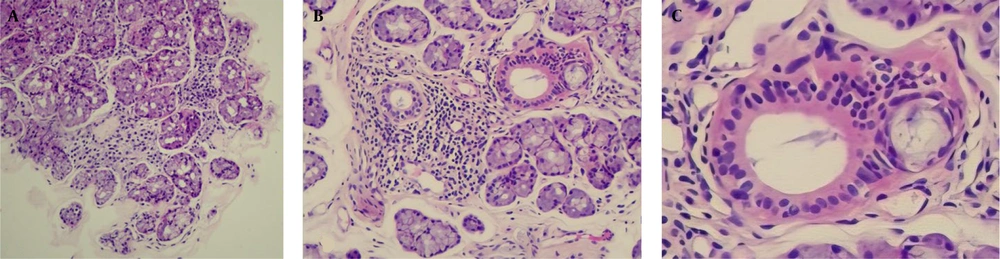
Figure 1.
A, representative histological section showing prominent lymphocytic infiltration, suggestive of possible focal lymphocytic sialadenitis. A reduction in acinar structures and areas of fibrosis are also observed (Hematoxylin and Eosin, × 100). B, histological section demonstrating dense periductal and periacinar mononuclear cell infiltration, predominantly composed of lymphocytes. Multiple focus-like areas (an aggregate of ≥ 50 mononuclear cells within 4 mm²) are visible, suggesting a focus score ≥ 1 (Hematoxylin and Eosin, × 200). C, high-power histological image showing prominent mononuclear cell infiltration, particularly lymphocytes, surrounding epithelial structures. Marked periductal lymphocytic infiltration is associated with epithelial distortion. Infiltration of lymphocytes into the ductal epithelium — referred to as lymphoepithelial lesions — is evident. At least one focal lymphocytic aggregate is visible (Hematoxylin and Eosin, × 400).
With this diagnosis, treatment was initiated with hydroxychloroquine sulphate (Plaquenil, 200 mg, Sanofi Drugs, Kirklareli, Turkey) twice daily, colchicine (Colchicum-Dispert, 0.5 mg tablet, Recordati Drugs, Tekirdag, Turkey) at a dose of 0.5 mg three times daily, and mycophenolate mofetil (Cellcept, 500 mg tablet, Roche S.p.A., Segrate, Italy) 500 mg three times daily.
During the follow-up period of 12 months, the patient remained clinically stable with no recurrence of pericardial effusion. Serial echocardiographic evaluations demonstrated complete resolution of pericardial fluid, and inflammatory markers progressively normalized. The patient continued routine outpatient monitoring for cardiac and autoimmune manifestations, with sustained improvement under appropriate therapy.
3. Discussion
As a well-characterized autoimmune disease in adults, SS remains underrecognized in pediatric populations due to its rare occurrence and atypical presentation. While sicca symptoms dominate adult cases, children with SS often lack these classic features, making early diagnosis challenging. Among the diverse systemic manifestations of SS, cardiac involvement is exceedingly rare, particularly in the pediatric population. Recurrent pericarditis is an uncommon and atypical initial presentation of SS in any age group, and to our knowledge, has not been previously reported as the sole presenting symptom in a child. The clinical significance of this case lies in its diagnostic complexity and its contribution to the limited literature on pediatric SS, emphasizing the need for heightened clinical suspicion when evaluating children with recurrent, idiopathic pericarditis.
Our patient was a previously healthy 16-year-old male with no family history of autoimmune disease who presented with recurrent pericarditis, persistent fever, and constitutional symptoms in the absence of classic sicca features. The diagnosis of SS was confirmed histologically via a minor salivary gland biopsy. Following the diagnosis, the patient was successfully treated with hydroxychloroquine, colchicine, and mycophenolate mofetil, and remained clinically stable during six months of follow-up.
The precise incidence and frequency of pediatric SS remain uncertain. Previous studies reported a limited number of children with pediatric SS 5 (12-15). Based on the Sjögren Big Data Registry, it has been thought that the estimated frequency of childhood-onset primary SS is around 1% (12). The diagnosis was made between ages 12 and 14 in large pediatric SS studies (5, 12, 13, 16). Contrary to the fact that most adult and pediatric SS cases were female (13, 17), our case is notable for involving a male patient, which is less commonly reported in pediatric SS, adding further to the uniqueness of the presentation.
The systemic phenotype of primary SS is strongly influenced by demographic characteristics such as age, gender, ethnicity, and place of residence, influencing the expression of systemic disease at diagnosis (18). Childhood-onset primary SS involves a clinical phenotype dominated by sicca features, parotid enlargement, and systemic disease, which is modulated by age at diagnosis (12). Children diagnosed at 10 - 14 years showed the highest systemic activity phenotype, with a higher frequency of anti-Ro antibodies and a higher frequency of systemic activity in the constitutional domain (fever, night sweats, and weight loss) (12, 19). Besides parotitis, the most frequently reported clinical SS-specific feature in children was extraglandular manifestations, and joint involvement was also a common clinical feature (16, 20, 21). However, in comparison to the adult SS population, a series of primary childhood SS cases from the United States (6) and Japan (22) found a lower prevalence of xerostomia and keratoconjunctivitis sicca. In contrast to these typical pediatric presentations, our patient lacked both sicca symptoms and parotid gland enlargement and presented instead with isolated recurrent pericarditis, highlighting an atypical and diagnostically challenging phenotype.
Although cardiac involvement in SS is uncommon and typically asymptomatic (23), systemic lupus erythematosus, undifferentiated connective-tissue disease, and SS were the most frequent systemic inflammatory diseases associated with acute pericarditis with pleural effusion as the initial presenting sign among adult patients (24). Most evidence is present in case reports and small case series (25). Acute pericarditis with and without pleural involvement was very rare as the initial presenting symptom in adult SS patients (7-11). The unique feature of this case report is that it is the first report showing both pericardial and pleural effusions in one child who was diagnosed with SS. This presentation markedly differs from the typical pediatric SS phenotype, which usually includes sicca symptoms or glandular enlargement, underscoring the rarity and diagnostic complexity of our patient's extraglandular-dominant manifestation.
Recent reports, such as the case of recurrent pericardial effusion associated with panhypopituitarism, further emphasize the broad differential diagnosis required when evaluating recurrent pericarditis in children (26). Moreover, pediatric cardiac involvement secondary to infectious or autoimmune etiologies has been documented in recent studies, highlighting the importance of comprehensive evaluation in similar presentations (27).
Within this clinical context, our patient's isolated positivity for Ro52 antibodies is particularly noteworthy. Although anti-Ro/SSA is one of the most frequent serological pieces of evidence for the diagnosis of SS, depending on the different institutional diagnostic criteria, Ro52 positivity alone does not fulfill the diagnostic criteria for SS and lacks specificity when considered in isolation. Positivity for anti-La/SSB, rheumatoid factor, or anti-nuclear antibody is other supportive evidence for its serological diagnosis (6). In cases where serological markers such as anti-SSA-Ro and anti-SSB-La are negative, and classical sicca symptoms are absent or minimal, as is frequently the case in children, diagnosis becomes particularly challenging. Under such circumstances, the persistence of clinical suspicion based on systemic features, such as recurrent pericarditis, necessitates further diagnostic evaluation.
Minor salivary gland biopsy plays a pivotal role in confirming the diagnosis of SS, especially in seronegative patients or those with atypical presentations (6). According to the 2016 ACR/EULAR classification criteria, a positive histopathological finding on salivary gland biopsy (focus score ≥ 1) contributes three points toward the five-point threshold required for diagnosis (4, 5). In many patients with limited serological or clinical findings, such as sicca syndrome, the biopsy result is decisive in reaching a definitive diagnosis. Additionally, salivary gland biopsy is critical for excluding alternative conditions that may mimic SS, such as IgG4-related disease, sarcoidosis, tuberculosis, or lymphoma (17). In our patient, who was Ro52-positive but negative for anti-SSA and anti-SSB antibodies, and who lacked classic sicca symptoms, a minor salivary gland biopsy was indicated to clarify the diagnosis. The presence of focal lymphocytic sialadenitis with a focus score of 1.76 confirmed the diagnosis of SS and supported the initiation of appropriate immunosuppressive therapy.
This case report has several limitations. As with all single-patient reports, the findings may not be generalizable to the broader pediatric population. The absence of sicca symptoms and the rarity of cardiac involvement in SS make it challenging to establish a definitive causal relationship between the recurrent pericarditis and the underlying autoimmune disease. Additionally, while the diagnosis was supported by minor salivary gland biopsy and compatible clinical features, more extensive immunological profiling and long-term follow-up data would provide more substantial support. Finally, the lack of previously reported pediatric SS cases presenting with isolated pericarditis limits our ability to compare and contextualize this presentation within the existing literature.
In conclusion, this case highlights an unusual initial presentation of primary SS in a pediatric patient, manifesting solely as recurrent pericarditis without classic sicca symptoms. Given the rarity of cardiac involvement in SS, particularly in children, this report underscores the importance of considering SS in the differential diagnosis of idiopathic, recurrent pericarditis, even in the absence of glandular features. Early recognition and appropriate immunomodulatory treatment may help prevent systemic complications and improve patient outcomes. Increased awareness among clinicians and a low threshold for autoimmune evaluation in unexplained cases are essential for the timely diagnosis and management of pediatric SS.