1. Background
Indirect inguinal hernia is a common congenital disease among the pediatric population, and its management requires surgical repair (1, 2). Due to the unique anatomy of the inguinal canal in children, it is typically addressed through open hernia repair with high ligation of the hernia sac (3). Due to progress in laparoscopic technology and equipment, laparoscopic methods are now commonly employed for pediatric inguinal hernia repairs, offering an alternative to open procedures (4-6). However, regardless of the intervention method used, a small number of pediatric patients show relapse after surgery. The etiology of recurrent indirect inguinal hernia in pediatric patients is currently understood to be multifactorial and remains incompletely elucidated. Research suggests that recurrence is influenced not only by factors intrinsic to the patient but also significantly by the surgical technique employed. Effective perioperative management strategies may mitigate the risk of recurrence (7, 8). There were only a few studies on recurrent hernia in children. Therefore, further investigation is required to determine which children are prone to relapse and which surgical method is more susceptible to relapse.
2. Objectives
We aimed to summarize our single-center experience of recurrent pediatric inguinal hernia so that pediatric surgeons can better manage children with indirect inguinal hernia.
3. Methods
We retrospectively reviewed indirect inguinal hernia repair cases from January 2014 to December 2024 and searched for reoperation cases wherein repair was performed two times or more at the Second Affiliated Hospital and Yuying Children's Hospital of Wenzhou Medical University (Wenzhou, China). This study included cases of patients with indirect inguinal hernia, irrespective of whether the initial surgical intervention was conducted via open or laparoscopic methods. Additionally, reoperation cases from external institutions, where the primary surgery was performed elsewhere, were considered. Exclusion criteria encompassed patients with incomplete data and those who were intraoperatively diagnosed with concurrent direct inguinal hernia or femoral hernia. Details about the patients' clinical information, such as diagnostic methods, therapeutic interventions, and outcomes, were obtained from the department's database. The ethics committee of the institution approved the protocol for the study involving human materials. The requirement for written informed consent was waived because of the retrospective nature of the study.
4. Results
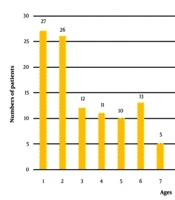
In total, 11219 pediatric inguinal hernia repairs were performed from January 2014 to December 2024. Of these patients, 122 patients [113 (92.6%) male and 9 (7.4%) female; mean age: 4.1 years; range: 1 - 14 years] were judged as reoperation cases. Their clinical features are shown in Table 1. Further, 31.1% of the patients were less than 1 year old during their initial repair, 43.5% were aged 1 to 3 years, and the other 25.4% were between 3 and 14 years old (Figure 1). The median period from the first repair to recurrence was 6 months. The patient group at the first operation consisted of 41 patients with unilateral left, 55 patients with unilateral right, and 26 patients with bilateral hernias. Five patients had a history of incarceration. Comorbidities during the first operation included umbilical hernia (n = 7), biliary atresia (n = 1), cryptorchidism (n = 1), and congenital hypothyroidism (n = 1). In all, 86.1% of patients underwent open surgery during the first operation, and 13.9% of patients underwent laparoscopic surgery. Emergency surgery was not performed in any patient. Table 2. shows the reoperation for recurrent inguinal hernia. Open surgery was employed in 81 patients (66.4%), and laparoscopic surgery was performed in 41 patients (33.6%). Left- and right-sided hernia was reported in 53 (43.4%) and 65 (53.3%) patients, respectively. Apart from one patient who had a scrotal hematoma, no major postoperative complications were reported. All patients were followed up from 3 months to 3 years (mean follow-up period: 20.3 months). No incidences of second recurrence were observed in this study population.
Table 1.
Clinical Features of 122 Patients with Recurrent Inguinal Hernia
| Variables | Hernia Repair Method at the First Operation | No. (%) | |
|---|---|---|---|
| Open Surgery | Laparoscopic Approaches | ||
| Gender | |||
| Male | 100 | 13 | 113 (92.6) |
| Female | 5 | 4 | 9 (7.4) |
| Age at the first operation (y) | |||
| < 1 | 33 | 5 | 38 (31.1) |
| 1 < age < 3 | 47 | 6 | 53 (43.5) |
| 3 < age < 14 | 25 | 6 | 31 (25.4) |
| Laterality at the first operation | |||
| Right | 47 | 8 | 55 (45.1) |
| Left | 34 | 7 | 41 (33.6) |
| Bilateral | 24 | 2 | 26 (21.3) |
| Comorbidities at the first operation | |||
| Umbilical hernia | 7 | 0 | 7 (5.7) |
| Biliary atresia | 1 | 0 | 1 (0.8) |
| Cryptorchidism | 1 | 0 | 1 (0.8) |
| Congenital hypothyroidism | 1 | 0 | 1 (0.8) |
| History of incarceration | 5 | 0 | 5 (4.1) |
| Duration between first operation to recurrence (mo), median (range) | 8 (0.3 - 78) | 4 (0.25 - 58) | |
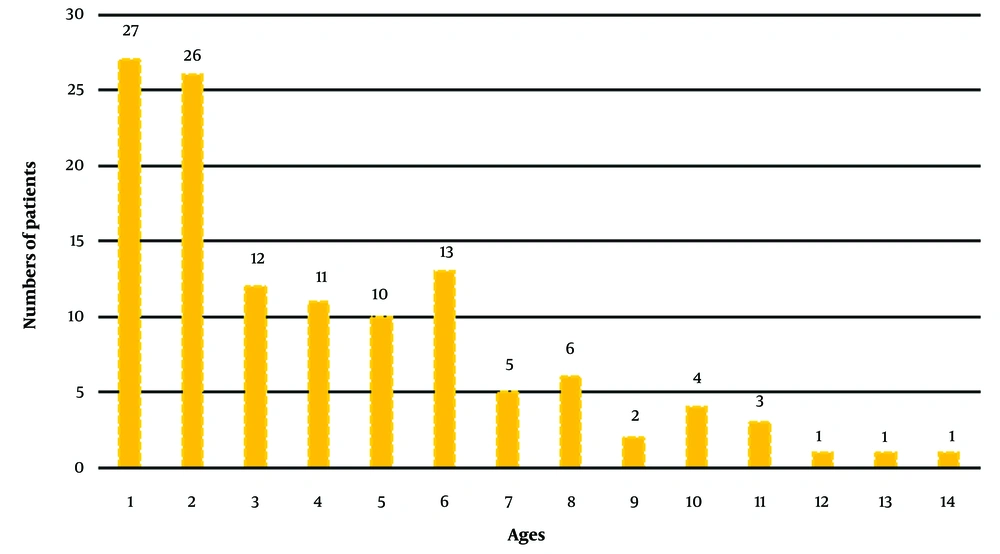
Figure 1.
The numbers of patients at each age in 10-year periods from 2014 to 2024
Table 2.
Clinical Factors of Reoperation
| Variables | No. (%) |
|---|---|
| Technique | |
| Open surgery | 81 (66.4) |
| Laparoscopic approaches | 41 (33.6) |
| Laterality at reoperation | |
| Right | 65 (53.3) |
| Left | 53 (43.4) |
| Bilateral | 4 (3.3) |
| Postoperative complications | |
| Hematoma | 2 (2.4) |
5. Discussion
It is believed that the rate of recurrent inguinal hernias in children is relatively low (9). The incidence in different countries is different, depending on patient selection, surgical skill, and surgical methods. Bisgaard et al. reported an incidence of 0.3% for recurrent pediatric inguinal hernia with 1-year follow-up, while Chin et al. reported an incidence of 1.23% in a series of 3,881 patients in Taiwan (10, 11). In our study, the total recurrent rate was about 1%, which was similar to previous studies. The male-to-female ratio was 12.5:1, with 45.1% right, 33.6% left, and 21.3% bilateral hernias at the first operation. The current series showed a male-to-female ratio of roughly 5:1 (12). The ratio of male to female of recurrent hernia in our study was much higher than the male-to-female incidence ratio in pediatric inguinal hernia. This is due to the risk of anatomical complexity in male patients that could cause disruption of testicular vascularization and the vas deferens (13). Laterality at the first operation was not an independent factor for recurrence. What factors can lead to recurrence of pediatric inguinal hernia? First, children’s own health status is an important risk factor for hernia recurrence. Patients younger than 1 year at the first operation are more likely to experience recurrence (14). Similar observations were shown in our current study. Factors such as prematurity and sustained high abdominal pressure, often due to coughing, constipation, or diarrhea, are also considered risks (15, 16). In addition, certain conditions, including connective tissue disorders like Marfan's and Ehlers-Danlos syndrome, as well as cloacal exstrophy and bladder exstrophy, elevate the risk of recurrent inguinal hernia (9). Those with recurrent incarcerations or anatomical characteristics like a large hernia sac and a wide inner orifice are also vulnerable to relapse (17). Second, the recurrence rate is closely related to the surgical methods. An analysis of recent literature, which included 90 pertinent studies on pediatric inguinal hernia, found significant variations in recurrence rates post-repair, ranging from 0 to 6% for open repair and 0 to 5.5% for laparoscopic repair (18). Furthermore, laparoscopic inguinal hernia repair has become popular, and the two laparoscopic approaches include intraperitoneal and extraperitoneal approaches (19). Shalaby et al. observed that the recurrence rates were 4% for intraperitoneal and 1.3% for extraperitoneal procedures, showing no significant variation (20). Finally, the skill of the surgeon is also an important factor for hernia recurrence. A good pediatric surgeon can select an appropriate method according to the patient’s situation instead of blindly opting for laparoscopic surgery. Surveys conducted recently show that 83 - 87% of pediatric surgeons in Europe and the U.S. still support open repair (21, 22). For an experienced surgeon, any intraoperative maneuver that can minimize trauma and avoid complications such as bleeding and scrotal hematoma is very important. One study reported that an experienced surgeon can achieve a 50% lower recurrence rate than a less experienced surgeon (23). Our study showed the median time from first repair to recurrence was 6 months in our series, with 8 months in the open surgery group and 4 months in the laparoscopic approach group. Grimsby et al. (24) and Shalaby et al. (20) reported that the time from the first repair to recurrence detection is approximately 3.6 to 6 months. One patient who underwent laparoscopic surgery relapsed only a week after surgery. There may be suspicions of technical errors, like loosening of the previous ligation. For most pediatric surgeons, open surgery is the preferred approach for the treatment of recurrent hernia, especially one that is associated with incarceration, ascended testis, and sliding hernia. Additionally, redo laparoscopic surgery proves to be both practical and efficient for managing recurrent inguinal hernia, no matter whether the initial operation was open or laparoscopic. We performed open surgery for the first time and laparoscopic surgery for the second time in some cases, while laparoscopic surgery was performed for the first time and open surgery for the second time in other cases. Mostly, it is determined by the surgeon’s experience. Generally speaking, when the size of the external ring cannot be entered by the index finger, simple high ligation of the hernia sac is effective. Conversely, for children whose external ring is larger than the index finger, traditional open surgery requires additional strengthening of the inguinal canal wall using a classic Ferguson’s open repair, while laparoscopic surgery requires additional medial umbilical fold covering and strengthening repair. In our study, the postoperative complications of reoperation comprised two scrotal hematomas, which subsided with conservative treatment. No re-recurrence was observed during a mean follow-up period of 20.3 months (range: 3 months to 3 years). There were some constraints in this study. Initially, it was a retrospective observational study carried out in one center with limited follow-up. The actual recurrence rate was difficult to ascertain because it required long-term follow-up. Second, some possible clinical risk factors such as surgical instruments and sutures could not be included in this study. This may also have something to do with recurrence. We also did not deeply compare the effects of open surgery and laparoscopic surgery on recurrence. Multivariate analysis or stratified analysis may need to be done in the future.
5.1. Conclusions
Based on our experience with 122 cases of hernia recurrence, we have identified the clinical characteristics and treatment options for hernia recurrence. The findings of this investigation will guide us in selecting the most effective approach for inguinal hernia repair to prevent relapse after surgery.