1. Background
Although the pediatric population in Korea has declined due to decreasing fertility rates, the number of emergency department (ED) visits by children under 12 years of age more than doubled — from approximately 190,000 in 2017 to around 400,000 in 2022 (1). Pediatric emergency patients require medical interventions that differ from those provided to adults, with care tailored to their developmental stage. In the absence of timely and appropriate first aid, these patients face elevated risks of severe complications and long-term sequelae, underscoring the critical need for specialized pediatric emergency care (2, 3). However, from 2016 to 2020, the number of pediatricians increased by only 1.8% annually, substantially lagging behind the overall average annual growth rate of 3.2% (4). The resulting shortage of pediatric specialists in EDs may contribute to an increased frequency of inter-hospital transfers. Notably, transferred pediatric patients exhibit a 1.9-fold higher 72-hour mortality rate and a 1.6-fold higher 30-day mortality rate compared to those treated at the initial facility (5).
To mitigate disparities in pediatric emergency care, the Korean government legalized the establishment of Pediatric Specialized Emergency Medical Centers (PSEMCs) in January 2016. As of 2024, 11 such centers were in operation nationwide. Nevertheless, the continued decline in the pediatric population and ongoing challenges in recruiting dedicated pediatric emergency personnel have impeded further expansion (6). Pediatric Specialized Emergency Medical Centers aim to improve pediatric treatment outcomes by operating pediatric-exclusive EDs that are physically separated from adult EDs, equipped with pediatric-specific medical devices, and staffed by dedicated physicians available 24 hours a day. Prior research has shown that pediatric patients treated in specialized pediatric EDs experience lower mortality rates compared to those treated in general EDs (7, 8). In addition, greater preparedness for pediatric care in EDs has been associated with decreased pediatric mortality (9).
In recent years, high-profile cases of so-called “emergency room ping-pong” — in which pediatric patients are repeatedly transferred between hospitals due to inadequate care — have drawn further attention to the urgent need for specialized pediatric emergency services.
2. Objectives
This study seeks to generate foundational evidence for evaluating the effectiveness of PSEMCs by analyzing the impact of their designation on pediatric treatment outcomes and the quality of emergency care. Specifically, we compare the general characteristics and quality indicators of severely ill pediatric patients based on PSEMC designation status and identify factors associated with PSEMC utilization. In addition, this study aims to test the hypothesis that the designation of PSEMCs contributes to improvements in quality indicators, such as reducing transfer rates and increasing final treatment provision rates.
3. Methods
3.1. Data and Variables
This cross-sectional study analyzed data from the National Emergency Department Information System (NEDIS) on severely ill pediatric patients under 18 years of age who visited center-level emergency medical institutions — including regional and local emergency medical centers — between January 1 and December 31, 2022. All patients under 18 years of age registered in NEDIS during this period were included in the analysis, and no sampling was performed. NEDIS comprises detailed records of ED encounters, including admission, discharge, and inter-facility transfers. The variables included in the analysis were sex, age, level of emergency medical center, visit type, mode of ED arrival, Korean Triage and Acuity Scale (KTAS) level, specialist treatment, emergency medical outcome, and date and time of ED visit. ED length of stay (ED-LOS) was defined as the time in minutes from ED arrival to discharge. Age was categorized into three groups: 0 - 1 years, 2 - 11 years, and 12 - 18 years, in accordance with the guidelines of the International Council for Harmonisation of Technical Requirements for Pharmaceuticals for Human Use (10).
Eligible participants were those assigned KTAS levels 1 through 3 and diagnosed with one of 23 severe pediatric disease codes defined by the 2024 evaluation criteria for emergency medical institutions (11). Patients were excluded if the visit type was recorded as “non-medical visit”, “cancellation of reception after initial severity classification”, or “unknown”. Additional exclusions included cases with missing emergency outcome data or those designated as “DOA without treatment”. Following the application of these criteria, 49,839 cases were included in the final analysis. To minimize potential sources of bias, we applied consistent inclusion and exclusion criteria across all cases, used standardized diagnostic codes from the NEDIS database, and limited the analysis to patients with KTAS levels 1 - 3 to ensure comparable clinical severity. Additionally, we performed systematic data cleaning to reduce information bias.
3.2. Statistical Analysis
Descriptive statistics using cross-tabulation with frequencies and percentages were employed to compare the general characteristics of severely ill pediatric patients according to PSEMC designation. Logistic regression analysis was conducted to identify factors associated with utilization of PSEMCs, with findings reported as odds ratios (ORs) and 95% confidence intervals (CIs). Quality indicators between PSEMC-designated and non-designated institutions were compared using the Mann-Whitney U test for nonparametric continuous variables (median, interquartile range) and the proportion test for categorical variables.
All statistical analyses were performed using IBM SPSS Statistics version 27 (IBM Corp., Armonk, NY, USA) and R version 4.2.3 (https://www.r-project.org/). A two-sided P-value of <0.05 was considered indicative of statistical significance. This study was approved for exemption from institutional review by the Research Ethics Committee of the National Medical Center (NMC-2023-12-141).
4. Results
4.1. General Characteristics
Emergency medical institutions were classified into two groups based on their designation as PSEMCs. Statistically significant differences were observed between the groups across multiple variables, including patient age, level of emergency medical center, visit type, mode of ED arrival, KTAS level, specialist treatment, and emergency medical outcomes (P < 0.001). Compared with general emergency medical institutions, PSEMCs treated a greater proportion of severely ill pediatric patients who were younger, exhibited higher acuity, and were more frequently diagnosed with illness (94.0%). A higher proportion of patients at PSEMCs arrived using other vehicles (76.9%) and received face-to-face care from a specialist (94.1%). Moreover, PSEMCs demonstrated a higher discharge rate from the ED (46.0%) and a lower transfer rate (1.6%) (Table 1).
Table 1.
General Characteristics of Patients a
| Variables | Pediatric Emergency Medical Center Designation | P-Value | ||
|---|---|---|---|---|
| Total | Yes | No | ||
| Total (Based on row 100%) | 49,839 (100) | 14,078 (28.2) | 35,761 (71.8) | |
| Gender | 0.051 | |||
| Male | 29,127 (58.4) | 8,324 (59.1) | 20,803 (58.2) | |
| Female | 20,712 (41.6) | 5,754 (40.9) | 14,958 (41.8) | |
| Age groups (y) | < 0.001 | |||
| 0 - 1 | 17,339 (34.8) | 5,472 (38.9) | 11,867 (33.2) | |
| 2 - 11 | 21,086 (42.3) | 6,582 (46.8) | 14,504 (40.6) | |
| 12- 18 | 11,414 (22.9) | 2,024 (14.4) | 9,390 (26.3) | |
| Level of EMC | < 0.001 | |||
| Regional | 24,588 (49.3) | 5,993 (42.6) | 18,595 (52.0) | |
| Local | 25,251 (50.7) | 8,085 (57.4) | 17,166 (48.0) | |
| Visit type | < 0.001 | |||
| Illness | 43,531 (87.3) | 13,236 (94.0) | 30,295 (84.7) | |
| Non-illness | 6,308 (12.7) | 842 (6.0) | 5,466 (15.3) | |
| Mode of ED arrival | < 0.001 | |||
| 119 ambulance | 10,823 (21.7) | 2,387 (17.0) | 8,436 (23.6) | |
| Other ambulance | 2,676 (5.4) | 807 (5.7) | 1,869 (5.2) | |
| Other vehicles b | 35,814 (71.9) | 10,825 (76.9) | 24,989 (69.9) | |
| Other methods c | 526 (1.1) | 59 (0.4) | 467 (1.3) | |
| KTAS | < 0.001 | |||
| Level 1 | 1,975 (4.0) | 623 (4.4) | 1,352 (3.8) | |
| Level 2 | 10,527 (21.1) | 4,108 (29.2) | 6,419 (17.9) | |
| Level 3 | 37,337 (74.9) | 9,347 (66.4) | 27,990 (78.3) | |
| Specialist treatment | < 0.001 | |||
| Yes | 43,835 (88.0) | 13,245 (94.1) | 30,590 (85.5) | |
| No | 6,004 (12.0) | 833 (5.9) | 5,171 (14.5) | |
| ED results | < 0.001 | |||
| Discharge | 20,733 (41.6) | 6,477 (46.0) | 14,256 (39.9) | |
| Transfer | 1,094 (2.2) | 230 (1.6) | 864 (2.4) | |
| Admission | 27,603 (55.4) | 7,319 (52.0) | 20,284 (56.7) | |
| Death | 363 (0.7) | 42 (0.3) | 321 (0.9) | |
| Others | 46 (0.1) | 10 (0.1) | 36 (0.1) | |
Abbreviations: EMC, emergency medical center; ED, emergency department; KTAS, Korean Triage and Acuity Scale.
a Values are expressed as No (%).
b Other vehicles include private car, bus, taxi, ship, subway, train, etc.
c Other methods include public vehicle, air transport, on foot, motorcycle, bicycle, wheelchair, etc.
4.2. Factors Associated with the use of Pediatric Specialized Emergency Medical Centers
Logistic regression analysis revealed that several variables were significantly associated with PSEMC utilization, including patient age, level of emergency medical center, visit type, mode of ED arrival, KTAS level, specialist treatment, and emergency medical outcomes. The OR for visiting a PSEMC was 1.674 (95% CI: 1.572 - 1.782) for children aged 0 - 1 years and 1.825 (95% CI: 1.719 - 1.938) for those aged 2 - 11 years, compared with those aged 12 - 18 years. Treatment at a regional emergency medical center was associated with lower odds of PSEMC use (OR: 0.704, 95% CI: 0.675 - 0.733) relative to local emergency medical centers. Visits due to illness were more likely to be managed at a PSEMC (OR: 2.321, 95% CI: 2.140 - 2.517) than visits for non-illness-related reasons. Among modes of ED arrival, the highest odds of PSEMC use were observed for patients arriving via other ambulances (OR: 3.061, 95% CI: 2.283 - 4.105), followed by other vehicles (OR: 2.849, 95% CI: 2.158 - 3.761) and 119 ambulance services (OR: 1.924, 95% CI: 1.452 - 2.550). With respect to KTAS, levels 1 and 2 were significantly associated with PSEMC utilization (OR: 2.256, 95% CI: 2.015 - 2.525 and OR: 2.261, 95% CI: 2.147 - 2.380, respectively). Patients who did not receive specialist treatment were less likely to visit a PSEMC (OR: 0.337, 95% CI: 0.312 - 0.365). Among emergency outcomes, mortality was least likely to occur at a PSEMC compared to discharge (OR: 0.288, 95% CI: 0.209 - 0.398) (Table 2).
Table 2.
Factors Associated with the Use of Pediatric Specialized Emergency Medical Centers
| Variables | OR | (95% CI) | P-value |
|---|---|---|---|
| Age groups (y) | |||
| 0 - 1 | 1.674 | (1.572 - 1.782) | < 0.001 |
| 2 - 11 | 1.825 | (1.719 - 1.938) | < 0.001 |
| 12 - 18 | Ref | ||
| Level of EMC | |||
| Regional | 0.704 | (0.675 - 0.733) | < 0.001 |
| Local | Ref | ||
| Visit type | |||
| Illness | 2.321 | (2.140 - 2.517) | < 0.001 |
| Non-illness | Ref | ||
| Mode of ED arrival | |||
| 119 amb | 1.924 | (1.452 - 2.550) | < 0.001 |
| Other amb | 3.061 | (2.283 - 4.105) | < 0.001 |
| Other vehicles a | 2.849 | (2.158 - 3.761) | < 0.001 |
| Other methods b | Ref | ||
| KTAS | |||
| Level 1 | 2.256 | (2.015 - 2.525) | < 0.001 |
| Level 2 | 2.261 | (2.147 - 2.380) | < 0.001 |
| Level 3 | Ref | ||
| Specialist treatment | < 0.001 | ||
| Yes | Ref | ||
| No | 0.337 | (0.312 - 0.365) | |
| ED results | |||
| Discharge | Ref | ||
| Transfer | 0.586 | (0.505 - 0.680) | < 0.001 |
| Admission | 0.794 | (0.763 - 0.826) | < 0.001 |
| Death | 0.288 | (0.209 - 0.398) | < 0.001 |
| Others | 0.611 | (0.303 - 1.233) | 0.169 |
Abbreviations: OR, odds ratio; CI, confidence interval; EMC, emergency medical center; ED, emergency department; Amb, ambulance; KTAS: Korean Triage and Acuity Scale.
a Other vehicles include private car, bus, taxi, ship, subway, train, etc.
b Other methods include public vehicle, air transport, on foot, motorcycle, bicycle, wheelchair, etc.
4.3. Comparison of Quality Indicators
All four emergency medical quality indicators significantly differed between PSEMC-designated institutions and general emergency medical institutions. The median ED length of stay (ED-LOS) was longer at PSEMCs (4.5 hours) compared to general institutions (3.7 hours). Additionally, a higher proportion of patients stayed in the ED for over 24 hours at PSEMCs (1.8% vs. 1.0%). Despite the longer ED-LOS, PSEMCs demonstrated better clinical outcomes, with a lower transfer rate (1.6% vs. 2.4%) and a higher final treatment provision rate (46.2% vs. 39.7%) (Figure 1).
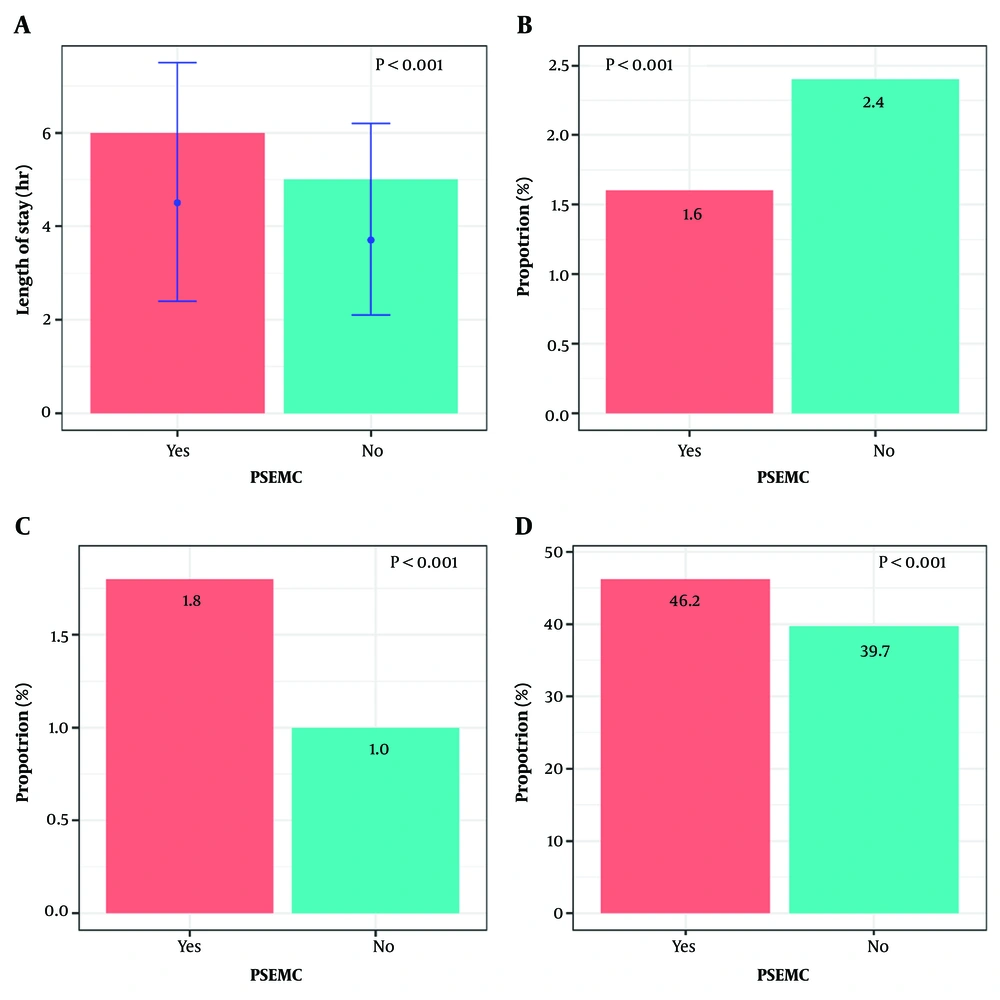
Figure 1.
Comparison of quality indicators between institutions with and without Pediatric Specialized Emergency Medical Center (PSEMC) designation. A, emergency department (ED) length of stay; B, transfer rate; C, percentage of patients staying over 24 hours; D, final treatment provision rate. In (A), the box indicates the average, the dot indicates the median, the lower line marks the first quartile, and the upper line marks the third quartile. The Mann–Whitney test was used for (A), and the proportion test was used for (B) through (D).
5. Discussion
In this study, we examined the characteristics of severely ill pediatric patients who visited PSEMCs and assessed the effectiveness of these centers. Compared with general emergency medical institutions, PSEMCs were more frequently utilized by younger patients, those presenting with higher acuity (KTAS levels 1 - 2), and those with illness-related conditions. These patient characteristics were significantly associated with an increased likelihood of utilizing PSEMCs. Consistent with previous research, patients presenting to PSEMCs were, on average, younger, more likely to have illness-related diagnoses, and more than twice as likely to be classified as severely ill compared with those at general emergency centers (7). These findings underscore the need for adequate pediatric-specific staffing, infrastructure, and equipment at PSEMCs to meet the specialized demands of this patient population.
Regarding modes of ED arrival, a substantial proportion (76.9%) of severely ill pediatric patients presented to PSEMCs using other vehicles (e.g., private vehicle, taxi, bus, or train). This high rate of private transport may reflect both lower clinical acuity in some cases and limited caregiver awareness about the appropriate use of ambulance services (12). The odds of visiting a PSEMC were 2.849 times higher for patients arriving via other vehicles and 3.061 times higher for those using other ambulances, compared with less commonly used transport modes. These findings suggest that caregiver decisions, rather than clinical severity, often influence the choice of emergency facility. Such utilization patterns — where children with relatively mild conditions are brought to centers intended for high-acuity care — may contribute to ED overcrowding, delays in evaluation and treatment of severely ill patients, communication challenges regarding diagnoses and prognoses, and constrained access to intensive treatment resources (13).
Notably, 94.1% of severely ill pediatric patients at PSEMCs received face-to-face care from a specialist, a significantly higher proportion than that observed in general emergency medical institutions. Logistic regression analysis indicated that patients who did not receive specialist treatment were significantly less likely to have been treated at a PSEMC (OR: 0.337), highlighting the central role of specialist services at these centers. Prior studies have demonstrated that specialist involvement in pediatric emergency care is associated with reduced ED length of stay (ED-LOS) and hospital admission rates, thereby improving the quality and efficiency of care delivery (14).
The discharge disposition of patients also differed between center types. Compared with general emergency medical institutions, PSEMCs discharged a higher proportion of severely ill pediatric patients to home and had lower transfer rates. Analysis of factors associated with PSEMC utilization revealed that patients who were transferred, hospitalized, or deceased were significantly less likely to have visited a PSEMC than those who were discharged home. These findings align with previous reports indicating that pediatric-specific EDs typically exhibit lower transfer rates (8). The higher discharge rate at PSEMCs may partly reflect the relatively high proportion of patients with mild conditions (7).
Quality-of-care indicators also varied by facility type. Pediatric Specialized Emergency Medical Centers exhibited longer ED-LOS and a higher proportion of patients staying in the ED for over 24 hours compared with general emergency medical institutions. However, PSEMCs also demonstrated lower transfer rates and higher final treatment provision rates. These seemingly less favorable time-related metrics may be attributable to the comprehensive diagnostic evaluations and multidisciplinary care models routinely employed at PSEMCs. In addition, higher patient acuity may contribute to increased ED-LOS, and this pattern appears to be reflected in the PSEMCs, where a higher proportion of high-acuity pediatric patients (KTAS levels 1 - 2) present (15). Although prolonged ED-LOS is often regarded as a marker of ED crowding or system-related delay, in the context of PSEMCs, it may instead represent clinically appropriate care processes for severely ill pediatric patients, including extended monitoring, multidisciplinary evaluation, and comprehensive diagnostic and therapeutic management delivered within the ED. Therefore, ED-LOS should be interpreted with caution as a standalone quality indicator without adequate consideration of patient acuity and care complexity. Also, the availability of pediatric-specialized personnel and facilities supports the delivery of definitive care within the center, reducing the need for external transfers and enabling the management of more complex cases. Thus, the lower reliance on patient transfer likely reflects the capacity of PSEMCs to accept and treat cases that exceed the capabilities of primary or secondary medical institutions.
This study has several limitations. First, the analysis was based on data from a single calendar year, which may not adequately reflect temporal trends or inter-annual variability, thereby limiting the generalizability of the findings. Second, although comparisons were drawn between PSEMCs and general emergency medical institutions, potential confounding variables — such as regional differences in healthcare infrastructure, distribution of medical resources, and demographic characteristics — were not fully accounted for. These unmeasured factors may affect the interpretation of comparative outcomes. Third, as this study utilized data from center-level emergency medical institutions in Korea, the generalizability of the findings to smaller facilities or to healthcare systems in other countries may be limited.
In conclusion, the present findings underscore the important role of PSEMCs in the management of severely ill pediatric patients, particularly in delivering specialized care and achieving favorable clinical outcomes. However, the substantial proportion of visits by patients with mild conditions may limit the efficient utilization of these specialized resources. In order to optimize the function of PSEMCs, there must be systemic improvements in patient triage and healthcare delivery processes to ensure that low-acuity cases are directed to general EDs appropriately. In 2024, the Ministry of Health and Welfare implemented a program that provides policy-based financial incentives to regional emergency medical centers when they redirect mild patients to more appropriate healthcare facilities, as part of efforts to reduce ED overcrowding and promote care centered on severe emergency cases. Such reforms would allow PSEMCs to focus on high-acuity pediatric care, improve resource allocation, and sustain the provision of high-quality, specialized services. Continued policy support and institutional development are essential to clarify the strategic role of PSEMCs within the emergency care system and to improve overall system efficiency. In this context, our findings underscore the need for concrete policy strategies to optimize the use of PSEMCs, including strengthening caregiver education on appropriate ED utilization and expanding pediatric urgent care alternatives to alleviate unnecessary demand on specialized emergency centers.