1. Introduction
Diabetes mellitus (DM) is a chronic metabolic disease with an increasingly severe global epidemic trend, becoming a major public health issue in today’s society (1). With changes in lifestyle and rising obesity rates, the incidence of DM continues to increase, affecting not only adults but also showing a noticeable rise among children and adolescents. Against this backdrop, the prevention and management of DM-related complications have become particularly important. Among these, microvascular complications, characterized by their insidious onset and significant harm, have become a major focus of clinical attention (2, 3). DR is one of the most common microvascular complications of DM and is a leading cause of irreversible vision loss in working-age populations (4). For a long time, the pathogenesis of DR has been considered closely related to chronic hyperglycemia, involving various metabolic disorders such as activation of the polyol pathway, accumulation of advanced glycation end products, abnormal protein kinase C signaling pathways, and enhanced oxidative stress. These pathological changes collectively lead to progressive damage to the retinal microvascular structure, characterized by pericyte loss, thickening of the basement membrane, and disruption of the blood-retinal barrier (5). However, recent findings indicate that the pathogenesis of DR is far more complex than previously understood. Microcirculatory disorders may arise in the early stages of the disease, even before clinical signs of retinopathy become apparent.
The ophthalmic artery, as the main blood supply to the retina, can objectively reflect the retinal microcirculation through changes in its hemodynamic parameters. Color Doppler ultrasound technology, as a non-invasive and highly reproducible examination method, has been widely used to assess ophthalmic artery hemodynamics, including parameters such as peak systolic velocity (PSV), end-diastolic velocity (EDV), Resistance Index (RI), and Pulsatility Index (PI) (6 - 8). These parameters not only reflect the vascular perfusion status but also indirectly assess the resistance of the distal microvascular bed. However, research in this field within pediatric diabetic populations remains in its infancy. Existing studies are largely confined to descriptions of isolated parameters, lacking investigation into the temporal patterns of hemodynamic parameter changes and failing to clarify the mechanisms of their interaction with inflammatory factor networks. Consequently, they cannot provide a reliable basis for the early warning of pediatric DR (9). More importantly, fundamental differences exist in the pathophysiological characteristics of DR between adults (e.g., mature vascular regulatory function, slower progression of complications) and children. Current clinical practice still primarily relies on diagnostic and therapeutic experience from adult DR and lacks dedicated research data that account for the immature vascular regulatory mechanisms and high metabolic demands characteristic of children’s growth and development stages. Meanwhile, the role of inflammatory responses in diabetic microvascular complications has garnered increasing attention. Chronic low-grade inflammation is now considered an important link between metabolic disorders and microvascular damage. Various cytokines, such as vascular endothelial growth factor (VEGF), have been shown to be involved in the development of DR (10). These cytokines interact in a complex network, regulating vascular permeability, promoting neovascularization, and exacerbating oxidative stress responses, ultimately leading to retinal tissue damage. Notably, recent studies have found that changes in serum cytokine levels may precede clinically visible retinopathy and have the potential to serve as early predictive biomarkers for DR (11 - 13).
Diabetic children represent a distinct population with significant physiological differences from adults. During critical growth and development periods, children exhibit high metabolic demands and immature vascular regulatory mechanisms. These factors may contribute to a unique pathogenesis of diabetic retinopathy (DR) in the pediatric population. However, notable research gaps persist in pediatric DR: first, there is a lack of systematic investigation into the correlation between ocular artery hemodynamic parameters and inflammatory factor networks, hindering the understanding of their synergistic effects in pediatric DR progression; second, existing studies have not elucidated child-specific hemodynamic-cytokine regulatory patterns, impeding the development of precise early intervention strategies; third, findings from adult DR research cannot be directly extrapolated to children due to differences in vascular immaturity and immune system activity that may lead to distinct pathophysiological responses. Investigating ocular artery hemodynamic characteristics and their correlation with serum cytokine levels in children with DR holds significant theoretical and clinical value. Theoretically, this study aimed to clarify the unique pathogenesis of pediatric DR and enhance understanding of its pathophysiological process. Clinically, integrating non-invasive examination methods with serological indicators may establish an early warning system for pediatric DR, providing objective evidence for determining optimal clinical intervention timing. Furthermore, identifying correlations between hemodynamic parameters and specific cytokines could reveal new targets for intervention, ultimately improving long-term visual outcomes in this special population.
2. Materials and Methods
2.1. Subjects
A total of 188 children with type 2 diabetes mellitus (T2DM) who visited the ophthalmology outpatient department of Xi’an Children’s Hospital Affiliated to Xi’an Jiaotong University from October 2021 to January 2025 were enrolled. They were assigned to three groups according to the results of retinal examination: no diabetic retinopathy (no-DR) group (32 cases), nonproliferative diabetic retinopathy (NPDR) group (75 cases), and proliferative diabetic retinopathy (PDR) group (81 cases). Additionally, 30 healthy children who underwent physical examination during the same period were included as the controls.
Ethical approval for this trial was granted by the Xi’an Children’s Hospital Affiliated to Xi’an Jiaotong University ethics committee, and this trial complied with the ethical principles of the Declaration of Helsinki. Regarding informed consent, this study is a retrospective observational investigation. All data were obtained from routine clinical records and health examination archives. All patient identifiers (such as name, ID number, medical record number, etc.) have been anonymized. The study did not involve any additional invasive procedures or risks of privacy disclosure. According to the approval from the Ethics Committee, written informed consent from the guardians was waived for this type of research utilizing anonymized routine clinical data.
Inclusion criteria: (1) Age 6 - 18 years, any gender, and ability to cooperate with ophthalmic examinations (e.g., lying still for color Doppler ultrasound, undergoing dilated fundus examination); (2) Diagnosis of T2DM meeting the criteria from the Expert Consensus on the Diagnosis and Treatment of Type 2 Diabetes in Children and Adolescents (2020 Edition): fasting plasma glucose ≥ 7.0 mmol/L, or 2-hour plasma glucose during an oral glucose tolerance test ≥ 11.1 mmol/L, or random plasma glucose ≥ 11.1 mmol/L accompanied by classic symptoms of DM (polyuria, polydipsia, weight loss), with a disease duration ≥ 1 year (excluding newly diagnosed cases without stable control); (3) Absence of severe systemic diseases: such as congenital heart disease (including atrial septal defect, ventricular septal defect), chronic kidney disease (glomerular filtration rate < 60 mL/min/1.73 m²), liver cirrhosis (Child-Pugh class B or higher), hyper/hypothyroidism (uncontrolled, thyroid function indices exceeding 20% of the normal reference range); (4) No other ocular diseases affecting retinal or ocular artery blood flow: such as primary open/closed-angle glaucoma (intraocular pressure > 21 mmHg and cup-to-disc ratio > 0.6), central retinal vein/artery occlusion (previous medical history or imaging evidence), uveitis (acute episode within the past 6 months); (5) No use of medications affecting vascular function or inflammatory status within the past 3 months: such as corticosteroids (oral, intravenous, or periocular injection, continuous use exceeding 7 days), vasoactive drugs (e.g., calcium channel blockers, angiotensin-converting enzyme inhibitors, without stable dosing), non-steroidal anti-inflammatory drugs (continuous use exceeding 14 days).
Exclusion criteria: (1) DM-type mismatch: type 1 DM (positive pancreatic autoantibodies, such as anti-insulin antibody or anti-glutamic acid decarboxylase antibody), or specific types of DM (e.g., MODY syndrome, cystic fibrosis-related DM); (2) Poorly controlled systemic diseases: uncontrolled hypertension (systolic/diastolic blood pressure persistently exceeding the 95th percentile for age and gender), autoimmune diseases (e.g., systemic lupus erythematosus, rheumatoid arthritis, in active phase), malignant tumors (previous history or current treatment), or severe infections (e.g., sepsis, pneumonia, with hospitalization history within the past month); (3) Ocular structural or functional abnormalities: history of ocular surgery (e.g., cataract extraction, strabismus correction, within the past year) or ocular trauma (e.g., ocular contusion, penetrating injury, affecting the fundus or ocular artery); (4) Factors interfering with fundus examination: moderate or greater opacities of refractive media (e.g., cataract with lens opacity affecting fundus observation; vitreous hemorrhage obscuring retinal details); (5) Insufficient data completeness: inability to complete all required tests (e.g., failed hemodynamic parameter measurements due to poor patient cooperation) or missing key clinical data (e.g., previous blood glucose monitoring records, documentation of DM duration).
Rationale for sample size calculation: based on preliminary pilot study results (a mean difference in ocular artery RI of approximately 0.12 between the no-DR group and the PDR group, with a standard deviation of 0.08), sample size estimation was performed using PASS 15.0. With parameters set at α = 0.05 (two-tailed test) and power (1-β) = 0.90, the calculation indicated a minimum requirement of 28 subjects per group. Accounting for potential follow-up attrition and data incompleteness, the actual sample size per group was increased by 15%-20%. The final determined sample sizes were: control group (n=30), no-DR group (n=32), NPDR group (n=75), and PDR group (n=81), ensuring sufficient statistical power for detecting intergroup differences and mitigating potential bias from sampling variability.
2.2. Hemodynamic Detection
Between October 2021 and January 2025, ocular artery hemodynamic parameters were measured in the ophthalmology ultrasound examination room of Xi’an Children’s Hospital affiliated to Xi’an Jiaotong University using a Mindray DC-8 color Doppler ultrasound diagnostic system (Shenzhen Mindray Bio-Medical Electronics Co., Ltd.). Prior to examination, children were guided to an adjacent quiet rest area (equipped with comfortable recliners and soft ambient lighting) to rest for 10 minutes, allowing their heart rate and blood pressure to stabilize and avoiding interference from activity or emotional excitement. Subsequently, the children assumed a supine position with their heads naturally relaxed and eyes gently closed. The ultrasound technician, wearing disposable medical gloves, lightly placed the probe (frequency 7.5 - 10 MHz, set to the ocular examination mode) on the center of the child’s eyelid, strictly controlling the probe pressure (to the level where the child felt no significant foreign body sensation) to prevent elevated intraocular pressure caused by eyeball compression, which could affect the accuracy of hemodynamic measurements. During the examination, the technician adjusted the probe angle and depth to clearly display the long-axis section of the ocular artery (from the optic canal opening to the posterior pole of the eyeball), seFqlecting a segment with clear vascular lumen and continuous, stable blood flow signals as the measurement sampling point, ensuring the sample volume (1 - 2 mm) completely covered the vascular lumen without extending beyond the vessel wall.
The examination environment was strictly controlled: room temperature was maintained at 22 - 25°C, lighting was kept soft (avoiding direct strong light on the instrument screen), and noise was controlled below 40 decibels to prevent external interference from affecting patient cooperation and signal stability. The measured parameters included: (1) Peak systolic velocity (PSV, unit: cm/s): the maximum blood flow velocity during cardiac systole; (2) EDV(unit: cm/s): the minimum blood flow velocity at the end of cardiac diastole; (3) Resistance index (RI): calculated using the equation (PSV - EDV)/PSV; (4) PI: calculated using the formula (PSV - EDV)/mean velocity (where mean velocity was automatically calculated by the instrument’s built-in algorithm as the time-averaged maximum velocity over one cardiac cycle).
Each eye was measured three times at 1-minute intervals to minimize the impact of transient blood flow fluctuations. After excluding data with significant signal interference (such as artifacts caused by eyelid tremor), the average of three valid measurements was taken as the final value for each parameter. All examinations were conducted between 8:00 and 11:00 daily to avoid the influence of circadian rhythms (e.g., morning peaks in sympathetic nerve activity) on hemodynamic parameters. Furthermore, all measurements were performed by the same experienced ultrasonographer (with eight years of clinical experience in ocular color Doppler imaging and holding national certification in ultrasound medicine) to ensure standardized procedures and data accuracy.
2.3. Serum Cytokine Detection
The levels of VEGF, TNF-α, IL-6, and TGF-β in fasting serum were detected by enzyme-linked immunosorbent assay (ELISA). 5 mL of venous blood was collected from the elbow in the early morning, centrifuged at 3,000 r/min for 15 minutes to separate the serum, and stored at -80°C. The corresponding ELISA kits (Yilaisa Biotech Co., Ltd., Jiangsu, China) were used strictly based on the guidance. Absorbance measurements were performed at 450 nm, with subsequent concentration determination based on the established standard curve. Each sample was tested in duplicate, and the average value was taken. The intra-batch and inter-batch variation coefficients were controlled at < 10% and < 15%, respectively, to ensure the quality of detection.
2.4. Collection of Clinical Data
Basic information of all children included: (1) Demographic characteristics: age, gender, height, weight, and Body Mass Index (BMI) calculation; (2) DM-related indicators: duration of DM, fasting plasma glucose (FPG), glycated hemoglobin (HbA1c), and insulin usage. All data were collected and entered by a dedicated person using a unified form to ensure data integrity and accuracy. Missing data were supplemented by rechecking medical records or contacting the children’s families. A double-check system was used during data collection to ensure data quality.
2.5. Statistical Processing
SPSS 26.0 was employed. Measurement data were tested for normality using the Shapiro-Wilk test. Normally distributed data were presented as mean ± SD, and one-way ANOVA and least significant difference t test were adopted for contrast. Non-normally distributed data were presented as median (interquartile range) [M (P25, P75)] and assessed using the Kruskal-Wallis H test. Count data were presented as number (percentage) and assessed using the χ² test or Fisher’s exact test. Pearson or Spearman correlation analysis was adopted to assess the correlation between ophthalmic artery hemodynamic parameters and serum cytokine levels. A multiple linear regression model was established to analyze the main factors affecting hemodynamic parameters. All statistical tests were two-sided, with P < 0.05 was considered statistically significant.
Covariate adjustment analysis was conducted. To control for the potential confounding effects of BMI, glycated hemoglobin (HbA1c), and DM duration on hemodynamic parameters (PSV, EDV, RI, PI) and serum cytokines (VEGF, TNF-α, IL-6, TGF-β), multiple linear regression models were employed for adjustment. Each hemodynamic parameter or cytokine served as the dependent variable, while BMI, HbA1c, and DM duration were included as independent variables. After controlling for these confounders, intergroup differences in the indicators and correlations between indicators were re-analyzed to ensure the robustness of the results.
3. Results
3.1. Comparison of Baseline Characteristics of Subjects
Figure 1 (Comparison of baseline characteristics of subjects) shows no significant differences in age or gender distribution across groups (P > 0.05). Regarding age, the control group was 12.35 ± 2.14 years, the no-DR group 12.68 ± 2.37 years, the NPDR group 13.02 ± 2.56 years, and the PDR group 12.98 ± 2.77 years. For gender, the control group had 16 males and 14 females, the no-DR group 18 males and 14 females, the NPDR group 40 males and 35 females, and the PDR group 43 males and 38 females. In contrast, metabolic-related indicators showed a significant increasing trend with DR severity (P < 0.05), following the pattern: *P < 0.05 vs. control group; #P < 0.05 vs. no-DR group; ΔP < 0.05 vs. NPDR group. Specifically, Body Mass Index (BMI; kg/m²) was 19.82 ± 2.15 in controls, 22.36 ± 3.24 in no-DR, 22.58 ± 3.67 in NPDR, and 24.12 ± 3.85 in PDR. DM duration (years) was 3.12 ± 1.25 in no-DR, 4.85 ± 1.67 in NPDR, and 6.32 ± 2.14 in PDR (not applicable for controls). HbA1c (%) was 5.12 ± 0.35 in controls, 7.25 ± 1.12 in no-DR, 8.36 ± 1.45 in NPDR, and 9.29 ± 1.67 in PDR. FPG (mmol/L) was 4.85 ± 0.42 in controls, 7.68 ± 1.25 in no-DR, 8.95 ± 1.67 in NPDR, and 10.12 ± 2.15 in PDR. Furthermore, the proportion of patients using insulin therapy was significantly higher in the PDR group (76.5%, 62/81) compared to the no-DR (34.4%, 11/32) and NPDR (53.3%, 40/75) groups (P < 0.01), indicating increased glycemic control requirements and treatment intensity with DR progression.
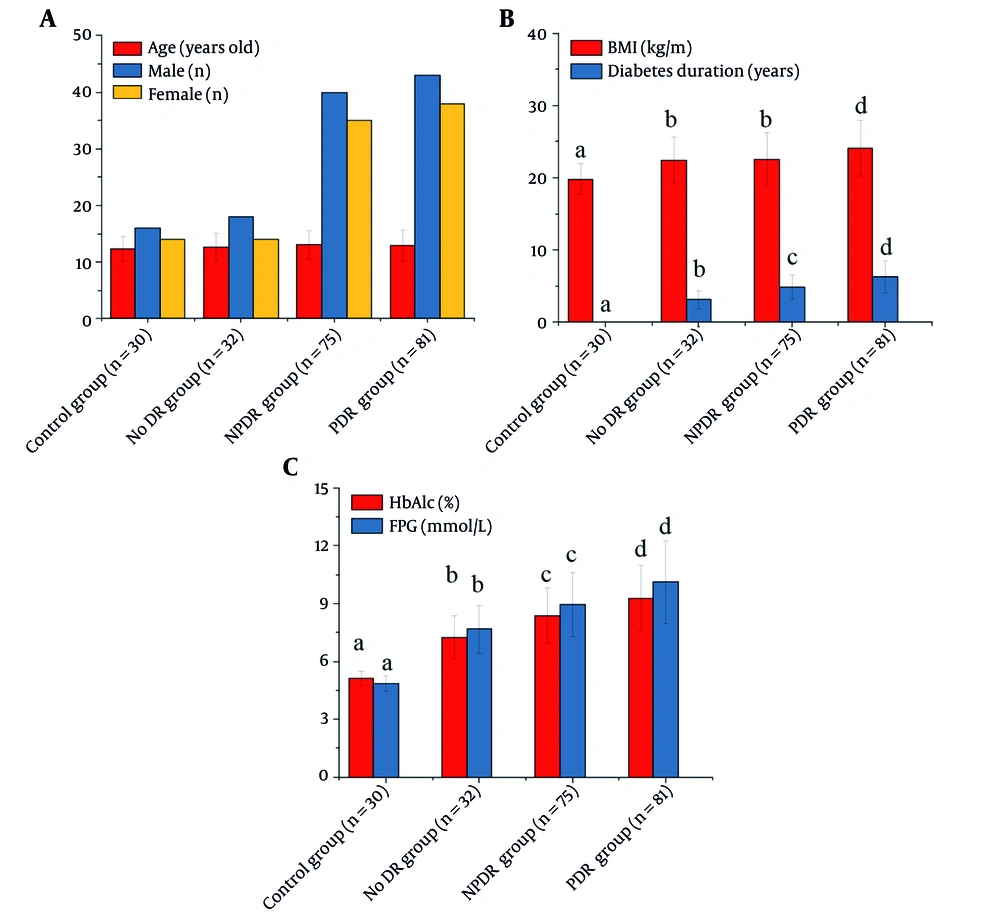
Figure 1.
Comparison of baseline characteristics of subjects. A, gender and age; B, disease duration and Body Mass Index (BMI); C, glycated hemoglobin (HbA1c) and fasting plasma glucose (FPG). Different letters indicate significant differences, P < 0.05
3.2. Ophthalmic Artery Hemodynamic Parameters of Subjects
In Figures 2 and 3, the comparison of ophthalmic artery hemodynamic parameters of the subjects was statistically significant (P < 0.01). The PSV and EDV progressively decreased with the increasing severity of DR, while the RI and PI showed an increasing trend. All hemodynamic parameters exhibited statistically significant distinctions in the subjects.
Results after covariate adjustment demonstrated that after correcting for BMI, HbA1c, and DM duration using multiple linear regression, the differences in PSV, EDV, RI, and PI among the groups remained statistically significant (all P < 0.05). Furthermore, the negative correlation between EDV and DR severity (r = -0.512, P < 0.01) was not affected by confounding factors, confirming that the association between ocular artery hemodynamic abnormalities and DR progression is independent of metabolic indicators.
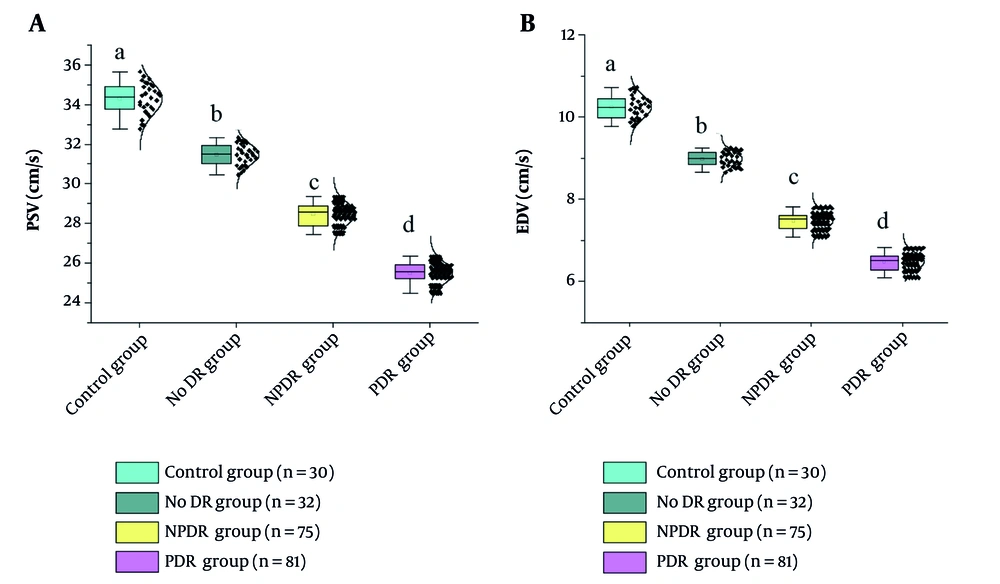
Figure 2.
Comparison of ophthalmic artery peak systolic velocity (PSV) and end-diastolic velocity (EDV) parameters in subjects. A, PSV; B, EDV. Different letters indicate significant differences, P < 0.05
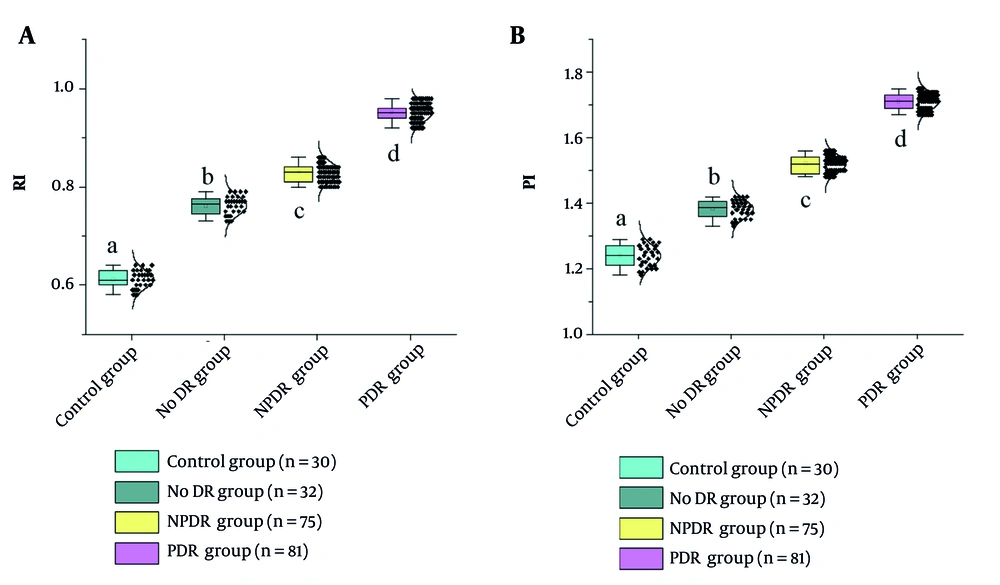
Figure 3.
Comparison of ophthalmic artery Resistance Index (RI) and Pulsatility Index (PI) parameters in subjects. A, RI; B, PI. Different letters indicate significant differences, P < 0.05
3.3. Serum Cytokine Levels of Subjects
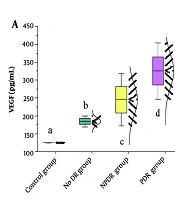
In Figures 4 - 5, the comparison of serum cytokine levels of the subjects was statistically significant (P < 0.01). Specifically, the levels of VEGF, TNF-α, and IL-6 all showed a gradual increase with the worsening of the disease severity (controls → no-DR group → NPDR group → PDR group) (P < 0.001), and the distinctions between each pair of groups were statistically significant (P < 0.01). In contrast, the level of TGF-β showed a gradual decrease with the worsening of the disease severity (P < 0.01), and the distinctions between each pair of groups were also statistically significant (P < 0.001).
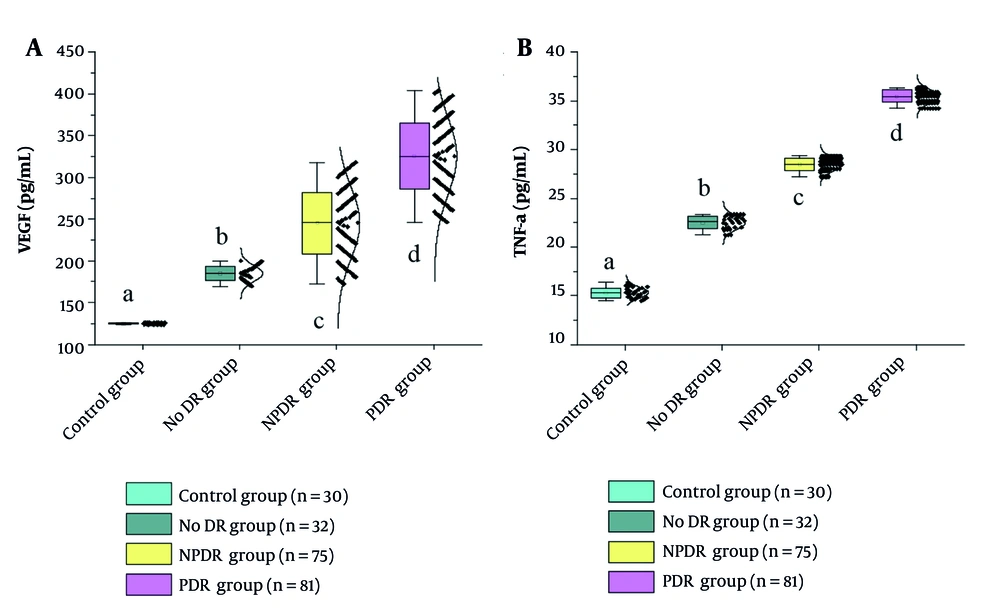
Figure 4.
Comparison of serum cytokine levels of vascular endothelial growth factor (VEGF) and tumor necrosis factor-α (TNF-α) in subjects. A, VEGF; B, TNF-α. Different letters indicate significant differences, P < 0.05
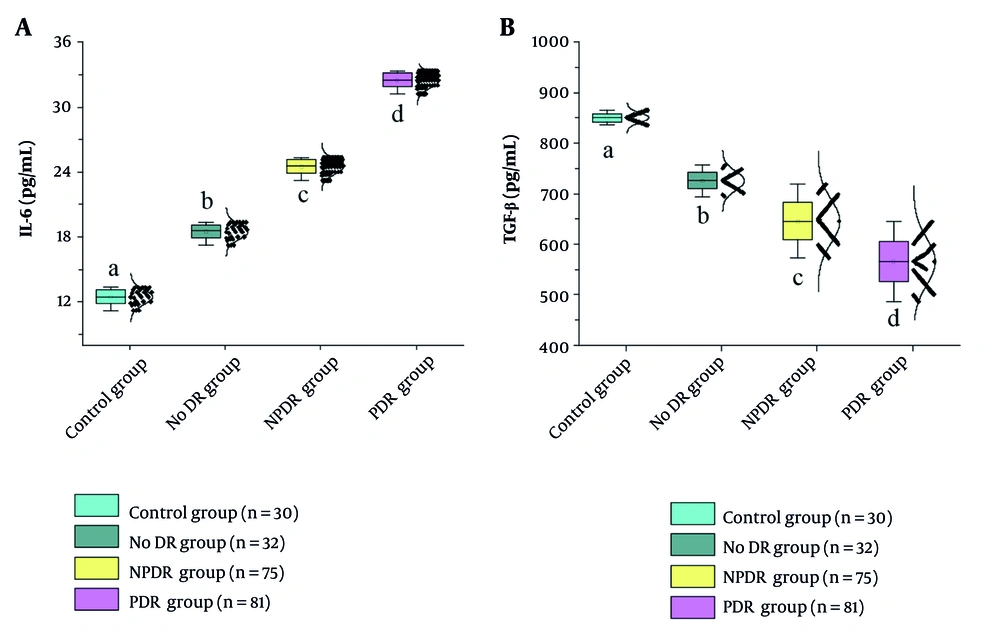
Figure 5.
Comparison of serum cytokine levels of interleukin-6 (IL-6) and transforming growth factor-β (TGF-β) in subjects. A, IL-6; B, TGF-β. Different letters indicate significant differences, P < 0.05
3.4. Correlation Analysis Between Ophthalmic Artery Hemodynamic Parameters and Cytokines
Results from Table 1 demonstrate that hemodynamic velocity parameters (PSV, EDV) showed significant negative correlations with pro-inflammatory cytokines (VEGF, TNF-α, IL-6) (r = -0.542 to -0.652, 95% CI: -0.689 to -0.481, all P < 0.01), and significant positive correlations with the anti-fibrotic factor TGF-β (r = 0.486 to 0.524, 95% CI: 0.413 to 0.592, all P < 0.01). Vascular resistance parameters (RI, PI) exhibited significant positive correlations with pro-inflammatory cytokines (r = 0.562 to 0.635, 95% CI: 0.495 to 0.698, all P < 0.01), and significant negative correlations with TGF-β (r = -0.492 to -0.502, 95% CI: -0.571 to -0.418, all P < 0.01).
Results after covariate adjustment showed that, after controlling for BMI, HbA1c, and DM duration, the negative correlation between EDV and VEGF remained at r = -0.586 (95% CI: -0.663 to -0.501, P < 0.01), and the positive correlation between EDV and TGF-β was r = 0.478 (95% CI: 0.397 to 0.553, P < 0.01). The strength of these correlations showed no substantial attenuation, indicating that the association between EDV and cytokines is not confounded by metabolic factors, further supporting their synergistic role in the pathological process of DR.
Table 1.
Correlation Analysis Between Ophthalmic Artery Hemodynamic Parameters and Cytokines
| Variables | VEGF | TNF-α | IL-6 | TGF-β |
|---|---|---|---|---|
| PSV | -0.652 a | -0.586 a | -0.612 a | 0.524 a |
| EDV | -0.598 a | -0.542 a | -0.568 a | 0.486 a |
| RI | 0.635 a | 0.572 a | 0.602 a | -0.502 a |
| PI | 0.624 a | 0.562 a | 0.592 a | -0.492 a |
Abbreviations: EDV, end-diastolic velocity; IL-6, interleukin-6; PI, Pulsatility Index; PSV, peak systolic velocity; RI, Resistance Index; TGF-β, transforming growth factor-β; TNF-α, tumor necrosis factor-α; VEGF, vascular endothelial growth factor.
a P < 0.01.
4. Discussion
DR has a complex pathogenesis involving the interaction of multiple pathological processes (14, 15). This study, by analyzing the association between ocular artery hemodynamics and serum cytokines in children with T2DM, provides a reference for the early assessment of pediatric DR. However, interpretation of the findings should consider the design logic and result characteristics of similar clinical studies. In the field of perioperative medicine, research focusing on the impact of fluid interventions on physiological indicators in specific populations has established a mature paradigm. For instance, the randomized double-blind clinical trial published by Saghravanian et al. (2023) (16) holds methodological comparability to this study and can offer insights for interpreting results and analyzing limitations in pediatric DR research. These findings not only enhance our understanding of the pathogenesis of pediatric DR but also offer new insights for early clinical intervention. The results indicate that as DR severity increases, metabolic control indicators in children demonstrate a clear trend of deterioration. Specifically, the level of HbA1c in the no-DR group (7.25 ± 1.12%) was already markedly higher than that in the controls (5.12 ± 0.35%), and the PDR group increased to 9.24 ± 1.67%. This gradient change strongly suggests a close association between the level of blood glucose control and the development of retinopathy. It is noteworthy that metabolic indicators already show abnormalities in children even before the onset of obvious retinopathy. This finding supports the “metabolic memory” theory, which posits that the early state of blood glucose control exerts a lasting influence on the development of subsequent complications (17). This finding reminds clinicians that for pediatric diabetic patients, blood glucose should be strictly managed from the time of diagnosis.
In terms of hemodynamics, the present study has made clinically significant findings. The results show that the PSV decreased markedly from 34.25 ± 3.12 cm/s in the controls to 25.32 ± 3.56 cm/s in the PDR group, while the RI increased from 0.68 ± 0.05 to 0.81 ± 0.08. These changes in parameters reflect the progressive impairment of retinal microcirculatory function. It is particularly noteworthy that these hemodynamic changes have shown significant differences in the NPDR stage, which is of great clinical significance because it suggests that microcirculatory disorders may occur before clinical manifestations, meaning that non-invasive hemodynamic detection may enable early identification of high-risk children (18, 19). This provides a potential time window for early clinical intervention. The study found that the level of VEGF increased stepwise from 125.36 ± 15.24 pg/mL in the controls to 325.45 ± 42.36 pg/mL in the PDR group, whereas TGF-β showed the opposite trend. These changes are highly consistent with the pathophysiological process of DR. As an important proangiogenic factor, the elevated level of VEGF is closely related to retinal neovascularization; the increase of pro-inflammatory factors reflects the activation of inflammatory responses in disease progression; the decrease of TGF-β may indicate a weakening of tissue repair capacity (20). TGF-β, a cytokine with multiple biological functions, plays a critical anti-fibrotic role in the pathological process of DR. In normal retinal tissue, TGF-β maintains vascular wall stability and inhibits excessive fibrotic responses to prevent tissue remodeling by regulating the proliferation and differentiation of vascular smooth muscle cells and pericytes. This study found that as pediatric DR progressed, TGF-β levels continuously decreased and were closely correlated with ocular artery hemodynamic parameters (positively correlated with PSV, negatively correlated with RI), suggesting that impaired anti-fibrotic function of TGF-β in the pediatric population may be a key driver of microvascular structural damage. Compared to adult DR, pediatric patients exhibit distinct characteristics in TGF-β changes: in adult DR, TGF-β levels typically show significant decline only in advanced stages, with a more gradual reduction, whereas in this study, children demonstrated marked TGF-β decrease starting from the no-DR stage, with a faster rate of decline. This discrepancy may be attributed to the immaturity of retinal vasculature in children, resulting in lower tolerance to metabolic disturbances and inflammatory stimuli. Weaker collagen fiber synthesis capacity in childhood vascular walls means that reduced TGF-β directly leads to insufficient vascular wall stability, accelerating the progression of microcirculatory dysfunction. Furthermore, while the anti-fibrotic effect of TGF-β in adult DR is often counterbalanced by its pro-angiogenic side effects, the pediatric population shows more pronounced elevations in pro-inflammatory factors (such as VEGF and TNF-α), further undermining TGF-β’s protective role and creating a vicious cycle of declining anti-fibrotic capacity, enhanced inflammatory response, and worsened microcirculatory impairment. These molecular-level changes provide new perspectives for understanding the pathogenesis and progression of DR. These molecular-level changes suggest an innovative approach for understanding the occurrence and development of DR.
The most important finding of the present study is the significant correlation between ophthalmic artery hemodynamic parameters and serum cytokine levels. Specifically, the PSV is markedly negatively correlated with VEGF, while the RI is markedly positively correlated with VEGF. This correlation is not a simple accompanying phenomenon, but reflects the key pathological mechanisms in the development of DR. It is speculated that there may be such a vicious cycle: microcirculatory disorders lead to retinal tissue perfusion insufficiency and hypoxia, which in turn stimulate the release of proangiogenic factors such as VEGF; these factors further change vascular permeability and function, aggravating microcirculatory disorders. The activation of inflammatory responses will damage vascular endothelial function, and the damage of vascular function will promote inflammatory responses, forming another vicious cycle (21, 22). This bidirectional interaction may be an important driving force for the progression of DR. Compared with findings from adult DR research, the present study found that pediatric patients showed some unique characteristics. The most prominent is that under similar disease duration conditions, the degree of inflammatory response in pediatric patients is more pronounced. This may be related to the fact that children are in the growth and development period, and their metabolism and immune system have specific characteristics. Children’s metabolism is more vigorous, and their reaction to hypoxia and metabolic disorders may be stronger (23). The pediatric vascular system is not yet fully mature, and it may have limited compensatory capacity for metabolic disorders. These characteristics suggest that more intensive intervention strategies may be needed in clinical management, and special treatment guidelines may need to be developed for pediatric patients. From a clinical practice perspective, the results of the present study have important application value. First, changes in ophthalmic artery hemodynamic parameters often occur earlier than clinical manifestations, making them potentially valuable indicators for early screening. First, routine ophthalmic artery blood flow detection should be performed for diabetic children with a disease duration of more than 1 year, and special attention should be paid to high-risk children with a PSV of < 30 cm/s or a RI of > 0.7. Second, combined detection of hemodynamic parameters and inflammatory indicators may establish a more accurate disease assessment system, for example, children with VEGF > 200 pg/mL may need closer follow-up. Most importantly, these findings suggest that comprehensive treatment strategies targeting hemodynamic disorders and inflammatory responses may achieve better clinical results, rather than just controlling blood glucose.
This study has several limitations that warrant consideration. First, as a cross-sectional investigation, it can only reveal associations between indicators rather than establish causal relationships, and cannot capture the dynamic changes in hemodynamic parameters and cytokine levels over time. For example, it remains undetermined whether the decline in TGF-β levels precedes hemodynamic abnormalities or vice versa, and the sequence of indicator changes across different disease stages cannot be elucidated. Second, the cross-sectional design limits the ability to evaluate the impact of interventions on these parameters, thereby constraining the clinical translational value of the findings. Furthermore, the sample size limitations may affect the reliability of certain subgroup analyses. Additionally, a more in-depth analysis of potential influencing factors such as blood pressure control and lipid profiles was not conducted. These limitations highlight directions for future research: there is an urgent need for large-scale prospective longitudinal studies involving long-term follow-up of diabetic children to dynamically monitor trajectories of ocular artery hemodynamic parameters and serum cytokines (particularly TGF-β), clarify temporal relationships among different indicators, and establish their causal links with DR progression. Longitudinal data should be utilized to develop predictive models assessing the prognostic value of various indicators for DR onset and development. Concurrently, based on longitudinal findings, interventions targeting microcirculatory protection and inflammatory regulation should be explored to verify their efficacy in delaying DR progression. Furthermore, future studies should expand the sample size, incorporate more potential influencing factors, and establish a more comprehensive evaluation system. In summary, through systematic measurement and analysis, this study confirms that children with T2DM exhibit significant ocular artery hemodynamic abnormalities and alterations in serum cytokine levels, which are significantly correlated. These findings provide important evidence for elucidating the pathogenesis of DR and offer actionable insights for clinical intervention. It is recommended that pediatric DM management, in addition to routine metabolic control, should also emphasize the assessment of microcirculation and inflammatory status, as this may provide new opportunities for the early identification and timely intervention in high-risk children. Future research should focus on exploring precise prevention and treatment strategies based on these indicators to improve the long-term prognosis of children with DM. Particular attention should be paid to the development of novel interventions targeting microcirculatory protection and anti-inflammatory therapy, as well as establishing early warning systems tailored to pediatric characteristics. This work will contribute to reducing the disease burden associated with DR, a serious complication.
5. Conclusions
This study, through systematic analysis of ocular artery hemodynamic characteristics and their correlation with serum inflammatory factors in children with T2DM, provides important evidence for a deeper understanding of the pathogenesis of pediatric DR. The results robustly confirm that the onset and progression of DR constitute a complex pathological process involving the combined effects of microcirculatory dysfunction and chronic inflammatory responses: significant hemodynamic alterations (including decreased PSV, reduced EDV, and elevated RI) and abnormal inflammatory factor levels are evident even in early stages, with both demonstrating progressive deterioration correlating with disease severity and exhibiting significant synergistic interactions. The findings hold substantial clinical guidance value and academic significance. From a clinical practice perspective, they provide actionable new indicators (such as EDV and TGF-β) for early screening and intervention of pediatric DR, facilitating a transition in pediatric DM management from sole focus on glycemic control toward comprehensive metabolic-microcirculatory-inflammatory assessment. Academically, this research systematically elucidates, for the first time, the independent association between ocular artery hemodynamics and cytokines in pediatric DR (after adjusting for confounders including BMI and HbA1c), thereby filling a critical gap in the research on microcirculatory-inflammatory mechanisms in pediatric DR. The study design focuses on the distinct characteristics of the pediatric population, employs standardized measurement methodologies, and demonstrates clear clinical translational value, possessing strong potential for publication in pediatric or ophthalmology specialty journals.
It should be specifically emphasized that children with DM exhibit distinct physiological and disease characteristics, precluding the direct application of adult DM management models. The findings of this study underscore the necessity of developing pediatric-specific diagnostic and therapeutic guidelines. Future research should focus on the metabolic changes characteristic of childhood growth and development stages, explore individualized treatment strategies suitable for pediatric patients, and concurrently validate the clinical intervention value of early screening indicators through interventional studies, thereby further enhancing the translational application of research outcomes.