1. Background
Excessive body weight and childhood obesity have been recognized as global public health concerns for decades. The prevalence of childhood overweight is increasing worldwide (1). WHO estimates indicate that in 2019, 38.2 million children under the age of five were overweight or obese (2). If these trends persist, the prevalence of overweight among children under five is projected to rise from 7% in 2012 to 11% by 2025 (2).
Early childhood weight gain is strongly associated with obesity in later life and increased morbidity. Studies have demonstrated links between early metabolic disorders and later cardiovascular diseases (3, 4), as well as an increased risk of metabolic complications such as type 2 diabetes mellitus and associated comorbidities (5). Furthermore, recent evidence indicates that metabolic alterations in obese children, including elevated insulin and uric acid levels, may contribute to the early development of hypertension and other cardiovascular risk factors (6), in addition to psychological distress resulting from peer and family stigmatization (7). Identifying nutritional disorders early is crucial, as the first five years of life represent a critical window for obesity prevention (8-11). Preventive measures are far more effective and economically justified than obesity treatment (9). In this context, recent research highlights the importance of community-based strategies and the assessment of community readiness as key prerequisites for the successful implementation of childhood obesity prevention programs (12).
Research suggests that breastfeeding provides protection against overweight in children and adolescents. Infants on a natural diet exhibit lower weight gain in the first six months than formula-fed infants, which lowers the risk of future obesity (3). Breastfeeding has been proposed as a preventive intervention against childhood obesity (9). Human milk contains hormones, neuropeptides, and growth factors that influence growth, development, and self-regulation of food intake (11). Additionally, it is easily digestible and meets all infant nutritional needs, delaying the introduction of solid foods and reducing obesity risk (10, 13).
2. Objectives
This study aims to determine whether breastfeeding and its duration are related to childhood obesity by analyzing anthropometric parameters [Body Mass Index (BMI), chest circumference, upper arm circumference, skinfold thickness, and head circumference] in children aged 0 - 5 years in Montenegro.
3. Methods
A cross-sectional study was conducted on a representative sample of 7.811 children aged 0 - 59 months, accounting for approximately 18% of Montenegro's total child population in this age group. The sample was defined based on the number of children under five in all Montenegrin municipalities.
Ethical approval was obtained in accordance with the Declaration of Helsinki, and written parental consent was secured. Anthropometric data (height - TV, head circumference - OG, upper arm circumference - ON, chest circumference - OGK, skinfold thickness - DKN, and body weight - TM) were collected following WHO recommendations. Data were recorded in standardized protocols and complemented by a questionnaire on breastfeeding status, duration, and chronic disease diagnoses. Parents or guardians completed the questionnaire.
The study was conducted in pediatric counseling clinics in all primary healthcare centers, preschool institutions, and maternity departments in Montenegro. Doctors and trained interviewers conducted the measurements. Skinfold thickness was measured using a John Bull caliper.
Descriptive statistics were presented as counts and percentages for categorical variables, and as means with standard deviations for continuous variables. To assess the relationships between variables, Pearson’s and Spearman’s correlation coefficients were calculated, depending on the data distribution and scale. Linear regression analysis was performed to examine the influence of breastfeeding status and breastfeeding duration on standardized anthropometric indicators, including BMI, head circumference, upper arm circumference, chest circumference, and skinfold thickness.
Pearson’s and Spearman’s correlations were used to assess variable relationships. Linear regression analysis was applied to assess the influence of breastfeeding and breastfeeding duration on standardized anthropometric variables. Data were analyzed using SPSS 29.0.
All statistical analyses were conducted using SPSS Statistics version 29.0 (IBM Corp., Released 2023. IBM SPSS Statistics for Windows, Version 29.0. Armonk, NY: IBM Corp.) and R version 3.4.2 (R Core Team, 2017. R: A language and environment for statistical computing. R Foundation for Statistical Computing, Vienna, Austria. Available at: https://www.R-project.org/). A P-value of less than 0.05 was considered statistically significant.
4. Result
The study included a total of 7.811 children of both genders, aged 0 to 60 months. The distribution of children by gender and age, as well as the measured anthropometric parameters, is presented in Table 1. The number of children is similar between genders, with the majority belonging to the infant age group. Anthropometric parameters are comparable across genders but, as expected, show higher values in older children.
Table 1.
Distribution of Children Regarding Gender, Age, and Anthropometric Values a
| Variables | Total | TM (kg) | TV (cm) | BMI (kg/m²) | HC (cm) | UAC (cm) | ST (mm) | CC (cm) |
|---|---|---|---|---|---|---|---|---|
| Gender | ||||||||
| Male | 4001 (51.2) | 12.5 ± 5.6 | 84.8 ± 19.8 | 16.8 ± 2.3 | 46.8 ± 5.1 | 14.9 ± 4.5 | 10.1 ± 5.4 | 51.5 ± 5.8 |
| Female | 3810 (48.8) | 11.9 ± 5.5 | 83.0 ± 20.3 | 16.5 ± 2.2 | 45.7 ± 5.1 | 14.8 ± 4.5 | 9.9 ± 5.6 | 50.0 ± 5.9 |
| Age group (mo) | ||||||||
| 0 - 6 | 2116 (27.1) | 6.3 ± 1.6 | 61.1 ± 5.8 | 16.5 ± 2.2 | 40.1 ± 2.9 | 12.1 ± 4.5 | 8.5 ± 6.2 | 40.9 ± 3.8 |
| 6.1 - 12 | 1374 (17.6) | 9.1 ± 1.5 | 71.9 ± 4.8 | 17.6 ± 2.1 | 44.7 ± 2.6 | 13.4 ± 5.3 | 12.1 ± 6.5 | 45.6 ± 4.1 |
| 12.1 - 24 | 1072 (13.7) | 11.8 ± 2.0 | 82.8 ± 6.4 | 17.2 ± 2.3 | 47.4 ± 2.8 | 14.3 ± 5.2 | 10.7 ± 5.8 | 49.3 ± 3.4 |
| 24.1 - 36 | 982 (12.6) | 14.7 ± 2.4 | 95.1 ± 8.5 | 16.3 ± 2.1 | 49.3 ± 2.6 | 16.5 ± 2.2 | 8.9 ± 3.0 | 51.1 ± 3.2 |
| 36.1 - 48 | 1054 (13.5) | 17.1 ± 2.9 | 103.5 ± 7.3 | 15.9 ± 1.9 | 50.5 ± 2.4 | 17.0 ± 2.3 | 9.8 ± 4.3 | 53.0 ± 3.4 |
| 48.1 - 60 | 1213 (15.5) | 20.2 ± 3.7 | 112.3 ± 7.3 | 16.0 ± 2.3 | 51.6 ± 2.3 | 17.7 ± 2.1 | 10.4 ± 5.6 | 55.5 ± 3.5 |
Abbreviations: TM, body weight; TV, height; BMI, Body Mass Index; HC, head circumference; UAC, upper arm circumference; ST, skinfold thickness; CC, chest circumference.
a Values are as expressed as No. (%) or mean ± SD.
The standardized anthropometric values between breastfeeding groups are presented in Table 2. In the total sample, children who were breastfed had significantly lower head circumference, upper arm circumference, and chest circumference mean z-scores compared to children who were not breastfed. A gender-stratified analysis yielded similar results.
Table 2.
Standardized Values (z Values) of Anthropometric Parameters Between Breastfeeding Groups a
| Breastfeeding | Yes | No | P-Value |
|---|---|---|---|
| Total | |||
| TM (kg) | 0.20 ± 0.99 | 0.25 ± 1.11 | 0.088 |
| TV (cm) | 0.18 ± 1.02 | 0.21 ± 1.02 | 0.357 |
| HC (cm) | 0.17 ± 1.02 | 0.33 ± 0.98 | < 0.001 |
| UAC (cm) | -0.03 ± 1.01 | 0.12 ± 0.93 | < 0.001 |
| ST (mm) | 0.02 ± 1.04 | -0.04 ± 0.86 | 0.135 |
| CC (cm) | -0.03 ± 0.98 | 0.07 ± 1.00 | 0.007 |
| BMI (kg/m2) | 0.19 ± 0.98 | 0.21 ± 0.96 | 0.451 |
| Male | |||
| TM (kg) | 0.20 ± 0.99 | 0.25 ± 1.08 | 0.225 |
| TV (cm) | 0.18 ± 1.01 | 0.21 ± 1.01 | 0.345 |
| HC (cm) | 0.16 ± 1.02 | 0.33 ± 0.97 | < 0.001 |
| UAC (cm) | -0.03 ± 1.01 | 0.08 ± 0.95 | 0.005 |
| ST (mm) | 0.01 ± 1.04 | -0.02 ± 0.88 | 0.635 |
| CC (cm) | -0.03 ± 0.99 | 0.05 ± 0.95 | 0.134 |
| BMI (kg/m2) | 0.19 ± 0.99 | 0.19 ± 0.94 | 0.996 |
| Female | |||
| TM (kg) | 0.21 ± 1.00 | 0.26 ± 1.14 | 0.209 |
| TV (cm) | 0.19 ± 1.03 | 0.20 ± 1.04 | 0.722 |
| HC (cm) | 0.17 ± 1.02 | 0.34 ± 0.99 | < 0.001 |
| UAC (cm) | -0.05 ± 1.02 | 0.15 ± 0.91 | < 0.001 |
| ST (mm) | 0.02 ± 1.04 | -0.06 ± 0.84 | 0.099 |
| CC (cm) | -0.03 ± 0.97 | 0.09 ± 1.05 | 0.020 |
| BMI (kg/m²) | 0.18 ± 0.97 | 0.23 ± 0.97 | 0.274 |
Abbreviations: TM, body weight; TV, height; HC, head circumference; UAC, upper arm circumference; ST, skinfold thickness; CC, chest circumference; BMI, Body Mass Index.
a Values are as expressed as mean ± SD.
The correlation between breastfeeding duration and standardized anthropometric parameter values is presented in Table 3. The average values for children who were not breastfed are lower compared to those who were breastfed for 0–6 months but higher than those who were breastfed for more than 6 months. Most parameters show an initial increase as the breastfeeding category rises, followed by a significant decrease. Spearman rank correlation analysis was conducted twice, with and without the "no breastfeeding" category. As shown in the table, correlation coefficients have a negative sign, with significantly higher values in the analysis excluding the "no breastfeeding" category.
Table 3.
Correlation of Anthropometric Parameters with Breastfeeding Duration by Gender a
| Gender and Parameter | No Breastfeeding | 0 - 3 (mo) | 3.1 - 6 (mo) | 6.1 - 9 (mo) | 9.1 - 12 (mo) | > 12 (mo) | Correlation (Rho) All | Correlation (Rho) Without No Breastfeeding | P-Value |
|---|---|---|---|---|---|---|---|---|---|
| Male | |||||||||
| TM | 0.25 ± 1.08 | 0.34 ± 0.98 | 0.45 ± 1.15 | -0.06 ± 0.88 | 0.00 ± 0.85 | -0.05 ± 0.90 | -0.120 b | -0.195 b | < 0.001 |
| TV | 0.21 ± 1.01 | 0.24 ± 0.95 | 0.42 ± 1.18 | 0.00 ± 1.00 | 0.03 ± 0.90 | 0.00 ± 1.00 | -0.077 | -0.127 b | < 0.001 |
| HC | 0.33 ± 0.97 | 0.22 ± 0.96 | 0.44 ± 1.03 | -0.05 ± 0.83 | 0.03 ± 1.07 | 0.00 ± 1.11 | -0.111 b | -0.105 b | < 0.001 |
| UAC | 0.08 ± 0.95 | -0.14 ± 1.10 | 0.06 ± 1.00 | 0.11 ± 1.00 | 0.11 ± 0.81 | -0.08 ± 0.95 | -0.046 b | -0.029 | 0.155 |
| ST | -0.02 ± 0.88 | 0.01 ± 0.96 | 0.02 ± 0.85 | 0.11 ± 0.89 | -0.02 ± 1.23 | -0.02 ± 1.18 | -0.026 | -0.093 b | < 0.001 |
| CC | 0.05 ± 0.95 | -0.03 ± 1.09 | 0.09 ± 0.95 | -0.05 ± 1.07 | -0.08 ± 0.97 | -0.06 ± 0.89 | -0.056 b | -0.041 | 0.132 |
| BMI | 0.19 ± 0.94 | 0.37 ± 0.87 | 0.34 ± 1.10 | -0.05 ± 0.97 | 0.00 ± 0.94 | -0.06 ± 1.08 | -0.131 b | -0.233 b | < 0.001 |
| Female | |||||||||
| TM | 0.26 ± 1.14 | 0.30 ± 0.93 | 0.45 ± 1.09 | -0.08 ± 0.92 | 0.18 ± 0.99 | -0.13 ± 0.93 | -0.105 b | -0.165 b | < 0.001 |
| TV | 0.20 ± 1.04 | 0.20 ± 0.93 | 0.46 ± 1.15 | -0.05 ± 1.05 | 0.23 ± 1.02 | -0.11 ± 0.96 | -0.060 b | -0.094 b | < 0.001 |
| HC | 0.34 ± 0.99 | 0.22 ± 0.97 | 0.41 ± 1.05 | -0.09 ± 0.94 | 0.11 ± 1.02 | -0.05 ± 1.06 | -0.113 b | -0.097 b | < 0.001 |
| UAC | 0.15 ± 0.91 | -0.13 ± 1.14 | -0.04 ± 1.06 | 0.00 ± 0.95 | 0.21 ± 0.75 | -0.13 ± 0.88 | -0.055 b | 0.003 | 0.872 |
| ST | -0.06 ± 0.84 | -0.07 ± 0.96 | 0.18 ± 1.40 | 0.10 ± 0.91 | -0.03 ± 0.90 | 0.01 ± 0.86 | 0.040 | -0.006 | 0.833 |
| CC | 0.09 ± 1.05 | -0.10 ± 0.93 | 0.17 ± 1.02 | 0.01 ± 0.99 | -0.06 ± 1.11 | -0.11 ± 0.82 | -0.044 | -0.006 | 0.817 |
| BMI | 0.23 ± 0.97 | 0.35 ± 0.88 | 0.32 ± 1.09 | -0.02 ± 1.03 | -0.02 ± 0.92 | -0.05 ± 0.89 | -0.131 b | -0.215 b | < 0.001 |
| Total | |||||||||
| TM | 0.25 ± 1.11 | 0.32 ± 0.96 | 0.45 ± 1.12 | -0.07 ± 0.9 | 0.09 ± 0.92 | -0.09 ± 0.92 | -0.113 b | -0.181 b | < 0.001 |
| TV | 0.21 ± 1.02 | 0.22 ± 0.94 | 0.44 ± 1.16 | -0.03 ± 1.03 | 0.13 ± 0.96 | -0.05 ± 0.98 | -0.069 b | -0.111 b | < 0.001 |
| HC | 0.33 ± 0.98 | 0.22 ± 0.97 | 0.42 ± 1.04 | -0.07 ± 0.89 | 0.07 ± 1.04 | -0.02 ± 1.08 | -0.112 b | -0.101 b | < 0.001 |
| UAC | 0.12 ± 0.93 | -0.13 ± 1.12 | 0.00 ± 1.04 | 0.06 ± 0.98 | 0.16 ± 0.79 | -0.10 ± 0.92 | -0.052 b | -0.015 | 0.316 |
| ST | -0.04 ± 0.86 | -0.03 ± 0.96 | 0.11 ± 1.19 | 0.11 ± 0.90 | -0.03 ± 1.09 | 0.00 ± 1.04 | 0.006 | -0.049 b | 0.010 |
| CC | 0.07 ± 1.00 | -0.07 ± 1.01 | 0.13 ± 0.99 | -0.02 ± 1.03 | -0.07 ± 1.04 | -0.08 ± 0.86 | -0.051 b | -0.024 | 0.205 |
| BMI | 0.21 ± 0.96 | 0.36 ± 0.87 | 0.33 ± 1.09 | -0.04 ± 1.00 | -0.01 ± 0.93 | -0.05 ± 0.99 | -0.131 | -0.224 b | < 0.001 |
Abbreviations: TM, body weight; TV, height; HC, head circumference; UAC, upper arm circumference; ST, skinfold thickness; CC, chest circumference; BMI, Body Mass Index.
a Values are as expressed as mean ± SD.
b Statistically significant (P < 0.05).
The correlation analysis between breastfeeding duration (in months) and standardized anthropometric parameters demonstrates a significant negative correlation (Figure 1).
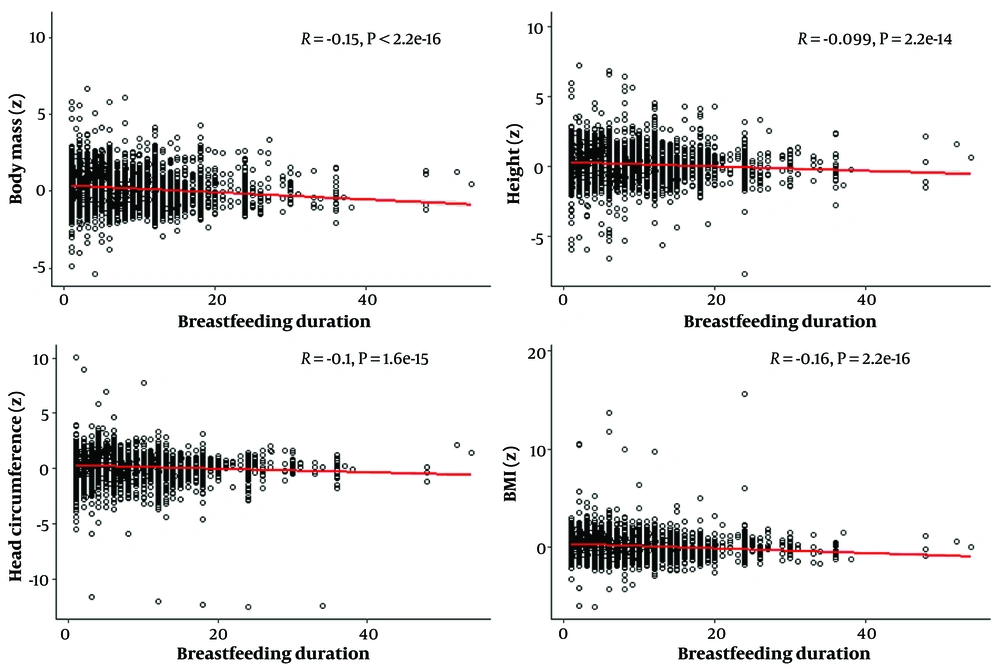
Figure 1.
Correlation between breastfeeding duration and standardized anthropometric parameters
The regression analysis of standardized anthropometric parameters in relation to breastfeeding duration demonstrated a significant impact of breastfeeding on anthropometric outcomes. The analysis was conducted using independent variables alone and with adjustments for gender, age, and their combined effect. The models consistently indicated a negative correlation between breastfeeding duration and standardized anthropometric parameters, with minimal or statistically insignificant changes in regression coefficients. All analyses were performed using breastfeeding status (Yes/No) and were repeated with breastfeeding duration as both a continuous variable (in months) and a categorical variable (Table 4).
Table 4.
Regression Models of Standardized Anthropometric Variables and Breastfeeding Status (Yes/No) and Duration
| Outcome Variables and Breastfeeding Variables | Crude B (Standardized β) | P-Value | Adjusted for Gender B (Standardized β) | P-Value | Adjusted for Gender and Age B (Standardized β) | P-Value |
|---|---|---|---|---|---|---|
| TM | ||||||
| Breastfeeding (yes/no) | -0.049 (-0.020) | 0.071 | -0.050 (-0.021) | 0.070 | -0.059 (-0.024) a | 0.031 |
| Breastfeeding duration (mo) | -0.019 (-0.121) a | < 0.001 | -0.019 (-0.121) a | < 0.001 | -0.015 (-0.094) a | < 0.001 |
| Breastfeeding duration (categorical) | -0.074 (-0.074) a | < 0.001 | -0.074 (-0.122) a | < 0.001 | -0.060 (-0.099) a | < 0.001 |
| BMI | ||||||
| Breastfeeding (yes/no) | -0.020 (-0.009) | 0.451 | -0.020 (-0.009) | 0.449 | -0.036 (-0.016) | 0.158 |
| Breastfeeding duration (mo) | -0.019 (-0.125) a | < 0.001 | -0.019 (-0.125) a | < 0.001 | -0.010 (-0.064) a | < 0.001 |
| Breastfeeding duration (categorical) | -0.073 (-0.127) a | < 0.001 | -0.073 (-0.127) a | < 0.001 | -0.044 (-0.076) a | < 0.001 |
| TV | ||||||
| Breastfeeding (yes/no) | 0.025 (0.010) | 0.357 | 0.025 (0.010) | 0.355 | 0.029 (0.012) | 0.282 |
| Breastfeeding duration (mo) | -0.016 (-0.099) a | < 0.001 | -0.016 (-0.099) a | < 0.001 | -0.015 (-0.095) a | < 0.001 |
| Breastfeeding duration (categorical) | -0.048 (-0.079) a | < 0.001 | -0.048 (-0.079) a | <0.001 | -0.042 (-0.070) a | <0.001 |
| HC | ||||||
| Breastfeeding (yes/no) | 0.168 (0.070) a | < 0.001 | 0.168 (0.070) a | < 0.001 | 0.180 (0.075) a | < 0.001 |
| Breastfeeding duration (mo) | -0.016 (-0.103) a | < 0.001 | -0.016 (-0.103) a | < 0.001 | -0.008 (-0.053) a | < 0.001 |
| Breastfeeding duration (categorical) | -0.071 (-0.119) a | < 0.001 | -0.071 (-0.119) a | < 0.001 | -0.052 (-0.088) a | < 0.001 |
| UAC | ||||||
| Breastfeeding (yes/no) | 0.152 (0.067) a | < 0.001 | 0.152 (0.067) a | < 0.001 | 0.150 (0.066) a | < 0.001 |
| Breastfeeding duration (mo) | 0.005 (0.031) a | 0.033 | 0.005 (0.031) a | 0.034 | 0.002 (0.012) | 0.451 |
| Breastfeeding duration (categorical) | -0.007 (-0.011) a | 0.368 | -0.007 (-0.011) a | 0.368 | -0.012 (-0.021) | 0.107 |
| ST | ||||||
| Breastfeeding (yes/no) | -0.052 (-0.022) | 0.175 | -0.052 (-0.022) | 0.175 | -0.053 (-0.023) | 0.170 |
| Breastfeeding duration (mo) | -0.001 (-0.004) | 0.713 | -0.001 (-0.004) | < 0.001 | -0.003 (-0.018) | 0.338 |
| Breastfeeding duration (categorical) | 0.007 (0.013) | 0.420 | 0.007 (0.013) | 0.420 | 0.007 (0.013) | 0.434 |
| CC | ||||||
| Breastfeeding (yes/no) | 0.096 (0.044) a | 0.007 | 0.096 (0.044) a | 0.007 | 0.104 (0.047) a | 0.004 |
| Breastfeeding duration (mo) | -0.002 (-0.014) | 0.455 | -0.002 (-0.014) | 0.455 | -0.005 (-0.039) a | 0.259 |
| Breastfeeding duration (categorical) | -0.025 (-0.048) a | 0.003 | -0.025 (-0.048) a | 0.003 | -0.033 (-0.063) a | < 0.001 |
Abbreviations: TM, body weight; TV, height; HC, head circumference; UAC, upper arm circumference; ST, skinfold thickness; CC, chest circumference; BMI, Body Mass Index.
a Statistically significant (P < 0.05).
5. Discussion
Obesity has remained a major global public health concern for decades. According to the World Health Organization (WHO), the prevalence of overweight children under the age of five has increased dramatically, reaching 41 million worldwide in 2016 (14).
Childhood obesity is associated with an increased risk of developing diabetes and hypertension and contributes to obesity in adulthood, thereby elevating the risk of premature mortality, chronic non-communicable diseases, and disabilities (9, 15).
A WHO analysis and other studies, including Ogden et al. and a large Chinese cohort, consistently showed that breastfeeding, particularly of longer duration or exclusive up to 5 - 6 months, is associated with a lower risk of childhood overweight and obesity (16-18).
A study in Montenegro examined this relationship by analyzing anthropometric parameters in a representative sample of children aged 0 - 59 months. Breastfed children had significantly smaller head, upper arm, and chest circumferences than non-breastfed peers, suggesting a protective effect of breastfeeding against early childhood overweight.
Gillman et al. found that exclusive or predominant breastfeeding during the first six months significantly reduced the risk of overweight, with longer breastfeeding (> 7 months) offering more protection than shorter duration (≤ 3 months) (19).
Consistent with these findings, the Montenegrin study showed that anthropometric values were highest in non-breastfed children, lower in those breastfed 0 - 6 months, and lowest in children breastfed over six months. Strongest correlations, especially for head, upper arm, and chest circumference, were observed in the non-breastfed group.
Similar protective effects of longer breastfeeding were confirmed in Germany, Brazil, and a multicenter European study, which also identified gestational weight gain as a key risk factor for childhood obesity (20-22).
Regression analysis from the Montenegro study showed a consistent negative association between breastfeeding duration and standardized anthropometric parameters. Adjustments for gender and age had minimal effect on the results. Prolonged breastfeeding was linked to reduced values of body mass, BMI, height, head circumference, upper arm circumference, and chest circumference, across both gender and age categories.
5.1. Conclusions
The findings of this study suggest that breastfeeding plays a crucial role in predicting obesity risk later in life for both genders. A longer duration of breastfeeding is associated with lower anthropometric parameter values, with children breastfed for more than six months exhibiting lower values compared to those breastfed for three months or less. The lowest values were observed in children who were not breastfed at all. These results further emphasize the protective role of prolonged breastfeeding in childhood growth and development.