
1. Background
Respiratory distress is one of the most common clinical presentations in premature neonates, often necessitating admission to neonatal intensive care units (NICUs). Nasal continuous positive airway pressure (nCPAP), which preserves functional residual capacity (FRC), is widely used as the first-line respiratory support for such infants (1). In preterm infants with respiratory distress syndrome (RDS), nCPAP is the most commonly used mode of respiratory support, as it effectively reduces the need for mechanical ventilation (MV) and, consequently, neonatal mortality. An interface is considered an integral component of nCPAP administration (2). Interface design is a critical factor in the successful delivery of nCPAP. Several designs have been developed and are currently in use, including nasopharyngeal tubes, binasal prongs, and nasal masks. To provide effective continuous distending pressure (CDP), the interface must be capable of delivering stable and sustained airway pressure (3).
Optimizing continuous positive airway pressure (CPAP) delivery remains a major clinical challenge for clinicians. A clinically effective CDP must ensure adequate oxygenation and ventilation at all times during respiratory support, while avoiding complications such as atelectasis and overdistension. Determining the optimal pressure is difficult due to the lack of reliable bedside tools. Therefore, clinicians rely on indicators such as respiratory rate and effort, supplemental oxygen requirement, chest X-ray, blood gas analysis, and electrical impedance tomography (EIT) to assess ventilation-perfusion matching (4).
Currently, short binasal prongs (SBPs) are widely used in NICUs to deliver non-invasive CDP. While some of these interfaces have been designed for specific CPAP circuits, a significant number are generic. These prongs are typically soft and round, measuring 6 - 15 mm in length. They are generally effective and reliable, but require additional securing devices at anatomical landmarks on the head and face, which can lead to nasal septum injury and restricted head movement (5, 6).
Nasal cannulas were originally developed for use in low-flow oxygen therapy and heated humidified high-flow nasal cannula (HHFNC) systems. Over time, some models have been adapted for use in nCPAP delivery. It is important to note that the basic design of nasal cannulas allows for intentional gas leakage around the cannulas, functioning as a safety mechanism to avoid excessive pressure buildup, as there is no expiratory limb in nasal cannulas. The RAM cannula (RC), developed by Neotech (Valencia, CA, USA), is a nasal cannula-based product. It features shorter, softer prongs with a larger diameter and thinner walls compared to traditional nasal prongs. The RCs are equipped with connectors that allow direct attachment to standard nCPAP systems, enabling inclusion of an expiratory limb — which makes pressure delivery measurable and controllable. Unlike conventional cannulas that fit less than 50% of the nasal openings, RCs obstruct approximately 60 - 80% of the nasal openings (7).
2. Objectives
Compared to traditional nasal cannulas, the RC features a design that combines softness with structural rigidity, making it structurally stable even after long-term use. This stability allows it to deliver gas flow with minimal resistance and less pressure drop than traditional nasal cannulas. These features have generated significant interest among researchers regarding its potential to effectively deliver nCPAP, especially given its ease of use. Many investigators aim to establish the RC as a standard of care in the administration of nCPAP for neonatal respiratory disorders, particularly in cases of RDS. Therefore, our research group designed a clinical trial to evaluate the effectiveness of the RC in delivering optimal CDP compared with the SBP.
3. Methods
3.1. Study Design and Setting
This randomized clinical trial was conducted from March 2023 to December 2024 at Shahid Beheshti and Alzahra hospitals in Isfahan, Iran. Eligible participants included neonates with a gestational age between 28 and 32 weeks who were diagnosed with RDS based on clinical symptoms [tachypnea, intercostal retractions, nasal flaring, grunting, and the need for fraction of inspired oxygen (FiO2) > 21% to maintain optimal saturation] and radiological findings. Exclusion criteria comprised neonates with chromosomal or genetic abnormalities, major congenital anomalies (such as congenital diaphragmatic hernia, tracheoesophageal fistula, Pierre Robin sequence, or choanal atresia), weak respiratory effort with apnea requiring invasive ventilation at admission to the NICU, signs of shock, pulmonary hemorrhage, or suspected persistent pulmonary hypertension. Additionally, infants with severe respiratory acidosis (pH < 7.2 and PaCO2 > 60 mmHg) or severe metabolic acidosis [pH < 7.2 and base deficit (BD) > 10 mEq/L] were excluded from participation in this study (10). Written informed consent was obtained from parents prior to the birth of each participant. The study was registered with the Iranian Registry of Clinical Trials (registration number: IRCT20120728010430N13).
3.2. Participants
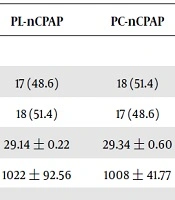
Neonates with a gestational age of 28 - 32 weeks meeting the inclusion criteria were randomly allocated into one of two groups (SBPs and RC) and enrolled upon parental consent. Randomization was performed using a block randomization method with equal block sizes. First, the total sample size was estimated, and the block size was determined. Then, a list of group allocations was generated using Random Allocation Software. When an infant entered the study, their allocation to either the intervention or control group was determined sequentially based on the pre-prepared randomization list. The researcher responsible for group assignment used the prepared allocation list with no involvement in the treatment process to ensure blinding and prevent bias. Treating clinicians could not be blinded due to the visible differences between the two CPAP interfaces. However, the outcome assessors responsible for determining CPAP failure and clinical stability were blinded to group assignment. To minimize observer bias, assessments were based on predefined, objective clinical criteria. Consecutive sampling continued until 35 neonates were enrolled in each group. Demographic characteristics of the participants are provided in Table 1.
Table 1.
Demographic Characteristics of Newborns in Short Binasal Prongs and RAM Cannula Groups
| Characteristics | SBP | RC | P-Value |
|---|---|---|---|
| Sex | 0.808 | ||
| Male | 21 | 20 | |
| Female | 14 | 15 | |
| GA (mean); wk | 30.59 | 30.63 | 0.873 |
| Birth weight (mean); g | 1338.86 | 1292.00 | 0.485 |
| Mothers receiving steroids | 35 | 35 | 1 |
| Route of delivery | 0.467 | ||
| NVD | 13 | 16 | |
| C/S | 22 | 19 |
Abbreviations: SBP, short binasal prong; RC, RAM cannula.
The sample size was calculated using the following formula:
Level of confidence:
3.3. Intervention
Infants in the SBP group received nCPAP via properly sized (BC3020; BC3520) binasal prongs (Fisher & Paykel Healthcare, Auckland, New Zealand, Figure 1), ensuring complete nasal opening fitting. The CDP was provided using the BC161 Set Bubble CPAP Infant Delivery System (Fisher & Paykel Healthcare, Auckland, New Zealand), which was initially set at 6 cmH2O with a flow of 5 L/min. Based on optimal CDP indicators — including resolution of grunting, reduced respiratory rate, decreased intercostal retractions, and reduced fraction of inspired oxygen (FiO2) requirements — pressure was adjusted up to 9 cmH2O and then titrated down as the infant stabilized (11, 12).
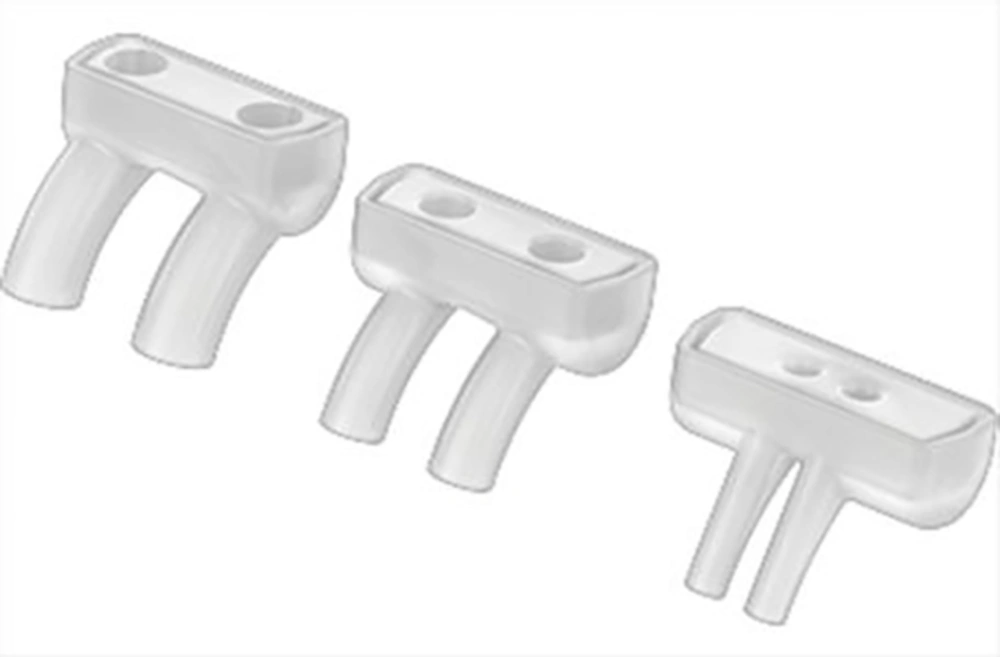
Figure 1.
Short binasal prong (SBP), Fisher & Paykel Healthcare, Auckland, New Zealand, adapted from www.fphcare.com
In cases where FiO2 > 30% was required to maintain preductal oxygen saturation (SpO2) at 90 - 95%, the infant received surfactant (Survanta) via the INSURE method at a dose of 100 mg/kg. Repeat dosing was administered after six hours if the requirement of FiO2 > 30% persisted, with a maximum of four doses. To guide respiratory support, capillary blood gases were assessed before and after surfactant administration and every 12 hours thereafter (13).
During weaning, infants maintaining SpO2 > 90% with CDP = 4 cmH2O and FiO2 < 30% for at least four hours were transitioned to high-flow nasal cannula (HFNC) at 2 L/min, with oxygen supplementation adjusted accordingly (14).
The presence of any of the following clinical criteria led to discontinuation of noninvasive respiratory support and initiation of endotracheal intubation along with invasive MV (15):
- Inadequate ventilation or respiratory failure (pH < 7.2; PaCO2 > 65 mmHg)
- More than four apneic episodes per hour requiring stimulation, or any apneic episode requiring positive pressure ventilation
- Requirement for FiO2 > 60% along with CDP > 7 cmH2O to maintain preductal SpO2 higher than 90%
Infants in the RAM group received nCPAP via RCs (Neotech, Valencia, CA, USA) (Figure 2), which were appropriately sized to fit the nasal nares (white and green cannulas coded as N4900 and N4901, respectively), and connected to the same BC161 bubble CPAP generator system. Clinical management for this group mirrored that of the SBP group.
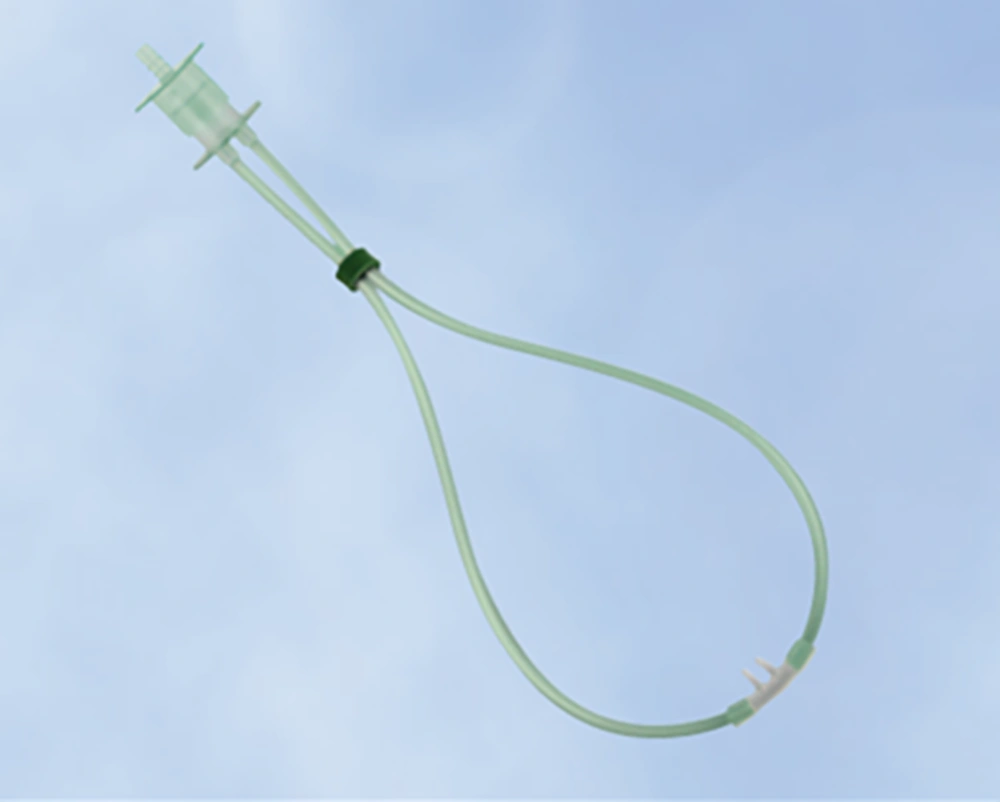
Figure 2.
RAM cannula (RC), Neotech, Valencia, CA, USA, adapted from www.neotechproducts.com
Demographic data, requirement for MV within 72 hours after birth, duration of non-invasive support, total surfactant doses, oxygen dependency beyond 28 days [indicative of chronic lung disease (CLD)], and incidence of pneumothorax were documented for the participants. Brain ultrasound evaluations were performed on days 3, 7, 14, and 28 to detect intraventricular hemorrhage (IVH) and periventricular leukomalacia (PVL).
3.4. Primary Outcome Measures
The primary outcome of this study was the need for invasive MV within the first 72 hours of life in the SBP and RC groups.
4. Results
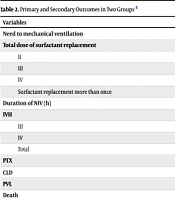
Table 2 presents the primary and secondary outcomes of the study. There was no statistically significant difference between the RC and SBP groups regarding the need for MV, the requirement for surfactant administration, the duration of non-invasive respiratory support, the incidence of CLD, the rates of severe IVH (grades III and IV), PVL, the occurrence of pneumothorax, and neonatal mortality.
Table 2.
Primary and Secondary Outcomes in Short Binasal Prongs and RAM Cannula Groups
| Variables | SBP | RC | P-Value | ||||||
|---|---|---|---|---|---|---|---|---|---|
| Replacement with Two Doses | Replacement with Three Doses | Total | Replacement with Two Doses | Replacement with Three Doses | Total | Replacement with Three Doses | Replacement with Two Doses | Total | |
| Total doses of surfactant replacement (n) | 10 | 6 | 22 | 9 | 6 | 28 | 1 | 0.788 | 0.112 |
| Duration of respiratory support (mean); h | 142.34 | 153.60 | 0.813 | ||||||
| Need to supplemental O2 (mean); d | 22.71 | 0.628 | 21.80 | ||||||
| Variables | III | IV | Total | III | IV | Total | IV | III | Total |
| IVH (n) | 8 | 5 | 13 | 6 | 1 | 7 | 0.088 | 0.550 | 0.112 |
| PTX (n) | 4 | 2 | 0.393 | ||||||
| CLD (n) | 11 | 12 | 0.799 | ||||||
| PVL (n) | 7 | 7 | 1 | ||||||
| Death (n) | 3 | 2 | 0.643 | ||||||
Abbreviations: SBP, short binasal prong; RC, RAM cannula; IVH, intraventricular hemorrhage; CLD, chronic lung disease; PVL, periventricular leukomalacia.
According to Table 2, the P-value for the need for MV was calculated as 0.721, with the risk ratio and confidence interval being 2.364 and 0.95%, respectively. Additionally, the P-value for the need for surfactant administration more than once was calculated as 0.112, with the risk ratio and confidence interval being 0.774 and 0.95%, respectively. In the following section, the results obtained in the present study will be compared with those of previously conducted studies.
5. Discussion
Over the past decade, a limited number of clinical trials have investigated the efficacy of the RC in neonatal respiratory support. In a study conducted by Singh et al. from October 2016 to April 2017 at Dartmouth Hitchcock Medical Center (Lebanon, New Hampshire), 15 preterm neonates with a mean gestational age of 28.4 weeks experiencing RDS were enrolled in a non-blinded, crossover clinical trial. The infants alternately received nCPAP via Hudson prongs and the RC. The study measured CDP within the oral cavity while the infants received bubble CPAP with CDP levels of 5 - 7 cm H₂O. The mean CDP in the oral cavity was significantly lower when the RC was used compared to the Hudson prongs (16).
Another crossover clinical study was conducted by Sharma et al. on 30 preterm neonates between April and September 2019 at Fernandez Hospital (Hyderabad, India). In this study, prongs, nasal masks, and the RC were utilized sequentially to deliver bubble CPAP (CDP = 5 - 6 cmH2O) to neonates with RDS while oropharyngeal pressure was measured for each interface. The pressure drop was shown to be significantly higher with the RC compared with the nasal mask (17).
In a randomized clinical trial conducted by Samim et al. from March 2020 to March 2021 in India at Safdarjung Hospital and Vardhman Mahavir Medical Institute, 254 preterm neonates with RDS were divided into two groups, with one group receiving nCPAP via binasal prongs and the other via RCs, both at 5 cmH2O. The primary outcome was defined as CPAP failure within 72 hours of birth. The study concluded that neither interface demonstrated superiority over the other (18).
Another randomized trial was conducted by Maram et al. on 264 preterm neonates presenting with RDS who were managed using nCPAP as first-line respiratory support via either binasal prongs or the RC. This multicenter trial was conducted between April 2019 and May 2020 at Fernandez Hospital (Hyderabad, India) and King Edward Memorial Hospital (Pune, India). Findings indicated no significant difference in the need for MV between the two groups (15).
In the present study, no statistically significant superiority was observed for either interface with respect to the primary and secondary outcomes, which aligns with findings from the studies by Maram et al. and Samim et al. (15, 18). In our study, 80% of neonates in the RC group required surfactant administration — a notably higher percentage than in the SBP group. However, this difference was not statistically significant. This finding could be in line with the observations of Singh and Sharma, who demonstrated that RCs may deliver lower effective CDP at equivalent pressure settings compared to prongs.
5.1. Conclusions
While this study did not demonstrate statistically significant superiority for either the RC or SBP across primary or secondary outcomes, the findings provide a foundation for future research with larger sample sizes. One of the main limitations of this study was the relatively small sample size. Moreover, the data suggest that RCs can achieve clinically acceptable results comparable to SBP in delivering nCPAP for preterm neonates, without the limitations imposed by prongs and masks. Nasal cannulas, initially developed for use in low-flow oxygen therapy and HHFNC systems, have recently been considered for delivering nCPAP due to design adaptations that allow for broader clinical applications. To achieve an optimal clinical airway pressure at the proximal airway using the RC for nCPAP, higher levels of CDP may be required compared to SBP.