
1. Background
Acute kidney injury (AKI) is a major concern in pediatric critical care, particularly among children admitted to intensive care units, and is associated with high morbidity and mortality (1, 2). It is characterized by a typically reversible increase in serum creatinine and nitrogenous waste products, along with the inability of the kidneys to maintain fluid and electrolyte homeostasis (3). Clinically, AKI is diagnosed when serum creatinine levels double the normal range for the patient’s age. Oliguria (urine output < 1 mL/kg/h) and anuria (complete cessation of urine production) are common symptoms, although they are observed in fewer than 50% of patients (4).
The mortality rate among critically ill children with AKI ranges from 9% to 67% (5, 6), particularly when accompanied by multiple organ failure or acute respiratory distress syndrome (7, 8). Most cases of AKI are secondary to acute tubular necrosis (ATN), often due to hypovolemia, sepsis, or nephrotoxic agents (7, 9). In pediatric intensive care units, AKI accounts for approximately 25% of admissions (10).
In advanced stages, patients may require renal replacement therapy (RRT), including hemodialysis, peritoneal dialysis, or kidney transplantation (11). Classic indications for initiating RRT in children include metabolic or electrolyte imbalances, uremia with bleeding and/or encephalopathy, fluid overload with pulmonary edema, and toxicity. In children with AKI, peritoneal dialysis (PD) is often the preferred RRT modality because of its feasibility, particularly in neonates after cardiopulmonary bypass or cardiac surgery (12, 13).
PD is a reliable modality for managing kidney failure. However, its utilization rate in Iran remains substantially lower than the global average: Less than 1% compared with approximately 15% (14). In clinical practice, rigid catheters are commonly used for PD in children in Iran, primarily because of their wide availability and low cost.
A major challenge in neonatal peritoneal dialysis is the lack of appropriately sized catheters, which leads to higher complication rates, such as leakage and dislodgement. Low-weight infants may require smaller and better-designed catheters because of their thin abdominal walls.
In a study by Garg et al., 67.2% of children undergoing peritoneal dialysis experienced complications, with 21.2% having mechanical issues, such as catheter obstruction and fluid leakage. The rates of peritonitis and exit-site infection were 4.4% and 1.8%, respectively, indicating substantial challenges associated with rigid catheters compared with softer alternatives, such as Tenckhoff catheters. Despite the lower cost and easier access to rigid catheters in developing countries, international guidelines recommend the use of softer catheters because of their lower complication rates (15). Cyphers et al. reported a technical success rate of 95.6% for percutaneous nephrostomy in infants, but complications such as catheter migration (19.6%) and obstruction (38.5%) remained prevalent (16).
These findings highlight the need for ongoing evaluation of catheter types and techniques to optimize outcomes in pediatric peritoneal dialysis. One alternative option is the nephrostomy catheter, which is primarily designed for urinary diversion but has been reported for use in PD in some clinical settings (17, 18).
2. Objectives
Given the substantial mechanical and infectious complications associated with rigid peritoneal dialysis (PD) catheters, the limited availability of appropriately sized pediatric catheters, and the scarcity of robust comparative evidence on alternative devices such as nephrostomy catheters, this study aimed to systematically evaluate the relative performance of these 2 catheter types in children requiring acute PD for AKI.
The objective of this randomized clinical trial was to compare nephrostomy catheters with conventional rigid PD catheters in terms of efficacy, safety, and complication rates, including leakage, obstruction, catheter malposition, peritonitis, exit-site infections, and technical success in achieving ultrafiltration and solute clearance. The study also aimed to assess procedural feasibility, time to PD initiation, and applicability in resource-limited settings. Ultimately, this investigation sought to generate high-quality evidence to guide clinicians in selecting the most effective and safest catheter option for pediatric acute PD, thereby improving clinical outcomes and reducing preventable complications in this vulnerable population.
3. Methods
3.1. Study Setting and Population
This randomized clinical trial used a 2-parallel-group superiority design. The study was conducted from June 2023 to February 2025 at Dr. Sheikh and Ghaem Hospitals, affiliated with Mashhad University of Medical Sciences. The study population comprised hospitalized children aged 0 - 12 years with a confirmed diagnosis of AKI who required urgent initiation of PD. A total of 64 patients were screened during the study period. Eligibility was determined using predefined inclusion and exclusion criteria to ensure that only appropriate candidates proceeded to randomization. The study included 2 arms: the rigid peritoneal catheter was considered the control intervention, and the nephrostomy catheter was considered the intervention.
Because age and weight are critical determinants of peritoneal dialysis outcomes, randomization was conducted using age-stratified blocks (neonate, infant, and child) to minimize imbalance between groups. Although full matching was not feasible in the acute clinical setting, this stratified approach reduced the impact of baseline variability. Weight and body mass index (BMI) were also recorded as continuous variables and included as covariates in the adjusted analyses.
3.2. Inclusion and Exclusion Criteria
Children were eligible if they were between 0 and 12 years of age, had AKI confirmed according to Kidney Disease: Improving Global Outcomes criteria, and required acute PD as assessed by the treating nephrologist. Written informed consent from parents or legal guardians was also mandatory. Exclusion criteria included previous abdominal surgeries that could interfere with catheter placement, known peritoneal membrane disorders, hemodynamic instability that precluded the safe initiation of PD, and peritonitis at admission. Only patients meeting all inclusion criteria and none of the exclusion criteria were entered into the eligibility pool.
3.3. Eligibility Assessment and Participant Flow
Among the 64 children screened, 14 were excluded: 9 did not meet the inclusion criteria, and 5 families declined participation. Thus, 50 children met the eligibility criteria and were enrolled. All 50 participants completed randomization, allocation, treatment, and follow-up without any losses. A CONSORT flow diagram (Figure 1) illustrating the numbers of participants assessed, excluded, randomized, allocated, and analyzed will be included in the manuscript to ensure transparency and adherence to reporting standards.
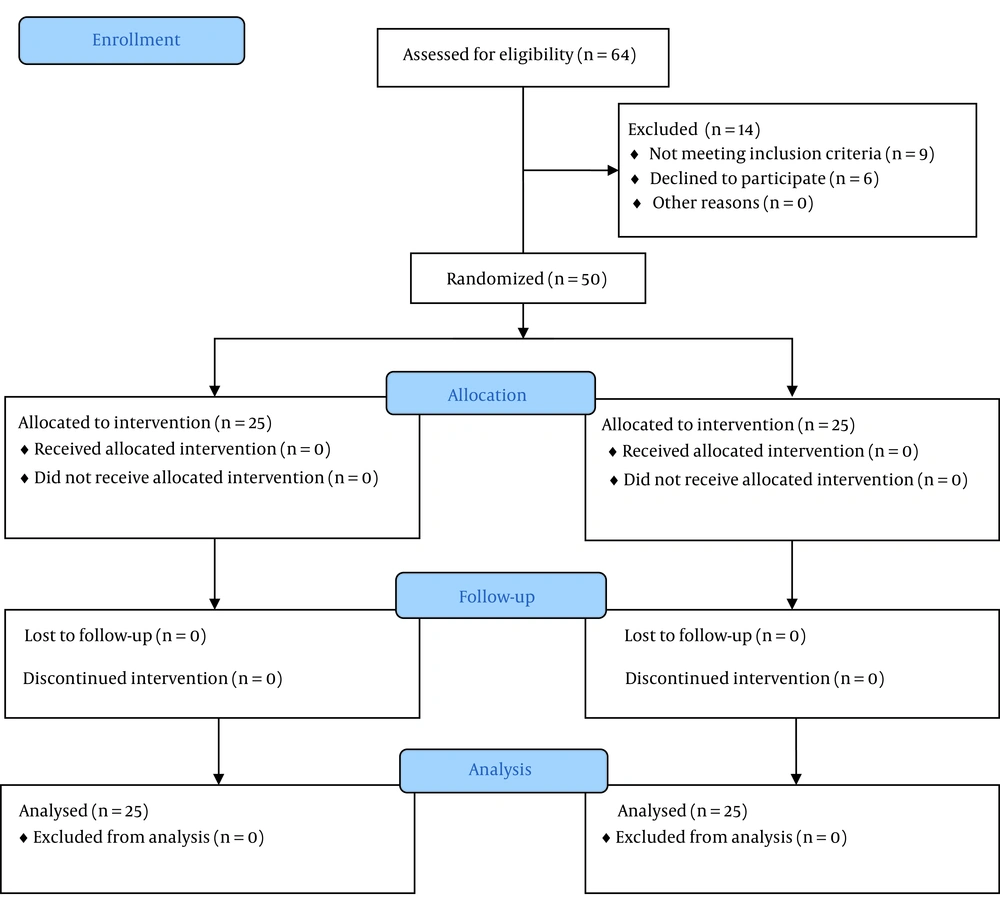
Figure 1.
CONSORT 2010 flow diagram
3.4. Study Design and Randomization Procedure
This investigation was designed as a randomized clinical trial with 2 parallel groups and a superiority framework to compare nephrostomy catheters with rigid peritoneal dialysis catheters. Randomization was performed using block randomization with variable block sizes generated by a computer-based random number table. Allocation concealment was maintained using sealed, opaque, sequentially numbered envelopes prepared by an independent research coordinator who was not involved in participant recruitment, clinical management, or outcome evaluation. Given the known influence of age and the clinical reason for admission on treatment outcomes in AKI, randomization was stratified by age category (neonate, infant, and child) to minimize baseline imbalances between groups.
Although efforts were made to balance the groups through age-stratified randomization and by recording key baseline characteristics (age, weight, BMI, and reason for AKI), no formal individual matching was performed. Complete matching in this acute clinical setting was not feasible, and extensive matching could introduce selection bias by limiting the natural variability of eligible participants. Therefore, randomization, rather than matching, served as the primary method for balancing the groups. Residual imbalances were subsequently addressed through multivariable regression adjustment.
3.5. Intervention and Peritoneal Dialysis Procedure
After informed consent, children were allocated in a 1:1 ratio to receive either a rigid peritoneal dialysis catheter (control group) or a nephrostomy catheter (intervention group). All catheters were inserted under strictly sterile conditions by an experienced pediatric surgeon or nephrologist. The peritoneal dialysis regimen was standardized across both groups with respect to dialysate composition, dwell times, cycle intervals, and monitoring protocols. From the first day of treatment, peritoneal fluid smears and cultures were collected routinely to evaluate catheter performance and detect infections. Episodes of fluid leakage, impaired drainage, catheter obstruction or malposition, spontaneous dislodgement, peritonitis, and exit-site infection were recorded throughout the treatment course.
3.6. Outcome Definitions and Data Collection
Outcome definitions followed internationally recognized criteria. Good catheter function was defined as uninterrupted, effective inflow and outflow of dialysis fluid without evidence of leakage, obstruction, malposition, or the need for catheter replacement. Poor catheter function was defined as inadequate fluid exchange associated with mechanical failure or obstruction requiring clinical intervention. Peritonitis was diagnosed using the ICD-11 code DC50.Z, and exit-site infection was identified according to the ICD-11 code NE81.2, consistent with the classification of surgical site infections. Data collected included demographic factors (age and sex), reason for admission, underlying diseases, catheter type, duration of catheter use, catheter function, fluid leakage, spontaneous dislodgement, peritonitis, exit-site infection, need for chronic dialysis, and mortality.
3.7. Sample Size Calculation
The sample size was calculated to detect a clinically meaningful difference in catheter-related complication rates between the 2 groups. Using a 2-sided α of 0.05 and a power of 80%, and assuming an expected complication rate of 30% in the rigid catheter group and 10% in the nephrostomy catheter group based on previous studies, a minimum of 22 patients per group was required. Considering potential exclusions and feasibility limitations in an acute pediatric population, a total sample size of 50 patients was deemed adequate.
3.8. Confounding Variables
Potential confounding variables were identified a priori based on clinical relevance and previous literature. These confounders included age, sex, weight, BMI, underlying disease, and the primary reason for AKI, such as sepsis, hypovolemia, cardiogenic causes, or nephrotoxic exposure. Diagnostic criteria for AKI followed Kidney Disease: Improving Global Outcomes guidelines. To assess and control confounding, multivariable regression models were applied for both categorical and continuous outcomes. Logistic regression was used for binary outcomes, such as peritonitis, catheter malfunction, and leakage, whereas linear regression was used for continuous variables, including catheter duration. Confounders were entered into the model simultaneously to evaluate independent associations between catheter type and clinical outcomes. The primary reason for AKI, such as sepsis, hypovolemia, cardiogenic causes, or nephrotoxic exposure, was recorded for all participants and considered a key confounding variable.
3.9. Ethical Approval
The study was approved by the Ethics Committee of Mashhad University of Medical Sciences on June 27, 2023, under approval number IR.MUMS.MEDICAL.REC.1402.188. The study was also registered in the Iranian Registry of Clinical Trials (IRCT) with registration number IRCT20230809059093N1 on August 19, 2023.
3.10. Statistical Analysis and Sample Size Justification
Data analysis was performed using SPSS version 27 (IBM Corp., Armonk, NY, USA). The Shapiro-Wilk test was used to assess the normality of continuous variables. Depending on the distribution, group comparisons were conducted using the independent samples t-test or Mann-Whitney U test for continuous variables and the chi-square or Fisher exact test for categorical variables. A significance level of P < 0.05 was adopted.
Because no prior randomized trials have compared nephrostomy catheters with rigid peritoneal catheters in pediatric AKI, the existing literature did not provide the effect-size parameters necessary for a conventional power analysis. Therefore, the sample size was determined pragmatically based on the minimum clinically important difference agreed upon by clinicians and researchers, along with feasibility considerations typical of exploratory clinical trials. Anticipating attrition, the study allocated 25 participants to each group, yielding a total sample size of 50.
Baseline characteristics, including age and underlying comorbidities, were compared between groups to assess balance after randomization. Multivariable regression modeling was performed to adjust for clinically relevant covariates, including age, weight, BMI, underlying disease, and the primary reason for AKI. Logistic regression was used for binary outcomes, and linear regression was used for continuous outcomes, including catheter duration. Effect estimates are presented with 95% CIs to enhance interpretability beyond P values.
In addition to hypothesis testing and P values, effect sizes with 95% CIs were reported to provide more precise estimates of the magnitude and direction of associations. For categorical outcomes, ORs with 95% CIs were calculated, and for continuous outcomes, mean differences with 95% CIs were presented. P values were not interpreted in isolation but were considered alongside effect-size measures to provide a more clinically meaningful interpretation of the results.
4. Results
4.1. Participants
Of the 50 enrolled patients, 50% were male and 50% were female. In the nephrostomy group, 52% (13 patients) were male and 48% (12 patients) were female. In the rigid catheter group, 48% (12 patients) were male and 52% (13 patients) were female. There was no significant association between sex and group assignment (P = 0.77).
Fifty percent of the patients (n = 25) received nephrostomy catheters, and the remainder received rigid catheters. The mean age was 8.80 ± 7.58 months in the nephrostomy group and 13.40 ± 19.64 months in the rigid group. Age ranged from 1 to 24 months in the nephrostomy group and from 1 to 84 months in the rigid group. Although the age ranges differed between groups, the age distribution did not differ significantly between the 2 groups (P = 0.83). Moreover, age-stratified randomization yielded comparable age profiles across groups, with no clinically meaningful imbalance.
4.2. Catheter Duration
The mean catheter duration was 5.20 ± 3.73 days (range, 1 - 17 days). The mean duration was 4.08 ± 3.27 days in the rigid group (range, 1 - 12 days) and 6.32 ± 3.95 days in the nephrostomy group (range, 2 - 17 days). There was a significant difference in catheter duration between the 2 groups (mean difference, 2.24 days; 95% CI, 0.18 - 4.29; P = 0.02).
4.3. Catheter Function and Associated Complications
Comparisons of clinical outcomes and complication rates between the 2 catheter types showed no significant differences (Table 1).
Table 1.
Comparison of Catheter Function and Associated Complications a
| Variables | Nephrostomy (n = 25) | Rigid (n = 25) | P-Value |
|---|---|---|---|
| Good catheter function | 18 (72) | 13 (52) | 0.14 |
| Fluid leakage | 5 (20) | 7 (28) | 0.50 |
| Spontaneous catheter dislodgement | 2 (8) | 1 (4) | 0.55 |
| Peritonitis | 1 (4) | 2 (8) | 0.55 |
| Catheter exit-site infection | 2 (8) | 3 (12) | 0.63 |
| Chronic dialysis requirement | 10 (40) | 12 (48) | 0.56 |
| Mortality | 13 (52) | 12 (48) | 0.77 |
a Values are expressed as No. (%).
4.4. Catheter Type and Underlying Disease
Among the 50 patients, 42% (n = 21) had infectious underlying conditions and 58% (n = 29) had noninfectious underlying conditions. Among patients with infectious etiologies, 52% (n = 11) received nephrostomy catheters and 48% (n = 10) received rigid catheters. Among the 29 patients with noninfectious causes, 48% (n = 14) were in the nephrostomy group and 52% (n = 15) were in the rigid group. These findings indicate no statistically significant association between catheter type and underlying disease (P = 0.77).
Patients were also evaluated for catheter-related complications according to the type of underlying disease (infectious vs noninfectious) and catheter type (nephrostomy vs rigid). Statistical analysis showed no significant association between underlying disease type and the frequency of catheter complications (Table 2).
Table 2.
Comparison of Catheter Complications by Catheter Type and Underlying Disease a
| Variables | Rigid (Infectious, n = 10) | Nephrostomy (Infectious, n = 11) | P Value (Infectious) | Rigid (Noninfectious, n = 15) | Nephrostomy (Noninfectious, n = 14) | P-Value (Noninfectious) |
|---|---|---|---|---|---|---|
| Good catheter function | 6 (60) | 11 (73) | 0.65 | 7 (47) | 10 (71) | 0.26 |
| Fluid leakage | 2 (20) | 1 (9) | 0.58 | 5 (33) | 4 (29) | 1.00 |
| Spontaneous catheter dislodgement | 1 (10) | 0 | 0.47 | 0 | 2 (14) | 0.22 |
| Peritonitis | 1 (10) | 1 (9) | 1.00 | 1 (7) | 0 | 1.00 |
| Catheter exit-site infection | 1 (10) | 1 (9) | 1.00 | 2 (13) | 1 (7) | 1.00 |
| Chronic dialysis requirement | 6 (60) | 4 (36) | 0.39 | 6 (40) | 6 (43) | 1.00 |
| Mortality | 5 (50) | 6 (54) | 1.00 | 7 (47) | 7 (50) | 1.00 |
a Values are expressed as No. (%).
4.5. Catheter-Related Outcomes Between Age Groups
All 50 patients were categorized into 2 age groups based on age:
- Age ≤ 6 months: 23 patients (46%)
- Age > 6 months: 27 patients (54%)
In infants aged ≤ 6 months and > 6 months, mean catheter duration was compared between the nephrostomy and rigid catheter groups; the differences were not statistically significant (Table 3). Although the age and weight distributions differed in range between the 2 groups, adjusted analyses accounting for these variables did not change the overall direction or significance of the outcomes.
Table 3.
Comparison of Catheter Duration by Catheter Type and Age Group
| Age Group (mo) and Catheter Type | Mean Duration ± SD (d) | P-Value |
|---|---|---|
| ≤ 6 | ||
| Nephrostomy | 6.09 ± 3.11 | 0.12 |
| Rigid | 4.08 ± 2.47 | 0.12 |
| > 6 | ||
| Nephrostomy | 6.50 ± 4.60 | 0.06 |
| Rigid | 4.08 ± 3.97 | 0.06 |
Catheter-related outcomes were also compared between catheter types in both age groups (≤ 6 months and > 6 months); however, no statistically significant differences were observed in either group (Table 4).
Table 4.
Comparison of Catheter-Related Outcomes by Catheter Type and Age Group a
| Variables | Rigid (≤ 6 mo, n = 12) | Nephrostomy (≤ 6 mo, n = 11) | P-Value (≤ 6 mo) | Rigid (> 6 mo, n = 13) | Nephrostomy (> 6 mo, n = 14) | P-Value (> 6 mo) |
|---|---|---|---|---|---|---|
| Good catheter function | 5 (42) | 8 (73) | 0.14 | 8 (61) | 10 (71) | 0.44 |
| Fluid leakage | 6 (50) | 2 (18) | 0.12 | 1 (8) | 3 (21) | 0.32 |
| Spontaneous catheter dislodgement | 1 (8) | 1 (9) | 0.73 | 0 | 1 (7) | 0.51 |
| Peritonitis | 0 | 1 (9) | 0.47 | 0 | 1 (7) | 0.22 |
| Catheter exit-site infection | 1 (8) | 2 (18) | 0.46 | 2 (15) | 0 | 0.22 |
| Chronic dialysis requirement | 5 (42) | 5 (45) | 0.59 | 7 (54) | 5 (36) | 0.28 |
| Mortality | 4 (33) | 6 (54) | 0.27 | 8 (61) | 7 (50) | 0.41 |
| Infectious underlying diseases | 4 (33) | 3 (27) | 0.55 | 6 (46) | 8 (57) | 0.42 |
a Values are expressed as No. (%).
5. Discussion
Fifty pediatric patients with acute kidney failure (25 per group) participated in this randomized clinical trial comparing complications between 2 peritoneal dialysis catheter types: rigid and nephrostomy catheters. Catheter function, fluid leakage, peritonitis, exit-site infection, spontaneous catheter dislodgement, chronic dialysis requirement, and mortality did not differ significantly between groups. The nephrostomy group had a longer catheter survival duration, which was the only significant difference. This finding may be related to improved catheter stability due to catheter design or material. Subgroup analyses by age (> 6 months vs ≤ 6 months) and underlying disease (infectious vs noninfectious) did not reveal any significant differences.
This study highlights the potential advantages of nephrostomy catheters in pediatric patients with AKI undergoing PD. The findings suggest that nephrostomy catheters may offer superior durability compared with traditional PD catheters, reducing the need for frequent replacements. This is particularly important in pediatric populations, in whom minimizing invasive procedures is critical to reducing complications and improving patient outcomes (19).
Previous studies have also emphasized the importance of catheter design and placement techniques in reducing complications, such as infections and obstructions, which are common in pediatric dialysis (20). Future multicenter studies with larger sample sizes and longer follow-up are recommended to confirm these results.
The findings of the present study are in partial agreement with previous research examining catheter types and outcomes in pediatric patients undergoing acute peritoneal dialysis due to AKI.
Auron et al. retrospectively evaluated the use of the soft, multipurpose Cook Mac-Loc catheter (CMMDC) in 21 children and neonates. They reported a high complication-free survival rate (90% over 14 days) and very low rates of leakage or obstruction, with no cases of peritonitis or exit-site infection (21). In contrast, although our study observed a higher incidence of peritonitis (6%) and exit-site infection (10%), nephrostomy catheters demonstrated a significantly longer functional duration than rigid catheters.
In a larger study by Garg et al., 113 children underwent PD with rigid catheters. Despite a high mortality rate (46.2%) and notable complications, the study concluded that rigid catheters were feasible in resource-limited settings (15). This aligns with our findings in terms of feasibility; however, we reported slightly higher rates of catheter-related complications, such as leakage (24%) and infection (10%).
In a more recent multicenter study, Sinha et al. compared soft CMMDC catheters with metal rigid catheters in neonates with extremely low birth weight (< 1000 g) and very low birth weight (< 1500 g) and found significantly fewer complications and lower mortality in the soft catheter group (22). Our results support the notion that catheter design affects outcomes, although we did not directly compare nephrostomy catheters with soft catheters.
Chadha et al. conducted a seminal study comparing rigid Cook catheters with soft Tenckhoff catheters in children with AKI and found significantly higher complication rates and a shorter catheter lifespan with the rigid catheter (23). This supports our findings, in which rigid catheters were associated with a shorter duration, although our study did not include Tenckhoff catheters.
Finally, Coccia et al. examined 389 children with Shiga toxin-producing Escherichia coli-associated hemolytic uremic syndrome who underwent PD primarily using Tenckhoff catheters. Their reported rates of peritonitis (19%) and leakage (11.5%) were higher and lower, respectively, than ours. Their study emphasized the importance of prophylactic antibiotics in reducing infection risk, an aspect not documented in our data but worth considering in future protocols (24).
The study by Widiasta et al. demonstrated that the quality of life of pediatric patients with end-stage kidney disease undergoing PD at their hospital was better than that of patients undergoing hemodialysis. Given the findings showing better quality of life in children undergoing PD, clinicians and parents may be better informed when making decisions regarding the management of pediatric end-stage kidney disease. The choice of dialysis method is crucial not only for addressing medical needs but also for considering the broader impact on the child’s physical, emotional, social, and educational well-being. These results further support the need for studies such as ours in larger groups and with longer follow-up (25).
5.1. Limitations
Limitations include the small sample size, which may have reduced the power to detect differences in low-incidence complications, and the lack of data on variables such as prophylactic antibiotic use, nutritional status, and long-term outcomes. Strengths include the randomized trial design, daily monitoring, and comprehensive evaluation of qualitative and quantitative variables. An important limitation of this study is the heterogeneity in age distribution between the 2 groups.
Another limitation is the wide variation in age and weight between groups. Although mean values were not statistically different, the extended range, particularly in the rigid catheter group, may introduce residual confounding. Despite applying age-stratified randomization and adjusting for age, weight, and reason for AKI in multivariable models, unmeasured effects may remain. Larger multicenter studies with narrower, predefined age and weight strata are recommended. In addition, data on prophylactic antibiotic use were not available, which may have influenced infection-related outcomes.
Although the study attempted to balance baseline characteristics through stratified randomization, formal matching was not performed, and extensive matching could potentially introduce selection bias. As a result, some residual baseline differences may persist. These were mitigated through adjusted statistical analyses, but the possibility of unmeasured confounding cannot be fully excluded.
5.2. Conclusions
This study aimed to compare the complications and performance of 2 types of PD catheters, rigid and nephrostomy catheters, in children with AKI. Fifty pediatric patients were included and equally assigned to each catheter group. Underlying conditions, catheter function, fluid leakage, peritonitis, spontaneous dislodgement, exit-site infection, chronic dialysis requirement, and mortality were evaluated. Although most variables showed no statistically significant differences, catheter dwell time was notably longer in the nephrostomy group, indicating potential advantages in stability and longevity.
Both catheter types were feasible and safe for acute PD in children. However, nephrostomy catheters might be more effective in situations requiring longer use. Further large-scale, multicenter studies are needed to determine optimal catheter selection in pediatric peritoneal dialysis.