
1. Background
Cerebral palsy (CP) comprises a group of nonprogressive disturbances that arise in the developing fetal or infant brain and lead to activity limitations. It is a leading cause of childhood physical disability worldwide (1). The prevalence of CP ranges from 2‰ to 4.4‰ in developed countries, whereas in China, it is 1.9‰ among children aged 1 to 6 years (2). Spastic CP is the most common subtype. Children diagnosed with CP often require prolonged rehabilitation, frequently necessitating hospitalization. However, hospitalized children are at a substantially increased risk of acquiring infections. Nosocomial infections not only undermine the effectiveness of rehabilitation but also prolong the duration of treatment (3).
Previous research has examined several potential risk factors, including age, birth weight, and gestational age (4). Nevertheless, the findings remain inconclusive in many respects. Notably, the caregiving environment for children with CP may indirectly affect infection risk (5). Caregivers’ psychological status directly influences the implementation of infection prevention strategies in routine care, indicating that the factors affecting nosocomial infections in children with CP are multidimensional.
In addition, the role of nutritional factors, particularly fat-soluble vitamins, in the incidence of infection among children with CP remains insufficiently understood. Among these nutrients, vitamin A is particularly important. Often referred to as the "anti-infection vitamin," its biological functions extend well beyond the maintenance of normal vision. In pediatric infectious diseases, the association between vitamin A levels and susceptibility to infection has attracted substantial scholarly interest. Vitamin A deficiency has been associated with an increased risk of postinfection kidney scarring, whereas vitamin A supplementation has been shown to alleviate infection-related symptoms, such as fever and frequent urination, and to reduce the likelihood of recurrence (6). Serum retinol deficiency is also clearly associated with an increased risk of respiratory infections. Mechanistically, vitamin A enhances host defense against infections through its interactions with both the innate and adaptive immune systems (7).
2. Objectives
Understanding these factors is crucial for developing targeted preventive strategies and improving the prognosis of children with CP. Therefore, this study aimed to comprehensively investigate the associations among fat-soluble vitamins, other clinical factors, and nosocomial infections in children with spastic CP. The findings may assist clinicians in formulating targeted preventive interventions. To our knowledge, this study is the first to explore the association between vitamin A levels and nosocomial infections in children with spastic CP.
3. Methods
3.1. Study Design and Participants
This retrospective study included children younger than 12 years who were diagnosed with spastic CP between January 2023 and December 2023. The inclusion criteria were as follows: 1) a medical diagnosis of spastic CP confirmed by 2 rehabilitation physicians; 2) hospitalization in a rehabilitation ward for more than 7 days; 3) patient sex, age, weight at admission, gestational age, birth weight, spastic CP subtype, gross motor function classified by the Gross Motor Function Classification System (GMFCS), and magnetic resonance imaging (MRI) patterns based on the MRI classification system (MRICS) recorded in the medical record; and 4) tests of fat-soluble vitamins (vitamin A, vitamin D3, and vitamin E) and plasma biochemical parameters, including serum calcium, phosphorus, magnesium, triglycerides, cholesterol, prealbumin, and ferritin, completed after admission. The exclusion criteria were as follows: 1) acute infection at admission and 2) immunodeficiency disorders.
3.2. Definitions
The spastic CP subtypes were classified based on the topographical distribution and predominant motor disorder type, including spastic diplegia (spasticity in both lower limbs more than both upper limbs), spastic quadriplegia (spasticity in all 4 limbs), and spastic hemiplegia (spasticity affecting one side of the body). The GMFCS classifies children into 5 levels based on gross motor function. Children at level I walk without limitations in all settings, whereas children at level V have severe limitations in head and trunk control and self-mobility (8). The MRICS consists of 5 main groups: A (maldevelopments), B (predominant white matter injury), C (predominant gray matter injury), D (miscellaneous), and E (normal findings). In cases with more than one pattern, the predominant pattern, or the pattern most likely to have caused CP, is used for classification (9). MRI classifications were determined by 2 radiologists.
3.3. Statistical Analysis
Data analysis was conducted using IBM SPSS Statistics version 27. Continuous variables with a normal distribution were presented as mean ± standard deviation (SD) and compared using the Student t-test. Otherwise, they were presented as median (interquartile range [IQR]) and compared using the Mann-Whitney U test. Categorical variables were presented as counts (percentages) and compared using the chi-square test or Fisher exact test, as appropriate.
To identify independent factors associated with nosocomial infection, stepwise logistic regression analysis was performed, with entry probabilities set at P < 0.1 and removal probabilities set at P > 0.15. Two models were constructed.
The crude model included only the presence or absence of nosocomial infection as the dependent variable and vitamin A and vitamin D3 levels as independent variables. This model was designed to evaluate the unadjusted association between these vitamins and infection.
The adjusted model (model 1) included all potential covariates collected in the study, except for the weight-for-age (WFA) Z score. The variables entered into this model for adjustment were hospitalization days, sex, gestational age, birth weight, spastic CP subtype, GMFCS level, and MRICS classification. The WFA Z score was excluded because of its high collinearity with other nutritional indicators and its nonsignificance in univariate analysis.
The results of the logistic regression analysis are presented as odds ratios (ORs) with 95% confidence intervals (CIs). A 2-tailed P value less than 0.05 (P < 0.05) was considered statistically significant.
4. Results
Between January and December 2023, 72 inpatient cases of spastic CP, including repeated admissions when applicable, were included in this study. Of these, 31 patients who developed infections during hospitalization were assigned to the infection group, whereas the remaining 41 patients without infection comprised the noninfection group. Within the infection group, 18 patients experienced upper respiratory tract infections, 7 developed lower respiratory tract infections, and another 7 were diagnosed with acute gastroenteritis. Notably, the incidence of respiratory infections peaked in March and July (Figure 1). Pathogens such as human rhinovirus, respiratory syncytial virus (RSV), influenza A virus, and enterovirus were detected in respiratory tract infections.
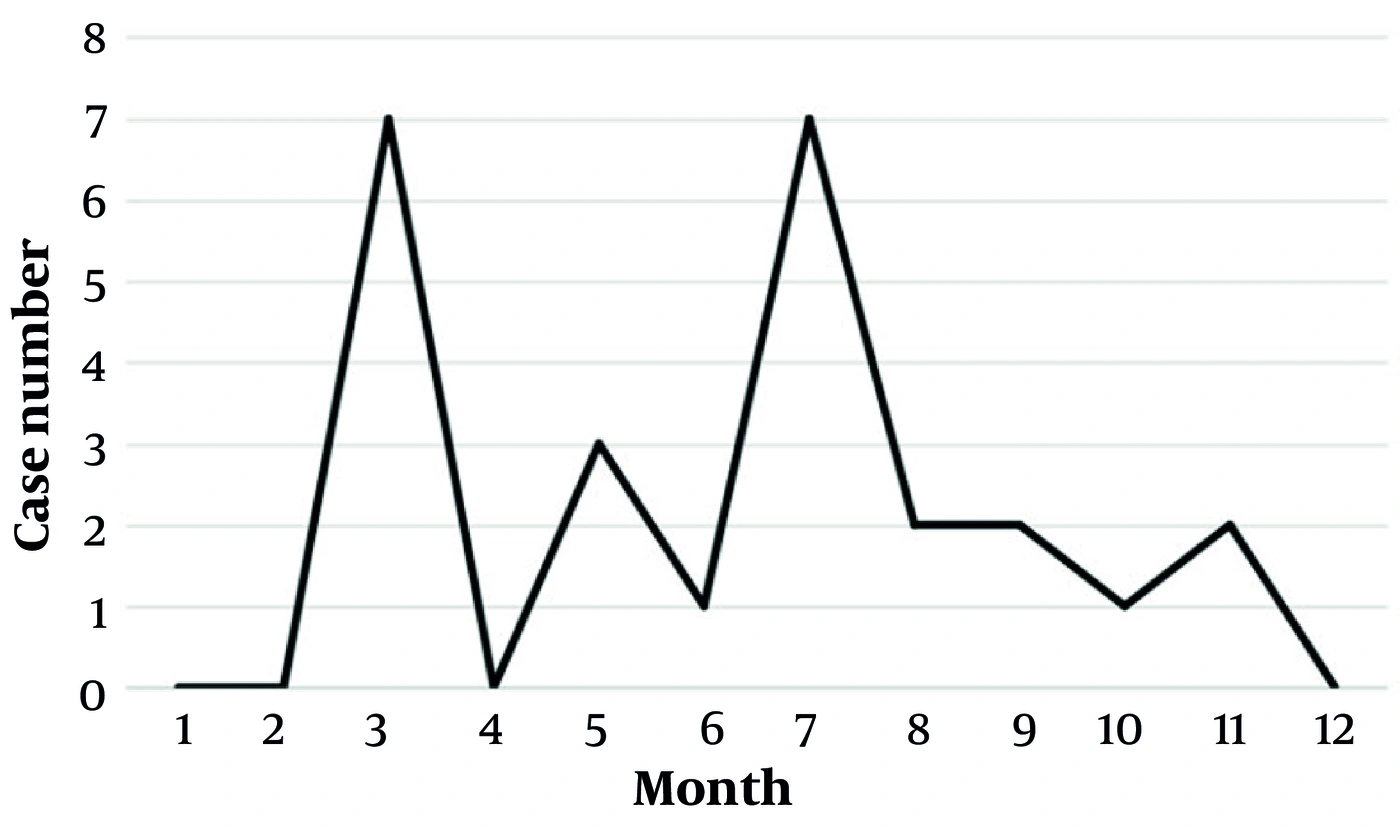
Figure 1.
Cases of respiratory infections in different months.
4.1. Characteristics of the Infection and Noninfection Groups
The characteristics of the infection and noninfection groups are presented in Table 1. The infection group showed a male predominance (80.6%, P = 0.082). The median length of hospitalization in the infection group was significantly longer than that in the noninfection group (20.0 vs 17.0 days, P = 0.039). No significant differences were observed between the 2 groups in gestational age, birth weight, spastic CP subtype, GMFCS level, MRICS classification, or WFA Z score.
Table 1.
Characteristics of the Infection and Noninfecting Groups a
| Characteristics | Infection Group (n = 31) | Noninfecting Group (n = 41) | P-Value |
|---|---|---|---|
| Hospitalization (d) | 20.0 (15.5, 21.0) | 17.0 (12.0, 21.0) | 0.039 b, c |
| Age (y) | 3.30 (2.75, 4.65) | 4.40 (2.70, 6.20) | 0.169 c |
| Male | 25 (80.6) | 24 (58.5) | 0.082 d, e |
| WFA Z score | 0.452 f | ||
| < -2 | 2 (6.5) | 6 (14.6) | |
| > -2 | 29 (93.5) | 35 (85.4) | |
| Gestational age (wk) | 0.237 g | ||
| ≥ 32 | 16 (51.6) | 27 (65.9) | |
| < 32 | 15 (48.4) | 14 (34.1) | |
| Birth weight (kg) | 2.10 (1.35, 3.20) | 2.70 (1.71, 3.30) | 0.439 c |
| Spastic CP subtype | 0.647 e | ||
| Spastic diplegia | 12 (38.7) | 12 (29.3) | |
| Spastic quadriplegia | 9 (29.0) | 12 (29.3) | |
| Spastic hemiplegia | 10 (32.3) | 17 (41.5) | |
| GMFCS | 0.336 e | ||
| Level I-II | 21 (67.7) | 33 (80.5) | |
| Level III-V | 10 (32.3) | 8 (19.5) | |
| MRICS | 0.772 g | ||
| A | 1 (3.2) | 3 (7.3) | |
| B | 17 (54.8) | 25 (61.0) | |
| C | 3 (9.7) | 3 (7.3) | |
| D | 10 (32.3) | 10 (24.4) | |
| Vitamin A (ng/mL) | 460.21 (108.41) | 402.70 (105.57) | 0.027 b, f |
| Vitamin D3 (ng/mL) | 26.59 (9.06) | 30.42 (9.10) | 0.081 d, f |
| Vitamin E (ng/mL) | 8.00 (6.50, 9.00) | 8.10 (7.15, 9.65) | 0.387 c |
| Serum calcium (nmol/L) | 2.44 (0.14) | 2.42 (0.11) | 0.408 f |
| Serum phosphorus (nmol/L) | 1.74 (1.56, 1.80) | 1.66 (1.52, 1.83) | 0.488 c |
| Serum magnesium (nmol/L) | 0.84 (0.82, 0.88) | 0.85 (0.80, 0.89) | 0.628 c |
| Triglycerides (nmol/L) | 1.05 (0.88, 1.57) | 1.18 (0.89, 1.54) | 0.842 c |
| Cholesterol (nmol/L) | 4.18 (3.69, 4.72) | 4.16 (3.63, 4.79) | 0.991c |
| Pre-albumin (nmol/L) | 207.19 ± 37.55 | 198.47 ± 31.26 | 0.286 f |
| Ferritin (ug/L) | 28.20 (19.35, 43.30) | 30.00 (19.60, 41.70) | 0.977 c |
a Values are expressed as median (IQR), No. (%) or me an ± SD.
b P < 0.05 was considered statistically significant.
c Wilcoxon rank sum test.
d P < 0.1 was considered statistically significant.
e Chi-square test.
ft-test
g Fisher exact test.
The vitamin A level was significantly higher in the infection group than in the noninfection group (460.21 vs 402.70 ng/mL, P = 0.027), whereas the vitamin D3 level was lower, showing a borderline trend (26.59 vs 30.42 ng/mL, P = 0.081). No significant differences were observed in other fat-soluble vitamins, biochemical parameters, or nutritional indicators.
4.2. Predictors of Infection
Stepwise regression analysis (Table 2) showed that vitamin A was independently associated with infection risk in both the crude model and the adjusted model (model 1) (OR = 1.01; 95% CI, 1.00 - 1.02; P < 0.05). This suggests that for each 1-ng/mL increase in serum vitamin A level, the estimated risk of infection increased by approximately 1%. A longer hospital stay tended to be associated with a higher risk of infection (P ≈ 0.05), whereas female sex appeared to be a protective factor.
Table 2.
Predictors of Infection: Stepwise Regression a
| Variables | Crude Model | Model 1 | ||
|---|---|---|---|---|
| OR (95% CI) | P-Value | OR (95% CI) | P-Value | |
| Hospitalization (d) | 1.11 (1.00, 1.25) | 0.063 | 1.13 (1.01, 1.30) | 0.050 |
| Vitamin A | 1.01 (1.00, 1.01) | 0.043 b | 1.01 (1.00, 1.02) | 0.006 b |
| Gender | 0.058 | 0.059 | ||
| Male | Ref | |||
| Female | 0.32 (0.09, 0.99) | 0.27 (0.06, 0.99) | ||
a Crude Model was included in the hospital infection or not, VitD3, VitA, while Model 1 included all study variables except WFA.
b P < 0.05 was considered statistically significant..
5. Discussion
The incidence of infections among children with CP in China has been reported to range from 18.6% to 35.4%, with respiratory tract infections being the most common (3). Among infected children, 80.6% developed respiratory tract infections, including 72.0% upper respiratory tract infections and 28.0% lower respiratory tract infections. Infection peaks occurred in March and July, consistent with the spring and summer seasons in Hangzhou. All cultures of throat swabs, stool, and blood samples were negative, and Mycoplasma pneumoniae was not detected. However, influenza A virus was detected in March; RSV and enteroviruses were detected in July; and human rhinovirus was present throughout the year (10). These findings indicate that these viruses play an important role in nosocomial infections among children with CP.
In this study, no significant differences were observed in age, WFA, gestational age, birth weight, spastic CP subtype, GMFCS level, or MRICS level between the infection and noninfection groups. However, stepwise logistic regression models showed that vitamin A was independently associated with nosocomial infection incidence. This finding highlights a specific association between vitamin A status and infection susceptibility in children with spastic CP. It is important to distinguish statistical significance from clinical relevance. The OR value of 1.01 suggests that the observed association, although statistically significant, corresponds to a negligible increase in absolute risk. Therefore, this finding alone may not justify changes to current clinical practice regarding vitamin A management in this patient population. It may indicate either a very minor role of vitamin A in infection susceptibility or the influence of unmeasured confounding factors.
A recent narrative review of vitamin supplementation and urinary tract infections in children noted that the effects of vitamins on pediatric immune function and infection risk are not universal and may be influenced by individual health status and underlying conditions (6). Our results demonstrate a positive correlation between vitamin A levels and infection. Vitamin A may not be a protective factor against infections in children with CP. This observation is consistent with previous reviews indicating that vitamin A does not significantly prevent acute upper or lower respiratory infections (7, 11). Furthermore, evidence is insufficient to suggest that vitamin A intervention enhances recovery in children (12-14). Although some studies have reported associations between serum vitamin A levels and underweight, as well as between vitamin A and recurrent respiratory tract infections (15), WFA did not differ between the 2 groups in the present study, and the proportion of patients with a WFA Z score less than -2 was extremely low. Moreover, in healthy children, vitamin A may even increase the risk of infections and complications (16).
Vitamin D deficiency is prevalent in children with CP because of limited mobility, reduced outdoor time, insufficient sunlight exposure, feeding difficulties, and malnutrition (17). Previous research has indicated that the effect of vitamin D in reducing infection risk is weak, and most studies have focused on the relationship between vitamin D and infection severity and survival rather than incidence risk (18). Consequently, maintaining adequate vitamin D levels is widely recommended (19).
5.1. Study Limitations
Several limitations of this study should be noted. First, confounding bias could not be controlled; for example, clinicians may have administered prophylactic vitamin A to high-risk children. Second, although 152 eligible children were initially screened, only 72 were ultimately included (inclusion rate: 47.4%) because of incomplete records for key variables, such as vitamin A test results and covariates. Missing data were not random and may have been associated with disease severity, length of stay, and medical interventions, leading to selection bias that could affect the observed association between vitamin A and infection. Third, the limited sample size restricted the number of covariates in the multivariable regression model, precluding adjustment for some potential confounders. It is possible that logistic regression analysis with a small sample size was not statistically stable and may have increased the risk of overfitting. Therefore, these findings are exploratory. Future multicenter, large-scale prospective cohort studies are needed to clarify the true association.
5.2. Conclusions
In conclusion, this 1-year, single-center study identified a weak positive correlation between vitamin A levels and nosocomial infections in children with spastic CP. This analysis demonstrates an association but not necessarily a causal relationship. Given the limitations of the single-center design and small sample size, future prospective cohort studies are needed to validate these results. Understanding these factors will contribute to the development of more effective preventive and treatment strategies for children with spastic CP.