
1. Introduction
Infants at risk, such as those born preterm or with encephalopathy, are known to require early intervention (1). Although advances in neonatal intensive care have increased survival rates among at-risk infants, morbidity remains substantial. Infants considered at risk are more vulnerable to cognitive, behavioral, language, and sensorimotor impairments, including cerebral palsy (CP). Disorders such as periventricular leukomalacia, grade 3 - 4 intraventricular hemorrhage, and bronchopulmonary dysplasia are strongly associated with a subsequent diagnosis of CP. These outcomes impose substantial emotional and financial burdens on families, society, and healthcare systems (2).
Functional improvement after early injury depends on neuroplastic mechanisms, reflecting the brain’s inherent ability to adapt and reorganize in response to damage and environmental interaction (3). Motor learning-focused early intervention programs enhance neuroplasticity and motor skills, and many studies recommend initiating physiotherapy early, ideally within the first trimester (4). Research has demonstrated benefits for children at risk. Ohgi et al. reported that physiotherapy contributed to improvements in neurobehavioral functioning and maternal psychological well-being among low-birth-weight infants with brain injury (5). Similarly, Nelson et al. and Badr et al. reported improved motor and cognitive outcomes in infants with central nervous system injuries (6, 7). Heathcock et al. and Lee also showed that neonatal developmental programs improved motor and growth outcomes in premature infants (8, 9). Various therapeutic models are used in early physiotherapy, including neurodevelopmental treatment, home-based and family-focused interventions, constraint-induced therapy, and goal-directed rehabilitation approaches.
Systematic reviews have extensively examined the effects of early intervention in at-risk infants. Spittle et al.’s Cochrane review found that early intervention in preterm infants improved cognitive development during infancy and preschool age, with modest motor benefits (10). Blauw-Hospers and Hadders-Algra reviewed term and preterm infants at risk and concluded that developmental stimulation programs improved motor and cognitive outcomes (11).
Morgan et al. systematically reviewed early motor interventions delivered from birth to 2 years of age, focusing on their effects on motor outcomes (12). They assessed different intervention types and emphasized effect sizes. Moderate to large intervention effects were typically observed in programs promoting self-initiated movement, enriched environmental experiences, and structured task-oriented training. Similarly, Hadders-Algra et al. systematically reviewed early intervention in infants with CP or high risk of CP within the first year of life (1). They identified limited and methodologically heterogeneous literature, with weak evidence regarding effectiveness.
The literature indicates that early interventions include family-guided physiotherapy and direct therapist-led physiotherapy. However, no systematic review has examined physiotherapist-led interventions for infants, including methods, session duration, and frequency. The effects of these interventions on motor development remain unclear. This gap motivated the present review, which aimed to critically analyze physiotherapist-led motor interventions for at-risk infants during the first 2 years of life, with a focus on this key period of brain development and intervention outcomes.
2. Methods
2.1. Protocol and Registration
This review was prepared in accordance with the PRISMA 2020 reporting standards (13). The review protocol was prospectively registered in the International Prospective Register of Systematic Reviews (PROSPERO) under the identifier CRD42021235094.
2.2. Search Strategy
Electronic database searches were conducted in PubMed, MEDLINE, EMBASE, the Cochrane Library (CENTRAL), CINAHL, Wiley Online Library, Web of Science, PEDro, and Scopus to identify eligible studies. The search covered the period from January 1, 1985, to May 15, 2025. The search was conducted on May 15, 2025, and only English-language publications were included.
The complete search strategies for each database, including Boolean syntax, field specifications, and applied filters, are provided in Table S1 in Supplementary File. The search combined controlled vocabulary (MeSH terms) with relevant free-text keywords related to early physiotherapy interventions in infants at risk, linked using Boolean operators (AND, OR, and NOT). Database-specific restrictions, including publication-type filters, were applied when appropriate (Table S1 in Supplementary File).
Search terms and eligibility criteria were developed according to the PICOS framework, including the population, intervention, comparator, outcome, and study design components. Two developmental physiotherapy experts developed keyword lists that were used individually or in combination. The reference lists of included studies and previous reviews were also screened. Text words and MeSH terms such as “infant development,” “early intervention infants,” “motor performance and infant,” “exercise and infant,” “motor training and infant,” “cerebral palsy and infant,” “motor development and infant,” and “risk infants” were used to search relevant databases.
The core search strategy included the following terms:
1) Population: “infant” OR “premature” OR “cerebral palsy”
AND
2) Intervention: “early intervention” OR “physical therapy” OR “physiotherapy” OR “rehabilitation” OR “exercise” OR “motor training”
AND
3) Outcomes: “child development” OR “infant development” OR “developmental disabilities” OR “motor performance” OR “motor disorders” OR “movement disorders” OR “motor skill disorders” OR “motor development”
NOT
4) Exclusions: “genetics” OR “chest physiotherapy” OR “cardiac” OR “neonatal intensive care unit”
To maximize study identification, the reference lists of included studies and previously published related reviews were also screened. The complete reproducible database search strategies are reported Table S1 in Supplementary File.
2.3. Eligibility Criteria
According to the predefined review protocol, eligibility was determined based on study characteristics, including language, publication type, and year; population characteristics; intervention and comparator details; and assessed outcomes.
2.3.1. Study Design
Randomized and quasi-randomized trials assessing physiotherapy interventions in infants considered at risk were eligible for inclusion. Observational, quasi-experimental, descriptive, and case-control studies were excluded. Only RCTs were reviewed to provide the strongest available evidence. Eligible studies were English-language publications identified in the selected databases from January 1, 1985, to May 15, 2025.
2.3.2. Population
Studies involving infants at risk were included. The review included at-risk infants aged 0 - 24 months, corrected for prematurity. Studies were excluded if participants had musculoskeletal disorders, congenital anomalies, mechanical dependency, or cyanotic heart disease.
2.3.3. Types of Interventions
Early developmental interventions initiated within 12 months post-term and delivered at home, in hospitals, or in community centers were included. Interventions delivered by physiotherapists or other healthcare providers included physiotherapy interventions, neurodevelopmental treatment, parent-infant support strategies, infant stimulation, developmental care practices, and early intervention programs. Interventions delivered only in NICU settings were excluded.
2.3.4. Comparators
Studies with a control group, either unexposed or exposed, and an intervention group were included. Studies with two intervention groups were also eligible.
2.3.5. Types of Outcomes
The primary outcome was performance on motor batteries used to assess motor developmental interventions in at-risk infants. Secondary outcomes included cognitive, fine motor, and activities of daily living skills, as assessed using the relevant sections of the assessment tools.
2.4. Study Selection Process
Two reviewers independently applied the inclusion and exclusion criteria during study selection. Screening began with the assessment of titles and abstracts, after which potentially eligible studies were reviewed in full text. Data were extracted independently and in duplicate using a standardized, pilot-tested form, and discrepancies were resolved through discussion and agreement.
Extracted data were categorized into 1) descriptive study characteristics and 2) quantitative outcome data. Descriptive data included study design, participant characteristics, study setting or site, and intervention and session characteristics. Quantitative outcome data included reported outcome measures relevant to the review and their corresponding time points. Available quantitative information, including mean values, standard deviations, and other reported outcome parameters, was collected during data extraction.
To ensure the suitability of the data extraction form and inter-reviewer consistency, a pilot calibration exercise was conducted on a subset of the included studies.
2.5. Data Collection
A customized data extraction form developed for this review was used to collect information from eligible studies. Eligible studies were independently selected by two reviewers according to predefined criteria, and extracted data were entered into Review Manager (RevMan) version 5.3. Extracted variables included author and publication details, study design and setting, intervention period, sample characteristics, gestational age, comorbidities, eligibility criteria, intervention frequency and duration, co-interventions, outcome measures and assessment instruments, reported findings, randomization and allocation processes, blinding procedures, post-randomization exclusions, and participant losses during follow-up.
2.6. Data Synthesis
Because of substantial clinical and methodological differences among the included studies, a quantitative meta-analysis was not conducted. Heterogeneity was attributable to differences in intervention types, intervention frequency and duration, outcome measures assessing motor function, and assessment timing. Therefore, a structured narrative synthesis was conducted. The included studies were grouped according to intervention characteristics and outcome domains. Findings were summarized by comparing the direction and magnitude of effects across studies while considering the consistency and clinical relevance of the results.
2.7. Risk of Bias Assessment
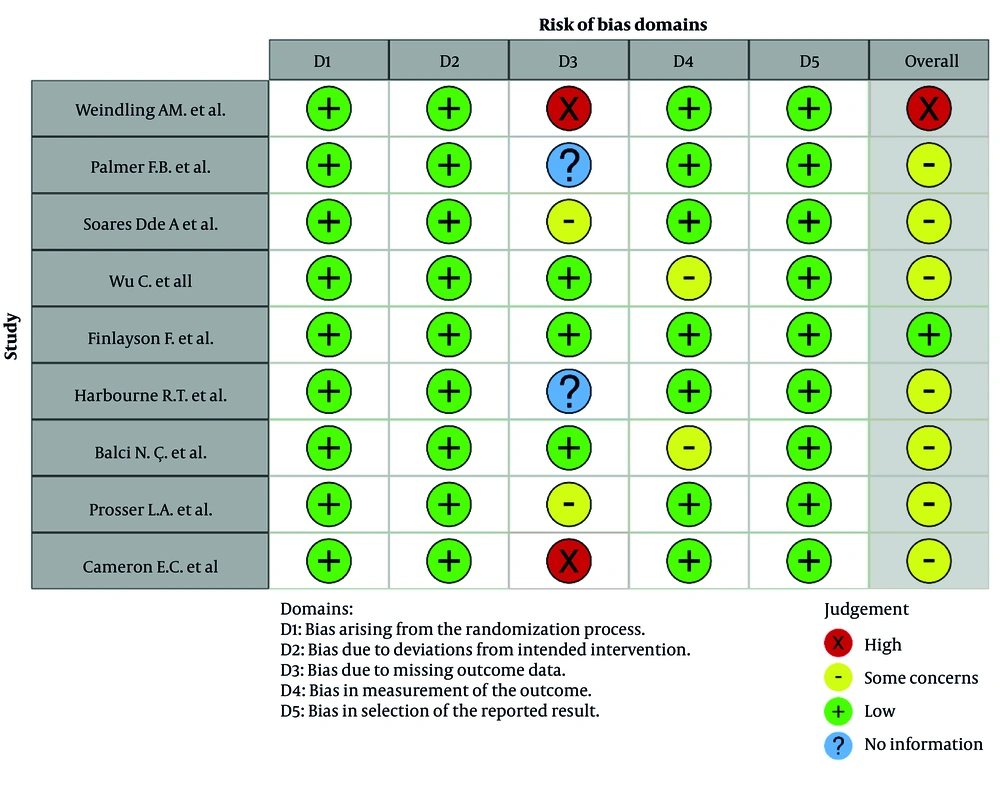
Methodological bias was assessed using the revised Cochrane risk-of-bias tool (RoB 2.0) (14). Two reviewers independently evaluated each study, and disagreements were resolved through discussion. Studies were categorized as low risk, high risk, or some concerns according to Cochrane criteria. Risk of bias was evaluated across domains, including randomization procedures, deviations from planned interventions, incomplete outcome data, outcome assessment, and selective reporting.
For each included study, allocation concealment was assessed according to the procedures used to protect the randomization sequence. Allocation concealment was judged as low risk when centralized or telephone randomization methods or consecutively numbered sealed opaque envelopes were used. A high risk of bias was assigned when open allocation procedures, unsealed or non-opaque envelopes, alternation methods, or allocation based on date of birth were reported. When insufficient methodological information was available, the domain was rated as some concerns.
Blinding procedures were evaluated to identify potential performance bias. The methods used to blind study personnel, participants, and outcome assessors to intervention allocation were examined separately. Participants, personnel, and outcome assessors were each rated as having low risk, high risk, or some concerns regarding blinding.
A 10% threshold was set for missing outcome data; losses above this threshold were rated as high risk. Reporting bias was assessed by determining whether reported results appeared to be influenced intentionally. If outcome assessors were unblinded, measurement bias was rated as some concerns. All studies were considered at low risk for deviations from intended interventions because no deviations occurred.
3. Results
3.1. Study Selection
Electronic database searches identified 1959 records. After duplicate removal (n = 57), 1902 records proceeded to title and abstract screening. A total of 1826 records were excluded because they were not relevant, and 76 articles were retrieved for full-text evaluation. All retrieved reports were assessed against the eligibility criteria.
After full-text review, 67 reports were excluded for the following reasons: family-based approaches (n = 12), sensory approaches (n = 10), outcome measures that did not include motor assessment (n = 10), studies conducted in intensive care units (n = 8), congress proceedings (n = 6), studies without a control group (n = 6), studies that did not specify intervention details (n = 5), studies published before January 1, 1985 (n = 4), studies not published in English (n = 4), and studies including participants older than 24 months, such as 36 months (n = 2). A total of 9 studies met the predefined inclusion criteria and were included in the review. The study identification and selection process is illustrated in Figure 1.
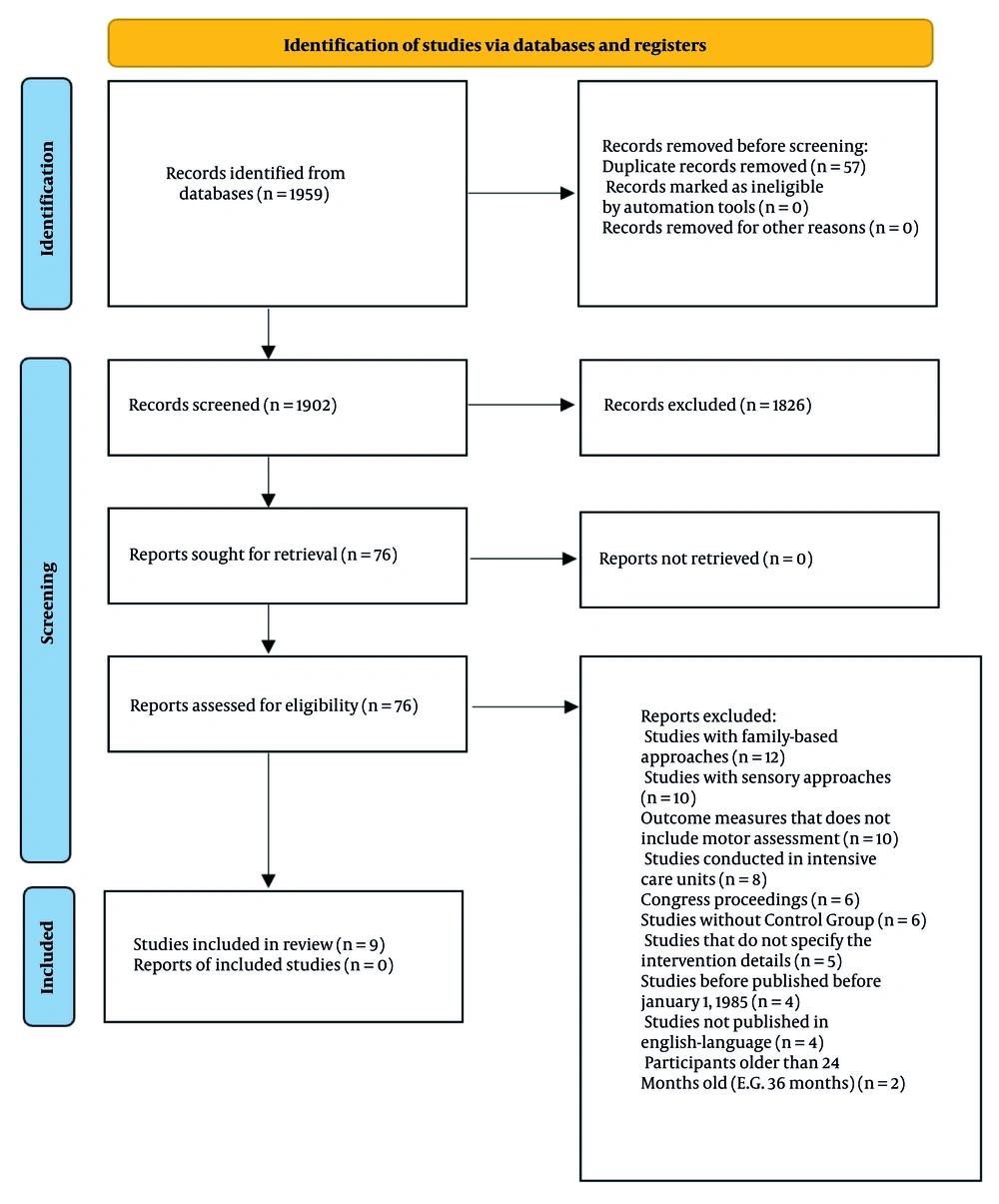
Figure 1.
PRISMA 2020 flow diagram of the systematic review study.
3.2. Characteristics of the Included Studies
An overview of the characteristics of the included studies is provided in Table 1. Table 1 includes the year of publication, groups, type of early rehabilitation, rehabilitation groups, the age of infants at assessment, assessment tools used, assessment frequency, session duration, and session site. The 9 studies involved at-risk infants receiving rehabilitation from physiotherapists or ergotherapists. Seven studies were two-arm RCTs (15-21), 1 was a three-arm RCT (22), and 1 was a feasibility pilot RCT (23). Interventions delivered exclusively in NICU settings were excluded from this review.
Table 1.
Characteristics of Studies a
| Author | Year of Publication | Trial Type | Rehabilitation Groups | End Point Population | Assessment Tools | Measurement Times | Session Frequency, Duration, and Total Period | Site | Outcomes |
|---|---|---|---|---|---|---|---|---|---|
| Weindling et al. (19) | 1996 | Blind, two-arm RCT | Early physiotherapy intervention group, n = 51; control group, n = 54 | Early physiotherapy intervention group, n = 42; control group, n = 41 | MAI; GDS*; Limb-by-Limb | T0: baseline (12 months of corrected age); T1: 30 months of corrected age after baseline | Once weekly for 6 months | Home | No significant between-group difference in outcome measures |
| Palmer et al. (17) | 1988 | Blind, two-arm RCT | 12-month early physiotherapy intervention group, n = 24; 6-month early physiotherapy intervention followed by 6 months of infant stimulation group, n = 24 | NA | BSID-III; VSMS; SB5 | T0: baseline (6 months after treatment initiation); T1: 12 months after treatment initiation | Once weekly, 1 hour, 2 weeks; additional therapy was provided for some infants with variable frequency and duration | Rehabilitation unit | Significant improvement in outcome measures in the group receiving a 6-month stimulation program after 6 months of physiotherapy |
| Soares Dde et al. (22) | 2013 | Blind, three-arm RCT | Blocked practice of reaching group, n = 12; serial practice of reaching group, n = 12; control group, n = 12 | Blocked practice of reaching group, n = 10; serial practice of reaching group, n = 10; control group, n = 9 | AIMS; computerized camera assessment | T0: baseline (around 3 months); T1: approximately 2 weeks after baseline | Once weekly, 4 minutes | Rehabilitation unit and home | Significant improvement in outcome measures in the serial schedule group |
| Wu et al. (20) | 2007 | Blind, two-arm RCT | Early physiotherapy intervention group, n = 42; control group, n = 42 | Early physiotherapy intervention group, n = 42; control group, n = 42 | GDS** | T0: baseline (12 months) | 5 times weekly, 40 minutes, 1 month | Rehabilitation unit | Significant improvement in outcome measures in the treatment group |
| Finlayson et al. (23) | 2020 | Pilot RCT | SPEEDI group, n = 8; control group, n = 9 | SPEEDI group, n = 8; control group, n = 9 | GMA; TIMP; BSID-III | T0: baseline (between 34 and 38 + 6 weeks postmenstrual age); T1: at 3 and 4 months of corrected age after baseline; T2: at 4 months of corrected age after baseline | 5 times weekly | Rehabilitation unit and home | Significant improvement in outcome measures in the SPEEDI group |
| Harbourne et al. (16) | 2020 | Blind, two-arm RCT | START-Play plus UC-EI group, n = 57; UC-EI group, n = 55 | NA | BSID-III; GMFM; APSP | T0: baseline (7 - 16 months of corrected age); T1: 1.5 months after baseline; T2: 3 months after baseline; T3: 6 months after baseline; T4: 12 months after baseline | 2 times weekly, 40.8 - 60 minutes, 12 weeks | Home | Significant improvement in outcome measures in the START-Play plus UC-EI group |
| Comuk Balci et al. (15) | 2021 | Two-arm RCT | EGDP group, n = 20; DGDHP group, n = 20 | EGDP group, n = 20; DGDHP group, n = 20 | HINE; AIMS; GAS | T0: baseline (0 - 15 months of corrected age); T1: 12 weeks after baseline | EGDP group: 3 days weekly, 45 minutes, 12 weeks; DGDHP group: once weekly, 30 minutes, 12 weeks | Rehabilitation unit and home | Significant improvement in HINE in the EGDP group; no significant between-group difference in AIMS and GAS |
| Cameron et al. (21) | 2023 | Blind, two-arm RCT | Early physiotherapy intervention group, n = 34; control group, n = 38 | Early physiotherapy intervention group, n = 28; control group, n = 32 | LAPI; AIMS | T0: baseline (neonatal period); T1: 4 months of corrected age after baseline | Early physiotherapy intervention group: once daily, 10 minutes; control group: observation only | Rehabilitation unit and home | No significant between-group difference in outcome measures |
| Prosser et al. (18) | 2024 | Blind, two-arm RCT | iMOVE group, n = 20; control group, n = 21 | NA | GMFM; BSID-III; COPM; Child Engagement in Daily Life | T0: baseline (12 - 35 months); T1: 12 weeks after baseline; T2: 24 weeks after baseline; follow-ups 1: 3, 6, and 9 months after T2 | NA | Rehabilitation unit | No significant between-group difference in outcome measures |
a Abbreviations: AIMS, Alberta Infant Motor Scale; APSP, assessment of problem solving in play; BSID-III, bayley scales of infant and toddler development – 3rd edition; CA, corrected age; COPM, canadian occupational performance measure; DGDHP, detailed goal directed home program, EGDP, early goal directed physiotherapy; GAS, Goal Attainment Scale; GDS*, Grifiths developmental assessments; GDS**, Gesell development schedules; GMA, prechtl's general movements assessment; GMFM, the gross motor function measure; HINE, hammersmith infant neurological examination; iMOVE, intensive mobility training with variability and error; LAPI, the longitudinal assessment of the preterm infant; MAI, motor assessment of infants limb by-limb; min., minutes; NA, not applicable; PMA, postmenstrual age; RCT, randomized controlled trial; SPEEDI, supporting play exploration and early development intervention; SB5, Stanford-Binet Intelligence Scale; START-Play, sitting together and reaching to play; TIMP, the test of infant motor performance; T0, baseline assessment; T1,T2,T3,T4, follow-up assessment; UC-EI, usual care early intervention; VLBW, very low birth weight; VSMS, Vineland Social Maturity Scale.
3.3. Details of Interventions
Methodological heterogeneity was observed among the included studies. This heterogeneity was related to differences in intervention type, intervention frequency and duration, motor function outcome measures, and assessment timing. Findings were summarized by comparing the direction and magnitude of effects across studies while considering the consistency and clinical relevance of the results.
Three studies were conducted exclusively in rehabilitation unit settings (17, 18, 20), 5 were conducted in both rehabilitation unit and home settings (15, 16, 21-23), and 1 was conducted exclusively at home (19). Intervention durations ranged from 2 to 12 weeks, with sessions lasting 4 - 60 minutes (Table 1).
Some interventions required therapists to complete special training provided by technique developers or experienced therapists (16, 23). This training was delivered to practitioners by the developers of the techniques or experienced therapists before the study.
Evaluation timing, intervals, and tools varied across studies. The Bayley Scales of Infant and Toddler Development, Third Edition (BSID-III), was the most commonly used assessment tool.
3.4. Risk of Bias
The risk-of-bias evaluation for all included studies is displayed in Figure 2 using a traffic-light visualization.
4. Discussion
This systematic review is the first to specifically evaluate the existing literature on early physiotherapy interventions delivered directly by physiotherapists to at-risk infants between 0 and 24 months of age. Among the included studies, 3 reported no significant between-group differences, whereas the remaining 6 reported significant between-group differences in comparative motor evaluations regarding early physiotherapy interventions in at-risk infants. The absence of significant between-group differences may be attributable to a lack of individualized therapeutic approaches tailored to infants, the absence of long-term intervention effects, and the clinical heterogeneity observed among infants with CP.
This review included 9 studies with a total of 548 patients and various intervention types aimed at managing symptoms and improving motor skills in infants at risk. These interventions included Early Goal Directed Physiotherapy, Detailed Goal Oriented Home Program, a combined Bobath and Vojta intervention, a Bobath-style intervention, the Neonatal Developmental Program, the Infant Stimulation Program, a short bout of reaching practice, SPEEDI, START-Play, and iMOVE.
Cameron et al. described an early physiotherapy intervention for premature, low-birth-weight infants (21). No significant effect on motor performance was found; however, at 4 months corrected age, treated infants showed no abnormal motor development. Higher parental compliance improved AIMS scores. The authors reported that study limitations included variable treatment frequency and non-standardized sessions due to infants’ medical conditions, as well as the small sample size. Similarly, Prosser et al. evaluated iMOVE therapy, a new early intervention, in 36 infants and found no significant differences between the iMOVE group and the control group in gross motor function at 12 and 24 weeks or in postural control (18). This was unexpected because iMOVE aligns with guidelines recommending early, task-specific motor training for children with or at high risk of CP (24). The lack of effect may have been related to participants’ age (1 - 3 years), when motor control is more established and less modifiable. The study also raises the question of whether 6 months of either intervention is superior to standard care. The authors recommended future studies with larger sample sizes and high-dose interventions.
The Bobath concept, also known as neurodevelopmental therapy, is widely used and is often considered the standard of care in neurorehabilitation (25). Weindling et al. found no motor improvement with Bobath (19). The study did not reach the initially planned sample size, although the number of infants included in each group exceeded the minimum of 39 participants specified in the original sample size calculation. The authors indicated that the predictive accuracy for detecting severe cerebral parenchymal lesions was lower than anticipated. Nevertheless, the cohort represented a markedly high-risk population, as reflected by the substantial proportion of children with severe motor impairment. At 30 months of age, 52 children (63%), equally distributed between groups, had locomotor subscale scores below 80. Mortality was also notable, with 10 children (11%) having died by 30 months. The lower-than-expected recruitment rate was attributed to a declining incidence of severe cerebral parenchymal lesions during the study period. The authors further emphasized that substantial heterogeneity in disability profiles among infants with CP complicates the evaluation of physiotherapy outcomes and highlights the importance of using assessment tools capable of capturing diverse functional presentations.
In contrast, Wu et al. reported better gross motor, fine motor, and speech skills in the Bobath group (20). The intervention had significant effects, particularly in these domains, with a higher overall success rate. However, the study by Wu et al. combined Vojta, Bobath, and drug treatment; therefore, the specific effect of each component remains unclear. Separate studies on Vojta and Bobath are needed (20).
Palmer et al.’s Infant Stimulation Program for children with spastic diplegia includes 100 cognitive, sensory, language, and motor activities for children aged 0 - 3 years (17). After 6 months, the group receiving infant stimulation after 6 months of early physiotherapy had higher BSID-III motor scores and walking rates than the group receiving early physiotherapy alone for 12 months, and these differences persisted at 12 months. No differences were found in contractures, bracing, or surgery. Early physiotherapy alone did not improve outcomes, possibly due to intervention intensity or compliance. Despite the small sample, infant stimulation shows potential benefits and warrants further study.
In the only RCT by Soares et al. on reaching kinematics in late preterm infants, infants practiced reaching in blocked or serial sequences (22). Surprisingly, only the serial practice group showed a transient increase in reaching, suggesting that serial practice may better mimic natural reaching and benefit late preterm infants. However, no clear group differences emerged, and gains from serial practice were not maintained after 24 hours. The study by Soares et al. underscores the need for further research on infant reaching practice.
Recent physiotherapy for at-risk infants includes the SPEEDI study by Finlayson et al. (23), which provided physiotherapist-led parental support in the rehabilitation unit and at home and focused on early, high-dose cognitive and motor activities and parent-child interaction (26). Unlike the other studies in this review, SPEEDI has 2 phases: phase 1 was conducted in the NICU, and phase 2 was conducted at home or in the hospital with the family and physiotherapist. Although phase 1 began with family education in the NICU, the study was included in this systematic review because phase 2 involved early physiotherapy interventions administered by physiotherapists, and motor assessments were conducted during the second phase. Finlayson et al. found higher BSID-III gross motor scores at 4 months corrected age, indicating improved motor performance (23). It remains unclear whether the gains resulted from phase 1 or phase 2; future studies should compare these phases. Phase 2 involves both the physiotherapist and the parent, but parent interaction mainly targets social-cognitive aspects and could also be delivered by the physiotherapist. Overall, SPEEDI is a promising early intervention for at-risk infants.
Harbourne et al. tested the START-Play intervention in infants with motor problems and found short-term (3-month) improvements in BSID-III fine motor scores and long-term (12-month) gains in fine motor skills and reaching frequency among infants with significant motor delays (16). These findings suggest that START-Play improves motor skills more than usual care early intervention. However, as an emerging approach, it requires further evaluation. Future research should compare intervention dosages alongside ongoing therapy and adapt activities for infants who gain mobility during treatment.
The Detailed Goal Directed Home Program and Early Goal Directed Physiotherapy are physiotherapy methods used to improve motor outcomes in at-risk infants. A randomized controlled study by Comuk Balci et al. showed that both interventions significantly improved AIMS, HINE, and GAS T scores (15). Early Goal Directed Physiotherapy was more effective and showed a larger effect size, particularly for HINE scores. However, the Detailed Goal Directed Home Program remains useful when parents receive appropriate guidance from physiotherapists. Long-term follow-up remains essential for early physiotherapy interventions.
Home-based, family-centered approaches (27-35) are also early physiotherapy interventions for infants at risk. However, some of these studies were excluded because they did not meet the eligibility criteria. Reasons included protocol-only designs (27-29), treatment protocols not performed by physiotherapists, participant age (30), and other criteria. Although multiple studies have explored early physiotherapy interventions in infants at risk, only 9 studies met the established inclusion criteria and were included in this review.
Systematic reviews and meta-analyses have examined motor interventions for infants and toddlers with CP, neurodevelopmental interventions for infants at risk of or diagnosed with autism, NICU developmental care, music therapy, and family-centered care for motor and cognitive outcomes in premature infants (31-35). Depending on symptoms, age, function, and diagnosis, these studies provide developmental interventions for at-risk infants. The present study differs by focusing on RCTs of direct physiotherapist-led motor interventions and excluding interventions delivered only in NICU settings.
A key strength of this review is that, to our knowledge, it is the first to specifically examine the literature on early physiotherapy interventions delivered directly by physiotherapists to infants at risk. Despite the limited number of included studies, the main findings may help to inform and support clinicians in applying physiotherapy interventions in clinical practice. The results indicate that few studies have investigated early physiotherapy for at-risk infants using motor assessments. They also indicate that severe cerebral parenchymal damage contributes to heterogeneity in the affected population and to variability in the assessment of early physiotherapy interventions. Further studies should apply appropriate randomization of infants according to cerebral imaging results. Intervention durations also varied across studies. The evidence suggests that long-term early intervention lasting approximately 12 weeks may be beneficial, whereas short-term measures appear insufficient. The studies also suggest that high-dose treatment protocols may be more beneficial for motor outcomes in at-risk infants.
Several limitations should be noted. Some studies were published in languages other than English and therefore could not be included. Only 1 study had a low risk of bias, whereas the other studies raised some concerns, mainly because of data loss and the inability to implement blinding in measurements. The literature search included only English-language publications from PubMed, Wiley Online Library, Web of Science, PEDro, Scopus, MEDLINE, EMBASE, the Cochrane Library (CENTRAL), and CINAHL. Additional limitations included the small number of studies, heterogeneous clinical outcomes among infants with CP in the reviewed studies, and varied outcome measures. Few studies reported long-term assessments; most outcomes were short- or mid-term. Treatment parameters and dosages also varied, making the standardization of protocols and statistical analysis difficult. Finally, relatively few studies on this topic have been published in recent years. Overall, heterogeneity in intervention content, dosage, and outcome measures limits comparability across studies.
Collectively, the results of this review indicate that early physiotherapy interventions delivered by physiotherapists may have promising effects in some developmental domains in infants at risk. However, the overall evidence base is heterogeneous, and findings are inconsistent across studies. Furthermore, the limited number of studies identified as having a low risk of bias reduces the overall strength of the conclusions.
Therefore, the available evidence is insufficient to support definitive conclusions regarding the effectiveness of these interventions. Although some approaches appear promising, further high-quality RCTs with rigorous methodology, standardized outcome measures, and long-term follow-up are required to establish their effectiveness and consistency.