
1. Background
Unconjugated hyperbilirubinemia in the neonatal period is a problem requiring urgent approach due to the risk of kernicterus and permanent neurological impairment. Bilirubin that arises as a result of the hemolysis of erythrocytes plays an important role in physiopathology of neonatal unconjugated hyperbilirubinemia (1). Although bilirubin is a powerful component of antioxidant capacity, it may cause significant neurological damage (2, 3).
Phototherapy (PT) is an accepted modality for management of hyperbilirubinemia (2, 3). Phototherapy is generally considered as a safe and well-tolerated therapy for neonatal jaundice (4). Recently, phototherapy has been proven to be associated with oxidative stress, lipid peroxidation and DNA damage (5-9).
The organism’s essential antioxidant defense system against reactive oxygen species includes bilirubin, erythrocytic enzymes, superoxide dismutase (SOD), Catalase (CAT), and glutathione peroxidase (GSH) (10). It is also known that neonates, particularly preterm infants, have limited antioxidant protective capacity against circulating free radicals (10-12).
2. Objectives
The primary objective of this study was to investigate the antioxidant status of preterm and term infants with hyperbilirubinemia before and after PT.
3. Methods
The study was conducted with a pretest-posttest quasi-experimental design at neonatal intensive care unit of a university hospital in Turkey between December 2012 and December 2013. Group 1 included preterm infants (28 to < 32 weeks), group 2 preterm infants (32 to < 37 weeks), and group 3 term infants requiring phototherapy due to significant jaundice during the first to ninth day of life. Approval of the local research ethics committee was obtained for the study and informed consent was provided by the parents. The infants with severe congenital malformations, maternal diabetes, maternal eclampsia-preeclampsia, birth asphyxia, even mild or transient respiratory distress, sepsis, hemolytic type of hyperbilirubinemia, ABO or Rh incompatibility, and positive direct Coombs test and those who were jaundiced within the first 24 hours after birth were excluded from the study.
All infants in the groups received standard and continuous PT (450 nm, 13 μW/cm2/nm; MicroLite Phototherapy System, Draeger), according to the guidelines of the American Academy of Pediatrics. Phototherapy was interrupted only for feeding, cleaning and blood sampling. Gestational age, postnatal age, gender and birth weight of the infants were recorded.
Levels of serum total bilirubin (STB), Malondialdehyde (MDA), superoxide dismutase (SOD), reduced glutathione (GSH), and catalase (CAT) were measured before and 24 hours after phototherapy. Venous blood sampling (2 mL) was performed from a peripheral vein to determine total bilirubin and antioxidants. Samples for antioxidants were centrifuged at 1500 × g for 10 minutes within 30 minutes of collection, and the serum samples were kept at -80°C.
The serum samples were spectrophotometrically measured using CAT (Item Number: 707002), GSH (Item Number: 703002) and SOD (Item number: 706002) Cayman commercial kit. Malondialdehyde measurement was manually performed according to the method of Ohkawa et al. (1979) (13). BIO-TEK /Power Wave XS microplate reader device was used for spectrophotometric measurements. Total bilirubin (OSR6112) was determined by Bilirubin Beckman Coulter AU 5800 autoanalyzer. Serum total bilirubin levels were measured every 12 hours using a direct spectrophotometry method. The bilirubinometry was calibrated daily and every three months in terms of low and high bilirubin standards.
The statistical package for social sciences (SPSS), version 18.0 (PASW ver.18, SPSS inc. Chicago, IL) was used to analyze the data. The descriptive statistics of demographic characteristics were presented as percentage and mean. The chi-square test was used to compare the groups. Pre- and post-PT values for STB, CAT, SOD, GSH and MDA variables were compared using Wilcoxon Signed Ranks Test. Kruskal-Wallis test was used to compare the groups in terms of STB, CAT, SOD, GSH and MDA variables. Mann-Whitney U test was used to compare intergroup measures for the advanced analysis. Correlation (Spearman) analyses were used to investigate the relationship between antioxidants and mean STB levels and between antioxidants, STB and phototherapy duration. The P < 0.05 was considered to be statistically significant at confidence interval of 95%.
4. Results
A total of 56 infants were included in this study. Postnatal age of group 1 involving 19 preterm infants, who needed PT, was 3.63 ± 2.40 days; postnatal age of group 2, involving twenty five preterm infants, who needed PT, was 4.16 ± 2.21 days; and postnatal age of group 3, involving twelve term infants, who needed PT, was 5.83 ± 2.69 days. While 52.6% (n = 10) of group 1 preterm infants were female, 68% (n = 17) of group 2 preterm infants were male, and 58.3% (n = 7) of group 3 term infants were female.
Table 1 illustrates the means and inter-group comparison of phototherapy duration in all groups. Phototherapy duration was 17.63 ± 7.68 hours in preterm infants in group 1, 17.16 ± 7.31 hours in preterm infants in group 2, and 18.82 ± 9.10 hours in term infants in group 3; the difference between the groups was not statistically significant.
Table 1.
Intra-Group and Inter-Group Comparisons of Antioxidants and Serum Total Bilirubin Before and After Phototherapy in Group 1 Preterm Infants, Group 2 Preterm Infants, and Group 3 Term Infants
| Group 1 Preterm Infants, Mean ± SD | Group 2 Preterm Infants, Mean ± SD | Group 3 Term Infants, Mean ± SD | Test and Significance | |
|---|---|---|---|---|
| CAT | ||||
| Pre test | 96.00 ± 39.39 | 76.71 ± 58.83 | 58.48 ± 24.89 | P < 0.05 |
| Post test | 117.70 ± 65.12 | 83.64 ± 66.03 | 63.83 ± 21.33 | P > 0.05 |
| Test and significance | P > 0.05 | P > 0.05 | P > 0.05 | |
| SOD | ||||
| Pre test | 5.85 ± 2.96 | 6.21 ± 3.93 | 7.83 ± 3.96 | P > 0.05 |
| Post test | 4.78 ± 1.59 | 5.76 ± 3.36 | 6.60 ± 3.35 | P > 0.05 |
| Test and significance | P > 0.05 | P > 0.05 | P > 0.05 | |
| GSH | ||||
| Pre test | 4.19 ± 0.92 | 3.77 ± 1.10 | 3.40 ± 099 | P > 0.05 |
| Post test | 3.62 ± 0.74 | 3.50 ± 1.06 | 3.45 ± 0.82 | P > 0.05 |
| Test and significance | P < 0.05 | P > 0.05 | P > 0.05 | |
| MDA | 10.35 ± 3.39 | |||
| Pre test | 3.54 ± 3.75 | 6.03 ± 4.76 | ||
| Post test | 3.76 ± 2.94 | 5.10 ± 3.70 | 9.92 ± 1.48 | P < 0.05 |
| Test and significance | P > 0.05 | P > 0.05 | P > 0.05 | P < 0.05 |
| STB | ||||
| Pre test | 12.25 ± 3.18 | 11.63 ± 2.85 | 15.06 ± 1.56 | P < 0.05 |
| Post test | 8.28 ± 2.78 | 8.21 ± 1.89 | 8.89 ± 0.78 | P > 0.05 |
| Test and significance | P < 0.05 | P < 0.05 | P < 0.05 | |
| Phototherapy duration | 17.63 ± 7.68 | 17.16 ± 7.31 | 18.82 ± 9.10 | F = 2.824; P = 0.068 |
Abbreviations: STB, serum total bilirubin; CAT, catalase; SOD, superoxide dismutase; GSH, glutathione peroxidase.
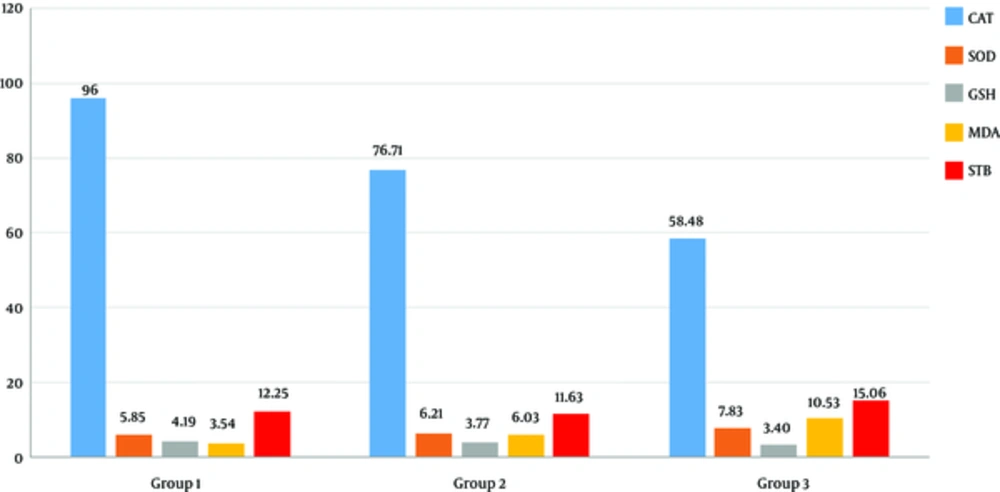
Figure 1.
The Distribution of Mean Levels of Antioxidants and Serum Total Bilirubin Before Phototherapy in All Groups
Table 1 illustrates the means and intra-group and inter-group comparison of pre- and post-PT measurements in terms of CAT, SOD, GSH, MDA, and STB. The levels of CAT increased after phototherapy in all groups; however, this increase was not statistically significant (P > 0.05). When CAT values before phototherapy were compared between the groups, it was observed that the difference between the groups was statistically significant; however the difference between the groups after phototherapy was not statistically significant. Mann-Whitney U test was performed in pretest measurements to specify which group was associated with the difference between the groups. As a result of the advanced analysis, it was determined that the difference between the groups was due to the term infants in group 3. Pretest CAT levels of infants in the term group were significantly low. The levels of SOD decreased after phototherapy in all groups; however, this decrease was not statistically significant (P > 0.05, Figure 2). Also, GSH levels of preterm infants in group 1 decreased significantly after phototherapy (P < 0.05). It was observed that levels of MDA increased significantly in term infants in group 3 compared to preterm infants in group 1 and group 2. The STB levels in infants of all groups also decreased significantly after phototherapy (P < 0.05, Figure 2).
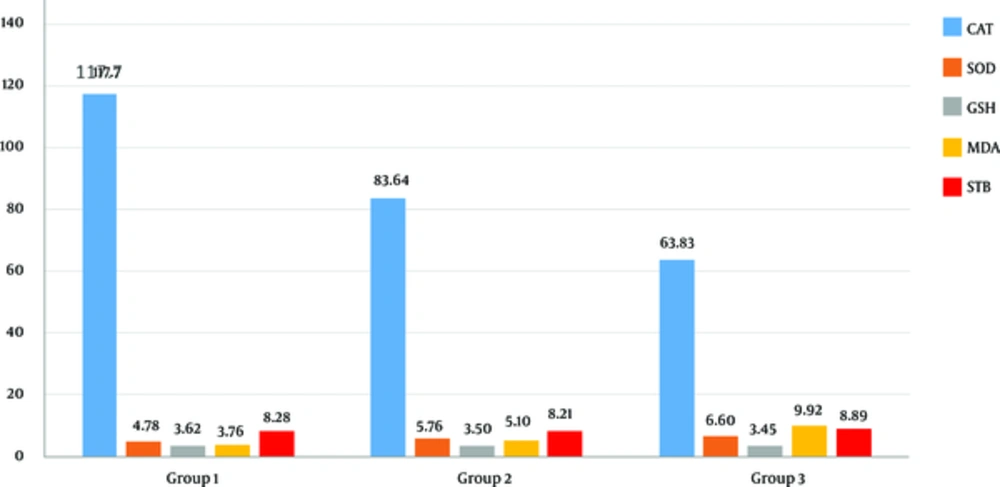
Figure 2.
The Distribution of Mean Levels of Antioxidants and Serum Total Bilirubin after Phototherapy in All Groups
The correlation analysis was conducted to indicate the correlation of the difference between antioxidants and STB mean levels of infants before and after phototherapy. While no statistically significant difference was found between STB levels and the antioxidant average delta change values in preterm infants in group 1, a positive significant correlation was found between STB average delta change and SOD average delta change in group 2 preterm infants and group 3 term infants (P < 0.05).
A correlation analysis was conducted in order to indicate the correlation of the difference between antioxidants, STB mean levels, and phototherapy duration of the infants. There was a positive significant correlation between phototherapy duration and MDA mean levels in group 2 preterm infants and group 3 term infants. A negative significant correlation was found between phototherapy duration and CAT mean levels in group 3 term infants (P < 0.05).
5. Discussion
In this study, we investigated the antioxidant status of preterm and term infants with hyperbilirubinemia before and after PT. The questions of the study were as follows: “Was there a change in antioxidant levels of term and preterm infants after phototherapy?”, “Did a change in serum total bilirubin level affect CAT, SOD, MDA, and GSH values?”, and “Did phototherapy duration affect STB, CAT, SOD, MDA, and GSH values?”
All biological systems involve oxidative reactions and toxic metabolites are often produced. The balance between oxidative stimulus and antioxidant defense mechanisms eliminates the toxic effects of the metabolites. As antioxidant mechanisms are immature in the neonatal period, this balance is unstable and circulating free radicals may cause intravascular hemolysis and lead to unconjugated hyperbilirubinemia (8, 14). Although phototherapy decreases hyperbilirubinemia, it may lead to oxidative injury to the red cell membrane and, as a result, increase the levels of lipid peroxidation products (15).
In case of oxidative stress, a decrease is expected in SOD. The SOD enzyme is the enzyme that converts oxygen radical into hydrogen peroxide. However, hydrogen peroxide has toxic effects, as well. Both CAT and GSH convert this harmful hydrogen peroxide into water through different reactions. In parallel with this, in the present study, a decrease was observed in SOD and GSH values. Although an increase was observed in catalase value, the difference was not statistically significant. Normally, an increase in MDA is observed in oxidative stress because hydrogen peroxide causes lipid destruction in cell membrane and as the last product of lipid destruction is MDA, when MDA is high, there is high lipid destruction and this depends on the oxidative stress. However in our study, there was a decrease in MDA values. Also in other studies found in the literature, it was reported that MDA decreased after phototherapy. It was reported in these studies that bilirubin and MDA increased together and decreased after phototherapy, however no statistical correlation was observed (5, 16, 17). While GSH decreased in all groups after phototherapy, it was significantly low in group 1 preterm infants after phototherapy. There were also other factors, which might cause oxidative stress in these infants in addition to oxygen treatment being in the first place. Furthermore, since the skin was still immature, phototherapy may have the tendency to create more oxidant stress in this age group (18). Similar to the result of the present study, Ayyappan et al. (2015) (17) showed that GSH level in plasma significantly decreased after phototherapy compared to before phototherapy.
There are numerous studies in the literature that revealed negative and positive effects of PT on antioxidant mechanism. Gathwala and Sharma (7) showed that phototherapy induced oxidative stress in preterm neonates after 96 hours of phototherapy. Aycicek and Erel (5) indicated that conventional phototherapy increased serum lipid hydroperoxides and had a negative effect on oxidant/antioxidant defense system in full term infants with hyperbilirubinemia. They reported that phototherapy did not significantly change the Total Antioxidant Capacity (TAC) levels but levels of Total Oxidant Status (TOS) and oxidative stress index (OSI) significantly increased in unconjugated hyperbilirubinemia (5). On the other hand, the study of Akisu et al. (19) demonstrated that PT did not change antioxidant defense systems in both full term and preterm infants. In their study, Torun et al. [11] did not find high oxidative destruction measurements after phototherapy and this result indicated that oxidative stress did not increase with phototherapy. Also in the present study, there was no statistical difference in antioxidant status at the end of 24 hours after PT, except for group 1 preterm infants’ GSH levels. What attracted attention in the present study was that antioxidant capacity in preterm infants did not show any difference when compared to term infants except for MDA.
Although bilirubin itself is a strong antioxidant, there are numerous studies in the literature indicating the effect of serum bilirubin level on antioxidant capacity. Dani et al. (20) showed that there was a decrease in plasma bilirubin concomitant with an increase in plasma antioxidant capacity and a decrease in oxidative stress in preterm infants. On the other hand, in their study, Kumar et al. (21) indicated that neonatal hyperbilirubinemia was associated with significantly lower oxidant levels and higher antioxidant enzyme activities (superoxide dismutase, catalase and glutathione peroxidase). In the present study, it was found that the effect of STB on antioxidants changed. As STB levels decreased in group 2 preterm and group 3 term infants, SOD levels also decreased (Table 1). On the other hand, pretest STB levels in group 3 term infants were significantly higher than the other groups and had significantly lower pretest CAT levels. Similar to the results of the present study, Ayyappan et al. (2015) (17) showed that the levels of bilirubin were significantly lower after phototherapy compared to before phototherapy. Perhaps, the way that antioxidant capacity is affected, changes based on serum STB level or it may be that different effects could be observed on different enzymes. However, it is obvious that more extensive, randomized controlled studies are required on the effect of serum STB level on antioxidant capacity.
The limitations of the study were that the study was conducted only on preterm and term infants requiring phototherapy, and STB and antioxidant levels were assessed 24 hours after phototherapy, and also the study was conducted at a single center.
5.1. Conclusions
In conclusion, this study determined no significant relationship between phototherapy and antioxidant capacity. However, GSH after phototherapy was found to be low in group 1 preterm infants with statistical significance. Therefore, it is thought that particularly in this age group, phototherapy should be used with close follow-up of bilirubin levels and its use with no indication should be avoided.