1. Background
Acute respiratory tract infections (ARTIs) are the most common illnesses worldwide. They account for considerable morbidity and mortality especially in young children and elderly. Viruses causing ARTIs include influenza viruses, parainfluenza viruses, respiratory syncytial virus (RSV), adenoviruses, coronaviruses, enteroviruses, rhinoviruses and human metapneumovirus (HMPV). Among these, influenza viruses within Orthomyxoviridae family are major pathogens of the lower respiratory tract infections (LRTIs) in all ages with significant rates of hospitalization (1). HMPV, a recently discovered virus, was identified in the Netherlands by van den Hoogens et al in 2001. HMPV is responsible for 5% - 8% of ARTIs in hospitalized children (2). It had been classified within Paramyxoviridae family, but according to the new taxonomy of the international committee on taxonomy of viruses (ICTV), now it is a member of Pneumoviridae family (3). In Iran, the influenza season starts in late November and lasts until late April, peaking in January and February. The national influenza center (NIC) in Iran, located in Virology Department, School of Public Health, Tehran University of Medical Sciences, examines clinical samples from patients with severe acute respiratory infections (SARI) for influenza virus surveillance throughout the year. During influenza season many other respiratory viruses can cause ARTIs which usually share a common set of symptoms. HMPV is an emerging respiratory pathogen which can cause mild upper respiratory tract infections (URTIs) and severe LRTIs (2). Although there are many reports of HMPV prevalence worldwide, data from Iran is limited. The aim of this study was to describe the contribution of HMPV and influenza virus infections in hospitalized children less than five years of age with SARI during four consecutive years.
2. Methods
2.1. Clinical Samples
From January 2013 until December 2016 a total of 770 nasopharyngeal swabs from children less than five years of age with SARIs were sent in a cold chain system by Ministry of Health to NIC Iran. This study has been approved by Tehran University of Medical Sciences ethics committee.
SARI is an acute respiratory infection with history of fever ≥ 38°C and cough with onset within the last 10 days which requires hospitalization. Of these specimens 161, 137, 299 and 173 were collected in 2013, 2014, 2015 and 2016 respectively (Table 1).
Table 1.
Detection of Influenza Viruses and HMPV in Children Less Than Five Years with SARI in National Influenza Center, Tehran, Iran, 2013 - 2016a
| Year | SARI | Influenza Positive | A/H1N1 | A/H3N2 | Influenza B | HMPV |
|---|---|---|---|---|---|---|
| 2013 | 161 (21) | 44 (16.7) | 9 (7.5) | 14 (15.8) | 21 (38.9) | 0 (0) |
| 2014 | 137 (17.8) | 36 (13.7) | 5 (4.1) | 19 (21.3) | 12 (22.2) | 1 (14.3) |
| 2015 | 299 (38.8) | 101 (38.4) | 61 (50.9) | 20 (22.5) | 20 (37) | 1 (14.3) |
| 2016 | 173 (22.4) | 82 (31.2) | 45 (37.5) | 36 (40.4) | 1 (1.9) | 5 (71.4) |
| Total | 770 (100) | 263 (100) | 120 (100) | 89 (100) | 54 (100) | 7 (100) |
Abbreviation: SARI, severe acute respiratory infection.
aValues are expressed as No. (%).
2.2. Molecular Analysis
Viral nucleic acids were extracted using high pure viral nucleic acid kit (Roche, Germany) according to the manufacturer’s instructions. Influenza virus detection and typing/subtyping were carried out with real time RT-PCR kit, SuperScript III Platinum (Invitrogen) using CDC protocol (Table 2). After influenza screening all negative samples for influenza viruses, were tested for HMPV RNA using One step RT-PCR kit (Qiagen, Germany) with primers amplifying a conserved region of M gene. The sense and anti-sense primers are as follows: 5’-TGARTCAGCYACTGTTGAAGC-3’ and 5’-TTTGGATTGTTCATGGTCATRATC-3’. Negative and positive controls were used in each run. Plasmid containing a fragment of HMPV M gene was kindly denoted by Dr B. Khansari Nejad to use as a positive control.
Table 2.
Primers and Probes for Detection of Influenza Viruses According to CDC REF. #I-007-05a
| Primers and Probes | Sequence 5’ - 3’ |
|---|---|
| Influenza A/B detection | |
| InfA Forward | GAC CRA TCC TGT CAC CTC TGA C |
| InfA Reverse | AGG GCA TTY TGG ACA AAK CGT CTA |
| InfA Probe | FAM-TGC AGT CCT CGC TCA CTG GGC ACG-BHQ1 |
| Influenza A/H1N1 | |
| SW H1 Forward | GTG CTA TAA ACA CCA GCC TYC CA |
| SW H1 Reverse | CGG GAT ATT CCT TAA TCC TGT RGC |
| SW H1 Probe | FAM-CA GAA TAT ACA TaCC RGT CAC AAT TGG ARA A-BHQ1 |
| Influenza A/H3N2 | |
| AH3 Forward | AAG CAT TCC YAA TGA CAA ACC |
| AH3 Reverse | ATT GCR CCR AAT ATG CCT CTA GT |
| AH3 Probe | FAM- CAG GAT CAC ATA TGG GSC CTG TCC CAG-BHQ1 |
Abbreviation: SW, Swine.
aTaqman® probes are labeled at the 5’-end with the reporter molecule 6-carboxyfluorescein (FAM) and quenched internally at a modified “T” residue with BHQ1.
3. Results
Of 770 children enrolled in this research, influenza viruses were detected in 263 cases (34%). Influenza A/H1N1pdm09, A/H3N2 and B viruses were detected in 120 (45.6%), 89 (33.9%) and 54 (20.5%) of positive samples respectively. Of 507 negative samples for influenza viruses, HMPV was positive in 7 (1.4 %).
As shown in Table 1, in the year 2013, 44 (27.3%) of the specimens were positive for influenza viruses and the prominent type was influenza B and HMPV was not detected. During 2014, 36 (26.2%) and 1 (1%) of the specimens were positive for influenza and HMPV infections and the prominent influenza subtype was A/H3N2. In 2015, 101 (33.8%) and 1 (0.5%) influenza and HMPV viruses were detected respectively with A/H1N1 being prominent. In 2016, 82 of 173 (47.4%) specimens were positive for influenza viruses and A/H1N1 was the prominent subtype (54.9%). Five (5.5%) specimens were identified as positive for HMPV.
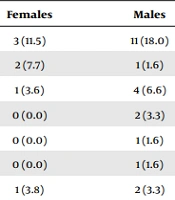
Of 770 patients, 459 (60%) were male and 311 (40%) female. Among positive children 97 (36%) were female and 173 (64%) male. Boys were more frequently infected by influenza viruses than the girls. HMPV was detected in four girls and three boys.
Incidence of influenza virus infections was higher in age group 0 - 1 year (46.8%). HMPV was detected in age group 3-5 years.
The peak prevalence of influenza was in December (n = 63, 24%), January (n = 63, 24%) and February (n = 56, 21.3%). The majority of HMPV detections were in January 2016 (5 out of 7), one positive sample was detected in June 2015 and one in December 2014.
4. Discussion
This paper showed the results of study of HMPV and influenza virus infections among hospitalized children less than 5 years of age with SARI during 2013 - 2016. In many studies detection rate of respiratory viruses are different which can be the result of different age groups, method of sampling and different detection methods. In our study distribution of HMPV, influenza A/H1N1, A/H3N2 and influenza B viruses was 1.4%, 15.6%, 11.5% and 7% respectively. Influenza A/H1N1 had the highest distribution. The reported incidence of influenza viruses and HMPV ranges from 1% to 40% in different studies as follows:
In a survey on 9274 respiratory samples for detection of HMPV and other viruses in west of Scotland, HMPV, influenza A and B viruses were positive in 2.2%, 4.5% and 3.7% of patients respectively (4). In a study in Pakistan, 169 children with WHO-defined severe pneumonia were tested for HMPV and influenza viruses’ detection. HMPV and influenza A viruses were detected in 24 (14.2%) and 9 (5.3%) cases respectively (5). In a study in San Francisco in 2002, in 266 cases with ARTIs, 54 were positive for influenza A and B viruses and 4 were positive for HMPV infection (6). Of 380 specimens from influenza illness-like (ILI) patients in Greece, influenza viruses were detected in 151 (39.7%) patients and HMPV in 23 (6.05%) (7). Of 94 specimens from children less than 2 years of age hospitalized with bronchiolitis, 6 (6.4%) were positive for HMPV and 1 (1.5%) for influenza A viruses in a French study (8). In a study in the United States, of 668 specimens taken from inpatient children, 26 (3.9%) and 23 (3.4%) were positive for HMPV and influenza viruses respectively (9). In a study in Hong Kong, of 587 children with ARTIs, 5.5% were HMPV positive and 8% influenza positive (10). Of 7091 respiratory specimens collected in Scotland, 2% were HMPV positive and 2.5% and 1.3% were influenza A and B positive respectively (11). In a study in Netherlands, of 685 samples obtained from patients with ARTIs, 48, 11 and 7 were positive for HMPV, influenza A and B respectively (12). Of 4989 nasopharyngeal samples in Stockholm, 2.9 % were positive for HMPV and 14.8% for influenza A and 2.3% for influenza B viruses (13). In a Brazilian study, of 240 nasal washes of ILI patients, 49, 35 and 23 were positive for influenza A, B and HMPV respectively (14). In a study in Italy, of 1505 children younger than 15 years, HMPV was detected in 42 (2.8%) and influenza viruses in 230 (15.3%) (15). In a study by Boivin G et al. in 208 children less than 3 years old hospitalized with ARTIs, HMPV and influenza viruses were detected in 12 (6%) and 49 (24%) respectively (16). As shown above, incidence percentage of 34% for influenza viruses in this study was in agreement with previously reported studies; however, 1.4% incidence of HMPV was lower than the above and following studies.
In a similar study in Japan during 2002 - 2003 and 2003 - 2004 influenza seasons HMPV was positive in 5.7% and 5.2% of ILI patients respectively (17). In a study in Finland, HMPV was found in 7% of children with respiratory infections from 2000 to 2002 (18). In a survey on 1132 respiratory specimens in a pediatric center, 41 (3.6%) were HMPV positive especially during winter (19). In a study in Southern Brazil on 156 samples collected during the winter months from the patients less than 4 years, HMPV was detected in 10 (6.4%) samples (20). Of 220 children tested in Thailand between March 2001 and September 2003, 12 (5.4%) specimens were positive for HMPV (21). In a study of 296 specimens from children less than 5 years which were negative for other respiratory viruses, HMPV was detected in 19 (6.4%) in USA (22). In a study of 146 patients with respiratory illness, HMPV was detected in 5 (3.4%) in Rochester in 2004 (23).
However in our study the relatively low detection rate of HMPV is not unusual. They are different similar studies with low detection rate. In 200 nasopharyngeal aspirates specimens from children with RTIs which were negative for influenza viruses, 3 (1.5%) HMPV were detected in an Australian study (24). In a study in Germany, frequency of HMPV positivity was determined < 1% among children less than 3 years of age with ARTIs but 18% among those admitted in intensive care units (25). In a study by Scheltinga SA et al. on 239 patients, HMPV was detected in 6 (2.5%) during one year period from December 2001 - 2002 (26). In a multiyear study at US Midwestern Medical Referral Center, 34 (2.6%) of 1294 clinical specimens were positive for HMPV (27). Of 171 children with ARTIs, 4 (2.3%) were positive for HMPV in a UK study (28). In a study by Stockton et al, of 408 samples negative for influenza and RSV in patients with ILI, 9 (2.2%) were positive for HMPV (29). In a study in the Republic of Ireland on 171 bronchoalveolar lavage samples from adults and 122 specimens from children less than 5 years of age with RTIs, 2.4% of adults were positive for HMPV but no HMPV RNA was detected in samples from children (30). Of 400 samples collected in Finnish population, 4 (1.1%) were positive for HMPV during November 2007 to June 2008 (31). In a ten year study of patients with ILI of different age groups, HMPV was detected in 3% (138/4549) of specimens in Germany (32). In an Iranian study during 2008 to 2009, of 202 specimens collected from children less than 6 years old, one (0.49%) HMPV was detected (33).
HMPV infection had temporal variation in our study with 5.5% in 2016, 0.0 %, 1.0 % and 0.5% during 2013 - 2015 respectively, the same as some other studies. In Italy during a 3 year study, HMPV positivity rate was 7% in 2001 in comparison to 40% in 2000 and 2002 (34). Another Italian study showed variation of HMPV infection from 1.5% to 7% in 1999 - 2000 and 2000 - 2001 respectively (35).
Some potential limitations in our research need to be addressed. First, we missed detection of coinfections with working only on influenza-negative specimens. Second, other groups of viruses such as RSV were not included by us because of limited sample amounts. Third, we did not have enough clinical and demographic information of the patients.
Finally, in our research two different viruses were detected in 35% of cases, the remaining 65% of the patients might have been infected by other viruses or bacteria, so more active surveillance studies with large sample size in different geographical regions and population based studies besides hospitalized patients with SARIs are needed to obtain more data about respiratory infections epidemiology.