1. Background
The incidences of mental health problems such as depression, and obsessive compulsive-, panic-, and anxiety disorder continue to increase year after year for a variety of reasons (1). Previous research has shown that personal factors such as age, sex, alcohol consumption, smoking and social factors (e.g., low socioeconomic status) contribute to the development or triggering of mental health problems (2, 3). Data from adult populations has shown that high-quality diets are associated with better mental health outcomes (4-6). In more recent years, the relationship between unhealthy dietary habits and mental health problems among adolescents has received increased attention (1, 7). With respect to specific dietary habits, adolescents who participate in shared dining experiences with family members report feeling 2.8 times happier than those who do not engage in this behavior, and also have reduced rates of alcohol consumption, smoking, and drug addiction (8, 9).
2. Objectives
In this study, we hypothesized that adolescents who skip breakfast may have more chances to engage in problem behaviors such as smoking and consuming alcohol. These behaviors can act as triggers for a depressed mood, suicide ideation, and suicide attempts. Thus, we wanted to explore the relationships between lifestyle, emotional state, and breakfast consumption in adolescents.
3. Methods
3.1. Study Design and Data Collection
The Korean Youth Risk Behavior Web-based Survey (KYRBS) was initiated by The Korean Ministry of Education, Ministry of Health and Welfare and Centers for Disease Control and Prevention in 2005 for the purpose of identifying the health-related status of Korean youth. The 13th KYRBS is a cross-sectional on-line self-reported survey consisting of 123 questions for adolescents aged 13 - 18 years. To make sure sample representativeness, the KYRBS uses proportional allocation methods, and the participants are drawn by stratified multistage clustered samples from 400 middle schools and 400 high schools. Adolescents take part in the KYRBS voluntarily and participation is facilitated by an anonymous self-reported questionnaires completed at a school computer laboratory. The aim of the KYRBS is to assess health-risk behaviors composing 15 sections including dietary behaviors such as skipping breakfast, perceived health state, physical activity, obesity and weight control efforts, oral health, hygiene status, injury, violence, drinking alcohol, smoking, sexual relationship, drug, atopy and asthma and internet addiction. Finally, the KYRBS also assesses mental health status by asking about symptoms of depressive mood, suicidal ideation, and suicide attempts. For the present study, we obtained data from the online site of the KYRBS (https://www.cdc.go.kr/yhs/home.jsp) and used publicly available documents for academic purpose from the 13th KYRBS published in 2017. The reasons for nonparticipation were not available, however, among targeted 64991 participants, 62276 included in this study.
3.2. Evaluation Indices
3.2.1. General Characteristics
Data for participants’ age, sex, school grade, height and weight, and educational status of parents were recorded. Data regarding scholastic achievements and perceived socioeconomic status were collected and were divided into five categories as follows: high, middle-high, middle, middle-low, and low.
3.2.2. Eating and Dietary Behaviors
Based on convention in the recent literature (12), participants engaging in any of the following behaviors are classified as displaying extreme weight control behavior (EWCB): using diet pills, using laxatives or diuretics, and inducing emesis after meals. Likewise, participants who fast for more than 24 hours, skip meals, or eat very little amount of food, or utilize diet food substitutes or smoke in order to lose weight or keep from gaining weight during the past year are considered to have unhealthy weight control behaviors (UWCB). The KYRBS also contains specific questions related to EWCB and UWCB. Frequency of breakfast consumption was assessed by the following question, “During the past 7 days, how many days did you eat breakfast?” with allowed responses of “never, 1, 2, 3, 4, 5, 6, or 7 days.” Those who reported that they ate breakfast less than 2 days per week were called “breakfast skippers.” Conversely, participants who ate breakfast more than 2 days per week were defined as steady eaters.
3.2.3. Alcohol and Smoking
Participants who had consumed at least one alcoholic beverage during their lifetime were considered as having drinking experience, while those who had consumed at least one drink of alcohol during the 30 days before the survey were defined as a current drinker. Likewise, subjects who had smoked at least one cigarette within the past 30 days were defined as current smokers.
3.2.4. Depressive Mood, Suicidal Ideation, and Suicide Attempts
Experience of depressive mood was defined when a subject reported they felt sad or desperate to a degree causing them to stop their usual activities for two weeks within recent 12 months. Questions about suicidal ideation and suicide attempts were “Have you ever thought about killing yourself?” and “Have you ever tried to kill yourself?”, respectively. Response options were binary such as “No,” or “Yes.” Repetition of depressive mood, suicidal ideation, and suicide attempts was not assessed.
3.3. Statistical Analysis
KYRBS data were collected through a representative, stratified, and clustered sampling method. To ensure the accuracy of our analysis, we utilized a method for selection of efficient stratification variables by weighting variables. All statistical analyses were performed with the IBM Statistical Package for the Social Sciences (SPSS) version 21.0 software (IBM Inc., Chicago, IL, USA). All P values less than 0.05 were considered statistically significant, and the demographic characteristics were calculated by the descriptive statics such as frequencies and percentages. The chi-squared test for categorical variables and independent t-test for continuous variables were used where appropriate to compare general characteristics between breakfast skippers and steady eaters. Following the selection of significant covariates, we performed logistic regression analysis to identify the relationships between breakfast skipping and prevalence of suicide attempts.
3.4. Ethics Statement
The Institutional Review Board (IRB) of the Centers for Disease Control and Prevention approved the on-line statistical research. The study protocol was reviewed and approved by the IRB of Samsung Changwon Hospital (IRB No. 2018-11-006), who also waived the requirement for informed consent.
4. Results
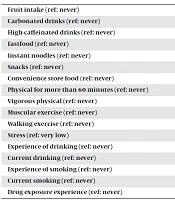
Among 62276 participants, 19658 were breakfast skippers (31.5%). By sex, 30.1% and 33.0% of men and women were breakfast skippers. A total of 10946 (17.6%) of participants reported never eating breakfast during the week, comprising 17.8% and 17.3% of the men and women analyzed in the study. Table 1 shows the demographic characteristics of breakfast skippers and steady eaters. Among the study subjects, men were more frequently steady eaters while women tended to fall into the breakfast skippers category. Breakfast skippers tended to be younger and shorter, have a poorer academic performance, lower parental education status, and lower family economic status. Table 2 shows the behavior patterns and emotional state of the study participants. With respect to dietary behavior, breakfast skippers reported consuming less fruit and snacks, but more carbonated drinks, highly caffeinated drinks, fast food, instant noodles, and convenience store food compared with steady eaters. Breakfast skippers were more overweight or obese, exercised less frequently, and reported feeling stressed and depressed more frequently compared to steady eaters. Breakfast skippers were also more likely to have experience smoking cigarettes or drinking alcohol, or be a current user of both. In addition, breakfast skippers engaged more frequently in suicidal ideation, suicide planning, and suicide attempts. Regarding weight control methods, contracted eating behavior such as fasting, using weight-loss drugs, laxatives, diuretics, a one-food diet, or diet foods were more likely to regularly skip breakfast. Table 3 shows the associated risk factors for depressive mood and suicide attempts in adolescents who skipped breakfast. Tables 4 and 5 show the demographics, behavior patterns, and emotional state of individuals who reported never eating breakfast compared to routine eaters. The contrast between these two groups with respect to demographics and behavior patterns were similar to those of the breakfast skippers and steady eaters shown in Tables 1 and 2.
| Characteristic | Total (N = 62276) | Breakfast Skipper (N = 19658) | Steady Eater (N = 42618) | P Value |
|---|---|---|---|---|
| Sex | < 0.001 | |||
| Male | 31624 (52.09) | 9532 (49.75) | 22092 (53.17) | |
| Female | 30652 (47.91) | 10126 (50.25) | 20526 (46.83) | |
| Age, y | 15.13 ± 0.02 | 15.18 ± 0.03 | 15.12 ± 0.03 | 0.002 |
| Grade | < 0.001 | |||
| Middle school 1st grade | 10189 (14.83) | 3028 (13.74) | 7161 (15.33) | |
| Middle school 2nd grade | 10377 (15.38) | 3190 (14.96) | 7187 (15.57) | |
| Middle school 3rd grade | 10319 (15.06) | 3418 (15.73) | 6901 (14.76) | |
| High school 1st grade | 10165 (17.12) | 3078 (16.60) | 7087 (17.35) | |
| High school 2nd grade | 10800 (18.99) | 3624 (20.22) | 7176 (18.43) | |
| High school 3rd grade | 10426 (18.62) | 3320 (18.74) | 7106 (18.57) | |
| Height, cm | 165.58 ± 0.18 | 165.43 ± 0.18 | 165.65 ± 0.18 | 0.028 |
| Weight, kg | 58.59 ± 0.19 | 58.71 ± 0.21 | 58.54 ± 0.20 | 0.198 |
| Body mass index | 21.24 ± 0.03 | 21.32 ± 0.04 | 21.20 ± 0.03 | < 0.001 |
| Academic performance | < 0.001 | |||
| Low | 6124 (9.95) | 2694 (13.81) | 3430 (8.18) | |
| Middle-low | 13818 (22.17) | 5171 (26.28) | 8647 (20.27) | |
| Middle | 17810 (28.71) | 5597 (28.55) | 12213 (28.79) | |
| High-middle | 15996 (25.57) | 4175 (21.09) | 11821 (27.63) | |
| High | 8528 (13.60) | 2021 (10.27) | 6507 (15.13) | |
| Educational status of father | < 0.001 | |||
| Middle school | 1186 (2.29) | 447 (2.93) | 739 (2.01) | |
| High school | 15908 (31.74) | 5490 (36.96) | 10418 (29.52) | |
| College | 31535 (65.97) | 8579 (60.10) | 22956 (68.47) | |
| Educational status of mother | < 0.001 | |||
| Middle school | 1009 (1.91) | 377 (2.40) | 632 (1.71) | |
| High school | 19427 (38.85) | 6649 (44.57) | 12778 (36.41) | |
| College | 29005 (59.23) | 7754 (53.03) | 21251 (61.89) | |
| Economic status | < 0.001 | |||
| Low | 1593 (2.55) | 674 (3.43) | 919 (2.15) | |
| Middle-low | 7299 (11.50) | 2628 (13.32) | 4671 (10.66) | |
| Middle | 28582 (45.57) | 9256 (46.72) | 19326 (45.05) | |
| High-middle | 18089 (29.40) | 5121 (26.28) | 12968 (30.84) | |
| High | 6713 (10.98) | 1979 (10.25) | 4734 (11.31) |
aValue are expressed as No. (%) or mean ± SE.
bThe chi-squared test was used for categorical variables and Independent t-test was used for continuous variables.
| Breakfast Skipper (N = 19658) | Steady Eater (N = 42618) | P Value | |
|---|---|---|---|
| Fruit intake | 16608 (84.40) | 39424 (92.57) | < 0.001 |
| Carbonated drinks | 16019 (81.54) | 33215 (78.05) | < 0.001 |
| High-caffeinated drinks | 5081 (26.03) | 9760 (22.93) | < 0.001 |
| Sweet drink | 17181 (87.48) | 37285 (87.43) | 0.879 |
| Fastfood | 15872 (81.35) | 33758 (79.81) | < 0.001 |
| Instant noodles | 15538 (78.70) | 32902 (77.22) | < 0.001 |
| Snacks | 16172 (81.85) | 35886 (83.99) | < 0.001 |
| Convenience store food | 13863 (70.69) | 26541 (62.81) | < 0.001 |
| Physical for more than 60 minutes | 11884 (60.29) | 27995 (62.22) | < 0.001 |
| Vigorous physical | 14428 (72.99) | 33083 (77.04) | < 0.001 |
| Muscular exercise | 9722 (49.11) | 22604 (52.47) | < 0.001 |
| Walking exercise | 18481 (94.25) | 40664 (95.58) | < 0.001 |
| Body mass index | < 0.001 | ||
| ≥ 30 | 342 (1.87) | 670 (1.65) | |
| 25 – 30 | 2345 (12.23) | 5001 (12.19) | |
| 20 – 25 | 8752 (46.57) | 18450 (44.96) | |
| < 20 | 7545 (39.32) | 17287 (41.20) | |
| Weight control status | 10323 (52.09) | 22474 (52.07) | 0.972 |
| Weight control method | |||
| Regular exercise | 7292 (70.43) | 16507 (72.87) | < 0.001 |
| Fast for more than 24 hours | 1524 (1461) | 1566 (6.79) | < 0.001 |
| Reduction in food intake | 7248 (69.99) | 14573 (64.99) | < 0.001 |
| Weight reduction drug (with a doctor’s prescription) | 238 (2.26) | 382 (1.72) | 0.003 |
| Weight reduction drug (without a doctor’s prescription) | 359 (3.45) | 522 (2.28) | < 0.001 |
| Laxative or diuretic | 254 (2.53) | 390 (1.70) | < 0.001 |
| Vomiting after meals | 403 (3.83) | 560 (2.47) | < 0.001 |
| One food diet | 1017 (9.66) | 1404 (6.07) | < 0.001 |
| Chinese medicine | 587 (5.83) | 1319 (5.79) | 0.901 |
| Diet foods | 987 (9.43) | 1730 (7.73) | < 0.001 |
| Stress | < 0.001 | ||
| Very high | 2553 (12.83) | 3955 (9.14) | |
| High | 5553 (28.22) | 11198 (26.27) | |
| Middle | 7917 (40.64) | 18354 (43.49) | |
| Low | 2887 (14.54) | 7342 (17.02) | |
| Very low | 748 (3.77) | 1769 (4.08) | |
| Depressive mood | 5626 (28.68) | 9986 (23.45) | < 0.001 |
| Suicidal ideation | 2754 (13.83) | 4830 (11.30) | < 0.001 |
| Suicide plan | 943 (4.71) | 1538 (3.57) | < 0.001 |
| Suicidal attempt | 654 (3.26) | 980 (2.27) | < 0.001 |
| Clinical therapy after suicidal attempt | 109 (17.51) | 171 (18.19) | 0.754 |
| Experience of drinking | 8634 (44.94) | 15783 (37.99) | < 0.001 |
| Current drinking | 3611 (42.51) | 5986 (38.61) | < 0.001 |
| Experience of smoking | 3139 (16.61) | 5011 (12.43) | < 0.001 |
| Current smoking | 1570 (50.38) | 2199 (44.16) | < 0.001 |
| Drug exposure experience | 248 (1.30) | 408 (1.02) | 0.011 |
| Current drug | 0.039 | ||
| Current | 101 (38.94) | 206 (50.26) | |
| Past | 72 (29.58) | 102 (25.10) | |
| Never | 75 (31.49) | 100 (24.64) |
aValue are expressed as No. (%).
bThe chi-squared test was used for categorical variables and Independent t-test was used for continuous variables.
Table 3.
Associated Risk Factors for Depressive Mood and Suicidal Attempts Using Logistic Regression in Adolescents Who Skip Breakfasta
| Depressive Mood, OR (95% CI) | P Value | Suicidal Attempts, OR (95% CI) | P Value | |
|---|---|---|---|---|
| Fruit intake (ref: never) | 1.17 (0.93 - 1.33) | 0.319 | 1.13 (0.72 - 2.29) | 0.401 |
| Carbonated drinks (ref: never) | 1.08 (0.95 - 1.23) | 0.220 | 0.92 (0.68 - 1.24) | 0.567 |
| High-caffeinated drinks (ref: never) | 1.66 (1.50 - 1.85) | < 0.001 | 1.50 (1.13 - 1.98) | 0.005 |
| Fastfood (ref: never) | 1.22 (1.08 - 1.38) | 0.001 | 0.92 (0.68 - 1.23) | 0.564 |
| Instant noodles (ref: never) | 1.10 (0.98 - 1.24) | 0.109 | 0.97 (0.70 - 1.35) | 0.857 |
| Snacks (ref: never) | 1.045 (0.92 - 1.19) | 0.478 | 0.70 (0.51 - 0.97) | 0.032 |
| Convenience store food (ref: never) | 1.64 (1.47 - 1.83) | < 0.001 | 1.66 (1.22 - 2.25) | 0.001 |
| Physical for more than 60 minutes (ref: never) | 1.29 (0.73- 1.43) | 0.071 | 1.60 (0.92 - 2.12) | 0.067 |
| Vigorous physical (ref: never) | 1.11 (0.99 - 1.24) | 0.069 | 1.20 (0.90 - 1.59) | 0.211 |
| Muscular exercise (ref: never) | 1.18 (0.96 - 1.31) | 0.212 | 1.35 (0.92 - 1.77) | 0.333 |
| Walking exercise (ref: never) | 1.03 (0.84 - 1.25) | 0.792 | 0.63 (0.40 - 1.01) | 0.056 |
| Stress (ref: very low) | 2.82 (2.63 - 3.01) | < 0.001 | 3.21 (2.70 - 3.82) | < 0.001 |
| Experience of drinking (ref: never) | 1.77 (1.59 - 1.98) | < 0.001 | 2.45 (1.87 - 3.21) | < 0.001 |
| Current drinking (ref: never) | 1.45 (1.26 - 1.68) | < 0.001 | 2.40 (1.70 - 3.38) | < 0.001 |
| Experience of smoking (ref: never) | 1.80 (1.55 - 2.09) | < 0.001 | 3.23 (2.28 - 4.58) | < 0.001 |
| Current smoking (ref: never) | 1.45 (1.13 - 1.87) | 0.004 | 2.09 (1.22 - 3.56) | 0.007 |
| Drug exposure experience (ref: never) | 3.33 (1.94 - 5.71) | < 0.001 | 5.39 (2.15 - 13.48) | < 0.001 |
Abbreviations: CI, confidence intervals; OR, odds ratio.
aLogistic regression analysis to identify the relationships between breakfast skipping and prevalence of suicidal attempts was used after adjusting sex, age, body mass index, academic performance, educational status of father, educational status of mother, economic status.
| Characteristic | Total (N = 33879) | Never Eater (N = 10946) | Daily Routine Eater (N = 22933) | P Value |
|---|---|---|---|---|
| Sex | < 0.001 | |||
| Male | 18322 (55.42) | 5641 (52.78) | 12691 (56.68) | |
| Female | 15547 (44.58) | 5305 (47.22) | 10242 (43.32) | |
| Age | 15.05 ± 0.03 | 15.14 ± 0.03 | 15.01 ± 0.03 | < 0.001 |
| Grade | < 0.001 | |||
| Middle school 1st grade | 5942 (16.01) | 1736 (14.22) | 4206 (16.86) | |
| Middle school 2nd grade | 5910 (16.05) | 1838 (15.42) | 4072 (16.35) | |
| Middle school 3rd grade | 5678 (15.33) | 1932 (16.05) | 3746 (14.99) | |
| High school 1st grade | 5471 (17.01) | 1706 (16.57) | 3765 (17.21) | |
| High school 2nd grade | 5601 (18.20) | 1992 (20.08) | 3609 (17.30) | |
| High school 3rd grade | 5277 (17.40) | 1742 (17.66) | 3535 (17.29) | |
| Height | 165.73 ± 0.18 | 165.58 ± 0.20 | 165.81 ± 0.19 | 0.081 |
| Weight | 58.54 ± 0.21 | 58.87 ± 0.23 | 58.38 ± 0.22 | 0.005 |
| Body mass index | 21.17 ± 0.03 | 21.34 ± 0.04 | 21.10 ± 0.04 | < 0.001 |
| Academic performance | < 0.001 | |||
| Low | 3208 (9.59) | 1589 (14.63) | 1619 (7.18) | |
| Middle low | 6911 (20.43) | 2874 (26.37) | 4037 (17.59) | |
| Middle | 9420 (28.02) | 3025 (27.74) | 6395 (28.15) | |
| High-middle | 9035 (26.54) | 2285 (20.75) | 6750 (29.30) | |
| High | 5305 (15.43) | 1173 (10.51) | 4132 (17.78) | |
| Educational status of father | < 0.001 | |||
| Middle school | 589 (2.10) | 231 (2.78) | 358 (1.80) | |
| High school | 8247 (30.05) | 3007 (36.65) | 5240 (27.21) | |
| College | 17833 (67.85) | 4765 (60.58) | 13068 (70.99) | |
| Educational status of mother | < 0.001 | |||
| Middle school | 520 (1.81) | 221 (2.53) | 299 (1.50) | |
| High school | 10139 (37.10) | 3689 (44.74) | 6450 (33.78) | |
| College | 16355 (61.09) | 4235 (52.73) | 12120 (64.72) | |
| Economic status | < 0.001 | |||
| Low | 814 (2.41) | 396 (3.59) | 418 (1.85) | |
| Middle-low | 3601 (10.33) | 1413 (12.78) | 2188 (9.16) | |
| Middle | 15160 (44.43) | 5141 (46.66) | 10019 (43.37) | |
| High-middle | 10220 (30.60) | 2833 (26.13) | 7387 (32.73) | |
| High | 4084 (12.23) | 1163 (10.85) | 2921 (12.90) |
aValue are expressed as No. (%) or mean ± SE.
bThe chi-squared test was used for categorical variables and Independent t-test was used for continuous variables.
| Never Eater (N = 10946) | Daily Routine Eater (N = 22933) | P Value | |
|---|---|---|---|
| Fruit intake | 9018 (82.25) | 21457 (93.58) | < 0.001 |
| Carbonated drinks | 8796 (80.47) | 17126 (74.89) | < 0.001 |
| High-caffeinated drinks | 2721 (25.03) | 4760 (20.78) | < 0.001 |
| Sweet drink | 9375 (85.78) | 19620 (85.55) | 0.608 |
| Fastfood | 8624 (79.41) | 17611 (77.43) | < 0.001 |
| Instant noodles | 8520 (77.36) | 17291 (75.53) | 0.002 |
| Snacks | 8778 (79.67) | 19083 (83.04) | < 0.001 |
| Convenience store food | 7337 (67.35) | 12464 (54.98) | < 0.001 |
| Physical for more than 60 minutes | 6394 (58.21) | 15040 (65.19) | < 0.001 |
| Vigorous physical | 7858 (71.56) | 17953 (77.72) | < 0.001 |
| Muscular exercise | 5305 (48.06) | 12362 (53.38) | < 0.001 |
| Walking exercise | 10192 (93.46) | 21846 (95.45) | < 0.001 |
| Body mass index | < 0.001 | ||
| ≥ 30 | 200 (1.90) | 361 (1.63) | |
| 25 - 30 | 1317 (12.41) | 2608 (11.82) | |
| 20 - 25 | 4875 (46.76) | 9683 (43.81) | |
| < 20 | 4149 (38.93) | 9671 (42.73) | |
| Weight control status | 5608 (50.81) | 11799 (51.06) | 0.717 |
| Weight control method | |||
| Regular exercise | 3927 (69.98) | 8808 (74.01) | < 0.001 |
| Fast for more than 24 hours | 871 (12.24) | 577 (4.78) | < 0.001 |
| Reduction in food intake | 3879 (69.20) | 7158 (61.04) | < 0.001 |
| Weight reduction drug (with a doctor’s prescription) | 126 (2.24) | 172 (1.50) | 0.002 |
| Weight reduction drug (without a doctor’s prescription) | 190 (3.41) | 210 (1.85) | < 0.001 |
| Laxative or Diuretic | 141 (2.60) | 164 (1.46) | < 0.001 |
| Vomiting after meals | 225 (3.97) | 245 (2.13) | < 0.001 |
| One food diet | 535 (9.36) | 539 (4.52) | < 0.001 |
| Chinese medicine | 329 (5.91) | 722 (6.01) | 0.806 |
| Diet foods | 502 (8.80) | 734 (6.40) | < 0.001 |
| Stress | < 0.001 | ||
| Very high | 1461 (13.14) | 1964 (8.36) | |
| High | 3048 (27.79) | 5568 (24.39) | |
| Middle | 4284 (39.60) | 9871 (43.59) | |
| Low | 1667 (15.05) | 4380 (18.77) | |
| Very low | 486 (4.44) | 1150 (4.89) | |
| Depressive mood | 3055 (28.04) | 4784 (20.93) | < 0.001 |
| Suicidal ideation | 1532 (13.89) | 2315 (10.08) | < 0.001 |
| Suicide plan | 538 (4.82) | 754 (3.28) | < 0.001 |
| Suicidal attempt | 389 (3.44) | 464 (2.00) | < 0.001 |
| Clinical therapy after suicidal attempt | 65 (18.28) | 85 (19.42) | 0.696 |
| Experience of drinking | 4775 (44.34) | 7635 (34.33) | < 0.001 |
| Current drinking | 1976 (41.89) | 2717 (36.21) | < 0.001 |
| Experience of smoking | 1764 (16.61) | 2321 (10.78) | < 0.001 |
| Current smoking | 891 (50.90) | 961 (41.22) | < 0.001 |
| Drug exposure experience | 151 (1.42) | 208 (0.95) | 0.001 |
| Current Drug | 0.211 | ||
| Current | 53 (37.28) | 59 (28.23) | |
| Past | 37 (25.04) | 46 (24.22) | |
| Never | 61 (37.68) | 103 (47.55) |
aValue are expressed as No. (%).
bThe chi-squared test was used for categorical variables and Independent t-test was used for continuous variables.
5. Discussion
In a study of 62276 Korean adolescents who participated in KYRBS online survey, we found that individuals who regularly ate breakfast exhibited overall better eating behaviors, academic performance, and emotional state compared to those who skipped breakfast. Importantly, we also found that steady eaters had less suicide ideation and suicide attempts relative to breakfast skippers. Many studies have looked at the relationship between adolescent mental health problems and regularly sharing family meals (8, 9, 12-15). Gender differences play a role in mental health concerns, and it may be surprising that the significant relationship between frequent family meals and prosocial behaviors as well as academic performance is stronger for males than females (14, 16). In the study with 7434 participants, when compared individuals who eat breakfast seldom or never with those who eat every day, the anxiety and depressive mood increased 3 times for boys and 1.6 times for girls in breakfast skippers (16). Traditionally, breakfast is regarded as the most important meal of the day, and there are several reports to suggest that eating breakfast in children provides many health benefits, ranging from improved overall dietary quality to enhanced cognitive abilities, academic performance, attention, and memory (17-20). Specifically, steady breakfast eaters have significantly higher scores in full scale verbal and performance intelligence quotient test than those of breakfast skippers, even after adjusting for gender, current residential situation, degree of parental education, parental employment, and source of the primary child caregiver (17, 21). Irregular consumption of breakfast is associated with a number of unhealthy behaviors, such as smoking, frequent consumption of alcohol, and infrequent exercise (17, 22). Consistent with these findings, the results of our study showed that breakfast skippers had a lower academic performance, were more likely to be overweight or obese, exercised less, and reported more unhealthy mental emotions and behaviors more frequently than steady eaters. Especially, we noted that breakfast skippers reported that they engaged in suicidal ideation, suicide planning, and suicide attempts more frequently than those who regularly ate breakfast. This finding was important in the context of adolescent suicide in Korea, which is the most common cause of Korean adolescents’ death in 2016 (10, 11).
Several hypotheses as to why skipping breakfast is a risk factor of suicide attempts have been proposed (4, 6, 17). One suggested mechanism concerns the social aspects of breakfast, suggesting that family meals with breakfast appear to be important to the healthy physical and emotional development of adolescents (17). In this model, breakfast can be viewed as a time for starting the day before school or work, and preparing for these tasks during breakfast allows family members to interactively communicate and socially establish a close relationship with one another (17). A consistent breakfast experience, especially when it includes family interaction, enhances family functioning by facilitating comfortable communication, sharing of values, identifications and aims in life, parental monitoring of adolescent behaviors, and solving collective problems (17, 22). In an environment where the rate of divorce is rapidly increasing, living either with only one parent or even alone is a risk factor for suicidal attempts; such individuals have a 2.24-fold higher risk of making a suicide attempt compared with those who live with both parents (21). A second hypothesis is that skipping breakfast interacts with specific behaviors such as cigarette smoking and alcohol consumption, which are known risk factors for suicide attempts (9). In support of this hypothesis, engaging in regular family meals is negatively correlated with the use of these substances (9). A third hypothesis relates to nutritional effects, proposing that the consumption of breakfast affects cognitive development in children (16-18). Eating breakfast after the overnight fast that occurs during sleep supplements low blood glucose levels through the rapid degradation of carbohydrates into glucose, which serves as fuel for physical and cognitive performance (17).
There were several limitations to our study. First, because of cross-sectional retrospective design, we were unable to establish a causal relationship between eating breakfast and adolescent health behaviors. Well-controlled prospective studies are necessary to confirm the results of the present study. Second, although this study was based on a nation-wide survey, selection or recall bias should be considered. For example, the survey did not include out-of-school adolescents such as those who had dropped out or expelled from school, attended the alternative schools, or had homeschooling. In addition, there were no data available for the 4.2% of students who did not participate in the study. Had such students been included, data on breakfast skipping and suicide ideation may have differed. Another limitation of this study was the self-reported nature of the survey. In this type of format, participants may have misunderstood that their reports would be linked to private and confidential information, resulting in erroneous reporting and thus decreased answer credibility. However, this study had several strengths that improve on the findings of previous reports related to breakfast eating. Especially, this study was based on a nation-wide government-directed survey with a high response rate (95.8%). And to the best of our knowledge, it comprised the largest number of participants (n = 62276) among any previous similar study with an equal division of middle and high school students and it was made up of socioeconomically diverse samples allowing for good generalization of the results.
5.1. Implications
The public health implications of our study can be applied at family, educational, and social levels. Almost a third (31.6%) of adolescents reported skipping breakfast more than five times per week, and 17.6% reported never eating breakfast. By preparing and eating breakfast with their adolescents, parents may be able to develop closer social interactions and observe for overt signs of depression or suicide. In addition, adolescents who engage in substance use or perform poorly in school in either the realms of academic achievement or friendships may avoid eating breakfast with their family to evade uncomfortable communication. Thus, eating breakfast together as a family may act to counter these behaviors. From an educational perspective, schools may consider delaying start class times, providing breakfasts to breakfast skippers through donations, and postponing more intensive aspects of the curriculum that demand a higher level of critical thinking until after lunch (22). Finally, the local community, especially community child centers, should take an active interest in high-risk adolescents that likely skip breakfast, such as orphans and those from either single-parent families, families with grandparents serving as parents, or families in a lower income bracket.
5.2. Conclusions
Our findings suggest that skipping breakfast regularly may adversely affect the health and well-being of adolescents. Especially, skipping breakfast was associated with an increased risk of suicide attempt. Public education on the benefits of eating breakfast is warranted, and the recommendation should be made to parents to encourage their adolescents to eat breakfast.