
1. Background
Suicide is a critical global public health challenge and a mental health priority. It is the second leading cause of death among adolescents and young people aged 15 - 29 years (1). Globally, more than 700,000 people die by suicide annually (2), and suicidal ideation, a precursor to future planning and action, remains highly prevalent even when it does not progress to a fatal attempt. In the United States, 17% of high school students report having seriously considered suicide (3), while ideation rates continue to rise in South Korea and Japan despite declining mortality rates. The World Health Organization (WHO) emphasizes that early identification of ideation is the most effective prevention strategy (4).
Across Asia, suicide patterns vary according to cultural, religious, and socioeconomic contexts (5). Comparative research shows that even where completed suicide rates are lower in some Muslim-majority countries, ideation prevalence remains substantial and is linked to complex factors (6). For example, about 15% of adolescents in Turkey report ideation, comparable to European rates, with similarly notable prevalence in Pakistan and Afghanistan, especially in border and less-developed regions (7). These findings suggest that cultural and religious factors alone are insufficient to account for ideation, underscoring the importance of psychosocial correlates (8), a concern echoed even in the relatively prosperous Persian Gulf states amid rapid social change (9).
In Iran, studies report an ideation prevalence of 12% - 25% among students (10, 11), although regional and ecological variation remains understudied (12). Javanrood County in Kermanshah Province, a border and underdeveloped region, faces compounding risks, including economic deprivation, limited access to psychological services, cultural pressures associated with rapid change, and weak educational infrastructure (13). According to psychosocial stress theory, adolescents chronically exposed to such structural stressors may face a heightened risk of suicidal ideation in the absence of adequate protective resources (14).
Social support is widely recognized as an important associated factor. Durkheim's classic theory linked social integration to reduced anomie and suicide risk (15), while Bowlby's attachment theory emphasizes the role of supportive relationships in fostering security and coping (16). Social support spans emotional, instrumental, and informational dimensions (17), and perceived support is considered a stronger correlate of mental health than objectively received support. Research suggests that supported adolescents exhibit greater resilience and lower hopelessness and ideation; a meta-analysis of 40 studies found a moderate-to-large association (18), potentially operating through reduced loneliness and stronger belonging and coping (19). Iranian studies support these findings: family support emerged as the strongest negative correlate of ideation (20), and students in Tabriz with low social support were three times more likely to report ideation (21), although border regions remain understudied.
Spiritual health, recognized as a core health dimension alongside physical, psychological, and social health (22), has also been associated with lower ideation. Paloutzian and Ellison's model (1982) distinguishes religious well-being, referring to a relationship with a higher power, from existential well-being, referring to meaning and life satisfaction. Frankl's logotherapy proposes that a lack of meaning contributes to hopelessness and suicidal ideation (23), while religious belief may be associated with lower suicide risk through social support systems and moral considerations (24). Koenig and Zmmit (5), studying 5,000 European adolescents, found higher spiritual well-being to be associated with a 40% lower likelihood of ideation (25). Iranian research similarly found existential well-being to be the strongest negative correlate of ideation among university students, with this relationship mediated by hope and reduced depression, although evidence in deprived border adolescent populations is limited.
The Reasons for Living (RFL) construct, introduced by Linehan (6), shifts the focus from risk factors to protective motivations for survival, including responsibility to family, fear of suicide, social and moral concerns, and coping beliefs (26), and is conceptualized as a cognitive-affective inhibitory system. In another study, the Interpersonal Theory of Suicide similarly highlights thwarted belongingness and perceived burdensomeness as opposing forces (27). Studies consistently show that RFL, alongside social support and spiritual health, is negatively associated with ideation (26). Khodabakhshi Koolaee et al. (24) found a significant negative relationship between RFL and ideation in a university sample, although generalizability to border adolescents is limited (28).
2. Objectives
Although social support, spiritual health, and reasons for living have each been examined individually in relation to suicidal ideation, evidence from studies assessing these variables simultaneously among adolescents in border regions remains limited. Therefore, this study investigated the associations of these three variables with suicidal ideation among secondary school students in Javanrood by assessing both correlational relationships and the relative statistical contribution of each variable. We hypothesized significant negative relationships between each variable and suicidal ideation, as well as significant predictive value for all three variables. Importantly, this study was conducted in a nonclinical school sample and did not assess clinical diagnoses such as borderline personality disorder, complex trauma, or severe emotional dysregulation; therefore, the findings and interpretations are limited to the general adolescent population and should not be generalized to clinical settings. By addressing this gap in Iran's border regions, the findings may inform future interventions targeting protective factors, including reasons for living, spiritual health, and social support, as potential avenues for strengthening adolescent resilience against suicidal ideation rather than focusing solely on risk reduction.
3. Materials and Methods
3.1. Study Design and Participants
This cross-sectional correlational study examined the associations among social support, spiritual health, reasons for living, and suicidal ideation in secondary school students in Javanrood County. The study population comprised all first- and second-cycle secondary students aged 12 - 18 years enrolled in Javanrood during 2025 - 2026, totaling 4,667 students according to Education Office records.
The sample size was estimated using the recommendation of 20 participants per variable, yielding an initial estimate of 80 for the study’s four main variables. To increase statistical power and account for attrition, the final target sample was set at 176, consistent with general correlational research guidelines.
A multistage cluster sampling method was used. The county was divided into four geographic zones (north, south, east, and west), and one boys’ school and one girls’ school were randomly selected per zone (eight schools in total). Two to three classes per school were randomly selected proportionally across grades, and all students in these classes were invited to participate. Of 182 distributed questionnaires, 182 were returned; 6 were excluded due to incompleteness (> 5% unanswered items), leaving 176 valid questionnaires.
Inclusion criteria were enrollment in a Javanrood secondary school during 2025 - 2026, age 12 - 18 years, no acute physical or psychiatric condition impairing participation, no psychiatric hospitalization during the previous 6 months, and provision of informed assent and parental consent. Exclusion criteria were incomplete responses (> 5% missing), voluntary withdrawal, or severe cognitive or comprehension difficulties during administration.
After institutional approval and coordination with school principals, the researcher explained the study aims, confidentiality, and the right to withdraw in each classroom. Questionnaires were completed anonymously and voluntarily, without teachers or staff present, and required 25 - 30 minutes. Given the clinical sensitivity of assessing suicidal ideation in minors, a standardized safety protocol was implemented. All completed Beck Scale for Suicidal Ideation (BSSI) questionnaires were immediately screened by a trained clinical psychologist.
Among the 176 participants, the most common age was 15 years (24.95%), and the least common age was 12 years (1.86%); the mean age was 15.32 years (SD = 1.94). The sample was 51.11% male (n = 91) and 48.89% female (n = 85). First-cycle students comprised 52.3% (n = 92: 33.7% grade 7, 32.6% grade 8, and 33.7% grade 9), and second-cycle students comprised 47.7% (n = 84: 33.3% grade 10, 34.5% grade 11, and 32.2% grade 12). Self-reported socioeconomic status was low for 27.8% (n = 49), moderate for 52.3% (n = 92), and high for 19.9% (n = 35), indicating a predominantly mid-adolescent, gender-balanced sample.
3.2. Instruments
3.2.1. Beck Scale for Suicidal Ideation
Developed by Beck et al. (29) for clinical and community use, the BSSI is a 19-item self-report scale with items rated from 0 to 2 (total range, 0 - 38) that assesses desire for death, suicide preparation, and active ideation. A total score of ≥ 15 was used as the clinical cutoff for significant suicidal ideation, consistent with the original validation studies. Original studies reported Cronbach’s alpha values of 0.89 - 0.97 (15) and convergent validity with the Beck Depression Inventory (16). The validated Persian version showed an alpha of 0.88 and confirmed convergent validity. In this study, alpha was 0.87. Based on the clinical cutoff, 24 adolescents (13.6%) scored in the high-risk range (BSSI ≥ 15).
3.2.2. Multidimensional Scale of Perceived Social Support
The Multidimensional Scale of Perceived Social Support (MSPSS), developed by Zimet et al. (3), is a 12-item scale that measures perceived support from family, friends, and significant others through three 4-item subscales, rated from 1 to 7 (subscale range, 4 - 28; total range, 12 - 84). The Persian version reported alpha values of 0.83 - 0.91 across subscales and 0.89 overall, with test-retest reliability of 0.69 - 0.86 and established convergent and discriminant validity.
3.2.3. Spiritual Well-Being Scale
The Spiritual Well-Being Scale (SWBS), developed by Paloutzian and Ellison (1982), is a 20-item scale with two 10-item subscales, Religious Well-Being and Existential Well-Being, rated from 1 to 6 (eight items are reverse scored; subscale range, 10 - 60; total range, 20 - 120; interpretive bands: low, 20 - 40; moderate, 41 - 99; high, 100 - 120). Original alpha values were 0.91 - 0.93, with test-retest reliability of 0.93 (22), and validity was confirmed through correlations with meaning, self-esteem, depression, and hopelessness (27). The Persian version showed alpha values of 0.82 - 0.90 (28). In this study, alpha values were 0.85 for Religious Well-Being, 0.83 for Existential Well-Being, and 0.87 for the total scale.
3.2.4. Reasons for Living Inventory for Adolescents
The Reasons for Living Inventory for Adolescents (RFL-A), developed by Osman et al. (23), is a 32-item scale rated from 1 to 5 that assesses five subscales: Future Optimism, Suicide-Related Concerns, Family Alliance, Peer Acceptance and Support, and Self-Acceptance (subscale range, 6 - 30 or 7 - 35; total range, 32 - 160). Higher scores indicate stronger reasons for living. The Iranian validation by Khodabakhshi Koolaee and Mahmoudi confirmed convergent and discriminant validity against the BSSI, Beck Hopelessness Scale, and happiness indices, with a total alpha of 0.94 (23, 24). In this study, subscale alpha values ranged from 0.81 to 0.86, with a total alpha of 0.91.
3.3. Procedure and Statistical Analysis
Following institutional approval, the researcher coordinated with school administrators, explained the study aims and confidentiality in each classroom, and emphasized participants’ right to withdraw. Questionnaires were completed collectively in classrooms, with the researcher present to clarify items. Data collection occurred between April and June 2025. Students scoring ≥ 15 on the BSSI were referred to school counselors or a clinical psychologist, and all participants subsequently received brief psychoeducational materials on mental health and local support resources.
Data were analyzed using SPSS version 26. After screening for missing values, normality, and outliers, descriptive statistics were computed for all variables. Pearson correlations were used to examine bivariate relationships among suicidal ideation, social support, spiritual health, and reasons for living, and multiple linear regression was used to assess their statistical contributions to suicidal ideation. Statistical significance was set at P < 0.05.
4. Results
4.1. Participant Characteristics
The frequency and percentage distributions of demographic characteristics among first- and second-cycle secondary school students are presented in Table 1.
Table 1.
Frequency and Percentage Distribution of Demographic Characteristics
| Variables | Frequency | Percentage |
|---|---|---|
| Age (y) | ||
| 12 | 5 | 1.86 |
| 13 | 20 | 11.17 |
| 14 | 30 | 16.95 |
| 15 | 44 | 24.95 |
| 16 | 41 | 23.09 |
| 17 | 32 | 18.62 |
| 18 | 6 | 3.35 |
| Gender | ||
| Male | 91 | 51.11 |
| Female | 85 | 48.89 |
As shown in Table 1, the highest frequency was observed among 15-year-old students (24.95%) and the lowest among 12-year-old students (1.86%). Male students comprised 51.11% and female students 48.89% of the sample, indicating a slight male predominance. These findings suggest that most participants were in mid-adolescence, with a broadly balanced gender distribution.
4.2. Descriptive Statistics
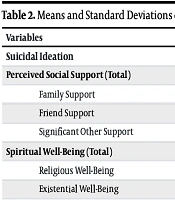
As shown in Table 2, the mean suicidal ideation score was 8.42 (SD = 6.15), indicating a relatively low level of suicidal ideation in the study sample and falling below the clinical cutoff of ≥ 15. The mean total perceived social support score was 56.38 (SD = 12.47), indicating a moderate-to-high level of perceived social support. Among the social support subscales, the highest mean was for family support (M = 19.64), followed by significant-other support (M = 18.62) and friend support (M = 18.12).
Table 2.
Means and Standard Deviations of Main Study Variables
| Variables | Mean | SD |
|---|---|---|
| Suicidal Ideation | 8.42 | 6.15 |
| Perceived Social Support (Total) | 56.38 | 12.47 |
| Family Support | 19.64 | 5.21 |
| Friend Support | 18.12 | 4.98 |
| Significant Other Support | 18.62 | 5.44 |
| Spiritual Well-Being (Total) | 71.85 | 11.26 |
| Religious Well-Being | 36.92 | 7.18 |
| Existential Well-Being | 34.93 | 6.87 |
| Reasons for Living (Total) | 118.74 | 17.63 |
| Future Optimism | 36.81 | 5.04 |
| Suicide-Related Concerns | 21.47 | 3.62 |
| Family Alliance | 25.96 | 4.33 |
| Peer Acceptance and Support | 24.42 | 5.15 |
| Self-Acceptance | 26.83 | 9.80 |
Regarding spiritual well-being, the mean total score was 71.85 (SD = 11.26), indicating a relatively favorable level of spiritual health within the moderate range of 41 - 99. The mean Religious Well-Being score (M = 36.92) was slightly higher than the Existential Well-Being score (M = 34.93), suggesting a more prominent role of religious components in the students' spiritual health.
The mean total reasons for living score was 118.74 (SD = 17.63), indicating relatively strong protective motivations against suicidal ideation. Among the subscales, Future Optimism (M = 36.81) and Family Alliance (M = 25.96) yielded the highest means, whereas Suicide-Related Concerns (M = 21.47) was at a moderate level.
4.3. Correlation and Regression Analyses
As shown in Table 3, social support was significantly and positively correlated with both spiritual well-being (r = 0.34, P < 0.01) and reasons for living (r = 0.26, P < 0.01). A strong positive correlation was also observed between spiritual well-being and reasons for living (r = 0.59, P < 0.01). Suicidal ideation was significantly and negatively correlated with social support (r = −0.33), spiritual well-being (r = −0.54), and reasons for living (r = −0.67), all at P < 0.01, indicating that higher levels of these variables were associated with lower suicidal ideation.
Table 3.
Correlation Matrix Among Social Support, Spiritual Well-Being, Reasons for Living, and Suicidal Ideation
| Variables | 1 | 2 | 3 | 4 |
|---|---|---|---|---|
| 1) Social Support | 1 | |||
| 2) Spiritual Well-Being | 0.34 a | 1 | ||
| 3) Reasons for Living | 0.26 a | 0.59 a | 1 | |
| 4) Suicidal Ideation | −0.33 a | −0.54 a | −0.67 a | 1 |
a P < 0.01 was considered statistically significant.
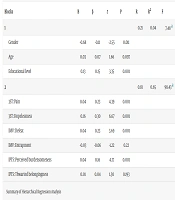
Before conducting the multiple regression analysis, multicollinearity among the predictor variables was assessed. Tolerance values ranged from 0.52 to 0.79, and variance inflation factor (VIF) values ranged from 1.27 to 1.93, all well below the conventional threshold of 10, indicating no problematic multicollinearity. The Durbin-Watson statistic was 1.94, supporting the independence of residuals. The multiple regression results are presented in Table 4.
Table 4.
Multiple Regression Analysis Predicting Suicidal Ideation a
| Variables | B | SE | β | T | P | Tolerance | VIF |
|---|---|---|---|---|---|---|---|
| Social Support | −0.43 | 0.23 | −0.09 | −1.83 | 0.048 | 0.79 | 1.27 |
| Spiritual Well-Being | −0.15 | 0.03 | −0.29 | −4.82 | < 0.001 | 0.54 | 1.86 |
| Reasons for Living | −0.49 | 0.09 | −0.35 | −5.57 | < 0.001 | 0.52 | 1.93 |
a r = 0.82, R2 = 0.69, F(3, 172) = 91.34, P < 0.001.
The overall regression model was statistically significant (P < 0.001), with the three predictors collectively explaining 69% of the variance in suicidal ideation (R2 = 0.69). Based on standardized coefficients, reasons for living (β = −0.35, P < 0.001) showed the strongest negative association, followed by spiritual well-being (β = −0.29, P < 0.001) and social support (β = −0.09, P = .048). The squared semi-partial correlations (sr2) indicated that reasons for living uniquely accounted for approximately 10% of the variance in suicidal ideation, spiritual well-being uniquely accounted for approximately 6%, and social support uniquely accounted for approximately 1%.
4.4. Subgroup Analyses
To examine age- and gender-related differences in reasons for living, independent-samples t-tests and one-way analysis of variance (ANOVA) were conducted. Subgroup analyses were restricted to the Reasons for Living scale for two primary reasons: 1) theoretical relevance, as previous research suggests that reasons for living are particularly sensitive to developmental and gender-related differences because cognitive-affective motivations for survival evolve with age and are shaped by gendered socialization processes (6, 23); and 2) statistical parsimony, given the exploratory nature of these subgroup comparisons and the need to avoid inflating type I error rates from multiple comparisons. We therefore focused on the scale that demonstrated the strongest association with suicidal ideation (β = −0.35, the largest standardized coefficient in the regression model). Results are summarized in Table 5.
Table 5.
Age and Gender Differences in Reasons for Living
| Comparison | Mean | SD | F | df | P | Cohen's d |
|---|---|---|---|---|---|---|
| Gender | 2.14 | 174 | 0.034 | 0.32 | ||
| Male (n = 91) | 122.10 | 16.84 | ||||
| Female (n = 85) | 116.40 | 18.21 | ||||
| Age group (y) | 4.87 | 2, 173 | 0.009 | η2 = 0.05 | ||
| 12 - 14 (n = 80) | 115.20 | 17.42 | ||||
| 15 - 16 (n = 37) | 121.85 | 16.93 | ||||
| 17 - 18 (n = 59) | 125.60 | 17.11 |
As shown in Table 5, male students scored significantly higher on reasons for living than female students (t(174) = 2.14, P = 0.034, d = 0.3, 95% CI for Cohen's d = [0.01, 0.63]), representing a small-to-moderate effect. A one-way ANOVA also revealed a significant main effect of age group on reasons for living (F(2, 173) = 4.87, P = 0.009, η2 = 0.05, η2 = 0.05 [0.01, 0.11]), with scores increasing progressively across age subgroups. Post hoc comparisons using Tukey's HSD indicated that the youngest group (12 - 14 years) scored significantly lower than the oldest group (17 - 18 years), whereas differences between adjacent groups did not reach significance. These findings suggest that both age and gender are meaningfully associated with protective reasons for living in adolescents.
In summary, spiritual well-being, social support, and reasons for living each showed significant negative relationships with suicidal ideation and together accounted for 69% of its variance. Reasons for living also showed significant associations with both age and gender, underscoring the need for developmentally informed and gender-sensitive approaches to adolescent suicide prevention.
5. Discussion
This cross-sectional study examined the associations of social support, spiritual well-being, and reasons for living with suicidal ideation among secondary school students in Javanrood County, a border region of Kermanshah Province, Iran. All three variables showed significant negative associations and collectively explained a substantial proportion of the variance in suicidal ideation, underscoring the explanatory value of an integrated correlational model for understanding adolescent suicidal ideation. Importantly, because this study was conducted in a nonclinical school sample, the findings and interpretations are limited to the general adolescent population and should not be generalized to clinical populations without further investigation.
5.1. Association Between Social Support and Suicidal Ideation
A significant negative relationship was observed between perceived social support and suicidal ideation, consistent with theoretical frameworks suggesting that perceived support from family, friends, and significant others is associated with belonging, security, and self-worth, which are related to resilience against stressors (3, 7), whereas its absence is associated with loneliness and worthlessness, creating conditions that may be conducive to ideation (4, 9, 29). This finding aligns with evidence from Iran indicating that family support showed the strongest negative association with ideation (20) and that low social support was related to a substantially higher risk of ideation (21). The salience of family support in this study may reflect the collectivist values of Javanrood and suggests that perceived interpersonal support remains an independently important correlate even in culturally conservative, religiously embedded contexts.
5.2. Association Between Spiritual Well-Being and Suicidal Ideation
Spiritual well-being was the second strongest correlate, which can be interpreted through Frankl's logotherapy: because humans are meaning-seeking beings, the absence of meaning is theorized to generate existential despair that may predispose individuals to ideation (2, 13). Spiritual well-being may help individuals make sense of suffering, whereas religious beliefs may be associated with lower suicide risk through communal support and moral considerations within Islamic ethics (16, 21). Higher religious than existential well-being scores in this sample may reflect the prominence of religious identity in the daily lives of adolescents in border regions and may serve as a protective resource. These results align with international evidence suggesting that spiritual well-being is associated with lower ideation (25) and extend this finding to an underrepresented, structurally disadvantaged border population in which spiritual resources may be particularly salient given limited alternatives.
5.3. Association Between Reasons for Living and Suicidal Ideation
Reasons for living was the strongest correlate overall, consistent with cognitive-behavioral theory, which conceptualizes it as a cognitive-affective inhibitory system that may be activated by suicidal thoughts (26). Adolescents with stronger reasons for living, including family responsibility, moral convictions, future optimism, and coping skills, reported lower ideation, consistent with Linehan's (6) conceptualization of RFL as active survival motivations and Joiner's (2005) theory identifying thwarted belongingness and burdensomeness as their conceptual opposites (27). Future optimism and family alliance were the most prominent subscales, suggesting that hope and family bonds are the most salient protective cognitions in this population and may be promising targets for school-based interventions.
5.4. Integrated Model and Contextual Considerations
Together, the three predictors explained a notably large proportion of the variance, highlighting the value of examining these correlates simultaneously rather than in isolation (5, 11). This integrated approach distinguishes the study from prior research that largely examined these variables separately or in urban centers (12, 24). Border regions, characterized by high unemployment, limited mental health services, and rapid social change, offer a distinct and underexplored context for testing vulnerability and resilience models (6, 28). The strong association between spiritual well-being and reasons for living raises the possibility that spirituality may operate both directly and as a mechanism translating meaning into concrete survival motivations, warranting future mediation testing (10, 22).
5.5. Sociocultural Context and Measurement Considerations
The sociocultural characteristics of Javanrood County merit specific attention when interpreting these findings. First, stigma surrounding mental health is prevalent in border regions, where psychological difficulties are often attributed to spiritual or moral failings rather than recognized as health concerns. This stigma may have influenced participants' willingness to report suicidal ideation accurately, potentially resulting in underreporting and social desirability bias. Second, traditional views on religion and the strong Islamic identity in this region may have shaped responses on both the Spiritual Well-Being Scale and the Reasons for Living Inventory; participants may have endorsed items in ways that reflect cultural and religious expectations rather than their true psychological states. Third, the sensitive nature of discussing suicide in a culturally conservative context may have further contributed to social desirability effects. These contextual factors suggest that the findings, while robust, should be interpreted with awareness of potential cultural response biases, and future research should consider using semistructured interviews or implicit measures to supplement self-report data in similar settings.
5.6. Age and Gender Differences
Demographically, older and male students reported higher reasons for living scores than younger and female students, suggesting that protective motivations may strengthen across adolescence and may reflect gendered socialization patterns. Female adolescents, potentially more exposed to interpersonal stressors and less likely to externalize distress, may particularly benefit from interventions that cultivate reasons for living and future optimism.
5.7. Practical Implications
These findings suggest that school-based prevention programs could benefit from strengthening all three associated factors simultaneously through communication and problem-solving workshops for students, parent training in emotional responsiveness, and spiritually informed counseling that fosters meaning and purpose. Suicide prevention in border regions may need to move beyond symptom-focused approaches toward a holistic model integrating psychological, social, and spiritual well-being.
5.8. Limitations and Future Directions
Several limitations should be acknowledged. First, the cross-sectional design precludes any inference of causality; we cannot determine whether social support, spiritual well-being, and reasons for living precede or follow changes in suicidal ideation. Second, the sample was drawn from a single border county in Iran, which may limit generalizability to other regions or populations. Third, the absence of potentially important covariates, particularly baseline depressive symptoms, which were not assessed, may have influenced the observed associations. More broadly, we did not measure several other established predictors of adolescent suicidal ideation, including hopelessness, anxiety, trauma exposure, bullying victimization, family conflict, and substance use history; consequently, the associations reported here for social support, spiritual well-being, and reasons for living may be subject to residual confounding by these unmeasured variables. Given the relatively high proportion of variance explained by the model (R2 = 0.69), it is plausible that some of this explanatory power reflects shared variance with these unmeasured clinical and psychosocial factors rather than the unique independent contribution of the three predictors examined here. Similarly, socioeconomic status, although collected, was not included as a covariate in the regression analyses; future research should systematically examine its role. Fourth, data were collected using self-report questionnaires, which are subject to social desirability bias, particularly given the cultural sensitivity of discussing suicide in this context. Fifth, subgroup analyses were restricted to the Reasons for Living scale; future studies should systematically examine age and gender differences across all study variables. Finally, the findings are based on a nonclinical school sample and should not be generalized to clinical populations without further investigation.
5.9. Conclusions
In this nonclinical school sample of adolescents from an Iranian border region, social support, spiritual well-being, and reasons for living were each independently and significantly associated with lower suicidal ideation in a correlational framework and may serve as important protective resources. Family relationships, peer support, a sense of meaning, and strong motivations for living appear to be modifiable resources for school-based prevention. Suicide prevention in Iran and similar contexts may benefit from moving beyond risk reduction toward strengthening protective beliefs, interpersonal bonds, and adolescents' sense of purpose and belonging, particularly in underserved border communities where structural vulnerabilities compound psychological risk (15). However, these findings are correlational and based on self-report data from a nonclinical sample; longitudinal and clinical research is needed to confirm the temporal and generalizable nature of these associations.