1. Background
Cancer is a significant cause of death in children worldwide (1). In the United States, the cancer with highest incidence in children aged 0 to 14 is leukemia (29%). Germ cell tumors (GCT) are also another highly prevalent kind of tumor found in 1 to 3% of the pediatric population (2, 3). Due to their histological diversity, many possible locations (2), and the high prevalence mentioned above, the research on these cancers must be considered appropriate.
Germ cell tumors, which rank number nine in terms of incidence in some studies (4), comprise a heterogeneous group of tumors (5). This type of tumor may develop in the gonads, as well as other locations, due to the migration of primordial germ cells during embryogenesis (3). On the other hand, depending on their histopathology, GCT can be classified into germinomas, including seminoma, dysgerminoma and germinoma, and non-germinomas, which include endodermic sinus tumors (EST), choriocarcinoma, embryonal carcinoma, and teratoma (mature and immature) (6). All these tumors originate from the same cell type; thus, they are regarded as a single group (7).
Several researchers point out the need for more studies that define the risk factors to be observed and allow knowing the particular prevalence in each country, as well as the epidemiological features of GCT (1). The need for such studies resides on the fact that more openness is required regarding the systematization of information concerning epidemiologic studies in general (8). For this reason, System Medicine, a complementary approach to the conventional research systems, has been chosen (9). Therefore, several strategies from different science fields have been implemented in the study of diverse cancers, such as probabilistic networks or Bayesian networks (10, 11).
2. Objectives
In this study, the main objective was to show the prevalence of pediatric cancer in general, as well as some of the epidemiological features of germ cell tumors in the pediatric population aged 0 to 18 years. Another goal was to apply the methodology from Bayesian networks to provide a global probabilistic perspective regarding the chosen risk factors.
3. Methods
3.1. Descriptive Statistics
A transversal retrospective study was carried out on cancer patients aged 0 to 18 at the Pediatric Oncology Service from Hospital “Dr. Miguel Dorantes Mesa”, State Cancer Center in the city of Xalapa, Veracruz state, Mexico. The patients considered for this study were those admitted from January 2006 to December 2016. Subsequently, the specific data from the patients with germ cell tumors were analyzed. In this case, pediatric patients diagnosed at the hospital with a histopathological diagnosis or serum tumor markers associated with GCT were included. The patients with clinical suspicion of GCT, with no histopathological confirmation or serum markers, were excluded. Lastly, no GCT patients with incomplete medical record were considered.
The patients with GCT were evaluated for percentage of histological type prevalence, body location, and tumor stage, as well as the presence or absence of some biological markers. In order to obtain a more detailed analysis, the data was arranged by gender, residence area, and diagnosis year. Later on, we made a Bayesian network to obtain the probabilistic relationship between risk factors.
3.2. Bayesian Network
Bayesian networks are a tool used for describing the relationship among variables within phenomena. It is possible to use them to make predictions and retrofit beliefs since their models reflect an event in terms of probability.
In the construction of the network for our study, GCT were used as the response variable and two sets of data were used: the first one consisted of a random group of 63 cases from the original set (the training set in the network); the second group was developed from the remaining 24 cases, with the purpose of testing the network. The variable “Age” was categorized because it was initially quantitative. The search method for building this network was based on a Hill-Climbing Heuristic, and Bayesian metrics were used for the evaluation of the network's outcome.
4. Results
4.1. General Outlook of Cancer Prevalence at Centro Estatal de Cancerologia (CECan)
The clinical records of 801 patients were analyzed. The most prevalent cancers among these children were leukemias, appearing in up to 48% of the cases; in second place, germ cell tumors with 11%, and lymphomas in the third place, with 10.5% (Figure 1).

Figure 1.
Prevalence percentage of oncological diseases at CECan from January 2006 to December 2016
4.2. General Data for Germ-Cell Tumors at CECan
From the 801 patients diagnosed with cancer between the years 2006 and 2016, 87 patients suffered from GCT, of whom 56.32% were boys and 43.68% girls (Figure 2), with a recorded boy-girl ratio of 1.29:0.77.

Figure 2.
Prevalence percentage of GCT in boys aged 0 to 18 years from January 2006 to December 2016
The average age was 12.46 years with a standard deviation of 5.38 years, and two prevalence peaks between 0 - 3 years, and 15 - 18 years. The histological type showing a higher prevalence percentage was the mixed germ cell tumor (MGT), with a presence of 45.98% (Figure 3).
The most prevalent location where GCT were found was the gonadal region, with 90.8%. As for the alpha-fetoprotein (AFP), 65% of the patients turned out positive for this molecular marker.

Figure 3.
Prevalence percentage of the histological type in all patients with GCT between 0 to 18 years at CECan from January 2006 to December 2016
4.3. Data on Germ-Cell Tumors at CECan by Gender
The number of girls with some type of GCT reported was 38, with an average age of 13.29 years and a standard deviation of 4.26 years. The most prevalent histological type was MGT with 31.58%, and the gonads, the most common location for these tumors (92.11%). The stage with the highest prevalence percentage at the time of diagnosis was stage I (36.84%), and 60.53% of these patients were β-GCH positive.
As for boys, the average age of the 49 patients was 11.82 years, with a standard deviation of 6.08 years. The histological type with the highest prevalence percentage was MGT (57.14%). The most prevalent location was the gonadal region (89.8%). The stage with the highest prevalence was stage IV (28.57%). A high percentage (79.59%) of patients presented AFP.
4.4. Data on Germ-Cell Tumors at CECan by State of Veracruz Region
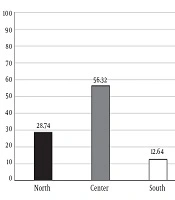
The region of Veracruz state with the highest number of patients with GCT was the central zone with 56.32% of the total population, 20 girls and 29 boys (Figure 4).

Figure 4.
Prevalence percentage of GCT cases per state region presented at the CECan from January 2006 to December 2016
In the central and northern zone, the GCT with the highest prevalence percentage was MGT (48.98%), while in the southern area, dysgerminoma (36.36%) was the primary histological GCT type. The most prevalent tumor location in all regions was the gonadal zone. In the Central and Southern area, the highest prevalence stage was stage I, and stage 4 for the Northern zone.
4.5. Data on Yearly Germ Cell Tumors at CECan from 2007 to 2016
The annual rate of patients who suffered from some type of GCT was around 8.6. The year 2008 showed the largest number of admitted cases (N = 12). The year with the smallest number of registered cases was 2012, with six patients, and 11 cases in 2015. The years that presented more GCT in girls were 2007, 2009, and 2016, all of them with a percentage above 57 points. As for boys, the rates surpassed 55% between 2010 and 2015. The highest average age was registered in 2011 (13.89 years), and the youngest in 2008 (7.33 years). In 2007, the most prevalent GCT were mature and immature teratomas (28.57% each); from 2008 to 2015, MGT’s showed numbers above 42%, and MGT and EST were more prevalent in 2016, along with immature teratoma, each one with a 28.57% prevalence.
Only in 2007 most patients were found to be negative for AFP, while from 2008 to 2016, the majority of patients showed a recordable level of this protein. In 2007, most patients came from the North and South of Veracruz. Between the years 2008 - 2011, and 2015 - 2016, the patients mainly came from the central area (with percentages above 57 points). In 2012 - 2013, the patients' most common place of origin was the Northern zone (50% and 57.14% respectively); finally, in 2014, the north and central zones (45.45% in both cases).
4.6. Bayesian Network of the Germ-Cell Tumors at CECan
The Bayesian network in here represents the statistical relationships between the data, or variables, obtained through the medical records of the pediatric patients with GCT from the CECan between 2006 and 2016. In Figure 5, we mapped the probabilistic dependencies between variables or risk factors through one-way arrows, from which we emphasize that the location of the tumor and the levels of human chorionic gonadotropin (hCG) showed a probabilistic relationship with the histological type. Apart from this relationship, it was evident that the histological type can be related to the patient's sex, AFP levels, and tumor stage. Furthermore, it is interesting to observe a relationship between some risk factors, such as geographical zone and the GCT stage at the time of diagnosis.

Figure 5.
Bayesian network of GCT cases at CECan from January 2006 to December 2016
This network model best suits the set of data (87 patients), allowing referring to the occurrence probability of a given event, and one or more known or unknown events corresponding to the set of variables shown in the network. The classification percentage equals 87.30% for the training group (63 patients) and 70.83% for the test group (24 patients).
5. Discussion
Childhood cancer is a pathology of high social relevance (12), and more studies around this pathology need to be generated in order to know its epidemiological characteristics throughout time. For instance, in Mexico, in 2016, the need for a more meticulous exploration of the data on Mexican children with cancer was reported (13). We carried out this research for this reason. In 2014, also in Mexico, it was reported that the highest mortality cancers were those in hematopoietic organs (59.2%), and lymphatic (8.6%) and bone tumors (6.8%) (14). Coincidentally, we found that in the period 2006 - 2016, leukemias were the most prevalent cancer at CECan. However, we found GCT to be in second place.
As it was observed throughout this study in CECan, like in other studies (15), CGT’s proved to be the pathology with the highest prevalence. In the present research, we found two age peaks in which the GCT are showing higher prevalence: one during early childhood and the other one at the start of adolescence similar to the study of Schneider et al (2004) (16).
GCT can present several histological types. In 2010, in research carried out in the United States, it was shown that teratomas were the most common histological type in pediatric patients, regardless of gender (17). In our case, mixed germ tumors were the most prevailing, regardless of gender. In 2014, Kaatsch et al. reported that in 1402 pediatric patients with GCT, the extragonadal location prevailed with 58% both in girls and boys (3), while we found 90.8% of these tumors in the gonadal region in both sexes. In 2017, it was reported that out of 101 cases of GCT, stage III was the most prevailing (50.6%) (2). However, we were unable to find an evident dominant stage. We observed an increase in AFP levels in more than half the patients, which, according to research, it is considered as a diagnosis and monitoring factor. It was proven that an increase in AFP levels of more than 10,000 ng/mL might be associated with a bad disease prognosis (18).
Some of the epidemiological features of pediatric cancer (including GCT), such as incidence, change through time (1). A 2014 study carried out on GCT patients showed that the GCT incidence in boys aged 10 - 19 increased between the years 1975 - 2006. Meanwhile, girls showed an increase in the 0 - 9 year group. In the same study, it was observed that the patients with tumors in the gonadal area improved their survival rate (17). In our case, we noticed an increase in the number of GCTC patients from 2013 to 2016 (mixed germ tumors located at the gonadal area mainly), and that the patients came from the central part of the state.
In order to generate a System Medicine perspective, we used Bayesian networks and demonstrated that risk factors included location of the tumor, histological type, stage, and patient's place of origin. It has been reported that tumor location may be related to disease prognosis; for example, it has been observed that the non-seminoma extragonadal GCT has a worse prognosis in the retroperitoneal zone than in the mediastinum (19). Additionally, in a study carried out on 44 patients, it was revealed that the histological type in GCT could be linked to mortality, with the yolk sac tumor showing the highest death rate (7). The disease stage can be related to the survival rate: one research showed that the 5-year survivability rate in stage I GCT patients is 100%; in stage II, 87%; stage III, 72%; and stage IV, 56% (20). Likewise, it has been observed that certain factors related to the geographical location may contribute to an increase of GCT cases (21). Therefore, our network shows that all the previously mentioned risk factors together, and not individually, in this particular case, are related to GCT prevalence at CECan during the period 2006 - 2016.
In this research, we found a probabilistic relationship between some characteristic features of the GCT epidemiological factors, as the patient's geographical area. Nevertheless, the inclusion of a higher number of cases of GCT is required, as well as the participation of more hospitals from other regions within the state of Veracruz to generate a more exact and broader epidemiologic overview. Besides, we emphasize the need for the inclusion of molecular markers, which allow the creation of a perspective on the evolution of the disease at this level. By bringing all this information together, the dynamics of all the different epidemiological levels will be covered, and not a single risk factor, looking for an eco-epidemiologic approach (22). Using this approach, we will try to create a systemic perspective where all these levels of the inherently complex health-disease cancer processes are integrated -particularly for GCT. In this manner, the preceding should serve as a starting point for the implementation of regional strategies related to public health in the state of Veracruz.
5.1. Conclusions
In this study, we found that in a tertiary hospital from the central region of the state of Veracruz, germ cell tumors rank second place in prevalence. This finding is relevance as GCT generally affect a smaller percentage of patients in the national and worldwide level. Moreover, it was clear that there was an increase in GCT prevalence in the population during the time frame in which this study was carried out. Finally, from the system theory point of view, through the proposed Bayesian network, some key factors were pinpointed, which, as a whole, can be useful for diagnosis and monitoring of the patients with this pathology.