


1. Background
Autism is a spectrum of complex behavioral disorders. The common symptoms of autism spectrum disorder (ASD) are stereotyped patterns of behavior, verbal communication difficulties, and poor social skills (1). Autism spectrum disorder is well known as an incurable condition with an unknown cause, and children with autism usually need parents or caregivers to meet their needs (2). Moreover, this need continues to provide different levels of care throughout their lives (3). Given the complexity of ASD, it is critical to help families understand it and related consequences, identify needs, and control stress, as well as provide them with enough information about treatment methods (4).
Families play a vital role in any treatment for their children (5). In addition to seeking treatment, coordinating appointments, and paying for care, parents often play a communicative role with specialists involved in the treatment process (6). Furthermore, parents have a supportive role in treating their children and perform home remedies during the treatment period (7). Raising a child with behavioral, communication, social, and learning disabilities may put much pressure on the family, and this pressure is much more in families with an ASD child than in families who have a child with other disabilities (8).
As mentioned, families face many challenges in caring for children with ASD throughout their lives. Children with ASD need to learn about the human capacity for flexibility, coping style, and sense of self-efficacy. Most of these skills and emotions should be taught to them by the family (9). Recently, researchers have focused on identifying the basic needs of families of children with ASD (10). One of the significant needs is to increase understanding about the family role and the behavioral characteristics of the child with ASD, to improve the development of children (11). These parents do not have enough information on how to deal with the problems caused by this disorder. Therefore, support centers must help them manage their problems in a comprehensive and problem-oriented way (10). Insufficient awareness of ASD and how to care for a child with ASD in the maladapted cultural context have been the main challenges for mothers of those children (12, 13).
The research literature has shown that identifying the needs of families of children with ASD can improve the quality of their lives and increase the capacity to provide adequate care for children (14). Given that efforts are being made today to better understand the needs of families of children with ASD and teach parents of children with autism continuously, there is a question: Do professionals and parents have a common vision of the needs of families?
2. Objectives
In this study, the term "needs" refers to the needs that a family of a person with autism may face, and these needs may include information needs, services, psychological support, social needs, and others (15, 16). The needs of families have been studied from different perspectives so far, but in general, we are not sure if there is a unified understanding of the needs between professionals and families. A set of parent-related factors, such as social support and behavioral factors, require researchers to study more broadly the needs of parents of children with autism. Therefore, this study aimed to identify the needs of families from the perspectives of professionals and parents.
3. Methods
3.1. Design and Setting
This study was carried out from January to March 2020, as a part of ABILAR (Azeri Blue Buddies: Interdisciplinary Longitudinal Autism Research) project, using a qualitative approach. The ABILAR project is a program developed by Tabriz University of Medical Sciences in the field of comprehensive management of autism spectrum disorder at the individual, family, and social levels. In Iran, services for children with ASD and their families are provided by government rehabilitation centers like clinics affiliated with Medical Universities, the State Welfare Organization, and special education organization (14). Also, other private and charity centers provide services to these children. The interviewees were selected from among the experts of these organizations. Moreover, the parents of children with ASD were selected from the visitors to Tabriz Comprehensive Autism Centre in East Azerbaijan, Iran.
3.2. Participant Sampling and Recruitment
The study population included ASD specialists and parents of children with ASD. Purposeful sampling using the principle of maximum variation was used. The inclusion criterion for specialists was a three-year direct contact with families of ASD children. Furthermore, for parents, the inclusion criterion was having a diagnosed child with ASD at least for one year. Recruitment continued until data saturation was achieved (42 interviews, including 19 specialists and 23 parents).
3.3. Interview Guide
The interview guide was developed by a focus group discussion of four specialists in the field of ASD. It contained three sections: 1- An explanation about the study, its aims, and ethical considerations, 2- Participants' demographic information, and 3- The main questions (four questions). The interview guide is provided as a supplementary.
3.4. Data Collection
Semi-structured, in-depth interviews were used for data collection. Nineteen interviews were conducted with ASD specialists (15 of them were face-to-face interviews, and four of them occurred through telephone calls) on participants' preferred time and place. The duration of the interviews ranged from 32 to 46 minutes. In the case of the four telephone interviews, they were invited via E-mail, the interview guides were sent to them, and were interviewed at the time they were appointed.
Parents were selected among those who were referred to the Tabriz Comprehensive Autism Centre (n = 23). Parents of children with autism usually come to this center for services, and the reason for choosing this center was its easy access to parents. They were interviewed in a private room at the center. The mean duration of the interviews with parents was 44 minutes. The population size of parents was about 1000 people, considering the membership of about 500 children with autism in the Comprehensive Center of Tabriz, including two parents for each child. The population of professionals who had worked in the field of autism and family empowerment was estimated at 50 people. The sampling method for both groups was purposeful sampling and continued until the data was saturated.
All participants were asked to provide written informed consent before the interview. In the case of telephone interviews, oral consent was obtained for participation in the study. After obtaining the participants' permission, their voices were recorded by a voice recorder.
3.5. Data Analysis
All interviews were recorded and transcribed verbatim. The analysis was performed simultaneously with transcription. Member checking was applied through data collection at the end of each interview to ensure study rigor (The recorded voice of each participant was typed in Word software and the typed text was sent via email to the given participant, and they were asked to edit or confirm their statements.) Moreover, coding and analysis of data were carried out independently by three authors.
Transcribed texts were read several times by two authors (K GH and SD). Data collected from interviews were analyzed by the content analysis method, and codes, themes, and subthemes were extracted. For ease of data analysis, MAXQDA-v10 software was used. The themes and sub-themes were identified by three researchers (L RK, R KH, and M FD. The data analysis and coding steps were as follows.
1- The recorded voices of the participants were typed and read several times by the researchers.
2- Meaning units and primary codes were identified.
3- Themes and sub-themes were identified.
4- Themes and sub-themes were named and defined.
5- The reliability of the extracted codes, themes, and subthemes were tested (with a final agreement between the three coders) (17).
4. Results
4.1. Demographic Characteristics of Participants
Most of the participating specialists were from private rehabilitation centers (n = 6). The professions of the participants were as follows: four psychologists, four family counselors, three children, and adolescent psychiatrists, one social medicine specialist, three occupational therapists, two speech therapists, and two directors of autism schools. Their minimum and maximum years of direct work experience with parents of children with ASD were four and 14 years, respectively (Table 1).
Table 1.Demographic Characteristics of Experts Participating in the Research
| Variable | Values |
|---|---|
| Age, Mean ± SD | 41.3 ± 8.68 |
| Gender | |
| Male (%) | (42.1) |
| Female (%) | (57.9) |
| Work experience with autistic families (y) | |
| Governmental centers | |
| State welfare organization (n = 2) | 6 |
| Special education centers (n = 4) | 5 |
| Academic centers (n = 5) | 11 |
| Non-governmental centers | |
| Private rehabilitation centers (n = 6) | 7 |
| Charity rehabilitation centers (n = 2) | 6 |
| N | 19 |
| Total mean | 7.42 |
Fifteen parents (65.2%) were female. The mean age of the participants was 34.2 ± 7.74 years, and 30.4% had a bachelor's degree or higher, and 39.1% had lower education. The share of participants with autistic boys and girls was 19 (82.6%) and four (17.4%), respectively. The mean age of children with ASD was 6.8 ± 1.87.
In the coding process, which was performed in MAXQDA-v10 software, the needs of families were categorized into nine themes and 11 sub-themes from the experts' perspectives and four themes and 13 sub-themes from the perspective of parents.
4.2. Families' Needs from the Perspective of ASD Specialists
The themes and sub-themes are presented in Figure 1. Experts believed that some needs should be addressed to empower the families of children with ASD in Iran, as follows.
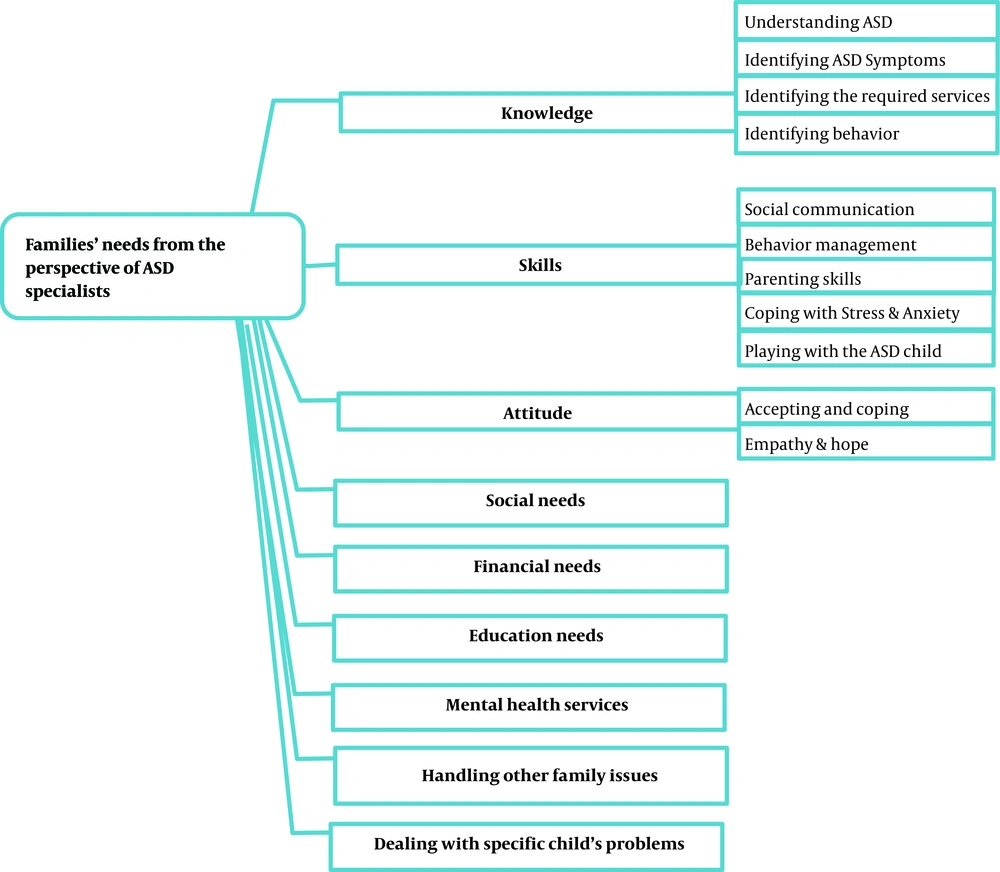
Figure 1.
Families' needs from the perspective of ASD specialists
4.2.1. Main Theme 1: Knowledge
The interviews' results indicated that most of the participants had a strong emphasis on the dimension of knowledge, information, and awareness of different areas of ASD. According to experts, the needs of families in this area include four sub-themes, namely understanding ASD, identifying ASD symptoms, identifying the required resources and services, and identifying and managing the behavior of the child. The emphasis on this topic by experts suggests that the lack of sufficient information about ASD is one of the significant problems of families in Iran and it should be addressed as a serious problem.
4.2.1.1. Sub-Theme 1: Understanding ASD
According to the participants, many families of children with ASD have insufficient information about ASD, the main reason for which is the lack of educational content in mass media, as well as misunderstanding of the symptoms of autism in society. Families and the community do not know autism; they do not know the differences between this condition and other disabilities; they have no information about the types of this condition, and they do not know how to treat ASD patients. One participant said: "Families do not have enough information about the nature of ASD, so they may be confused, frustrated, and sometimes depressed when they first encounter ASD diagnosis for their child".
4.2.1.2. Sub-Theme 2: Understanding ASD Symptoms
Participants believed that families should recognize the symptoms of ASD and be able to recognize it in the early stages. This information is necessary not only for families with ASD children but also for other families. This lack of awareness often makes it too late to visit a specialist and lose the golden age of learning (before age 5). This includes identifying the early symptoms of ASD and changes, prognosis, and symptoms that affect it. "Families need to be aware of the early symptoms of the disease", said one of the participants.
4.2.1.3. Sub-Theme 3: Identifying the Required Services
Most participants believed that parents should have information about the type of services they need and how to access them. One of them said: "Most of these families have no information about the type of services and places they can find services." Also, another participant stated that: "We had a family coming for several years to do only speech therapy while they needed other services and did not know that their child should utilize services like occupational therapy, play therapy, etc."
4.2.1.4. Sub-Theme 4: Identifying the Behavior
Families should know about identifying and managing ASD children's behavior. These parents need to understand the different behaviors of the child in different situations and find ways to manage each one. In this context, it is essential to understand the behavioral changes in different periods, such as adolescence, as well as to be aware of the concept of growth and growth components in these children. According to one participant: "Families are often completely unaware of new behavioral manifestations and only encounter them when the ASD child exhibits these behaviors for the first time, which causes them to become confused in such situations".
4.2.2. Main Theme 2: Skills
The theme consists of five sub-themes: Social communication skills, behavior recognition, and management skills, parenting skills, coping skills regarding stress and anxiety, and skills to play with the ASD child.
4.2.2.1. Sub-Theme 1: Social Communication Skills
Families must learn all communication and social skills and transfer them to their children as much as possible. They must learn and teach children the skills such as starting a relationship, being able to communicate independently, and how to interact with family and community members so that they can be present in the community independently and maintain healthy social relationships. "The families of these children should be taught social skills, eye contact, shared attention, peer to peer interaction, and body language", said one expert.
4.2.2.2. Sub-Theme 2: Behavior Management Skills
Beyond what was said in the knowledge theme, families need to learn behavior management skills and apply them.
4.2.2.3. Sub-Theme 3: Parenting Skills
The parenting skill is another aspect of empowerment that experts believed the parents should have. These skills cover all aspects of the child's education, the ways of emotional interaction with the child, and self-transformation based on the child's needs. In this regard, one of the participants said: "Having parenting skills is one of the essential components of empowerment in families of children with ASD". Also, one expert said: "If a family does not know or learn these skills, I do not think they will be able to deal with an ASD child".
4.2.2.4. Sub-Theme 4: Coping Skills Regarding Stress and Anxiety
The need for learning how to cope with stress and anxiety is one of the essential family's needs. If they do not learn this skill, it can disrupt their lives and negatively affect other family members. One expert stated that: "Most of the parents suffer from stress, anxiety, and low self-esteem. They need to learn how to manage stress and anxiety because if not, they are not sustainable for a long time".
4.2.2.5. Sub-Theme 5: Playing with an ASD Child
One of the skills that are overlooked by families is the ability to play with an ASD child since they differ from other children in how to play and the type of toys and entertainment. Most families cannot teach these children to play with toys and other children. The importance of playing skills is such that one expert said: "We tell mothers you are the best playmates and toys for these children! That means you can play safely and in a variety of different modes. Best of all, the child is interested in you and can interact with you and learn something during the game, so that the child will learn the communication and other concepts. So, you have to learn the skill of playing with these children".
4.2.3. Main Theme 3: Attitude
Another need for families is empowerment in attitude and perspective, which has two sub-themes of "acceptance and coping" and "empathy, hope, and reassurance". Experts believed that the emotional strength and change in attitudes of these families could significantly increase their resilience.
4.2.3.1. Sub-Theme 1: Acceptance and Coping
In the early stages, some parents, when confronted with the diagnosis of ASD, naturally deny the fact that their child has ASD. This rejection can take months or even years. However, as long as they do not accept the disease, they cannot take a step toward their child. In other words, accepting the disease at first can pave the way for the start of rehabilitation and therapeutic measures. One specialist said: "Coping with the illness and getting it in early stages can help parents look for appropriate treatments for their child, and the acceptance will make them more adaptable."
4.2.3.2. Sub-Theme 2: Empathy and Hope
One of the main problems that families face is frustration and uncertainty. Some experts believed that one of the best things we can do to empower these families is to give them hope for the future and encourage them to follow the treatment process. Also, as these families feel empathy for them, they feel more secure in life.
4.2.4. Main Theme 4: Social Needs
This dimension seems to be somewhat overlapping with the communication and socialization dimension. But, this need implies that families should have an active presence in the community so that it can attract the support of other family members, friends, and even the community in the care of their child. According to one participant: "Parents should act as a core member of the rehabilitation team in the clinic and at home, and even be the most active member of the group".
4.2.5. Main Theme 5: Financial Needs
Most experts believed that in Iran, the most crucial dimension that these families need to empower is the financial dimension. In Iran, the economic condition has been worsening by international sanctions, as well as widespread unemployment caused by the COVID-19 pandemic. In this situation, families are under pressure to meet the needs of children with ASD, besides other aspects of their lives. In this regard, one of the experts stated: "The country is in a difficult economic situation, and families, especially families with disabled children, are struggling to meet their needs."
4.2.6. Main Theme 6: Educational Needs
According to some participants, parents need to learn to act as a trainer. That is, in any area where they have learned skills, they can teach it to their child. Parents should be excellent teachers for their children and have sufficient knowledge and skills to teach. A specialist stated: "Parents need to know how to teach, be able to evaluate what they give, and see if it is appropriate for the child's age!"
4.2.7. Main Theme 7: Mental Health Services
Improving the mental health, finding, and solving psychological problems in these families are other needs of these families. Mental empowerment will make the families more resilient and enable them to follow the patients' issues effectively with better morale. One participant said: "Families need to be empowered mentally so they must be psychologically capable of dealing with problems".
4.2.8. Main Theme 8: Handling Other Family Challenges
In addition to the needs considered for families, they also need to be able to resolve and manage other problems that the family is facing. As ASD requires a great deal of time and money, sometimes, most of the family resources, including money, are spent on the ASD child. Moreover, this causes other members of the family, especially other children, to be deprived of some resources, which can harm their quality of life and education. One specialist stated: "Parents need to be able to provide lasting peace in the family environment so other children can use the environment".
4.2.9. Main Theme 9: Dealing with the Child's Specific Problems
One of the participants said: "ASD children sometimes have specific problems such as various phobias, sleep problems, and hyperactivity that need to be identified and managed by the parents, in addition to their general problems such as stereotyped or weak communication." The families should be able to identify any of these problems and provide a solution or at least identify resources that can help them solve the problems.
4.3. Families' Needs from the Perspective of Parents of Children with ASD
The needs of families of children with ASD from the perspective of parents included a set of personal needs and concerns of parents, as well as the needs of children, which are generally categorized into four themes and 17 sub-themes: Information needs, service needs, supportive needs, and financial needs. Each of these major themes has several sub-themes, which are followed by descriptions of each sub-theme and quotations from the parents. The themes and sub-themes are displayed in Figure 2.
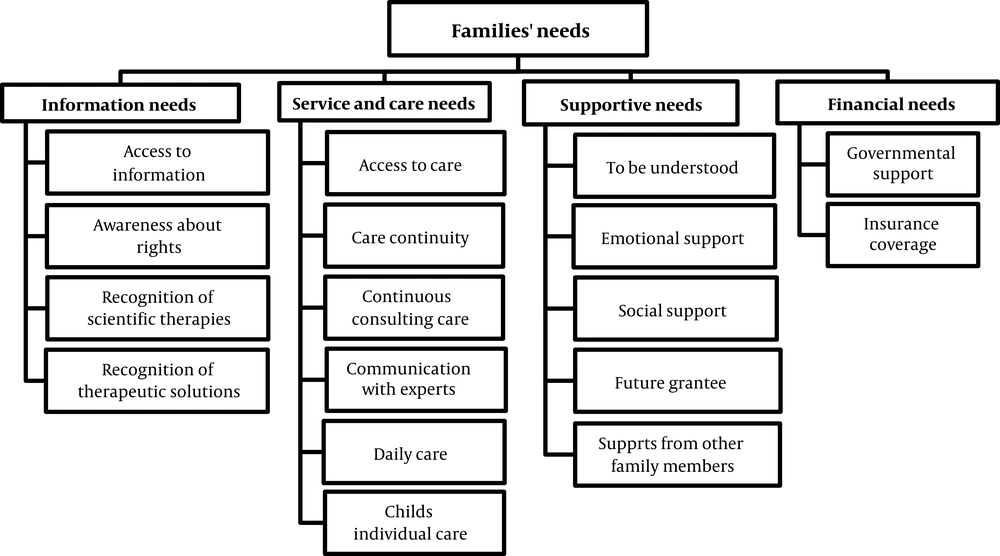
Figure 2.
Families' needs from the perspective of parents of ASD children
4.3.1. Main Theme 1: Information Needs
4.3.1.1. Sub-Theme 1: Access to Information Resources
Parents need information and knowledge to recognize the signs and symptoms of ASD and understand the needs of children with this disorder, as well as information to deal with various situations in the care of an autistic child. Also, effective and efficient care requires knowledge and awareness that must be obtained from reliable and scientific sources. "At first, when my son was diagnosed with ASD, I was so confused that I did not know how to get information about autism at all, and most of the search results on the Internet were useless or inadequate, or in other languages that I couldn't understand", said one of the parents.
4.3.1.2. Sub-Theme 2: Awareness About the Individual and Social Rights of a Person with ASD
Awareness of rights is the main requirement for pursuing and achieving it. In this regard, one of the parents said: "We don't even know what rights our children with autism have to claim it, and we don't even know where we should get to know these rights or pursue them".
4.3.1.3. Sub-Theme 3: Recognition of Scientific and Non-Scientific Therapies
Traditional medicine and complementary medicine are conventional in Iran. Many beliefs are often associated with superstition. Thus, when the desired results of scientific medicine are not achieved in a short time, people usually follow non-scientific treatment paths, which comes at a high cost and often has no results. A mother said: "At the beginning of my four-year-old son's diagnosis, I went to rehabilitation centers for several months, including speech therapy and occupational therapy, and because I didn't know autism well, I expected him to heal during that time, and because my expectations weren't met, I stopped following the treatment and took it to traditional healers for about a year, and they tried to open the tongue of my son by feeding the decoction of plants, etc. But his condition did not improve. And when I got back to the rehabilitation center, experts told me that you ruined one year of the best possible time for training"
4.3.1.4. Sub-Theme 4: Recognizing Different Therapeutic Methods
Parents need to know different treatments and the advantages and disadvantages of each of them, so they can choose a treatment solution based on their condition and participate in the treatment process for better results. "We are completely unaware of the interventions and treatments that are taking place in the clinic for our children, and we are not involved in the treatment process. This process is often done behind closed doors, and we wait in a waiting room until it is over", one participant said.
4.3.2. Main Theme 2: Service and Care Needs
4.3.2.1. Sub-Theme 1: Recognizing Resources and Access to Service and Care
Because ASD is not a well-known disease in the community, it is difficult for parents of children with ASD to identify the sources of services and where to reach them at the beginning of the diagnosis. Moreover, they do not know what governmental and non-governmental supportive services and resources they can utilize. One of the parents said: "Most parents and I, at first, did not know the available services, how to access them, and related support."
4.3.2.2. Sub-Theme 2: Continuity of Care
The continuity of service is necessary to achieve therapeutic goals. However, according to participants, most services are provided in the early years after diagnosis, and the service does not last until older ages and throughout life. These conditions jeopardize the future of children with autism, as one participant put it: "I often get frustrated when I look at my son's future and what happens to him after we die."
4.3.2.3. Sub-Theme 3: Continuous Consulting Services
Families of children with ASD are always preoccupied with anger, stress, and other intense emotions. Accordingly, one of their essential needs is constant guidance and counseling to control these emotions and cope with them. Parents, especially mothers, say that they often need to talk to a counselor to control their emotions, especially stress and frustration, while counseling services for these families are very limited. One participant stated: "The families of children with autism are under much stress, but unfortunately, our need for counseling services to deal with these psychological pressures has been ignored".
4.3.2.4. Sub-Theme 4: Communications with Experts
Families need to have constant contact with professionals in various fields, including family counseling, psychiatry, psychology, speech therapy, and occupational therapy. This is while they cannot afford all of these services or visit the professionals in person, so they need help in this regard. The use of communication and remote technologies allows for continuous communication and observance of the needs of families and children with ASD. "During the day, we encounter various situations that change over time, so, we need to consult with specialists frequently", one of the parents said.
4.3.2.5. Sub-Theme 5: Daily Care
Many participants stated that they need to have a daycare center for these children so that parents can do other daily tasks. One of the parents stated: "Currently, there are very few well-equipped care centers where parents can safely leave their children, and be sure that their children will be well cared for. Parents can do other tasks related to home and the family or attend a ceremony".
4.3.2.6. Sub-Theme 6: Childs 'Care
One of the needs of parents is to properly understand the child's needs according to the child's specific circumstances and design and plan treatment measures to solve each child individually. Some of the activities done in the form of teamwork for families usually raise some issues that are not a common concern of all families, so each treatment plan and support should be designed and implemented specifically for a family or a child to work. "Children with different conditions need different services", one participant said.
4.3.3. Main Theme 3: Supportive Needs
4.3.3.1. Sub-Theme 1: Need to Be Understood
The families of children with ASD are not well understood by others, which causes them to become isolated. "When a child misbehaves in a public place, children think that it is because of the lack of attention from the child's family", said one parent. Usually, most families with ASD children pay close attention to their child's behaviors and development, but he/she naturally exhibits abnormalities.
4.3.3.2. Sub-Theme 2: Emotional Support
Parents of children with ASD always need emotional support from others, especially friends and family, because of the emotional and physical exhaustion imposed on them by the difficulty of caring for an autistic child. One participant stated: "We expect friends and relatives to give us motivation and hope and to understand us, and if they can, they sometimes take care of the child for a short time instead of autistic parents to understand their situation".
4.3.3.3. Sub-Theme 3: Social Support
Families need social support from authorities and policymakers, as well as healthcare institutions such as universities and schools. These families complained about the lack of individual attention paid to them by these institutions. Moreover, they expect that these institutions pay more attention to them and do some practical measures to improve their situation. One of the participants stated in this regard: "The family of children with autism experiences complex and difficult situations. Therefore, social support is needed from civil society organizations, as well as government agencies".
4.3.3.4. Sub-Theme 4: Future Grantee (Marriage, Job)
One of the main concerns of parents is about the future of their children. Providing jobs and skill training for these children to have a good job and even get married was a significant concern for families. One of the mothers said with regret: "The future of my daughter worries me. What she will do without me? Whether she will succeed in marriage?"
4.3.3.5. Sub-Theme 5: Support from Other Family Members
In families with several children, that one of them has ASD, most of their energy and family income is usually spent on the disabled child. In some cases, other children are deprived of individual facilities or parental attention. So, supportive organizations should pay attention to other children in the family and children with ASD. Moreover, they provide them with some support and facilities. "Sometimes most of the family's attention and resources are spent on the child with ASD, which causes other children in the family to drop out of school", one parent stated.
4.3.4. Main Theme 4: Financial Needs
One of the urgent needs of families is financial need. The financial needs can be addressed in two sub-themes: The need for governmental support and the need for insurance coverage. In this study, most families emphasized the cost of care and treatment services, high medical tariffs, weak insurance coverage, and insignificant support received from support organizations. One participant said: "The costs of caring for a child with ASD are very high. Occupational and speech therapy is not covered by any insurance, and we even have troubles in getting there". Furthermore, another participant stated: "My daughter's special circumstances and the lack of necessary arrangements in public transportation require me to use a taxi to get around, which increases my expenses".
5. Discussion
According to the results, the needs of the families of children with autism are categorized into nine themes and 11 sub-themes from the perspective of specialists and four themes and 17 sub-themes from the perspective of the parents. Exploring the families' needs from the perspective of professionals and parents showed that whereas the professionals are more interested in discussing technical and caring needs, the parents focus mainly on daily life, emotional needs, and psychological needs. Although the perception of the parents' needs from the perspectives of both groups was somewhat similar, there were differences in many ways. The needs expressed by specialists were focused on improving the condition of the child with autism, while the needs expressed by the parents were a little broader and included all aspects of family life, including the needs of other family members and emotional and social needs of the parents. Experts did not pay much attention to social and emotional aspects.
The results showed that the identified needs mainly were focused on information, performance, skills, and attitude. These four dimensions of needs and their subcategories appear to be more common among all the families, and the rest of the dimensions may not be needed by all the families with autistic children. Unlike this study, in Khanzadeh et al. research to identify parents' needs, most critical parental needs included their awareness of the cognitive and communication abilities and personal needs of the child (18). Participants have repeatedly been aware of the dimension of knowledge, and given their generality, the families of children with autism have poor knowledge of autism, and thus, the information should be provided for them. The study of Anwar et al. also highlighted the lack of knowledge about the signs, symptoms, and nature of autism in the Pakistani population (19). The skill needs are also one of the families' essential needs, as mentioned in a previous study (20). The specialists emphasized the importance of attitudes in these families. Other needs of the families, such as social role, education, mental health, ability to manage other family problems, and ability to deal with specific child problems, are also of medium to small importance. Among the needs of the families is the financial dimension that was highly regarded by experts and parents; however, the country's specific economic status appears to have fueled this thinking.
In the second part of the study, which discusses the needs of the family from the parents' perspectives, three significant needs included financial, support, and service and care needs. The results of this study are consistent with Ahmadi et al. 's study (10). According to studies in the Middle East, 70% of employee's income is spent on the care of an autistic child (21). Moreover, this has had a much more profound effect on these families' financial position because of the decline in income and the value of the currency. On the other hand, inadequate insurance coverage for the services available for children with autism and the lack of adequate support from relevant institutions can increase the pressures on these families (22). In this situation, insurance companies, the government, and NGOs need to reach out to professionals and families and offer their support for a better and further empowerment process. As can be seen, most of the needs are related to infrastructures, such as cultural, facility, financial, and managerial issues.
5.1. Conclusion
There were many similarities in the needs expressed by experts and parents, despite some exciting differences. It is possible to combine these needs into two groups: Needs related to the family and its members and needs related to circumstances outside the family. Those needs related to family members, such as knowledge, awareness, skills, and mental health, can be met with their participation. However, other needs, including financial and supportive needs in various dimensions mentioned, require broader policy, planning, and implementation measures to be met.
Accordingly, policymakers and authorities of educational, service and welfare organizations should identify the needs of the families of autistic children, consider the stakeholders and players in this field, and provide the ground for the provision of the proper service to ASD patients and their families with the right policy, wise legislation, and comprehensive advocacy. Furthermore, information and media institutions have a great responsibility in creating the public culture and informing society.
Certainly, ASD is a prevalent disorder, and autistic children are people with particular features who need to be understood, served, and supported to grow and develop.
5.2. Study Limitations
One of the limitations of this study was the absence of autism specialists and families of children with autism from the whole country. Since the sample of this study was limited to the city of Tabriz (Northwest Iran), the needs of these families may be different according to the cultural and ethnic context of their society. Also, since this study was conducted in Iran, which has its own cultural, social, and economic context, the results may not be generalizable to families of children with autism in other countries.


