1. Background
Grief, mourning, and bereavement refer to the psychological reactions of the survivors to the loss of someone important to them. Depending on the cultural norms and expectations and given the loss conditions (i.e., unexpected vs. expected one), mourning would covers a wide range of emotions. Traditionally writing, mourning lasts about six months to a year, and some of the mourning symptoms may even resist one to two years. In this regard, the survivors are affected by the mourning-related emotions, symptoms, and behaviors lifelong; however, natural mourning ultimately gets settled, and they would return to their daily life and reach a feeling of relative comfort. Generally, the acute symptoms of mourning gradually disappear, and during one or two months, the mourner gets back to his/her daily life. This is while the process of grief and mourning is abnormal in some individuals (1).
Although mourning is considered a natural phenomenon in different communities, individuals' reactions to this phenomenon and mourning-induced consequences vary in different societies (2). The level and scope of the psychological problems following the mourning phenomenon depend on several factors, including culture, the mourner's personality traits, sudden death of the family members or friends, and many other factors, which may play a role in prolonging and increasing the mourner’s mourning and grief depth (3). Although most individuals naturally go through mourning, some exhibit psychological problems such as anxiety and depression in reaction to mourning and bereavement (4).
On the other hand, mourning and expressing grief are strongly interrelated with cultural rituals. According to the cross-cultural findings, mourning reactions to the death of a child or parents depend on the socio-cultural differences in the East and the West (5, 6). For example, a study suggested that, unlike the US, the expression of feelings in mourning for a dead child does not occur like that for parents in Korea and Taiwan. Evidently, there are some differences in grief and mourning reactions to the death of immediate family members in our culture (6).
The cause of death has consistently been reported as a factor affecting the mourning reaction, and there is some evidence indicating that an unexpected and sudden death results in more severe reactions in the survivors (7, 8).
COVID-19 has spread worldwide and claimed many lives. According to the statistics issued on August 4, 2020, by Iran’s Ministry of Health and Education, 2751 new patients have been detected in Iran, of whom 1560 persons have been hospitalized. Taking these cases into account, the total number of patients in Iran has reached 314786 persons. The daily death toll has been announced as 212 cases. The total number of deaths from COVID-19 has reached 17617 persons (9). The outbreak of Coronavirus in Iran has exposed many families to the unexpected death of their beloved ones and made them bereaved and grief-stricken for the loss of their family members. However, given the existing conditions, several restrictions have been imposed on the processes of the funeral procession, funeral ablution, burial, mass mourning, and the memorial gathering of the family, relatives, friends, and neighbors, and this condition has even made the mourning process more complicated.
Some consequences of unexpressed grief are as follows: constant grief, self-blame, conscience-stricken feeling, long-term depression, wish for death to join the beloved dead person, sometimes getting cross with the dead person and other individuals, avoiding to recall the dead person’s memories or vice versa, excessive preoccupation with the dead, feeling guilty about not being mournful, not being able to return to daily life, staying in grief, communication problems, feeling lonely, and reluctant to accept new responsibilities in life (10).
2. Objectives
Regarding the lack of a study on the mourning experiences of the family of the dead affected with COVID-19, this study aimed to deal with the mourning experiences of the families with COVID-19 dead victims.
3. Methods
This research was a qualitative content analysis. In this study, the qualitative content analysis was adopted to detect and delve into the mourning experiences of the families with COVID-19 dead victims. The qualitative research approach aimed to detect and examine individuals’ inner world, and since individuals’ experiences construct the structure of the truth for each person, the researcher can merely discover the meaning behind a phenomenon from their perspective by delving into the individuals’ world of experiences (10). The study community consisted of the families of the dead infected with COVID-19 in Sari in 2020.
Regarding the research objective, the participants were selected from the families of the dead infected with COVID-19 in Bu Ali Sina Medical Teaching Hospital in Sari (n = 16). Inclusion criteria were an immediate family member (namely parents, children, sister, and brother) of the dead person passed away within the last week. Exclusion criteria were the existence of any debilitating factors in expressing mourning experiences (e.g., inability to speak).
After obtaining permission from the Ethics Committee affiliated to Mazandaran University of Medical Sciences (code: IR.MAZUM.REC.1399.279), the researcher referred to the Bu Ali Sina Medical Teaching Hospital in Sari. The researchers spared efforts to observe the highest variety in selecting the participants. The data was collected by the researchers using an in-depth interview with the participants in a convenient and quiet room in the medical center. The interviews were performed with regard to the research objectives and the inclusion criteria and after obtaining the oral consent and ensuring the participants of information confidentiality. The face-to-face interviews were performed using open-ended questions and recorded as the participants agreed. The questions were as follows: (1) what comes across to your mind when you hear Coronavirus; (2) would you please describe your experiences of the dead person’s death moment; (3) could you please tell us about your experiences of mourning, the memorial ceremony, and rituals; moreover, (4) would you please count barriers to mourning? During the interview, the focus was on the points leading the participants towards their mourning experiences. When information about a particular case was concerned, more specific questions were asked. Finally, the participants were asked to explain how they and their family had mourning if they wished. The next follow-up and exploratory questions were posed based on the participants’ statements to clarify the concept and deepen the interview process. The sampling procedure lasted as long as data saturation was reached, and no new data was further extracted. The researcher was to be an active listener a much as possible. The interview lasted from 20 - 40 minutes, depending on the participant’s status. To analyze the data, some notes were made immediately after each interview (the notes included what the interviewer perceived of the most critical ideas proposed in the interview). Then the interviews were transcribed verbatim, and their content was double checked. To analyze the interview content, Graneheim and Lundman’s qualitative approach was employed (11) as follows: (1) the researcher transcribed the interviews and studied them several times to understand them thoroughly; (2) all interviews were taken as an analysis unit and referred to the notes to be analyzed and encoded; (3) the paragraphs, sentences, and words were considered as semantic units conceptualized as a collection of words and sentences interconnected in terms of content; (4) according to their hidden concept, the semantic units then reached the abstraction and conceptualization level and were titled by the codes; (5) the codes were compared in terms of their similarities and differences and classified as more abstract categories using a specific label; (6) finally, after comparing the categories and delving into the detected categories, the inner data hidden content was introduced as the study themes.
To ensure the research robustness and accuracy, Guba and Lincoln's criteria were applied (12). The researcher was to raise the research credibility by providing long-term involvement and sufficient cooperation and interaction with the participants, collecting reliable data, and reconfirming the collected data by the participants.
The dependability of data was improved by stepwise replication as well as inquiry audit by the supervising and advising professors and other experts. To increase the confirm ability of the data, the faculty members confirmed the data, and their complimentary comments were employed. The data transferability was also accepted by providing a detailed description of the study report to evaluate and apply the research on other grounds so that other researchers would get the opportunity to understand the families of the dead infected with COVID-19 in terms of mourning and come up with similar findings. In this regard, the participants’ quotations are presented as expressed. To observe the ethical consideration and protect the participants’ rights, after obtaining the letter of introduction from the Vice Chancellor of Research and Technology at Mazandaran University of Medical Sciences, the researcher introduced herself to the participants and explained the research objectives and procedures. The researcher also ensured the participants of the confidentiality of their information. At the beginning of the study, the participants' demographic information was recorded, and the transcripts were also deleted following the data analysis and paper publication phases. The participants were also allowed to leave the study at any stage they wished.
4. Results
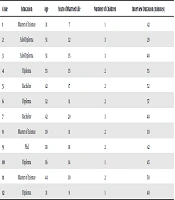
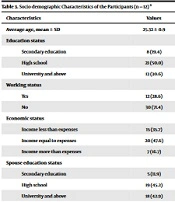
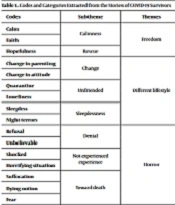
The study participants encompassed 16 family members having a dead family member infected with COVID-19 at the Bu Ali Sina Medical Teaching Center in Sari, of whom 62.5% were female. The participants’ age ranged from 18 to 55 years, with the mean age of 31.37 ± 1.14 years (Table 1). In this study, 520 initial codes were extracted from the participants' rich and deep descriptions. After several reviews, the codes were summarized and categorized by their similarity and appropriateness. Further analyses and comparisons of the statements resulted in four main categories and 12 subcategories, which were titled as conceptual and abstract regarding their nature (Table 2).
Table 1.Participants’ Demographic Information
| Variables | No. (%) |
|---|---|
| Age (y) | |
| Below 20 | 3 (18.75) |
| 20 - 30 | 6 (37.5) |
| 31 - 40 | 3 (18.75) |
| 41 - 50 | 3 (18.75) |
| 51 - 60 | 3 (18.75) |
| 51 - 60 | 1 (6.25) |
| Gender | |
| Male | 6 (37.5) |
| Female | 10 (62.5) |
| Relation with the dead person | |
| Mother | 1(6.25) |
| Sister | 2 (12.5) |
| Brother | 1 (6.25) |
| Daughter | 8 (50) |
| Son | 4 (25) |
Table 2.Themes, Categories, and Codes Extracted From Participants’ Experiences
| Main Themes/Categories | Codes |
|---|---|
| Response to mourning | |
| Psychological responses | Shocked; not being understood; feelings of loneliness; isolation; woefulness feebleness; resentfulness; sore days; angriness; nervousness |
| Behavioral responses | Weeping; sobbing; shedding tear; being reluctant; not being joyful; not listening to music |
| Physical responses | Hypertension; headache; migraine recurrence; nausea |
| Virtual mourning | |
| Innocent death with secluded burial procession | To die innocently; performing burial alone and in isolation; secluded burial |
| Virtual mourning ceremony | Qur’an recitation to commemorate the dead on the whatsapp; qur’an recitation to commemorate the dead on telegram; asking for first-night burial praying via whatsapp |
| Virtual consolation | Friends and relatives’ condolences via phone call; friends and relatives’ condolences via whatsapp; friends and relatives’ condolences via telegram; preparing clips of dead person’s photos |
| Regretful mourning | |
| Regret at not hugging the survivors | Regret at not cuddling children; regret at not hugging the beloved ones |
| Regret at not cuddling the dead | Regret at not seeing mom’s face; regret at not cuddling the dead |
| Regret at not holding a deserving memorial ceremony for the dead | Regret at not holding a mourning ceremony; wishing for a noble mourning ceremony |
| Feelings of rejection mixed with fear | |
| Rejected by the relatives because of their fear | Friends and relatives’ getting away from the family; friends and relatives’ being afraid of survivors; individuals’ turning away from survivors; |
| Rejected for the dread of rumors | Rumors about burial ablution and shrouding the dead body; rumors about burial method; eschewing others because of the existing rumors; avoiding others to avoid disease transmission; others’ withdrawal from survivors due to their fear of the disease |
4.1. Responses to Mourning
During the Coronavirus pandemic, those who lost their beloved members did not spend a normal period, and they could not even look at the dead’s face for the last time. In this regard, saying goodbye to the dead makes this event more believable.
4.1.1. Participant 2 (Male, 20 Years of Age, Son)
“Since we weren’t with him at the last moments…., I still can’t believe I lost my father, it happened too rapidly.”
However, during these days, under the lockdown conditions and social distancing, none of the conventional mourning rituals can be performed, and individuals inevitably go through this tough time, being isolated and not receiving the support of their friends and relatives. The dead’s relatives are left alone with a heavy burden of grief and suffering.
4.1.2. Participant 8 (Female, 46 Years of Age, Daughter)
“We stayed home alone, and no one came to visit us to condole with us for our father’s loss. My sister and I caressed our mom and wept.”
4.1.3. Participant 11 (Male, 46 Years of Age, Brother)
“Being overwhelmed and weeping, we didn’t know how to hold our brother’s burial ceremony.”
In the last days of the last year, the pandemic left the bereaved families with a highly heartbreaking story. Instead of recording pleasant memories of the new year and visiting friends and relatives, these families were kept obsessed with the memories and the framed photos of their beloved ones who died of Coronavirus.
4.1.4. Participant 14 (Female, 55 Years of Age, Sister)
“With the arrival of the new year, I hugged my sister’s photo while I was crying. I remembered last year when we were together.”
The survivors exhibited some behavioral reactions such as avoiding the places reminiscent of the dead one, abstaining from the lost one’s favorite tasks, shrinking away from joyful situations, eschewing parties, and persistent crying.
4.1.5. Participant 6 (Female, 29 Years of Age, Daughter)
“I don’t like to go to my mom’s house …when I see her picture on the wall, I get upset.”
Some of the physical changes expressed by some of the survivors were headache, nausea, diabetes, and hypertension.
4.1.6. Participant 4 (Female, 23 Years of Age, Daughter)
“After the ceremony, my sister came up with migraine headaches, so that we took her to the hospital….”
4.2. Virtual Mourning
The survivors and the grieved families of the dead infected with COVID-19 had been deprived of close physical contact with their dear patient and failed to accompany him/her while he/she was feeling sick and on the verge of death. Even the burial was performed with the minimum number of individuals observing social distancing.
4.2.1. Participant 15 (Female, 19 Years of Age, Mother)
“My son passed away in solitude and innocently, and the burial was performed while only two or three persons were there.”
Conventionally, when a family loses a beloved member, many friends and relatives take part in their burial and mourning ceremony. Moreover, the family members are not left alone for some days or weeks, so that the survivors have little chance to be obsessed with the dead for a moment. However, with imposing bans on individuals' gathering and the arousal of the feelings of fear, no burial and mourning ceremony is held in mosques and houses, and all consolatory and soothing deeds are performed in distant and via phone calls or messages. The dead person’s family members return home after the burial and stay locking down in isolation under despairing conditions.
4.2.2. Participant 10 (Female, 35 Years of Age, Daughter)
“My aunt condoled with my mom via the phone call, and we cried a lot.”
4.2.3. Participant 1 (Female, 18 Years of Age, Daughter)
“Some of our relatives contacted us on the phone and talked ….so we cried and felt relieved.”
4.2.4. Participant 9 (Female, 23 Years of Age, Daughter)
“My brother set up a Telegram channel, on which we requested for the prayers for the buried one and started the Qur’an recitation to commemorate the dead ones.”
4.3. Regretful Mourning
The bereaved families cannot bury their beloved person conveniently, and they cannot see his/her face to bid farewell. Moreover, the survivors are deprived of putting their heads on their beloved ones’ shoulders or hugging them, and there is no comforting and soothing hand to be stretched to wipe their tears. They also lose the chance of holding a ceremony for the dead.
4.3.1. Participant11 (Male, 35 Years of Age, Son)
“Regarding the likelihood of the virus being present everywhere ……. I really longed for hugging my brother and …."
4.3.2. Participant 13 (Male, 21 Years of Age, Son)
“Feeling rueful about hugging and kissing my father would never ever be wiped away from my mind.”
4.3.3. Participant 9 (Male, 53 Years of Age, Son)
“My father was the authority figure of the clan, and the regret for holding a befitting ceremony would remain as a wish in our heart forever.”
4.4. Feelings of Rejection Mixed With Fear
Such families keep away from others because of being afraid of ‘social stigma’ and ‘getting affected or infecting others.’
4.4.1. Participant 9 (Male, 53 Years of Age, Son)
“The next door fellows disinfected the gate, stairways, and elevators as if we were the Coronavirus spreaders.”
Unfortunately, many rumors have been spread in cyberspace and among the public, leading to the dismay and rejection of the families with a dead infected with COVID-19. Some rumors are as follows: Sprinkling lime on the dead body, not submitting the dead to his/her family, and burying the dead with no burial ablution or shroud. Such rumors about the Coronavirus have aroused panic in many individuals these days.
4.4.2. Participant 12 (Female, 46 Years of Age, Daughter)
“My sister didn’t attend our mom’s burial ceremony since she had heard that the dead with COVID-19 was not given ablution and was not shrouded. She was afraid of being infected with the virus.”
5. Discussion
The present study was the first qualitative investigation of the mourning experiences of the families having dead members infected with COVID-19. Analyzing the collected data and delving into the mourning experiences of such families resulted in the extraction of the following four main categories “psychological, behavioral, and physical reactions, virtual mourning, regretful mourning, and feeling of rejection mixed with fear."
5.1. Response to Mourning
Death is of the realities experienced by each human being and can easily involves individual’s emotions (13). In this study, a majority of the participants were entangled in states of shock and disbelief, loneliness and despair, and loss and irritation. Scott also referred to the restrictions on mourning and the funeral procession and rituals, safe corpse management, and burial processes change during the pandemic. In this case, individuals are deprived of the most essential post-death rituals. In such rituals during the Coronavirus crisis, families and friends cannot contact their beloved ones and express their love, support, and sympathy. On the other hand, they are left alone to cope with their excessive grief, sorrow, and emotional exhaustion. In this case, deep grief and sorrow would remain throughout society (14). Compared with natural or predictable death resulting from chronic diseases, the family members experience more severe mourning and further psychological health problems with their beloved one’s sudden death (8). A few participants talked about the physical changes, which might be inappreciable due to the dominant emotional changes at the onset of the mourning process. The symptoms of such physical changes, however, gradually emerge (15).
5.2. Virtual Mourning
Millions of individuals worldwide have experienced losing a beloved one because of COVID-19. Concerning the restricting rules on communicating and staying at home, most individuals could not get the chance to say goodbye to their beloved ones and hold an appropriate burial or mourning ceremony. Consequently, millions of individuals have gone through a regular cycle of sorrow and suffering. The dread, quarantine rules, and social distancing have changed the quality of some dimensions of human relations. For several months, unlike always, people have expressed their love to their elderly by staying away from them (16). In the present study, the participants had employed virtual mourning due to fear of disease transmission and observing the lockdown. Accordingly, the researchers also recommend holding a virtual ceremony to honor the dead with coronavirus instead of traditional rites. The cyberspace-based mourning experience and sharing voices, texts, photos, and clips are practical as this form of mourning goes beyond the geographical borders (17, 18).
5.3. Regretful Mourning
Regarding the feelings of fear from the Coronavirus transmission and observing social distancing, the survivors have regrets at not hugging the dead person, not cuddling the survivors, and not holding a deserving ceremony for the dead.
A bereaved person naturally gets shocked when receiving the beloved individual's death news, and such an emotion then turns into disbelief and emotional apathy. The stage of encountering the dead one's death news is more challenging than other stages for the bereaved individuals. However, the woe of not rejoining the dead member makes the mourner be closer to this reality that his/her beloved one is lost forever. After passing hundreds or maybe thousands of such dolorous moments, the bereaved family members and other friends and relatives assume that they have to give up the memorable relations they used to have with the dead person (19). Long-term mourning encompasses severe grief and woe, feeling guilty, longing and deep feeling of missing the dead person, mental obsession with the lost and death-related events, avoidance to remember the loss, bed-temperedness, and difficulty in trusting or caring for others (20). Such symptoms have to last longer than the period we expect the mourn to get over (21). There has been no qualitative research on the mournful families’ remorse during the Coronavirus pandemic to compare the present findings.
In this study, the participants stated being left with their regret at not cuddling their beloved ones. During the pandemic, the feelings of grief and sorrow are accompanied by physical isolation. The woeful individuals have no physical contact with their friends and relatives and are deprived of touching them (22). In this case, supporting somebody in woe, expressing condolence, and sympathizing occur via other media such as phone calls, messages, or social media (23).
5.4. Feeling of Rejection Mixed With Fear
In the present study, the participants felt being rejected due to the likelihood of infecting others and the dread of rumors. It indicates a negative stigma or label individuals attribute to a group or individuals who are different from them in some aspects (24). The study findings are consistent with those proposed by Sotgiu and Dobler (25). In Ren et al.’s study, the arousal of fear and stigma was noticed in China during the Coronavirus pandemic (26). Another study revealed unfair treatment towards the population of Wuhan at a national level. Similarly, the same event was observed to the Chinses at an international level (27). Lockdown-induced anxiety, unknown issues about COVID-19, and fear of getting infected are factors promoting stigma in the local communities (25). When there is no obvious reason behind the pandemic, the closed-mindedness results in rumors (27). In the present study, the participants experienced the fear of rumors.
The study limitations were obtaining the participants' agreement to participate in the research and controlling interview conditions to sympathize with the participants.
5.5. Conclusion
According to the research results, COVID-19 changed the personal and social lives of the families with dead infected with Coronavirus from different perspectives. In this regard, providing support to families during the mourning period would help them better adjust with such changes causing the loss of a family member.