


1. Background
The concept of social appearance anxiety (SAA) is a branch of social anxiety referring to worrying about the negative evaluation of appearance and the fear of rejection by others due to appearance (1). Individuals with a high score on the social appearance anxiety scale (SAAS) are constantly concerned about the negative evaluation of others, and the reason for this negative evaluation is their appearance (1, 2). Studies have linked SAA to social anxiety, eating disorders, and fear of negative evaluation (3, 4). Individuals who get a high score on the SAAS are more likely to be anxious about the negative evaluation or rejection of others and more likely to avoid situations where their bodies are being evaluated by others, and more experience social isolation. Studies showed that SAA is associated with avoiding social relationships, feelings of loneliness, and media addiction (due to less visible appearance) (5, 6).
Numerous scales have been developed to assess different aspects of social anxiety, such as the Brief Fear of Negative Evaluation questionnaire (7), the Social Phobia Scale, the Social Interaction Anxiety Scale (8), and the Social Physique Anxiety Scale (9). However, each of these scales emphasizes more specific aspects of appearance; therefore, it was necessary to design a questionnaire that can consider more general aspects of appearance. The SAAS is a 16-item self-reported scale developed by Hart et al. (1) to evaluate the worries about the general aspects of appearance in a social context, rather than particular features of appearance (eg, one’s nose or eyebrow) (10).
Numerous studies (2, 5, 10, 11) have studied the psychometric properties of the SAAS, and the results indicated good internal consistency and appropriate convergent-divergent validity. On the other side, exploratory factor analysis (EFA) and confirmatory factor analysis (CFA) have shown the single-factor model of the SAAS. Therefore, it can be concluded that the SAAS is a reliable tool for measuring the general aspects of appearance anxiety in a social context.
2. Objectives
Given that SAA can affect the etiology of several disorders, such as eating disorders and body dysmorphic disorder, and due to the prevalence of body dysmorphic in Iran, the high correlation of SAA with psychological disorders, and the lack of appropriate tools for measuring SAA in Iran, the present study aimed to investigate the validity, reliability, and factor structure of the SAAS in Iranian populations.
3. Methods
This cross-sectional study was carried out on 415 university students studying in Tehran, Iran, using convenience sampling. After checking inclusion criteria, the research plan was first introduced to the participants, and if they were satisfied and willing to cooperate, they were provided with pre-prepared questionnaires. In the process of answering, their questions and ambiguities were answered by the researcher. The researcher’s e-mail was also provided to the subjects to make a call if they had any questions or were willing to be informed of the results. After obtaining informed consent, the questionnaires were completed. The inclusion criteria were the age range of 18 - 35 years and inclination to participate in the study. The exclusion criteria were disinclination to take part in the study and incomplete questionnaires. The present scale was translated into Persian based on the minimum translation criteria. Accordingly, this scale was firstly translated from English to Persian by two masters of clinical psychology. After editing, a reverse translation was done from Persian to English by an English language expert. Then, the reverse translation was compared to the original scale by the two professors of clinical psychology, and no difference was observed in this regard. All the participants gave written informed consent and were informed of the study procedures. The ethical approval code was provided by Shahid Beheshti University of Medical Sciences, Tehran, Iran (ID: IR.SBMU.MSP.REC.1398.760).
3.1. Measures
3.1.1. Social Appearance Anxiety Scale
This scale consists of 16 items designed by Hart et al. (1) to assess the fear of being evaluated and judged by others. Participants can rate their answers on a Likert scale (from 1: not true for me to 5: absolutely true for me). The test-retest reliability of this scale after one month was 0.84 (7). Internal consistency had a good score of 0.94. In addition, the results of CFA showed that this is a one-factor questionnaire. The convergent validity results showed that this questionnaire is well correlated with similar tools, such as the negative assessment of appearance, social anxiety, and self-body questionnaires (1). The internal consistency of the SAAS in the present study was good (Cronbach’s alpha = 0.94), and the results of CFA and EFA confirmed that it is a single-factor scale.
3.1.2. Social Physique Anxiety Scale
This scale consists of 7 items based on the initial 12-item scale of Hart et al. (9). This scale measures the level of anxiety experienced by an individual about the shape of his/her body in a social situation. Participants rate their responses based on a 5-point Likert scale appropriate to their situation. The score of the participants on this scale is within the range of 7 - 35. The reliability of this scale was 0.94 (12) in Iran. Internal consistency values were 0.85 and 0.81 for female and male students, respectively (13).
Body Shape Questionnaire: This is a short version of the Body Shape Questionnaire with 8 items (14) measuring the severity of dissatisfaction with body shape. Participants choose their answers in the form of a 6-point Likert scale from never to forever. Veisy et al. reported Cronbach’s alpha of 0.79 (15). In Iranian populations, it has good internal consistency (split-half: 0.74) and concurrent acceptable validity (15).
3.1.3. Yale-Brown Obsessive-Compulsive Scale Modified for Body Dysmorphic Disorder
This is a 12-item self-report tool based on a 5-Likert scale that measures the severity of body dysmorphic symptoms (16) with two factors of obsession and compulsion. The correlation of this scale with similar questionnaires was within the range of 0.25 - 0.58. Cronbach’s alpha coefficient was reported as 0.93 (16).
3.2. Statistical Analysis
Statistical methods, including internal consistency, EFA, CFA, and convergent validity, were performed for the evaluation of the psychometric properties of this scale. SPSS software (version 24) and AMOS software (version 22) were used for the statistical calculations. In addition, Cronbach’s alpha was used to assess the reliability. Before the statistical analysis, the outliers were checked by z scores and box; a visual check showed that the data were normally distributed. All 417 samples were divided into two equal categories, and EFA and CFA were performed on different samples.
4. Results
The population in this study included 415 students of Tehran universities. Moreover, 69.2% of the participants in this study were female, and the average age was 24.69 years. According to Table 1, test 219, 132, and 64 participants had a bachelor’s degree (52.8%), a master’s degree (31.8%), and a doctorate or a professional doctorate (15.4%), respectively. The majority of the participants were single (83.4%).
Table 1. Demographic Characteristics a
| Total (n = 415) | Male (n = 128) | Female (n = 287) | |
|---|---|---|---|
| Age, Mean ± SD (y) | 24.69 ± 5.34) | 24.38 ± 0.45) | 24.83 ± 0.32 |
| Marital status | |||
| Single | 346 (83.4) | 119 (28.7) | 227 (54.7) |
| Married | 69 (16.6) | 9 (2.2) | 60 (14.5) |
| Education | |||
| Bachelor’s degree | 219 (52.8) | 74 (17.8) | 145 (34.9) |
| Master’s degree | 132 (31.8) | 37 (8.9) | 95 (22.9) |
| PhD | 64 (15.4) | 17 (4.1) | 47 (11.3) |
Abbreviation: SD, standard deviation.
aValues are expressed as No. (%) unless otherwise indicated.
Cronbach’s alpha was used to test the internal consistency of the SAAS. The SAAS had excellent internal consistency (Cronbach’s alpha = 0.95), and if any of the items are removed, the internal consistency decreases. The item-total correlation of the Iranian SAAS was within the range of 0.51 - 0.84. The Yale-Brown body dysmorphic, body shape, and social physical anxiety were used to assess the convergent validity of the present scale. As shown in Table 2, the aforementioned variables had a significant positive correlation. Table 2 shows the convergent validity correlation matrix.
The results of the Kaiser-Meyer-Olkin (KMO) test showed that the sample size of the present study was sufficient (KMO: 0.96). Furthermore, the results of Bartlett’s test of sphericity (χ2 of 5084.96 and a P-value of less than 0.000) indicated the possibility of factor analysis. The EFA was applied for extracting the subscales of the SAAS. The results of EFA indicated that the overall items of the scale are defined as one subscale, and a single factor explains 60% of the variance of the scale. As shown in Table 3, the factor load of the items is within the range of 0.61-0.87.
Table 3.Internal Consistency of Social Appearance Anxiety Scale and Factor Loadings
| Items | Scale Mean If Item Deleted | Scale Variance If Item Deleted | Corrected Item-Total Correlation | Squared Multiple Correlation | Cronbach’s Alpha If Item Deleted | Factor Loading |
|---|---|---|---|---|---|---|
| 1 | 31.48 | 194.41 | 0.58 | 0.37 | 0.954 | 0.62 |
| 2 | 31.80 | 190.45 | 0.58 | 0.42 | 0.955 | 0.61 |
| 3 | 32.18 | 190.80 | 0.61 | 0.46 | 0.954 | 0.65 |
| 4 | 32.06 | 184.97 | 0.76 | 0.62 | 0.951 | 0.79 |
| 5 | 32.42 | 189.51 | 0.71 | 0.54 | 0.952 | 0.75 |
| 6 | 32.18 | 183.67 | 0.80 | 0.74 | 0.950 | 0.84 |
| 7 | 32.33 | 184.00 | 0.81 | 0.75 | 0.950 | 0.85 |
| 8 | 32.49 | 186.13 | 0.78 | 0.69 | 0.951 | 0.81 |
| 9 | 32.44 | 186.25 | 0.74 | 0.67 | 0.951 | 0.78 |
| 10 | 32.21 | 187.75 | 0.76 | 0.61 | 0.951 | 0.79 |
| 11 | 32.16 | 187.40 | 0.75 | 0.60 | 0.951 | 0.78 |
| 12 | 32.45 | 187.93 | 0.74 | 0.64 | 0.951 | 0.77 |
| 13 | 32.29 | 184.53 | 0.84 | 0.79 | 0.949 | 0.87 |
| 14 | 31.67 | 184.18 | 0.74 | 0.61 | 0.951 | 0.78 |
| 15 | 32.29 | 185.52 | 0.68 | 0.50 | 0.953 | 0.72 |
| 16 | 32.26 | 183.24 | 0.83 | 0.74 | 0.950 | 0.86 |
According to the results of EFA and a review of previous studies, it was observed that to date, only one typical factor structure has been proposed for the present scale. In this study, the hypothesis (ie, the single factor of the scale) was examined using CFA. The results of CFA of structural equations, as observed in Table 4, showed that the introduced model has a good fit (Table 4 and Figure 1).
Table 4.Fit Indices of the Model
| Model | χ2 | df | χ2/df | CFI | GFI | RMSEA | P-Value |
|---|---|---|---|---|---|---|---|
| One factor | 308.05 | 103 | 3.08 | 0.959 | 0.959 | 0.071 | 0.001 |
Abbreviations: CFI, comparative fit index; GFI, goodness of fit index; RMSEA, root mean square error of approximation.
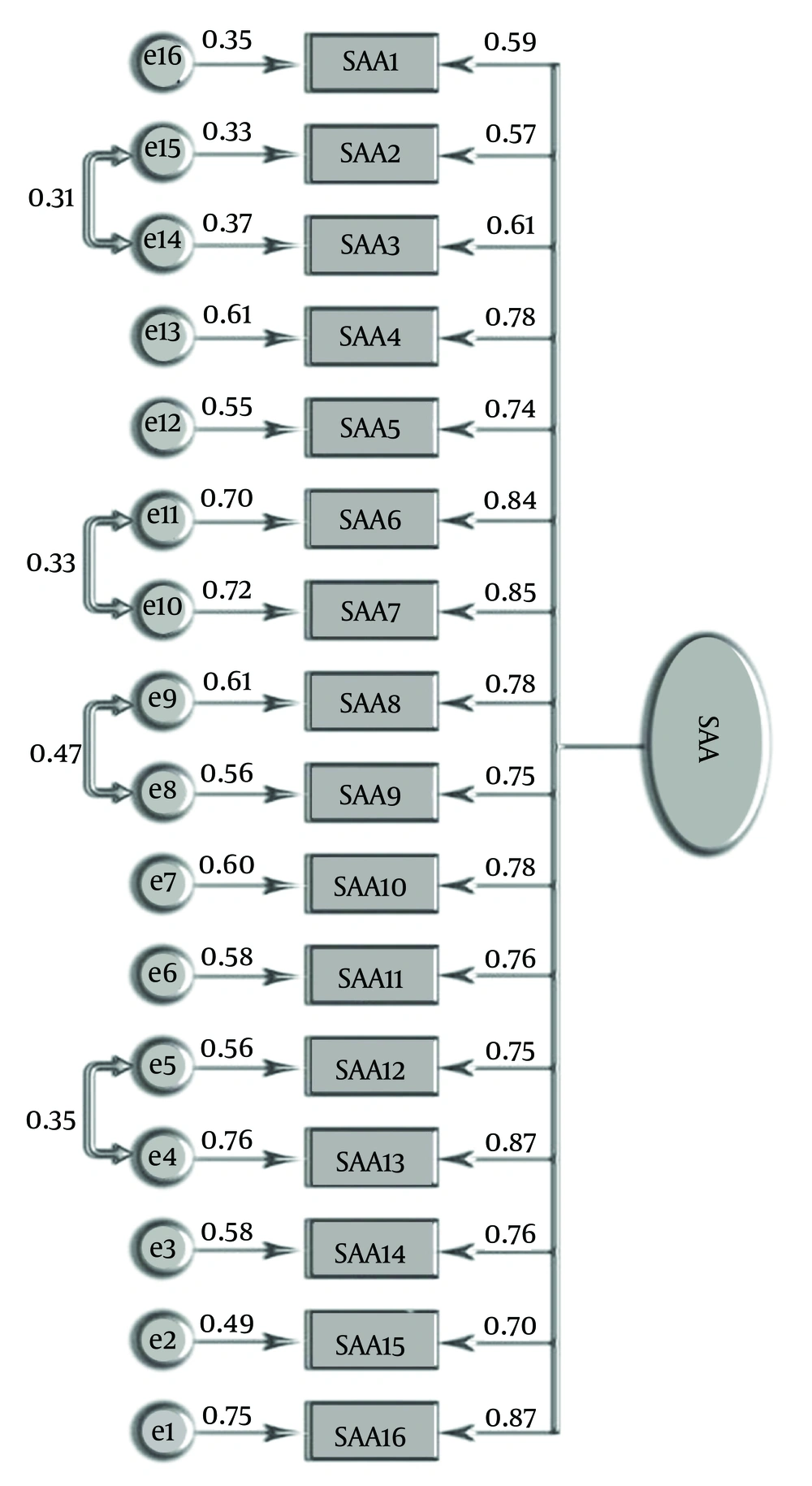
Figure 1.
Confirmatory factor analysis
5. Discussion
The current study aimed to evaluate the validity, reliability, and factor structure of the 16-item SAAS designed by Hart et al. (1). The results showed that the SAAS had good internal consistency (Cronbach’s alpha = 0.95), which in this respect is consistent with the results of Hart et al.’s study (1) (Cronbach’s alpha = 0.94) and Claes et al.’s study (17) on patients with eating disorders. Cronbach’s alpha coefficients obtained in the aforementioned studies were reported as 0.94 and 0.96, respectively (17).
The EFA and CFA were performed on the students. The results of EFA, as mentioned in previous studies (2, 5, 10, 11), showed that this scale has a one-factor structure with factor loading items within the range of 0.61-0.87. The single-factor structure explains 60.04% of the total variance of scale. The CFA model was made to determine whether the factor structure of the original form could be verified in a sample of Iranian university students. The results of CFA confirmed that the structure is one factor and showed that the assumed model in the scale has a good fit which is in line with the results of previous studies (18, 19).
Based on convergent validity in this study, the relationship between SAA and body dysmorphic disorder, body shape, and physical social anxiety were tested. The results showed that SAA had a significant positive correlation with the aforementioned variables. The SAA had a strong positive correlation with social, physical anxiety that is consistent with the results of previous studies (1, 20). In addition, SAA had a strong positive correlation with body dysmorphic that is consistent with the results of Hart et al.’s study (1). Moreover, SAA had a moderate positive correlation with a body shape that is in line with the results of Claes et al.’s study (17). Theoretically, it was expected that there would be a positive relationship between SAA and the above-mentioned questionnaires. These results showed that the scale has sufficient validity.
The present results are consistent with the results of a study by Mastro et al. in 2016 (21). Individuals who score high on the SAAS are more likely to have problems with their appearance. They might tolerate considerable anxiety in this regard and show compensatory behaviors, such as strict diets and avoidance of social situations, to reduce this pressure (4, 17). Therefore, this scale can be used to accurately assess anxiety in an individual, which might lead to eating problems and avoidant behaviors, and is distinct from the symptoms of eating disorders and social anxiety because it measures anxiety around the axis of the body.
There were some limitations in this study. First, the sample group was students, and because attitudes toward appearance and physical dissatisfaction are variables that affect cultural values, the results might have been influenced by cultural factors. Secondly, the present study used a self-report questionnaire, and some individuals might have refused to give an accurate answer. Based on the findings of the present study, it can be suggested that this questionnaire should be standardized in clinical populations in future studies.
5.1. Conclusions
In general, it can be said that this scale has appropriate psychometric properties in the student community of the Iranian population and can measure the anxiety of being evaluated and judged for the desirability of the body; therefore, this scale can be used in studies related to body dysmorphia, social anxiety, eating disorders, and interpersonal relationship problems. It is suggested that future studies should address the relationship between SAA and psychological trauma, explain its formation, and use the results to investigate and identify problems related to body dysmorphic. Both EFA and CFA results showed that the scale was parallel with its original form regarding construct validity. In terms of the values obtained as a result of the reliability investigations, it can be said that the scale has a very high level of reliability.
According to the results of the present study, the SAAS has acceptable psychometric properties and can be used in the future to identify more specific aspects of related disorders, such as social anxiety, body dysmorphia, and eating disorders. This study was conducted on a sample of university students. It would be appropriate to examine the psychometric properties of the SAAS in children, adolescents, and clinical populations in future studies. In addition, further studies can examine the relationship of the scale with valid and reliable scales measuring depression, anxiety disorders, body dysmorphic disorder, and body image in a clinical sample. Therefore, it might be suggested to investigate the association between SAA and other related variables, such as communication skills, self-esteem, anxiety disorders, and depression.


