
1. Background
The importance of psychological skills training in athletic performance development is widely recognized (1, 2). The central assumption underlying psychological skills training indicates the fundamental mental health of athletes, but it also indicates that they must learn cognitive skills and strategies to overcome different requirements of sports competition (3). For instance, to overcome competitive stress, facilitate attentional control, and boost self-confidence, one can use imagery, relaxation, and self-talk strategies. Furthermore, psychological skills are analogous to physical skills because they can be taught and learned to a specific degree (4). Thus, sports mental training is defined as the process through which athletes learn how to regulate and control their mental states and sports behaviors by adopting special methods (5).
Sports mental training includes 2 elements: Mental skills (e.g., self-awareness, self-confidence, optimal attention, and interpersonal skills) and mental techniques (e.g., goal setting, imagery, and education) employed to develop those skills (4). Mental skills training requires athletes to learn and implement traditional cognitive-behavioral methods to help sports participants develop mental skills to succeed in performance and attain personal well-being. The model of mental skills for athletes and coaches includes 4 basic types of mental skills in sports (6). Vealey distinguished foundation, performance, personal development, and team skills (6). As intrapersonal sources, foundational skills (achievement drive, self-awareness, productive thinking, and self-confidence) are the basic foundation of mental skills required to succeed in sports. Performance skills (perceptual-cognitive skill, attentional focus, and energy management) are mental abilities that are of importance to execute skills while performing sports. Personal development skills (identity achievement and interpersonal competence) represent important maturational markers of personal development and make a higher level of psychological functioning possible via self-concept clarity, feelings of well-being, and feeling closer to others (relatedness). Finally, team skills (leadership, communication, cohesion, and team confidence) are the team’s collective characteristics that are of paramount importance for a team to work effectively and successfully.
The Sport Mental Training Questionnaire (SMTQ) is the only tool that determines the difference between mental skills and mental techniques. In response to the challenge of contradictions between the concepts of mental skills and mental techniques, Behnke et al. (5) followed the theoretical framework proposed by Vealey (6) and developed SMTQ. Behnke et al. (5) were the first to design SMTQ. The first draft of SMTQ was a 66-item questionnaire that reflects both an overall score for mental training and scores for the 4 subscales, including foundational skills (intrapersonal sources essential to succeed in sports), performance skills (mental abilities that are of importance to execute certain physical skills while performing sports), personal development skills (important markers of maturation of personal development that make a higher level of psychological functioning possible via self-concept clarity, feeling healthy, and feeling closer to others [relatedness]), and psychological strategies (goal-setting, relaxation methods, mental imagery, self-talk, and performance routines).
After the initial psychometric analysis in study 1, the decreased item pool was provided for mental training in sports specialists to support the scale structure. Then, the scale structure was validated in 2 additional studies (5). Finally, a 20-item questionnaire with 5 subscales (foundational, performance, interpersonal skills, self-talk, and mental imagery) was obtained. SMTQ is a reliable and valid brief questionnaire that can be used to facilitate the psychological evaluation of mental skills and mental techniques among athletes (5). The psychometric properties of SMTQ have already been supported with 2 adaptations of SMTQ in Turkish and Lithuanian (7, 8).
To the best knowledge of the authors, no specific questionnaires have been designed in Iran to assess the mental preparation among athletes. Accordingly, the development of a tool designed to measure key mental training features to be used in a Persian context is of significant importance. We chose to adapt SMTQ due to its validity, reliability, and applicability in the sporting context. In addition, this would allow for further international and cross-cultural comparisons of the psychometric properties of SMTQ. Culture refers to a set of learned traditions and living styles shared by a society’s members. It includes the ways of thinking, feeling, and behaving (9). These interpretations, values, and behaviors should be integrated into testing, representing a culture-dependent activity and different cultural conditions and idiosyncrasies that may affect test scores (10).
2. Objectives
The aims of this study are to translate and adapt SMTQ into Persian based on a global standardized method and investigate the factor structure and psychometric properties of SMTQ. Furthermore, the literature suggests that mental training components are affected by certain athlete characteristics, including competitive level or gender (11). Thus, athletes with higher levels of competition were expected to show higher mental training levels than athletes with lower levels of competition.
3. Methods
3.1. Measurement Instruments
SMTQ is a self-report scale with 20 items, which was developed to evaluate sports mental training across 5 dimensions, including foundational skills (4 items: 3, 7, 10, and 14), performance skills (6 items: 1, 5, 8, 12, 16, and 19), interpersonal skills (4 items: 4, 11, 15, and 18), self-talk (3 items: 2, 6, and 13), and mental imagery (3 items: 9, 17, and 20). Participants responded to the items using a 5-point Likert scale (1 = strongly disagree, 5 = strongly agree). The mental skills score is obtained from the sum of the scores on foundational skills, performance skills, and interpersonal skills. The mental techniques’ score is obtained from the sum of the scores on self-talk and imagery.
3.2. Translation and Cultural Adaptation
SMTQ was translated into Persian by 2 bilingual researchers. Then, 2 bilingual investigators verified the translation. The forward and backward translation and cultural adaptation of the questionnaire were performed in accordance with a recommended methodology (12, 13). First of all, the English version of SMTQ (including the original items, instructions, and response options) was forward translated into Persian by 2 native Persian translators, who were also experts in the field of this research. The translators then discussed their translations to alter any untranslatable word or concept and produce an easy-to-understand and conceptually semantic equivalent translation of the original version. They finally came to an agreement on a single version (14).
A native English speaker who was also fluent in Persian then backward translated the SMTQ. To correct any misunderstandings or inaccuracies, the backward-translated questionnaire and the original version were compared. Finally, the translated questionnaire was used for a sample of respondents to confirm the acceptability, understandability, and comprehensibility or difficulty, as well as clarity of the questionnaire items, instructions, and options. For this purpose, the face-to-face cognitive interviews were conducted by a native Persian speaker, and feedback was provided to the respondents to eliminate any translation error or misunderstanding (12, 13). The ease of comprehension of each item was also rated by respondents on a numerical rating scale (ranging from 0 = very easy to understand to 10 = very difficult to understand). The respondents finally expressed their perception of each item to investigate their interpretations of questionnaire items. Each item was then rephrased to verify the respondents’ perceptions.
In the next stage, 10 experts in the field examined the content validity of the questionnaire quantitatively and qualitatively.
3.3. Participants
A total of 364 athletes participated in this study. They were recruited using a web-based survey. A number of academics recommend using 300 or more cases. The particular sample upon which the measurements of data variables are taken significantly affects the final results of the factor analysis. In this regard, the sample size upon which the correlations are evaluated is of paramount importance. The reliability of the obtained correlations increases with an increase in the number of observations. For most factor analytic objectives, a sample of size 50 gives inadequate reliability of the correlation coefficient, while a sample of size 1000 is more than adequate. Sample size adequacy might be evaluated on the following scale: 50, very poor; 100, poor; 200, fair; 300, good; 500, very good; and 1000 or more, excellent (15).
The mean age of the sample was 26.3 years, and the mean age of starting exercise was 10.6 years. The inclusion criteria included being older than 18 and fluent in Persian. Written informed consent was obtained from all participants.
3.4. Procedure
Online SMTQ questionnaires were distributed to 364 athletes between March and April 2021.
After participants were provided with an explanation on the objective and method of the research and confidentiality and anonymity of their participation, informed consent was obtained online from all participants. The participants completed a set of online self-report questionnaires. The study was approved by the Ethics Committee of Islamic Azad University.
3.5. Statistical Analysis
Quantitative content validity was assessed by calculating the content validity ratio (CVR) (16). All coefficients were obtained for 20 items above 0.62, which was the minimum coefficient based on the number of 10 experts. As a result, all 20 items remained.
We performed structural equation modeling in AMOS22 software (Armonk, NY, USA) to evaluate the validity of the questionnaire. We tested the original 5-factor model using a second-order solution and 2 scales, including mental skills (foundation, performance, and interpersonal skills) and mental techniques (self-talk and mental imagery). We evaluated the model fit following recommendations (17). The comparative fit index (CFI), parsimonious CFI (PCFI), root mean square error of approximation (RMSEA), normed chi-square (CMIN/DF), Tucker-Lewis index (TLI), and standardized root mean square residual (SRMR) were used to examine the factorial validity. Considering the cut-off values of CFI and TLI, an index value greater than 0.90 and 0.95 signifies an adequate and good fit to the data, respectively (17). For RMSEA and SRMR, a cut-off value less than 0.08 indicates an adequate fit, and a cut-off value less than 0.06 indicates a good fit. Based on the cut-off values of PCFI, an index value greater than 0.50 signifies an adequate fit, and cut-off values of the CMIN/DF value of lower 5 indicate an adequate fit (17). The reliability of the questionnaire was examined by the Cronbach α and composite reliability (values > 0.07 indicating acceptable reliability).
To evaluate the criterion validity of SMTQ, we followed theoretical premises that mental training components are affected by certain athlete characteristics (e.g., competitive level or gender) (11). Thus, we compared low- and high-level athletes, and the male and female athletes were compared using t tests. The criterion validity of SMTQ will be supported once athletes at a higher competitive level would show higher mental training levels than athletes at a lower competitive level.
The number of participants with high- and low-competitive levels was 213 and 151, respectively. Consistent with previous research (18), those athletes who competed in various sports at national and international levels were defined as the high-competitive level athletes, and those who competed at a recreational or club level were defined as low-competitive level athletes. To ensure that each sport has equal representation in each group, the 2 groups of participants were matched for the type of sport. The corresponding data were discarded and not further analyzed in the case of not matching sports. The result was a sample of 200 sport-matched athletes in 2 groups of 100 participants.
The number of female and male athletes in the sample was 146 and 218, respectively. To ensure that each gender has equal representation in each group, the 2 male and female groups of participants were matched for the type of sport and competition level. The relevant data were discarded if the competition level and sport type were not matched. The result was a sample of 192 sport-matched athletes in 2 groups of 96 participants.
4. Results
Participants were 364 athletes (59.90% male and 40.10% female) recruited via a web-based survey. The mean age of the sample was 26.3 years, and the mean age of starting exercise was 10.6 years. The participants’ demographic characteristics are summarized in Table 1.
Table 1.
Characteristics of Participants
| Variables | No. (%) | Mean ± SD |
|---|---|---|
| Gender | ||
| Male | 218 (59.90) | - |
| Female | 146 (40.10) | - |
| Age (y) | - | 26.27 ± 9.27 |
| Number of sports disciplines | 24 (-) | - |
| Experience (y) | - | 2.40 ± 0.71 |
| Age of onset | - | 10.62 ± 4.72 |
| Competitive level | ||
| Recreational | 22 (6) | - |
| Club | 191 (52.50) | - |
| National | 81 (22.30) | - |
| International | 70 (19.20) | - |
4.1. Structural Equation Modeling
Structural equation modeling supported the original structure of SMTQ (Figure 1). The proposed second-order solution and 2 scales of mental skills and mental techniques fitted data well (RMSEA = 0.056; TLI and CFI > 0.90; PCFI = 0.75; CMIN/DF = 2.15). Standardized factor loadings ranging from 0.40 to 0.74 were significant at P value = 0.001 (Table 2).
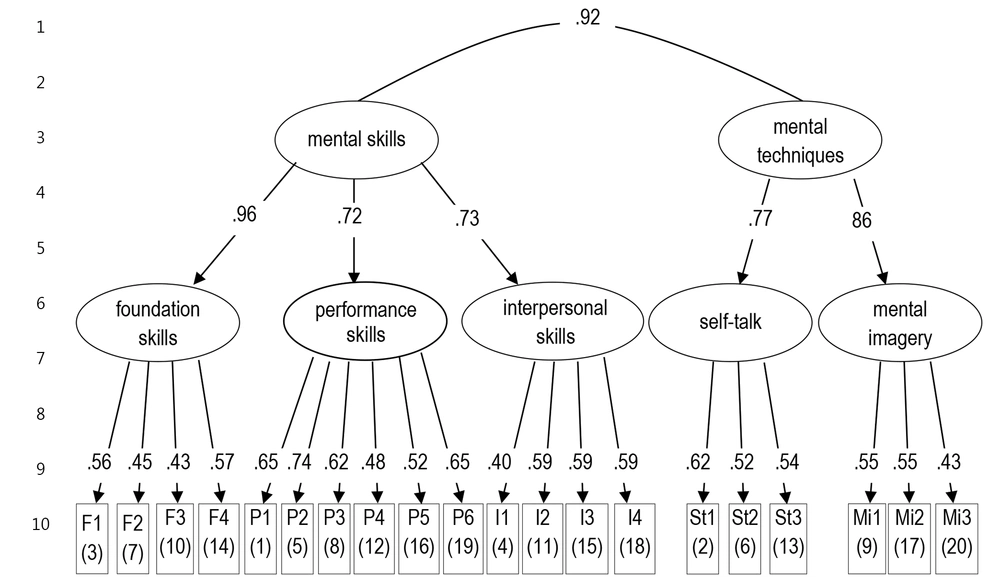
Figure 1.
The hierarchical structure of mental training in sports. Confirmatory factor analysis with standardized coefficients
| Item | Foundational Skills | Performance Skills | Interpersonal Skills | Self-talk | Mental Imagery |
|---|---|---|---|---|---|
| 3- I have a high level of self-confidence that makes me believe I can achieve anything I put my mind to. | 0.56 | ||||
| 7- I am able to “bounce back” and overcome any failure; it does not discourage me from further action. | 0.45 | ||||
| 10- I know my own value, strengths, and weaknesses; I plan how to improve them. | 0.43 | ||||
| 14- I have an unshakable belief in my athletic skills. | 0.57 | ||||
| 1- I can control my emotions when I am under pressure. | 0.65 | ||||
| 5- When I am under pressure during a competition, I am able to relax physically and mentally, so I am ready to perform. | 0.74 | ||||
| 8- During a competition, I am able to adapt quickly to changes in a performance situation and distracting factors. | 0.62 | ||||
| 12- Whenever I lose my self-control during a competition, I can regain control of my own actions at the right moment. | 0.48 | ||||
| 16- I can relax and reduce my arousal level during competition if the situation requires so. | 0.52 | ||||
| 19- I am able to concentrate my attention on my performance and maintain it during the performance, and in the case of any disruption, I can quickly restore my focus. | 0.65 | ||||
| 4- I know and follow the rules established in the training group. | 0.40 | ||||
| 11- I accept my role in the group, and I see it clearly. | 0.59 | ||||
| 15- I am aware that I am part of my team and know the role of each person. | 0.59 | ||||
| 18- I am able to communicate effectively with my team and staff during the competition. | 0.59 | ||||
| 2- I use self-talk to improve my actions and focus my attention on key elements of the performance (technique, tactics, body sensations, etc.). | 0.52 | ||||
| 6- I use self-talk to help myself overcome hard times. | 0.62 | ||||
| 13- I talk to myself to regulate my own thoughts, emotions, and arousal. | 0.54 | ||||
| 9- During the preparation for the competition, I create real and accurate “inner films,” planning possible obstacles and feeling sensations associated with the imagery situation. | 0.55 | ||||
| 17- I use mental imagery to control my own emotions. | 0.55 | ||||
| 20- Before starting, I rehearse my performance in my mind going exactly the way I want it to look during the real competition. | 0.43 |
a The factor load of the questions is shown in the table.
b P < 0.001
4.2. Reliability
We found that the Persian version of SMTQ was internally consistent (α = 0.84 for the whole questionnaire). Similarly, all 5 subscales were reliable, including foundational skills (α = 0.78), performance skills (α = 0.77), interpersonal skills (α = 0.75), mental imagery (α = 0.79), and self-talk (α = 0.72). The obtained results were greater than the acceptable cut-off value (α ≥ 0.70) (19). The correlations between mental training scores and its subscales ranged from r = 0.63 to r = 0.82. The composite reliability for the whole questionnaire is 0.827. Also, all 5 subscales were reliable, including foundational skills (0.758), performance skills (0.842), interpersonal skills (0.777), mental imagery (0.778), and self-talk (0.747).
4.3. Criterion Validity
We found that high-level athletes scored higher on all mental training subscales, including mental imagery, self-talk, and foundation, performance, and interpersonal skills, than low-competitive level athletes (Table 3). Additionally, in comparison with females, male athletes obtained higher scores on foundational skills (Table 3).
Table 3.
The Sport Mental Training Questionnaire Criterion Validity a
| Characteristics | Low Level | High Level | t | Effect Size (d) | Female | Male | t | Effect Size (d) |
|---|---|---|---|---|---|---|---|---|
| N | 100 | 100 | 96 | 96 | ||||
| Foundational skills | 16.01 (1.74) | 16.91 (2.08) | 3.31 b | 0.48 | 15.71 (2.36) | 16.48 (2.41) | 2.24 c | 0.47 |
| Performance skills | 21.65 (3.74) | 23.07 (2.95) | 2.96 b | 0.42 | 21.87 (4.35) | 22.37 (3.98) | 0.83 | 0.12 |
| Interpersonal skills | 16.28 (2.13) | 16.86 (1.73) | 2.11 c | 0.29 | 16.4 (2.46) | 16.44 (2.36) | 0.119 | 0.02 |
| Self-talk | 11.98 (1.45) | 12.49 (1.68) | 2.29 c | 0.32 | 12.21 (1.69) | 11.97 (1.93) | 0.911 | 0.13 |
| Mental imagery | 11.57 (1.65) | 12.17 (1.62) | 2.58 c | 0.37 | 11.52 (1.99) | 11.76 (1.87) | 0.858 | 0.12 |
| Overall score | 77.49 (6.86) | 81.50 (5.27) | 4.63 d | 0.66 | 77.73 (8.95) | 79.04 (9.45) | 0.988 | 0.14 |
Abbreviations: SD, standard deviation; t, statistics of independent samples; effect size (d), Cohen's d.
a Mean differences obtained by tests for independent samples and degree of freedom were 198 and 190 for the high- vs. low-level athletes and female vs. male.
b P < 0.01
c P < 0.05
d P < 0.001
5. Discussion
Our study aimed to develop a tool that would be useful for psychologists and coaches, which worked with Persian athletes to evaluate the mental training process. We chose to adapt a brief and valid questionnaire (ie., SMTQ that has already been translated into other languages [e.g., Turkish and Lithuanian] (7, 8)). The internal consistency coefficients of the questionnaire were found to change between 0.82 and 0.91 in the Turkish version of SMTQ. As a result, it can be said that the Turkish version of the “Mental Training Questionnaire-SMTQ” is a valid and reliable measurement tool for athletes.
Considering the number of Persian-speaking countries with a strong interest in effective mental training in sports, we filled the gap in the literature by conducting an adaptation study.
We found that the structure of the final Persian version of SMTQ was consistent with the original version and that our study replicated its psychometric properties. The final Persian version of SMTQ included 5 factors: Foundational skills, performance skills, interpersonal skills, self-talk, and mental imagery. The examination of the psychometric properties of the Persian version of SMTQ supported the scale’s enough convergent validity and divergent validity. However, the internal reliability obtained for the Persian version of SMTQ was a bit lower than that of the English version (0.79 to 0.86) (20); internal reliability above the minimum recommendations of 0.60 was obtained for all factors (ranging from 0.72 to 0.79).
In addition, we presented the criterion validity of the scores of SMTQ. For example, we found that high-level athletes scored higher on all mental training subscales, including foundation, performance, and interpersonal skills, mental imagery, and self-talk scales, than low-level athletes, which is in line with previous studies (5, 20, 21). High-competitive level athletes engage in high psychological practice with further opportunities to create more mental preparation. Thus, it is justified that high-level athletes also display higher sports mental skills. We also observed gender differences. Male athletes scored higher on foundational skills than female athletes. Our findings are consistent with previous studies (5, 22, 23). The above-mentioned findings show certain weaker points to be targeted for gender differences minimization.
Given the adequate psychometric properties of the Persian version of SMTQ, we recommend using it in both applied and research settings. More specifically, the Persian version of SMTQ can be used to monitor the mental preparation of Iranian athletes. Using the Persian version of SMTQ in a research setting can improve the perception of the importance and relevance of various characteristics of mental training and the way in which the important factors are related to different consequences. This scale can also be employed to monitor or guide interventions. Additionally, further research on the SMTQ applicability across different contexts and cultures is needed to continue the investigation of the scale psychometric properties.
The present study has some limitations that should be acknowledged. First, the data were gathered during the COVID-19 pandemic. This might have affected the mental training due to quarantine restrictions. Second, SMTQ was only administered once; thus, we were not able to determine the test-retest reliability.
Additionally, the concurrent validity was not measured. Finally, the SMTQ validation and its dimensions were completely based on self-report scales, which are subject to different methods biases.
5.1. Conclusions
The present study presented the successful translation, development, and validation of the Persian version of SMTQ. Accordingly, SMTQ can be confidentially employed as a valid tool for Persian-speaking subjects and sporting settings.
5.2. Suggestions for Further Research
The test-retest reliability and concurrent validity were not measured in this study. Future studies are suggested to consider them.
Additionally, future studies are suggested to measure criterion validity using other tools.