


1. Introduction
Get informed of national, regional, and local suicide prevention methods is very challenging to prevent suicide. In addition, a more comprehensive understanding of the mechanisms of suicide is critical. National studies on suicide show that suicidal behavior, and particularly suicide preference differ across countries (1).
For instance, the prominent method for suicide in the United States includes firearms followed by arbitrary drug use (2). In comparison, hanging, pesticide use, and drug and substance misuse are more frequent among Asian nations (3, 4). Interestingly, in some Southeast Asian regions, suicide by charcoal burning is common (5). Different factors contribute to the choice of a suicide tool, including the availability of the tool, culture, and beliefs, and the psychological state of the person contemplating suicide (6-8). While the literature cites many Risk factors related to suicide, psychopathology or psychological imbalance appear to play an important role in one’s life at a particularly critical time. Some examples of suicide consist of two young men jumped out of the tall building after being chained, a woman injected toxin into her vein and a man with a deep wound in his chest due to self-injury with a sharp object. The cause of these events such as psychopathology and drug abuse has been studied (9). Zribi et al. reported a case of suicide by electric saw (10). Herein, we report a case of a suicide attempt that occurred with a grinding stone as an unusual tool for suicide.
2. Case Presentation
This case describes a 27-year-old Afghan refugee working in masonry in Iran. The patient and his brother gave the history. The patient had attempted to commit suicide by cutting the front of his neck with a grinding stone in his workplace because he had heard a voice ordering him to do so. On admission, a deep cut on the anterior part of his neck, specifically, a deep laceration of the skin and superficial muscles without the involvement of the cervical nerves and blood vessels from upper left to lower right, were detected (Figure 1). The patient was right-hand dominant and fully conscious. Vital signs were stable. During the physical exam, except for the cervical laceration, no abnormal signs were found in other parts of the body or vital organs. After the initial emergency assessment and hemodynamic stabilization, the patient was immediately transferred to the operating room to repair the laceration. After the surgical repair, psychiatric consultation was requested due to the suspicion of psychological problems. During consultation, the patient revealed a three-year history of depression, including frequent crying, loss of appetite, disrupted sleep patterns, and suicidal thoughts. The patient further explained that, in the week prior, he had heard a voice ordering him to commit suicide by cutting his neck to be free. The patient was brought to the hospital by his brother, who agreed with the history provided by the patient and added that the patient was an opium addict and HIV positive, had poor communication with others, of low socioeconomic status, and illiterate. Given the presence of psychotic patterns and behaviors, especially auditory hallucination, depressed mood, anhedonia, psychomotor retardation, feelings of guilt, low energy levels, a lack of interest, or pleasure in most activities, major depressive disorder (MDD) with psychotic features (PF), leading to the suicide attempt was diagnosed. The patient was admitted for 7 days in the psychiatric ward with full care to minimize the risk of another attempt. During this time, windows were checked, all items that may be used for suicide were removed, the patient was accompanied by a care-maker at all times, and medication (biperiden and risperidone) was administered. After a week, the patient no longer showed signs of suicidal thoughts and was referred to a psychiatric hospital to obtain more care. However, the patient and his brother refused. As the patient was no longer considered a threat to himself and others, he was discharged with personal fulfillment, and his brother accepted all responsibility for his discharge. Risperidone and sertraline were prescribed, and a strong emphasis was made on the follow up in the next week. The brother was also advised to take the patient to the hospital if he observed unusual behaviors.
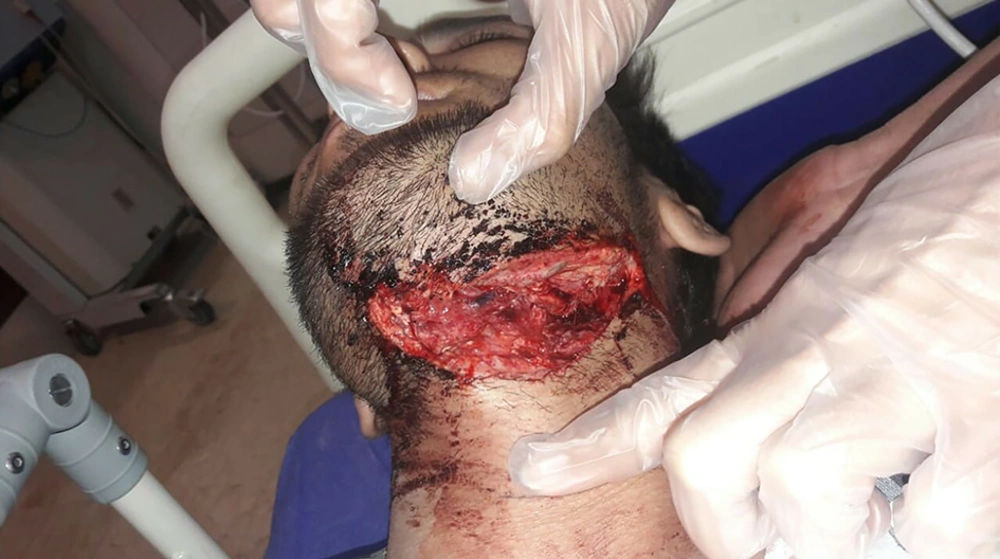
Figure 1.
Deep cut in the neck with laceration of the skin and superficial muscles without the involvement of the cervical nerves and blood vessels
3. Discussion
3.1. Psychotic Depression or MDD with PF
A person has a depressive or psychotic mood. Psychosis is usually portrayed as a nihilistic illusion, believing that bad events are happening (11). Symptoms of psychosis in major depression elevate the risk of complete suicide after suicidal trials. The treatment for MDD with PF after suicidal trials should change to prevent suicide (12). Mental disorders are associated with high altitude jumps, and substance abuse disorders are related with poisoning. Depression disorders are not related to any specific suicide attempt. Men prefer to hang, but women prefer to poison themselves. In patients prefer to jump before the train, while outpatients prefer to poison themselves. Bipolar patients prefer to skip hanging before the train (13).
Specifically, patients with mental disorders and women have used height jumping than hanging for suicide (= 2.98 and = 2.83, respectively). Patients prefer using other ways of suicide in comparison to hanging (e.g., OR = 6.7 for jumping, 5.3 for drowning, and 2.7 for poisoning) (14). Overall, the most commonly used suicidal tools appear to be firearms, hanging, and drugs; jumping, cold weapons, and other methods are other alternatives to suicide. As described in our case, the use of unusual tools for suicide may be considered, particularly in psychiatric disorders. The presence of psychotic patterns and behaviors may increase the risk of suicide attempt by selecting uncommon tools (15).
Our case describes the main demographic, physical, and mental factors influencing suicide attempts. To effectively prevent repeated attempts at suicide, medical practitioners should be aware of the risk factors in order to enable early diagnosis. Routine hospital care and management, psychological consulting, and long-term following up the patient are also necessary. Preventing suicide according to this case, propose decreasing the access to environments or tools that may promote to commit suicide. Diagnosing and managing psychotic problems well are crucial.




