


1. Background
Elder abuse, as defined by the World Health Organization (WHO), encompasses any harm inflicted upon individuals aged 60 and above, with an estimated prevalence of approximately one in six, or 16%, of this demographic (1). It manifests in various forms, including neglect, psychological, physical, financial, authority deprivation, abandonment, and emotional neglect (1).
The detrimental effects of elder abuse on health range from physical ailments to diverse mental and psychological issues, ultimately leading to a decline in quality of life and, in severe cases, premature death (2, 3). Recognizing the significance of elderly wellbeing, the WHO has designated 2020 - 2030 as "The Decade of Healthy Aging", prioritizing the welfare of the elderly worldwide (4).
Prevalence rates of elder abuse vary globally depending on definitions and study settings, spanning from 0.8% to 79% (5). For instance, Chang's 2020 study in the US reported a 21% prevalence of at least one form of elder abuse (6). Meta-analyses conducted in Iran estimate overall elder abuse rates at 45.7% (7), 48.3% (8), and 55% (9), though none of these studies included data from Isfahan .
Recent articles from various regions in Iran indicate prevalence rates of elder abuse at 78% (10), 44.6% (11), 75.4% (12), and 55.2% (13). Recognizing the importance of the elderly population and their significant impact on society, particularly as our population ages, prompted our study design to address the lack of data on elder abuse in Isfahan.
2. Objectives
Conducting a situational analysis serves as the initial step in community intervention. Therefore, we aimed to determine the extent of elder abuse and its associated factors to facilitate the design of future studies tailored to address this public health concern in our country.
3. Methods
3.1. Participants
This cross-sectional study was carried out in Isfahan, Iran, in 2021. Isfahan, with a population of 2 861 260 in 2021, ranks as the third most populous city in Iran. The ethical approval code for this study is IR.MUI.NUREMA.REC.1400.058. Elderly individuals aged 60 and above, who were recipients of services from the "Comprehensive Health Services Centers" affiliated with Isfahan University of Medical Sciences, capable of responding to inquiries, without significant hearing impairments, and not diagnosed with confirmed mental illness or cognitive disorders as self-reported, were eligible for inclusion. Participants who expressed dissatisfaction at any stage of completing the questionnaire or left more than or equal to 20% of the questionnaire unanswered were excluded from the study. Elderly individuals were randomly selected from the list of those aged 60 and above. The sample size was determined to be 424 (α = 0.05, d = 0.05, P = 50%, and attrition = 10%).
A simple random sampling method was employed, whereby elderly individuals served by all four comprehensive centers of educational health services under Isfahan University of Medical Sciences (Ibn Sina Center, Shahid Rostamian Center, Shahid Rezaian Center, and Kerdabad Center) were selected randomly from the existing lists. It's important to note that these four centers are situated in distinct regions with varying socio-economic statuses.
Upon obtaining informed consent from the elderly participants and verbally explaining the research objectives, interviews were conducted via telephone. However, if an elderly individual preferred an in-person interview, a private room was allocated to ensure confidentiality and adherence to COVID-19 health protocols. Participants were assured of the complete confidentiality of their personal information. The interview process involved completing a demographic information form and the Elderly Abuse in the Family questionnaire through discussions with the elderly.
As per the exclusion criteria, if the phone was answered by a caregiver or family member indicating that the elderly individual was unable to participate due to cognitive limitations, they were not included in the study, and another participant was randomly selected.
Although conducting interviews over the phone may not be ideal, it was deemed the safest method for data collection, particularly considering the ongoing COVID-19 pandemic, especially for this age group.
3.2. Tools
We utilized a demographic form and a questionnaire for our study. The demographic form included variables such as age, gender, marital status, education level, history of drug or alcohol abuse, and past illnesses of the elderly participants. The Abuse of the Elderly in the Family questionnaire comprised 49 items divided into 8 subscales: Care neglect (11 items), psychological abuse (8 items), physical abuse (4 items), financial abuse (6 items), authority deprival (10 items), abandonment (4 items), financial neglect (4 items), and emotional neglect (2 items). Each item required a "yes" or "no" response, with a "yes" indicating elder abuse in that specific area. This questionnaire assessed the lifelong prevalence of elder abuse, and the 8 subscales were determined through factor analysis. The psychometric properties of the tool, including face validity, content validity, construct validity, internal consistency, and test-retest reliability, were analyzed by Heravi Karimooi et al. in 2010. Approximately 80% of the variance was explained by these 8 factors. The Cronbach's alpha coefficient was calculated to be between 0.9 and 0.975, stability through a retest was 0.99, and the test-retest reliability over a 2-week interval was 0.98 (P < 0.001) (14).
3.3. Statistical Analysis
Following data collection, analysis was conducted using SPSS software version 16. Frequency distribution, standard deviation, and mean were utilized to measure the dimensions of elder abuse. To compare elder abuse dimensions based on demographic variables and explore relationships between variables, independent t-tests, chi-square tests, and Spearman and Pearson correlation coefficients were employed. Logistic regression analysis was performed to determine the contribution of each independent variable in explaining the frequency of elder abuse.
4. Results
In this study, there were 424 elderly participants aged between 60 and 97 years old. Among them, 65% fell within the age range of 60 to 70 years, with 48% being female, and approximately 80% currently married, while the remaining 20% were either divorced, widowed, or single. A minority, comprising 12.5%, were cigarette smokers, 5% reported addiction, 2% were alcohol users, and around 64% had a history of some form of illness (Table 1). The most common illnesses reported in the study population were diabetes mellitus and/or hypertension, accounting for about 50% of cases.
Table 1.Demographic Characteristics of the Participants (N = 424) a
| Characteristics | Values |
|---|---|
| Age, year | |
| 60 - 69 | 275 (64.9) |
| ≥ 70 | 149 (35.1) |
| Gender | |
| Male | 201 (47.9) |
| Female | 219 (52.1) |
| Marital status | |
| Divorced, single or widow | 85 (20.6) |
| Married | 328 (79.4) |
| Education status | |
| Illiterate | 95 (23.2) |
| Elementary & middle | 191 (46.6) |
| Diploma & university | 124 (30.2) |
| Occupation | |
| Employed or self-employed | 55 (13.1) |
| Retired | 168 (40) |
| Housekeeper or unemployed | 197 (46.9) |
| Cigarette smoking | |
| No | 308 (87.5) |
| Yes | 44 (12.5) |
| Alcohol abuse | |
| No | 346 (98.3) |
| Yes | 6 (1.7) |
| Addiction | |
| No | 335 (95.2) |
| Yes | 17 (4.8) |
| Chronic illness | |
| No | 137 (36.4) |
| Yes | 239 (63.6) |
a Values are expressed as No. (%).
Participants were further categorized based on their educational background, with 23% being illiterate, 47% having attended elementary or middle school, and 30% possessing a diploma or university degree. In terms of occupation, 13% were employed, while 47% were housekeepers or unemployed, and 40% were retired.
Around 36% of the participants reported a history of elder abuse in at least one form (Figure 1). The least prevalent forms of abuse were abandonment (0%), physical abuse (3.3%), financial neglect (4.5%), and care neglect (5.4%), while authority deprivation (19.6%) was the most common, followed by emotional neglect (19.3%), psychological abuse (12.5%), and financial abuse (9.7%).
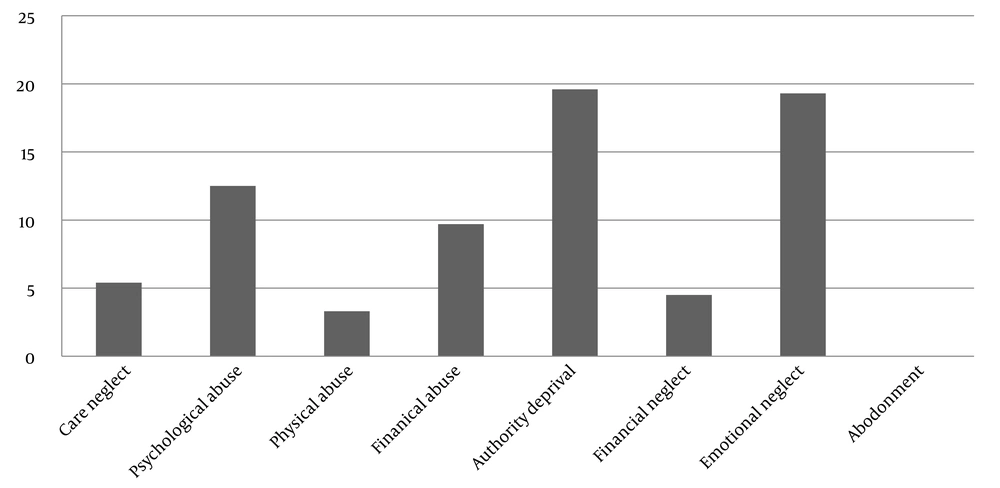
Figure 1.
Prevalence of elder abuse subgroups.
Statistical analysis using the chi-square test revealed significant associations between elder abuse prevalence and factors such as age, gender, occupation, and history of chronic illness, but not with education, marital status, cigarette smoking, or alcohol use (Table 2). Specifically, elder abuse was significantly more prevalent among those aged 60 - 69 years (40.4%), females (43.4%), retirees (40.5%), and individuals with a history of chronic illness (35.9%).
Table 2.Association of Factors with Overall Abuse (At Least One Type of Abuse) (N = 424) a
| Characteristics | Any Type of Abuse | P-Value | |
|---|---|---|---|
| No | Yes | ||
| Total | 271 (63.92) | 153 (36.08) | |
| Age, year | 0.012 | ||
| 60 - 69 | 164 (59.6) | 111 (40.4) | |
| ≥ 70 | 106 (71.1) | 43 (28.9) | |
| Gender | 0.001 | ||
| Male | 145 (72.1) | 56 (27.9) | |
| Female | 124 (56.6) | 95 (43.4) | |
| Marital status | 0.80 | ||
| Divorced, single or widow | 56 (65.8) | 29 (34.2) | |
| Married | 210 (64.1) | 118 (35.9) | |
| Education status | 0.447 | ||
| Illiterate | 66 (69.4) | 29 (30.6) | |
| Elementary & middle | 122 (63.9) | 69 (36.1) | |
| Diploma & university | 76 (61.3) | 48 (38.7) | |
| Occupation | 0.001 | ||
| Employed or self-employed | 49 (89.1) | 6 (10.9) | |
| Retired | 100 (59.5) | 68 (40.5) | |
| Housekeeper or unemployed | 118 (59.9) | 79 (40.1) | |
| Cigarette smoking | 0.11 | ||
| No | 221 (71.7) | 87 (28.3) | |
| Yes | 26 (59.1) | 18 (40.9) | |
| Alcohol abuse | 0.67 | ||
| No | 242 (69.9) | 104 (30.1) | |
| Yes | 5 (83.3) | 1 (16.7) | |
| Addiction | 0.59 | ||
| No | 236 (70.4) | 99 (29.6) | |
| Yes | 11 (64.7) | 6 (35.3) | |
| Chronic illness | 0.021 | ||
| No | 104 (75.9) | 33 (24.1) | |
| Yes | 153 (64.1) | 86 (35.9) | |
a Values are expressed as No. (%).
The results of logistic regression analysis, presented in Table 3, indicated that the odds of experiencing elder abuse were higher among those aged 60 - 69 years compared to those aged 70 or older (adjusted odds ratio [OR] = 2, CI [1.19 - 3.45], P = 0.01), females compared to males (adjusted OR = 2.61, CI [1.30 - 5.25], P = 0.007), retirees compared to those employed or self-employed (adjusted OR = 4.15, CI [1.59 - 10.92], P = 0.004), and individuals with a history of chronic illness compared to those without (adjusted OR = 2.11, CI [1.26 - 3.53], P = 0.004).
Table 3.Binary Logistic Regression for Factors Associated with Elder Abuse (N = 424)
| Characteristics | OR (95% CI) Unadjusted | P-Value | OR (95% CI) Adjusted | P-Value |
|---|---|---|---|---|
| Age, year | ||||
| ≥ 70 | Reference | - | Reference | - |
| 60 - 69 | 1.69 (1.09 - 2.56) | 0.019 | 2 (1.19 - 3.45) | 0.010 |
| Gender | ||||
| Male | Reference | - | Reference | - |
| Female | 1.98 (1.31 - 2.98) | 0.001 | 2.61 (1.30 - 5.25) | 0.007 |
| Occupation | ||||
| Employed or self-employed | Reference | Reference | ||
| Housekeeper or unemployed | 5.47 (2.37 - 13.72) | 0.0001 | 2.15 (0.74 - 6.24) | 0.16 |
| Retired | 5.55 (2.25 - 13.69) | 0.0001 | 4.15 (1.59 - 10.92) | 0.004 |
| Chronic illness | ||||
| No | Reference | - | Reference | |
| Yes | 1.77 (1.10 - 2.84) | 0.018 | 2.11 (1.26 - 3.53) | 0.004 |
Other significant findings not depicted in tables or figures include the following: A significant association was observed between occupation and emotional neglect (chi-square test, P = 0.013), as well as between occupation and authority deprivation (chi-square test, P = 0.002). Additionally, significant relationships were found between gender and emotional neglect (chi-square test, P = 0.013), gender and care neglect (chi-square test, P = 0.034), and gender and authority deprivation (chi-square test, P = 0.035). Moreover, there were significant associations between a history of chronic illness and care neglect (chi-square test, P = 0.015), as well as between chronic illness and financial abuse (chi-square test, P = 0.05).
5. Discussion
The primary objective of this study was to assess the prevalence of elder abuse in Isfahan. Our findings revealed a 36% prevalence of elder abuse in at least one form. This prevalence was higher among individuals aged 60 - 69 years, females, retirees or housekeepers, and those with a history of chronic illness.
Recent research indicates that Iran is facing the challenge of an aging population, and studies have highlighted elder abuse as a significant public health concern. Reports from various countries, including Iran, demonstrate geographical variations and differences across different settings (15). For instance, in Molaei et al.'s systematic study conducted in Iran, elder abuse rates ranged from as high as 87% in Tehran to 17% in Shahrekord (16). This wide disparity may be attributed to diverse factors such as the presence of different risk factors, social determinants of health, and cultural differences. For instance, Shahrekord, being a smaller city with a traditional culture, often entails families living together or providing extensive support to their elders, whereas Tehran's modernization has led to changes in family dynamics and support structures.
In a bibliometric analysis conducted in 2017, physical abuse emerged as the most prevalent issue, followed by psychological and financial abuse as the primary forms of abuse (17). Additionally, Greene's article highlighted financial abuse as the most underreported form of abuse among the elderly in the US population, attributing part of this phenomenon to the influence of new technologies and the internet (18). A recent study in Tabriz, Iran, identified emotional neglect and financial abuse as the predominant forms of abuse (19). Similarly, Rohani et al.’s study in Tehran, Iran, found care neglect to be the most prevalent form of abuse, with sexual abuse being the least reported (10).
In our community, authority deprivation (19.6%), emotional neglect (19.3%), and psychological abuse (12.5%) emerged as the most prevalent forms of elder abuse, warranting attention from policymakers and public health practitioners. While some studies suggest that socio-demographic factors such as aging, employment status, lower education levels, and gender influence the risk of elder abuse, there are conflicting findings (20). Contrary to expectations, our study revealed an inverse relationship between age and elder abuse, with individuals aged 60 - 69 experiencing more abuse compared to those aged 70 and above.
In a study by Piri et al. in Tehran, elder abuse prevalence was estimated at approximately 90% among women (21). While some studies indicate higher rates of abuse among males, others report higher prevalence among females (22-24). Our study found that overall elder abuse, as well as subgroup analyses, showed higher rates among women than men (P < 0.05). Addressing this gender disparity is crucial, as it is a component of social determinants of health (SDH), and interventions should be tailored to mitigate this inequity.
It is estimated that 80% of individuals in Tehran have at least one underlying medical condition, with 10% experiencing a disability (25). Having a medical condition is identified as a risk factor for elder abuse, alongside marital status (1). In our study, a statistically significant association was found between having a medical condition and elder abuse, although no such relationship was observed for marital status.
A study conducted in 2021 highlighted education level and health status as additional risk factors for elder abuse (22). Both education level and health status are components of SDH, believed by public health experts to significantly impact people's lives. However, in our study, while education level was not correlated with elder abuse, a history of illness was significantly associated with instances of care neglect and financial abuse.
We attribute differences in the prevalence of risk factors to cultural variations, variations in the definition of elder abuse, and the use of diverse tools and questionnaires across different studies. In 2022, the World Health Organization (WHO) prioritized addressing elder abuse, emphasizing the need for high-quality data on its prevalence and risk factors (4).
Given that our study was conducted during the COVID-19 pandemic, there were limitations related to this unprecedented situation. Contact was primarily made via telephone interviews, which may not have been as effective as face-to-face interviews. Furthermore, the pandemic's specific circumstances could have influenced the study findings. We excluded individuals with mental health issues and those with hearing difficulties or Alzheimer's disease, potentially limiting the study's scope, as these individuals may be at higher risk of abuse. Additionally, as the study was conducted in Isfahan, the findings may not be generalizable to the entire country due to the diverse cultures within Iran. Moreover, there may be other unidentified factors related to elder abuse that could emerge as scientific knowledge advances.
However, our study possesses several strengths, including the significant number of participants involved and the comprehensive nature of the questionnaire used, which examined all dimensions of elder abuse.
Considering the limited availability of public health resources, the growing elderly population, and the prevalence of elder abuse in our community, our study highlights that authority deprival, emotional neglect, and psychological abuse are the most prevalent forms of elder abuse. Therefore, we recommend prioritizing community-based interventions targeting these specific forms of abuse.
5.2. Conclusions
In conclusion, elder abuse represents a pressing public health concern that requires prioritization in planning efforts. Understanding the prevalence and distribution of this issue within our community is crucial. Our study revealed a 36% prevalence of various forms of elder abuse in Isfahan. We advocate for the development of intervention studies aimed at preventing and reducing elder abuse.


