


1. Background
2. Objectives
3. Methods
3.1. Participants
3.2. Tools
3.2.1. Body Image Scale
3.2.2. Interpersonal Stress Scale
3.3. Procedure
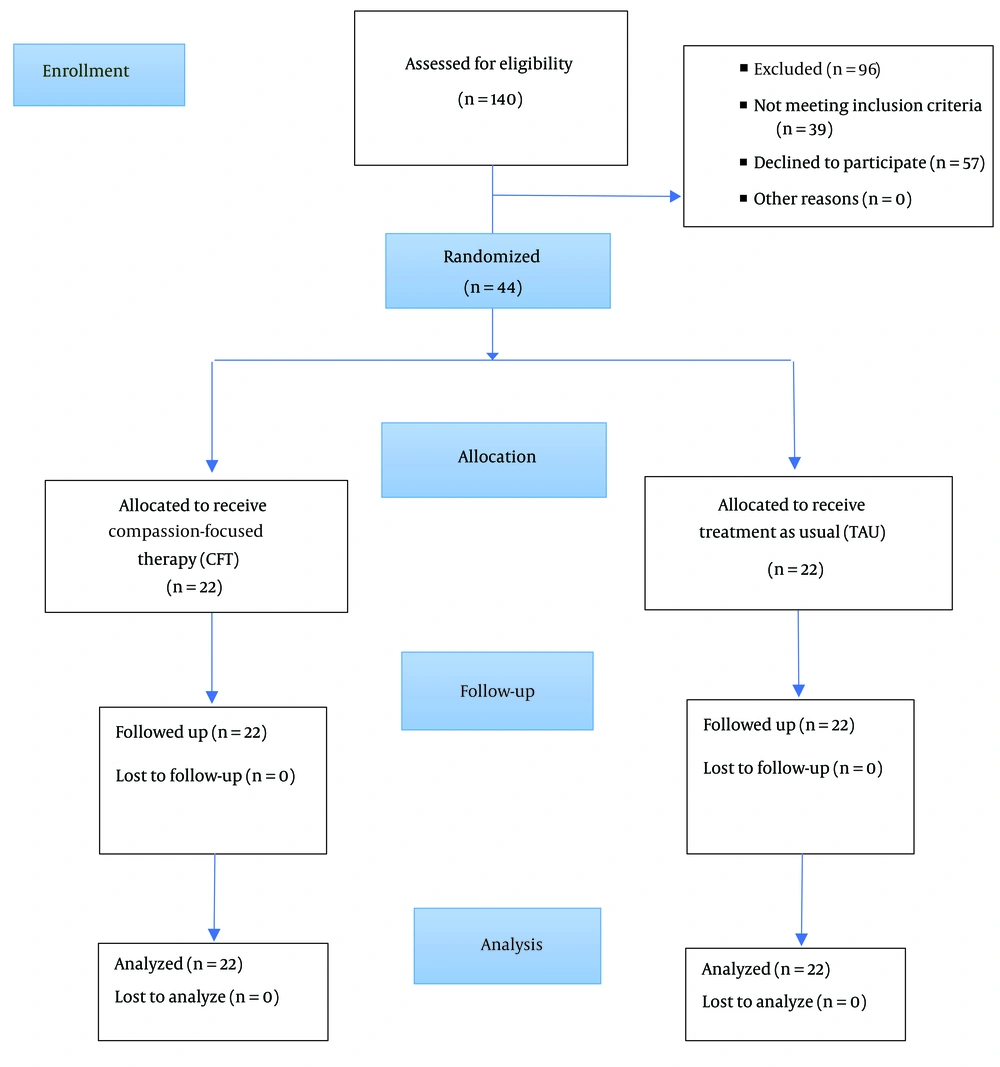
CONSORT flow chart of study participants
3.4. Treatment
| Session | Steps |
|---|---|
| First | Introducing the members to each other, determining the goals of the group, and introducing and explaining the general treatment approach. Assignment: Listing the most important problems that patients face. |
| Second | Introducing different types of emotions and three-affect regulation systems and soothing breathing rhythm exercises. Assignment: Practicing soothing breathing rhythm daily and recording its effects. |
| Third | Introducing multi-mind, the interaction of the old and new brains, and examining self-critical blaming and individual responsibility. Assignment: Continue practicing soothing breathing rhythm, doing a reality check on current problems, and examining their fault and responsibilities. |
| Fourth | Introducing compassion (to oneself) and its characteristics, mindfulness, and its types, practicing mindful breathing, and focusing on the object. Assignment: Practicing mindful breathing, focusing on an object daily, and recording its effects. |
| Fifth | Introducing walking, sound, and eating mindfulness practices and informal mindfulness practices. Assignment: Conducting formal and informal exercises and recording their effects. |
| Sixth | Examining the obstacles to self-compassion, examining self-criticism and its functions and effects, and introducing and implementing imagery exercises. Assignment: Recording at least five self-critical situations and doing one of the imagery exercises afterward (suitable to the situation); noting feelings and thoughts before and after the exercise. |
| Seventh | Implementing the compassionate letter writing, compassion-focused imagery exercise. Assignment: Noting three disturbing situations and then performing a compassion-focused imagery exercise, noting feelings and thoughts before and after the exercise. |
| Eighth | Examining compassion towards others, examining situations where compassion towards others may be difficult, cognitive restructuring, exercising compassion with others, concluding the sessions, and conducting the post-test. |
4. Results
| Variables | PR/PO/FO a (Mean ± SD) | Group | Time*Group | Within-Subject b | Post Hoc c |
|---|---|---|---|---|---|
| Total body image score | F (1, 42) = 12.40; P = 0.001, η2 = 0.23 | F (1.48, 62.10) = 46.32; P < 0.001, η2 = 0.84 | |||
| Intervention | 20.23 ± 1.97)/12.45 ± 1.71/12.77 ± 1.51 | F (1.06, 28.41) = 250.51; P < 0.001, η2 = 0.92 | PR > PO; PR > FO; PO = FO; | ||
| Control | 19.36 ± 2.04/16.54 ± 3.31/16.59 ± 3.54 | F (1.35, 22.41) = 28.88; P = 0.001, η2 = 0.58 | PR > PO; PR > FO; PO = FO | ||
| Total interpersonal stress | F (1, 42) = 5.53; P = 0.023, η2 = 0.12 | F (1.38, 58.11) = 18.11; P < 0.001, η2 = 0.30 | |||
| Intervention | 24.09 ± 8.52/15.41 ± 4.86/15.32 ± 5.27 | F (1.38, 29.02) = 30.15; P < 0.001, η2 = 0.59 | PR > PO; PR > FO; PO = FO | ||
| Control | 23.73 ± 6.62/21.86 ± 6.26/21.77 ± 6.28 | F (1.17, 24.61) = 90.28; P < 0.001, η2 = 0.81 | PR > PO; PR > FO; PO = FO |
a PR, pre-test; PO, post-test; FO, follow-up.
b Following the significant interaction effect (Time*Group), within-subject ANOVA was conducted separately in both groups.
c Pairwise comparison for three assessment times; if Leven's test for homogeneity of variance was significant, Games-Howell was used as the post-hoc test; if not, Bonferroni was used.
| Body Image Subscales | PR/PO/FO a (Mean ± SD) | Group | Time*Group | Within-Subject b | Post Hoc c |
|---|---|---|---|---|---|
| Emotional | F (1, 42) = 4.49; P = 0.04, η2 = 0.06 | F (1.24, 52.26) = 23.44; P < 0.001, η2 = 0.36 | |||
| Intervention | 9.05 ± 0.65/5.36 ± 0.90/5.64 ± 0.90 | F (1.52, 31.89) = 175.55; P < 0.001, η2 = 0.89 | PR > PO; PR > FO; PO = FO | ||
| Control | 8.27 ± 1.03/6.81 ± 1.99/7.05 ± 1.76 | F (1.08, 22.84) = 13.55; P = 0.001, η2 = 0.39 | PR > PO; PR > FO; PO = FO | ||
| Behavioral | F (1, 42) = 31.44; P < 0.001, η2 = 0.43 | F (1.37, 57.67) = 12.61; P < 0.001, η2 = 0.25 | |||
| Intervention | 3.76 ± 0.75/1.73 ± 0.77/2.00 ± 0.44 | F (1.57, 33) = 61.69; P < 0.001, η2 = 0.75 | PR > PO; PR > FO; PO = FO | ||
| Control | 3.77 ± 0.61/2.95 ± 0.84/3.14 ± 0.71 | F (1.15, 24.20) = 5.78; P = 0.002, η2 = 0.34 | PR > PO; PR > FO; PO = FO | ||
| Cognitive | F (1, 42) = 4.91; P = 0.032, η2 = 0.11 | F (1.24, 52.06) = 13.66; P < 0.001, η2 = 0.25 | |||
| Intervention | 7.41 ± 1.50 /5.36 ± 1.00/5.14 ± 1.09 | F (1.38, 28.98) = 110.85; P < 0.001, η2 = 0.84 | PR > PO; PR > FO; PO = FO | ||
| Control | 7.31 ± 1.13/6.77 ± 1.51/6.41 ± 2.06 | F (1.03, 21.54) = 5.78; P = 0.025, η2 = 0.22 | PR = PO; PR = FO; PO = FO |
a PR, pre-test; PO, post-test; FO, follow-up.
b Following the significant interaction effect (Time*Group), within-subject ANOVA was conducted separately in both groups.
c Pairwise comparison for three assessment times; if Leven's test for homogeneity of variance was significant, Games-Howell was used as the post-hoc test; if not, Bonferroni was used.
| Interpersonal Stress Subscales | PR/PO/FO a (Mean ± SD) | Group | Time*Group | Within-Subject b | Post Hoc c |
|---|---|---|---|---|---|
| Conflicts with family | F (1, 42) = 13.04; P = 0.001, η2 = 0.24 | F (1.14, 47.96) = 12.42; P = 0.001, η2 = 0.23 | |||
| Intervention | 7.09 ± 3.07/2.27 ± 1.08/2.54 ± 0.80 | F (1.07, 22.54) = 60.24; P < 0.001, η2 = 0.74 | PR > PO; PR > FO; PO = FO | ||
| Control | 7.54 ± 3.61/6.04 ± 3.05/5.78 ± 2.99 | F (1.16, 24.44) = 0.6.83; P = 0.012, η2 = 0.25 | PR = PO; PR = FO; PO = FO | ||
| Conflicts with colleagues | F (1, 42) = 3.31; P = 0.076, η2 = 0.07 | F (1.13, 47.27) = 8.52; P = 0.004, η2 = 0.17 | |||
| Intervention | 3.05 ± 2.01/2.86 ± 3.51/2.77 ± 3.24 | F (1.05, 22.12) = 0.16; P = 0.704, η2 = 0.01 | PR = PO; PR = FO; PO = FO | ||
| Control | 3.27 ± 0.88/0.91 ± 1.41/1.18 ± 1.37 | F (1.27, 26.66) = 40.21; P < 0.001, η2 = 0.66 | PR > PO; PR > FO; PO = FO | ||
| Conflicts with friends | F (1, 42) = 3.40; P = 0.129, η2 = 0.05 | F (1.09, 47.76) = 21.04; P < 0.001, η2 = 0.34 | |||
| Intervention | 7.45 ± 3.92/3.14 ± 1.70/3.41 ± 1.37 | F (1.05, 31.94) = 29.68; P < 0.001, η2 = 0.59 | PR > PO; PR > FO; PO = FO | ||
| Control | 6.32 ± 3.46/5.77 ± 3.75/5.95 ± 3.66 | F (1.23, 25.84) = 0.3.97; P = 0.397, η2 = 0.16 | PR = PO; PR = FO; PO = FO | ||
| Changes in the environment | F (1, 42) = 2.00; P = 0.165, η2 = 0.05 | F (1.72, 72.40) = 0.71; P = 0.705, η2 = 0.007 | |||
| Intervention | 3 ± 1.66/2.81 ± 2.38/3.18 ± 2.46 | F (1.52, 31.95) = 0.88; P = 0.704, η2 = 0.04 | PR = PO; PR = FO; PO = FO | ||
| Control | 2.36 ± 0.79/2.27 ± 1.20/2.36 ± 0.95 | F (1.70, 35.66) = 0.11; P = 0.869, η2 = 0.005 | PR = PO; PR = FO; PO = FO | ||
| Changes in personal life | F (1, 42) = 1.50; P = 0.227, η2 = 0.03 | F (1.14, 48.02) = 0.06; P = 0.842, η2 = 0.001 | |||
| Intervention | 3.5 ± 1.99/3.23 ± 2.25/3.41 ± 2.26 | F (1.07, 22.41) = 0.31; P = 0.599, η2 = 0.01 | PR = PO; PR = FO; PO = FO | ||
| Control | 4.23 ± 1.51/3.86 ± 2.70/4.23 ± 2.41 | F (1.15, 24.24) = 0.56; P = 0.486, η2 = 0.03 | PR = PO; PR = FO; PO = FO |
a PR, pre-test; PO, post-test; FO, follow-up.
b Following the significant interaction effect (Time*Group), within-subject ANOVA was conducted separately in both groups.
c Pairwise comparison for 3 assessment times; if Leven's test for homogeneity of variance was significant, Games-Howell was used as the posthoc test; if not, Bonferroni was used.


