


1. Context
Metaphors are not only literary devices but also a method of thinking and a linguistic key to understanding the world conceptually (1). The initial understanding of the world is developed through sensory-motor representations, forming the basis for more abstract thoughts. Neuroimaging data have shown that interpreting metaphors, similes, and analogies activates sensory-motor areas of the brain in addition to semantic or linguistic areas (2). They provide representational frameworks needed for abstract concepts lacking sensory-motor representation (2). One study suggests that physicians use common analogies to convey medical information to patients (3).
In psychotherapy, metaphors create new ways of viewing situations and solving problems (4). Schön defined the concept of generative metaphors; a new metaphor generates new logic for resolution, new meanings, and new ideas for action (5). Thus, situations initially perceived as complex become clearer through generative metaphors, facilitating the diagnosis of problems and identification of solutions (5). Using metaphors helps clients gain insight and effect changes in their lives (6). Therapists from various theoretical orientations concur that insight is a key attribute of an effective therapist (7). Research has shown that metaphor use in a solution-focused approach enhances patients' self-management skills (8). Additionally, a study found that metaphor therapy was effective in addressing irrational beliefs among drug addicts (9).
Metaphors also play other significant roles in psychotherapy. They deactivate clients' defenses without inducing anxiety, allowing clients to shift their focus from the problem to the metaphor (10). Furthermore, psychotherapists can discuss very personal aspects of clients' lives using metaphors without seeming as intrusive as when making direct statements (4). Since metaphors often relate to bodily experiences and are personal in nature, therapists do not fully explain their meanings but allow clients to interpret them in their own ways (4). Lastly, metaphors and stories transform therapeutic information into a format that is memorable, applicable in everyday situations, and provides useful guidance (11).
Literature maintains an inseparable link with various sciences, notably psychology. In the nascent stages of human knowledge, when the demarcation of scientific disciplines was less defined, many human experiences were expressed through literary works (12). Furthermore, considering that scientific methodologies of the past lacked the structured nature of contemporary scientific approaches, philosophers and poets often incorporated reflections on psychological aspects of human nature within their literary works, which included narratives, poems, metaphors, allegories, sonnets, and others.
This study poses a fundamental question: Is reflection on thoughts, self, life, and interpersonal relationships dependent solely on the era in which scientific methodologies flourished? Did exploration of the sociocultural, religious, philosophical, and psychological dimensions of human existence not precede the advent of formal science? We argue that scientists, philosophers, and poets of the past made significant contributions to knowledge, often embedding profound insights within their literary works, unbeknownst to contemporary generations. Modern scholars are charged with studying the works of these historical figures to systematically uncover and analyze the intellectual content therein. There is a pressing need to foster a symbiotic relationship between modern psychotherapy and our rich cultural heritage, diligently applying scientific rigor to these invaluable insights.
Due to Rumi’s frequent use of metaphors and allegories to express his deepest thoughts, this study focuses on the metaphors and allegories of this distinguished philosopher. Maulana Jalaluddin Balkhi Rumi (1207 - 1273) produced two major works, Diwan Shams Tabrizi and Masnavi, which contain approximately 40 000 and 26 000 couplets, respectively. Rumi’s 800th anniversary was celebrated in 2007, an occasion on which UNESCO declared him an advocate of tolerance and love, noting that ‘his work and thought remain universally relevant today’ (13).
Several studies have utilized Rumi’s “Guest-house” metaphor to elucidate the concept of acceptance in mindfulness-based therapies (14-18). Other metaphors by Rumi have also been applied to explain psychological concepts such as reflection and resilience (19). Farooqi highlighted similarities between Rumi's ideas and those of Western theorists/therapists, including Carl Gustav Jung, Jean-Paul Sartre, Karl Jaspers, Ludwig Binswanger, Victor Frankl, R.D. Laing, and Carl Rogers (20). This study explored their common focus on helping clients clarify their values and devise meaningful ways to navigate the existential dilemmas of everyday life. Since the primary aim of therapeutic approaches is to alleviate suffering and distress, similar techniques recur across various cultures and healing traditions (21).
The extent to which psychologists have incorporated Rumi's metaphors and allegories in psychotherapy has not yet been extensively studied. Exploring this could lay the groundwork for developing rigorous empirical evidence to assess the effectiveness of Rumi's metaphors and allegories in psychotherapy. Our study aims to examine Rumi’s ideas purely from a psychological perspective, without the influences of religious, mystical, philosophical, or literary contexts.
2. Objectives
The objectives of our study were:
(1) To identify what is known from the research literature about the use of Rumi’s metaphors and allegories in psychotherapy.
(2) To determine the extent and nature of published scientific research on Rumi’s metaphors and allegories in psychotherapy.
3. Evidence Acquisition
This scoping review utilized the structural framework developed by Arksey and O'Malley and refined by Levac et al. (22, 23). It was conducted in accordance with the PRISMA-SCR guidelines (24).
A comprehensive literature search was conducted in Scopus, PsychInfo, ProQuest, Google Scholar, PubMed, and Cochrane databases in English and SID, and Google Scholar databases in Persian (until May 31, 2022). The search terms used were “Rumi,” “Psychology,” and “Psychotherapy” in both Persian and English. Included studies were published in either English or Persian and focused on therapeutic approaches. We excluded studies that presented religious, mystical, philosophical, or literary perspectives of Rumi's thoughts. The inclusion of studies was decided through consensus between two reviewers.
4. Results
In the initial search, 117 studies were identified. After reviewing titles, abstracts, and keywords and removing duplicate and irrelevant studies, 61 studies remained for full-text review. Also, 38 studies that did not meet the inclusion criteria were excluded from our review. Finally, after checking the reference list of articles, one study was added, and thus the current research includes 24 studies. The article selection process was summarized as a flowchart in Figure 1.
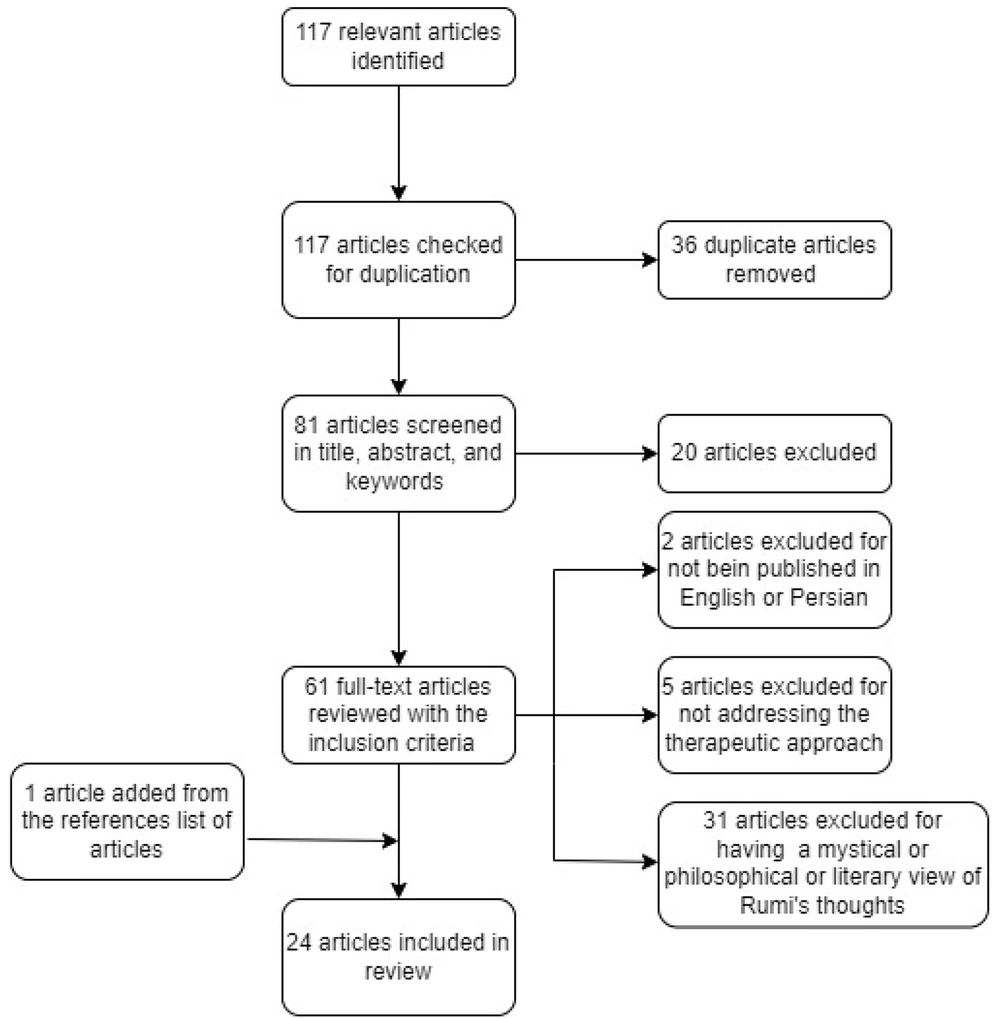
Figure 1.
Flowchart of the study selection process
Table 1 provides an overview of the included studies. According to our review, the first article that psychologically investigated Rumi’s thoughts was published in 1999 (25). Furthermore, we found that the number of studies has been growing increasingly in recent years, with 10 of 24 studies published in 2020 and 2021 (26-35). Also, in recent years, the articles have studied more diverse topics and have been more experimental. Since most of the studies were conducted in Iran, only 21% of the studies were written in the English language (21, 25, 27, 32, 36). Among the reviewed studies, Rumi's metaphors and allegories have been employed more in cognitive approach (31, 32, 36-40), mindfulness-based approach (21, 26, 28, 29, 33, 41, 42), and existential-humanistic approach (29%, 29%, and 25%, respectively) (25, 35, 43-46). Also, 3 studies have developed interventional packages based on Rumi’s thoughts (30, 34, 41). About 37% of studies have investigated the effectiveness of Rumi's metaphors and allegories in an interventional way (26, 27, 29, 30, 32-34, 41, 42).
Table 1.Summary of the Included Studies
| N | Authors | Year | Article Type | Context | Therapy Approaches | Overview |
|---|---|---|---|---|---|---|
| 1 | Alipour and Norouzi (26) | 2019 | Experimental | Iran | Logotherapy based on Rumi’s thoughts | Examining the effectiveness of logotherapy based on Rumi’s thoughts on the death anxiety of the elderly |
| 2 | Daboui et al. (27) | 2020 | Experimental | Iran | Poem therapy | Examining the effectiveness of Rumi's poems as poetry therapy on the hope and functional scale of quality of life of breast cancer patients |
| 3 | Ersever (25) | 1999 | Qualitative | Turkey | Humanistic | Effective communication to promote universal peace from the perspective of Rumi and Rogers |
| 4 | Eslahi et al. (28) | 2020 | Qualitative | Iran | Mindfulness | Extracting mindfulness-based metaphors from the first, second, and third books of Masnavi |
| 5 | Eslahi Farshami et al. (29) | 2021 | Experimental | Iran | Mindfulness | Studying the effectiveness of mindfulness therapy based on metaphors of Masnavi on self-efficacy, hope, resilience, and optimism in depressed female students |
| 6 | Ismailzadih et al. (37) | 2012 | Qualitative | Iran | Cognitive | Analyzing the irrational beliefs of Albert Ellis with Rumi's allegories |
| 7 | Farazi et al. (30) | 2021 | Experimental | Iran | Developing an intervention package | Combining communication skills training with techniques derived from the allegory of Parrot and Merchant of Rumi and examining the effectiveness of this model in enhancing parent-child relationships in students. |
| 8 | Ghanizadeh et al. (31) | 2016 | Qualitative | Iran | Cognitive | Describing the process of cognitive psychotherapy with an allegory of Rumi |
| 9 | Ghanizadeh (38) | 2021 | Qualitative | Iran | Cognitive | Extracting psychological concepts, especially from the perspective of George Kelly's personal construct theory in an allegory of Rumi |
| 10 | Hakimi and Hakimi (36) | 2018 | Qualitative | Iran | Cognitive | Explanation of cognitive concepts by Rumi's allegories: The formation of mental disorders, cognitive distortions, mindfulness, and returning to the original self. |
| 11 | Hejazi et al. (43) | 2013 | Qualitative | Iran | Humanistic | Personality, the hierarchy of needs, and self-actualization from Maslow's and Rumi's points of view. Using Rumi's allegories |
| 12 | Matinzadeh et al. (32) | 2020 | Experimental | Iran | Cognitive | Investigating the influence of cognitive-metaphor group counseling based on Rumi's Masnavi on diminishing rumination and improving cognitive flexibility and self-efficacy of depressed housewives. |
| 13 | Mirdal (21) | 2012 | Qualitative | Denmark | Mindfulness | Studying the compatibility between mindfulness-based therapies and Rumi's thoughts. |
| 14 | Motaghiniya et al. (47) | 2017 | Qualitative | Iran | Psychotherapy approaches | Explaining psychotherapy approaches using an allegory of Rumi |
| 15 | Noruzi et al. (41) | 2017 | Experimental | Iran | Developing an intervention package | Developing logotherapy using Rumi’s allegories and metaphors and studying the effectiveness of this package on the well-being of the elderly |
| 16 | Noruzi et al. (42) | 2019 | Experimental | Iran | Logotherapy based on Rumi’s thoughts | Examining the effectiveness of logotherapy based on Rumi’s thoughts on the autobiographical memory of the elderly |
| 17 | Noruzi et al. (33) | 2020 | Experimental | Iran | Logotherapy based on Rumi’s thoughts | Examining the effectiveness of logotherapy based on Rumi’s thoughts on the social health of the elderly |
| 18 | Shariat Bagheri (44) | 2013 | Qualitative | Iran | Humanistic | Examining Rumi and Maslow's theories about the perfect human being |
| 19 | Taqiyara (45) | 2013 | Qualitative | Iran | Existential | Extracting existential psychotherapy components from Rumi's thought |
| 20 | Vafaeefard et al. (39) | 2017 | Qualitative | Iran | Cognitive | Studying the two cognitive distortions, overgeneralization and jumping to conclusions, based on Masnavi's allegories |
| 21 | Vafaeefard et al. (40) | 2018 | Qualitative | Iran | Cognitive | Studying the two cognitive distortions, black-and-white thinking and mental filtration, based on Masnavi's allegories |
| 22 | Yaghoubian et al. (34) | 2020 | Experimental | Iran | Developing a death-centered intervention package | Developing a death-centered intervention package based on Rumi's viewpoint and investigating the effectiveness of this package on the death anxiety of the elderly |
| 23 | Yamini et al. (35) | 2021 | Qualitative | Iran | Existential | Examining the commonalities and differences between Rumi and Yalom's thoughts about existential fears and their treatment |
| 24 | Zahirinav et al. (46) | 2008 | Qualitative | Iran | Humanistic | Clarifying the characteristics of self-actualized people using Rumi's metaphors and allegories |
5. Discussion
We conducted a scoping review to examine the use of Rumi's allegories and metaphors within psychotherapy. Out of 117 studies initially considered, 24 were included in this review. The findings indicate a modest but growing body of research on Rumi's metaphors and allegories in psychotherapy. According to our analysis, these metaphors and allegories are predominantly utilized in cognitive, mindfulness-based, and existential-humanistic approaches. Additionally, several studies have developed interventional packages inspired by Rumi's ideas.
5.1. Rumi and the Cognitive Approach
Several studies have elucidated major components of the cognitive approach using Rumi’s allegories and metaphors (31, 32, 36-40). Muran and DiGiuseppe noted that in cognitive therapy, metaphors challenge irrational, anti-empirical, and dysfunctional personal paradigms while introducing more adaptive alternatives for clients (48). Empirical evidence suggests that metaphors significantly aid in cognitive restructuring and reducing mental distress (49). Yu et al. found that metaphorical solutions in psychotherapy activate neural networks, including the hippocampus and amygdala; these areas overlap significantly with networks involved in insightful problem-solving (50). Therefore, metaphorical interventions in cognitive psychotherapy are seen as essential for fostering insight and neural activity related to problem-solving (50). Otto emphasized that the effectiveness of stories and metaphors in cognitive-behavioral therapy (CBT) should be empirically and continuously validated (11).
Rumi's metaphors and allegories are designed to stimulate critical thinking and facilitate cognitive generation and modification. He uses imagery to deepen contemplation and understanding, as he describes in one of his metaphors:
“This (God-given) trust is in the heart, and the heart is pregnant with it: These counsels are like the midwife.” (Appendix 1A).
Rumi aimed to guide individuals to profound levels of thought through his literary devices. Nonetheless, he recognized the limitations of his ability to fully reveal complex thoughts to his audience, leaving much to their personal interpretation and discovery:
“What I am saying is according to the measure of your understanding: I die in grief for (the absence of) a sound understanding.” (Appendix 1B).
Allegories and metaphors guide individuals toward profound contemplation, shaped by their personal experiences and lifestyles. These literary devices act as pathways to deeper understanding, allowing for interpretation that resonates on a personal level.
“Were I joined to the lip of one in accord with me, I too, like the reed, would tell all that may be told.” (Appendix 1C).
5.2. Rumi and Mindfulness
Eslahi et al. identified 1027 mindfulness-based metaphors in the first three books of Rumi's Masnavi (28). An experimental study assessed the effectiveness of mindfulness therapy using Rumi’s metaphors (29). Alipour and Norouzi elucidated the concept of mindfulness using the allegory of “The naked man and the bee,” among other metaphors by Rumi (26). Mirdal highlighted the parallels between mindfulness-based therapies and Rumi's thoughts, emphasizing acceptance of the present moment, the ‘‘beginner’s mind,’’ decentration, meditation practices such as breathing and walking, and the integration of body and mind through music and dance, reflecting the concept of ‘‘flow’’ and letting go (21).
“The Sufi is the son of the (present) time, O comrade: It is not the rule of the way to say ‘Tomorrow’.” (Appendix 1D).
In mindfulness-based therapies, allegories and metaphors encourage therapists to craft their own literary devices. Mychailyszyn introduced a new mindfulness metaphor in his study (51). Similarly, while common metaphors are used in acceptance and commitment therapy (ACT), therapists are encouraged to create metaphors that resonate specifically with their clients (52). We suggest that within each culture are deep allegorical and metaphorical constructs that might be overlooked by researchers. Recognizing these cultural metaphors can enhance therapists’ effectiveness by connecting more profoundly with their clients' cultural contexts.
5.3. Developing Interventional Packages Based on Rumi's Thoughts
Yaghoubian et al. and Noruzi et al. have designed interventional packages inspired by Rumi's thoughts (34, 41). In Yaghoubian et al.'s study (34), concepts related to death anxiety were extracted from Rumi's works, forming the basis for coping strategies and treatments aimed at reducing death anxiety. This experimental study demonstrated that the package effectively reduced death anxiety among the elderly, with outcomes comparable to those achieved through ACT. Similarly, Alipour and Norouzi developed a logotherapy approach based on Rumi's thoughts, addressing concepts such as the source of meaning, self-regulation, acceptance, assimilation of suffering, mindfulness through dhikr and meditation, death anxiety and meaning-making, patience and tolerance in suffering, and gratitude. Empirical evidence indicated that this logotherapy approach improved well-being reduced death anxiety and depression, enhanced social health and autobiographical memory among the elderly (26), and alleviated anxiety and depression in frontline nurses during the COVID-19 pandemic (53). Additionally, Farazi et al. implemented a model that integrated communication skills training with techniques derived from Rumi's allegory of the Parrot and Merchant (30). This experimental study assessed the model's effectiveness in enhancing parent-child relationships among students. Given the influence of culture on individuals and the need for culturally competent psychotherapy (54), we recommend that Iranian researchers continue to develop interventional packages based on Rumi’s ideas. However, we also believe that Rumi's metaphors and allegories have the potential to transcend cultural boundaries in therapeutic applications. A study has shown that brain neural responses were similar between Russian listeners hearing a story in Russian and English listeners hearing a translated version of the same story (55), suggesting that a narrative can evoke comparable brain responses irrespective of the language used to convey it.
5.4. Rumi and the Existential-Humanistic Approach
Our review highlights that, in addition to cognitive and mindfulness-based concepts, existential-humanistic concepts feature prominently in Rumi's works. The deep roots of humanistic and existential thinking in Eastern culture (56) may explain their resonance with Rumi’s perspectives. Studies exploring Rumi’s viewpoint have delineated existential-humanistic concepts such as self-actualization, needs, existential fears, and effective communication (25, 35, 43-46).
Rumi consistently emphasizes the importance of recognizing needs without obsessing over them within the framework of his metaphorical and allegorical expressions. He likens the journey of personal growth to ascending a ladder. To climb the ladder of awareness and understanding, one must recognize and address one's needs without becoming overly attached, aiming ultimately for spiritual enlightenment.
“These pleasures and needs are like a ladder; the steps of the ladder are not places to stay but are meant for passing. Blessed is the one who realizes this sooner, for he will shorten his journey and not waste his life on these steps of the ladder.”
Additionally, empathy is a pivotal theme in interpersonal relationships in Rumi's thoughts:
“Oh, many are the Indians and Turks who speak the same tongue; oh, many the pair of Turks who are as strangers to each other.
Thus, the tongue of mutual understanding is indeed different: To be one in the heart is better than to be one in the tongue.” (Appendix 1E).
In summation, it can be inferred that Rumi's metaphors and allegorical expressions serve as valuable tools for enhancing understanding across diverse therapeutic approaches. Two noteworthy points merit attention. Firstly, it is noteworthy that Rumi’s philosophical tenets align with the fundamental principles of all psychotherapies, which revolve around clients gaining insight. In this regard, Rumi employs allegorical and metaphorical constructs to delve into the intricacies of human thought processes, aiding individuals in their comprehension. Secondly, in psychotherapies, a therapist’s role is not to prescribe solutions to the client but rather to facilitate introspection and assist the client in discovering the optimal solution independently. In a parallel manner, Rumi adopts a comparable approach in his literary works. He initiates discussions, prompts his audience to embark on contemplative journeys, and ultimately entrusts the process of insight and conclusion to the audience themselves.
To the best of our knowledge, this study is the first comprehensive examination of the application of Rumi’s allegories and metaphors in psychotherapy. However, it is subject to certain limitations. Firstly, the number of studies investigating Rumi’s metaphors and allegories from a psychological perspective was limited, thus hindering confident generalization. Additionally, the considerably lower number of non-Iranian articles poses a challenge to extending the findings to other cultural contexts.
We suggest that contemporary scholars study the works of past scientists, philosophers, and poets, extracting the intellectual foundations contained within and analyzing their application in psychotherapy. Additionally, we recommend that Iranian researchers concentrate more on applying Rumi's thoughts in psychotherapy. However, we believe that Rumi's ideas hold the potential to contribute to non-cultural psychology.
6. Conclusions
This scoping review has gathered evidence from diverse and heterogeneous sources to determine what research literature has presented on the use of Rumi's metaphors and allegories in psychotherapy. Although the small number of identified articles makes definitive conclusions challenging, they reveal that Rumi's metaphors and allegories may facilitate insight for clients across various therapeutic approaches. We also recommend that the metaphors and allegories in Rumi's thoughts have the power to be employed across disparate cultures. These findings are beneficial both in national and international contexts, as they provide a baseline for future discussions and research on investigating the effectiveness of Rumi's thoughts in psychology.


