


1. Background
As the prevalence of COVID-19 increased globally, the World Health Organization (WHO) declared on January 11, 2020, that it constituted a public health emergency of international concern — posing a threat not only to China but to the entire world (1). By April 20, 2021, the WHO reported over 141,754,944 confirmed cases and 3,025,835 deaths worldwide (2). Effective outbreak control depends on timely identification, treatment, isolation of infected individuals, contact tracing, quarantine measures, travel restrictions, and public participation to interrupt transmission chains (3-5). Achieving these objectives requires close collaboration among health workers, governments, and the public. Experiences from previous infectious disease outbreaks, such as SARS, pandemic influenza, and swine flu, demonstrate that the success of control strategies is heavily influenced by public risk perception (6).
Risk perception refers to individuals’ subjective judgment about threats in society and is regarded as a key factor influencing appropriate behavior during health crises (7). The main theoretical perspectives in risk perception research are rationalism and structuralism (8). Rationalist approaches emphasize individual cognition, assuming that risk perceptions lead to rational decision-making and precautionary behaviors. Studies based on this paradigm aim to model, describe, and predict behavioral responses to risks (9, 10). Conversely, the structuralism perspective views risk as shaped by social structures, suggesting that decisions are constrained and influenced by social environments (11).
Research on risk perception has been conducted across psychology and cultural theory, often bridging the two domains (12, 13). The psychological paradigm began with Starr’s foundational work on technological risk assessment (14). Building on Starr, Slavic developed the psychometric model, identifying two key factors influencing individual risk perception: "Fear" and the “unknown risk factor” (15). The cultural theory, introduced by Douglas and Wildavsky, offers a macro-sociological view, positing that risk perception and acceptance are shaped by worldviews, subcultural affiliations, and group memberships within society (16). Social psychologists, sociologists, and anthropologists suggest that societal norms, values, and cultural practices significantly influence how individuals perceive and respond to risks (17). In this framework, risk perception reflects the execution of cultural norms, values, and practices within groups (18).
Renn categorized risk perception into individual and collective expressions, across four levels — each encompassing the previous: (1) Heuristics-driven processing of information; (2) cognitive and emotional factors; (3) political and social actions; and (4) overarching cultural contexts that integrate all previous levels (19). Given its central role in risk communication, accurately measuring public risk perception is crucial for crisis managers (20). Ripple attempted to develop an instrument to assess risk perception based on cultural patterns, but its application has been limited (21). A systematic review of infectious disease risk perception studies reveals that approximately 90% are Knowledge, Attitude, and Practice (KAP) studies, relying on questionnaires designed around respondents’ knowledge, attitudes, and behaviors (22). Additionally, tools for assessing risk perception in natural disasters predominantly consist of researcher-designed questionnaires, with few standardized instruments available. For example, Samadipour developed a risk perception model specific to natural disasters in Iran, encompassing individual, societal, and contextual dimensions within a comprehensive crisis management framework (23, 24).
In conclusion, despite the substantial theoretical foundations in disaster risk perception research, there remains a lack of precise and comparable measurement tools. Many existing studies are either purely theoretical or employ researcher-made questionnaires whose validity and reliability are rarely evaluated. Given the widespread impact of the COVID-19 pandemic globally and nationally, understanding public risk perception is critical for effective crisis management — in particular, to foster adherence to health guidelines and physical distancing measures. A reliable, validated tool for measuring risk perception can support policymakers in designing targeted social policies and public health interventions. Therefore, this study aims to develop and psychometrically assess a questionnaire for evaluating COVID-19 risk perception among the Iranian population. A reliable tool to measure risk perception can assist in shaping social policy and crisis management.
2. Objectives
This study aims to design and psychometrically assess a questionnaire to measure the risk perception of COVID-19 among Iranians.
3. Methods
3.1. Study Design and Setting
This cross-sectional study was conducted between July and August 2020 to develop and psychometrically evaluate the “General Perception of COVID-19 Risk (GPCOVID-19R)” Questionnaire. Key components of the instrument were carefully selected, following standard procedures for scale development and validation (25). The process involved the following steps:
- Defining a comprehensive and practical concept of COVID-19 risk perception.
- Generating and refining questionnaire items.
- Assessing validity.
- Evaluating reliability.
3.2. First Step: Context, Concept Definition
To establish an operational definition of COVID-19 risk perception, a qualitative content analysis was conducted. Ten experts from diverse fields related to public perception of COVID-19 participated in semi-structured interviews. These included three PhD holders in disaster and emergency management, one psychologist, three members of the target population, two nursing educators, and one cleric. The interview transcripts were analyzed using the latent content analysis method according to Graneheim and Lundman (26).
3.3. Second Step: Item Generation, Wording, and Order
The questionnaire items were developed based on the operational definition, an extensive literature review, and insights from previous studies on factors influencing Iranian perceptions of COVID-19 (24). The literature review was conducted across multiple databases — including Web of Science, PubMed, ScienceDirect, and Google Scholar — without time restrictions, using keywords such as “risk perception”, “crisis”, “natural disaster”, and “risk perception questionnaire.
3.4. Third Step: Psychometric Evaluation and Statistical Analysis
The psychometric properties of the questionnaire — face, content, and construct validity — were systematically assessed:
3.4.1. Face Validity (Qualitative and Quantitative)
The initial draft was emailed to ten participants who provided feedback on item clarity, relevance, and difficulty. Based on their suggestions, modifications were applied. Quantitative face validity was then evaluated using the impact score method; items with an impact score ≥ 1.5 were retained (27), resulting in the removal of nine items.
3.4.2. Content Validity
Both qualitative and quantitative approaches were employed:
1. Qualitative: Five experts in qualitative research, tool development, and disaster health reviewed the 56-item draft for grammatical correctness, appropriate wording, importance, and placement. Their feedback was used to refine the items.
2. Quantitative: Two indices were calculated:
- Content Validity Ratio (CVR): Using Lawshe’s method (28), with a minimum CVR of 0.99 (based on having five experts, per Lawshe’s table), only items rated as ‘essential’ were retained (27). This process resulted in 32 items.
- Content Validity Index (CVI): Experts rated relevance on a 4-point Likert scale. Items with a CVI ≥ 0.79 were retained; those between 0.70 and 0.78 were revised, and items below 0.70 were eliminated. After this step, 26 items remained.
3.4.3. Construct Validity
Confirmatory factor analysis (CFA) was performed using AMOS software (version 23), employing Varimax orthogonal rotation to identify underlying factors (29). A factor loading cutoff of 0.30 was used to confirm item inclusion, resulting in 20 items retained for the final version of the GPCOVID-19R.
3.5. Fourth Step: Reliability Testing
Internal consistency reliability was evaluated using Cronbach’s alpha. A value between 0.70 and 0.80 was considered acceptable (19), indicating the scale items reliably measure the construct of COVID-19 risk perception.
3.6. Participants and Sampling Method
- Sample size: Based on recommendations for CFA — which suggest 5 to 10 participants per item (29) — a minimum of 300 participants was required for the 26-item questionnaire.
- Inclusion criteria: Iranian adults aged 18 to 65, internet access, and willingness to participate.
- Exclusion criteria: Incomplete questionnaire responses.
- Data collection: The target population included internet users active in Telegram and WhatsApp groups. Convenience and snowball sampling techniques were employed: The questionnaire link was posted in researcher-managed groups, and group administrators encouraged participation. Participants were also asked to share the link with others.
- Questionnaire structure: The survey comprised a demographics section (5 items) and the risk perception section (26 items), measured on a 5-point Likert scale (strongly agree to strongly disagree).
- Distribution: The GPCOVID-19R questionnaire was distributed online in Tehran over a two-week period, resulting in 304 completed responses.
- Ethical considerations: Participation was voluntary and anonymous. Each respondent was assigned a unique code to protect identity. Participants could exit the study at any time by clicking the “Completed” button.
4. Results
4.1. Concept Definition
The questionnaire development was guided by Schneider’s four-stage framework. In the first stage, a qualitative approach was used, involving 10 experts to establish an operational definition of COVID-19 risk perception. The resulting definition is: "An individual's mental judgment across five dimensions — cognitive, emotional, social, cultural, and political — regarding the COVID-19 crisis and the choice of appropriate behaviors".
4.2. Item Generation, Wording and Order
During the second stage, an initial pool of 136 items was generated. These items were reviewed multiple times by the research team. In the first review, 40 items were eliminated due to redundancy and content overlap, leaving 96 items for the secondary review.
4.3. Psychometric Evaluation and Statistical Analysis
In the third stage, face validity — both qualitative and quantitative — led to the removal of 9 items, leaving 87 items. The CVR assessments resulted in the elimination of 24 items, reducing the pool to 63. Further evaluation of CVI resulted in the removal of an additional 6 items, leaving 57 items with acceptable scores for relevance, simplicity, and clarity. In the final stage, after assessing internal consistency (via Cronbach’s alpha) and construct validity, the item count was further reduced to 20 items (Figure 1).
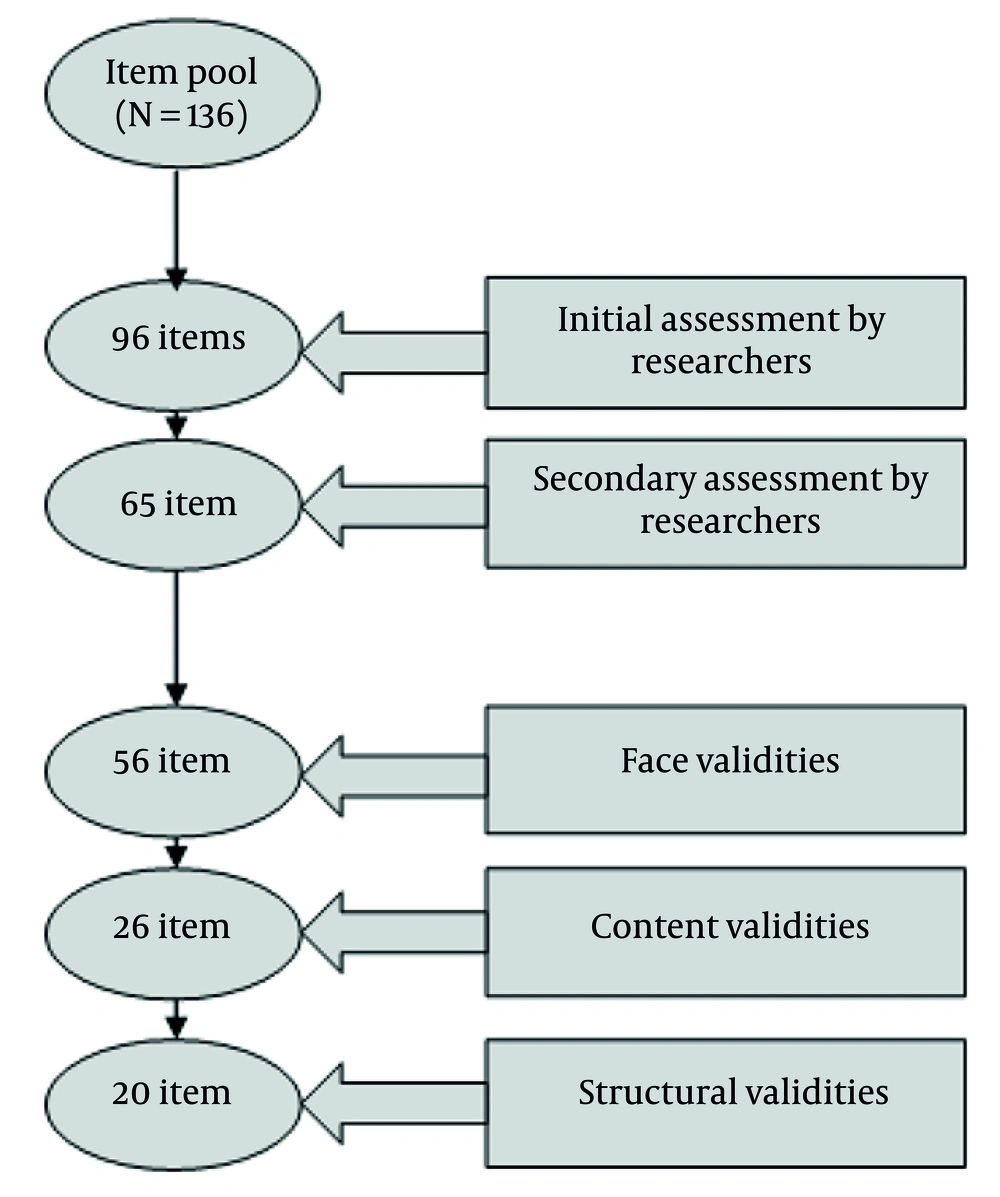
Figure 1.
The flowchart summarizing the psychometric stages of the “General Perception of COVID-19 Risk” Questionnaire
4.4. Descriptive Results
Out of 304 participants, 191 were women (62.8%). The most common educational level was a bachelor’s degree, with 98 participants (33.6%), and the predominant age group was 29 - 40 years, with 136 individuals (44.7%, Table 1).
Table 1.The Demographics of Participants
| Variables | No. (%) |
|---|---|
| Gender | |
| Male | 113 (37.2) |
| Female | 191 (62.8) |
| Missing | 0 |
| Age (y) | |
| 18 - 28 | 77 (25.3) |
| 29 - 40 | 136 (44.7) |
| 41 - 59 | 88 (28.9) |
| 60 | 2 (0.7) |
| Missing | 1 (0.3) |
| Job | |
| Student | 29 (9.5) |
| Housewife | 55 (18.1) |
| Teacher | 15 (4.9) |
| Employee | 59 (19.4) |
| Unemployed | 26 (8.6) |
| Private job | 34 (11.2) |
| Healthcare | 24 (7.9) |
| Retired | 34 (11.2) |
| Free | 27 (8.9) |
| Missing | 1 (0.3) |
| Education | |
| Less diploma | 18 (5.9) |
| Diploma | 62 (20.4) |
| Associate | 19 (6.2) |
| Bachelor | 102 (33.6) |
| Master | 76 (25) |
| Ph.D. | 26 (8.6) |
| Missing | 1 (0.3) |
| Total sum | 304 |
4.5. Internal Consistency and Reliability
The internal consistency of the full questionnaire and its subscales was evaluated using Cronbach’s alpha. The overall Cronbach’s alpha was 0.781, indicating good internal reliability (29).
4.6. Sample Adequacy and Correlation
Sampling adequacy was assessed using the Kaiser-Meyer-Olkin (KMO) test and Bartlett’s test of sphericity. The KMO value was 0.750, indicating acceptable sampling adequacy, while Bartlett’s test was significant (P < 0.0001), confirming suitability for factor analysis.
4.7. Exploratory Factor Analysis
EFA revealed five factors with eigenvalues greater than 1. The minimum factor loading threshold was set at 0.30; three items were removed due to low loadings. These five factors explained 65.50% of the total variance, with the remaining factors accounting for 34.50%. Thus, the five retained factors captured a substantial proportion of the variance.
4.8. Confirmatory Factor Analysis
Construct validity was assessed via structural equation modeling (both first- and second-order CFA). The first-order CFA for the 22-item questionnaire across the five subscales showed factor loadings ranging from 0.34 to 0.72, supporting construct validity. Two items (questions 5 and 20) were removed due to loadings below 0.30 (Table 2).
Table 2.The Result of the Exploratory Factor Analysis of the 22-Item General Perception of COVID-19 Risk Questionnaire a
| Row s | Items | Factor Loadings | Subscales |
|---|---|---|---|
| 1 | It is absolutely necessary to take measures to prevent COVID-19 disease. | 0.58 | Cognitive Factors |
| 2 | By following the health recommendations (such as: Wearing a mask and maintaining a physical distance) you can prevent COVID-19 disease. | 0.69 | |
| 3 | Scientifically, it is quite possible to prevent COVID-19 disease. | 0.72 | |
| 4 | My knowledge of how COVID-19 disease is transmitted can lead to preventive measures. | 0.61 | |
| 5 | Authority warnings are commensurate with the magnitude of the risk of COVID-19 disease. | 0.47 | Political Factors |
| 8 | The performance of the officials is accompanied by hope and encouragement to the people in the fight against COVID-19 disease. | 0.68 | |
| 9 | Executives make every effort to control COVID-19 disease. | 0.57 | |
| 10 | Carrying out preventive measures against COVID-19 is completely in accordance with religious recommendations. | 0.55 | Cultural Factors |
| 12 | Clergy and cultural officials agree with scientists on the risk of COVID-19. | 0.65 | |
| 14 | We Iranians believe we can defeat COVID-19. | 0.34 | |
| 15 | Iranian culture is action based on reason. | 0.47 | |
| 13 | If we want, we can prevent COVID-19 disease. | 0.41 | Social Factors |
| 16 | It is the social duty of all of us to help control COVID-19 disease. | 0.35 | |
| 18 | It is necessary to inform the measures to prevent COVID-19 disease in cyberspace. | 0.59 | |
| 19 | I participate in public cyberspace scans to prevent COVID-19 disease. | 0.56 | |
| 7 | Healthcare managers and staff exaggerate the risk of COVID-19. | 0.65 | Emotional Factors |
| 11 | Without doing anything, only relying on God can prevent COVID-19 disease. | 0.54 | |
| 17 | It is not my job to control COVID-19 disease; It is the duty of others (scientists, officials, etc.). | 0.41 | |
| 21 | I feel that the risk of COVID-19 disease is not as high as they say. | 0.55 | |
| 22 | I am strong, COVID-19 disease can not hurt me. | 0.40 |
a Acceptable significance level: > 0.3; average significance level: > 0.4; strong significance level: > 0.5.
4.9. Model Fit Indices
A second-order CFA was conducted to further refine the factor structure. The fit indices evaluated included Root Mean Square Residual (RMR), Goodness-of-Fit Index (GFI), Adjusted Goodness-of-Fit Index (AGFI), Comparative Fit Index (CFI), and Root Mean Square Error of Approximation (RMSEA) (19). The results, along with their acceptable threshold values, are presented in Table 3.
Table 3.Measured Indices of the Components of the General Perception of COVID-19 Risk Questionnaire
| Variables | CFI | AGFI | RMSEA | TLI | IFI | |
|---|---|---|---|---|---|---|
| Components | < 3 | > 0.9 | > 0.9 | > 0.08 | > 0.9 | > 0.9 |
| Factors | ||||||
| Cognitive | 0.571 | 1.000 | 0.991 | 0.000 | 1.000 | 1.000 |
| Emotional | 0.717 | 1.000 | 0.986 | 0.000 | 1.000 | 1.000 |
| Political | 0.970 | 1.000 | 0.997 | 0.000 | 1.020 | 1.010 |
| Social | 0.970 | 1.000 | 0.998 | 0.000 | 1.040 | 1.000 |
| Cultural | 2.779 | 0.987 | 0.955 | 0.070 | 0.976 | 0.912 |
Abbreviations: CFI, Comparative Fit Index; AGFI, Adjusted Goodness-of-Fit Index; RMSEA, Root Mean Square Error of Approximation.
The final COVID-19 risk perception model, based on the 20-item questionnaire, was visualized (Figure 2), and the corresponding fit indices confirmed an adequate model fit.
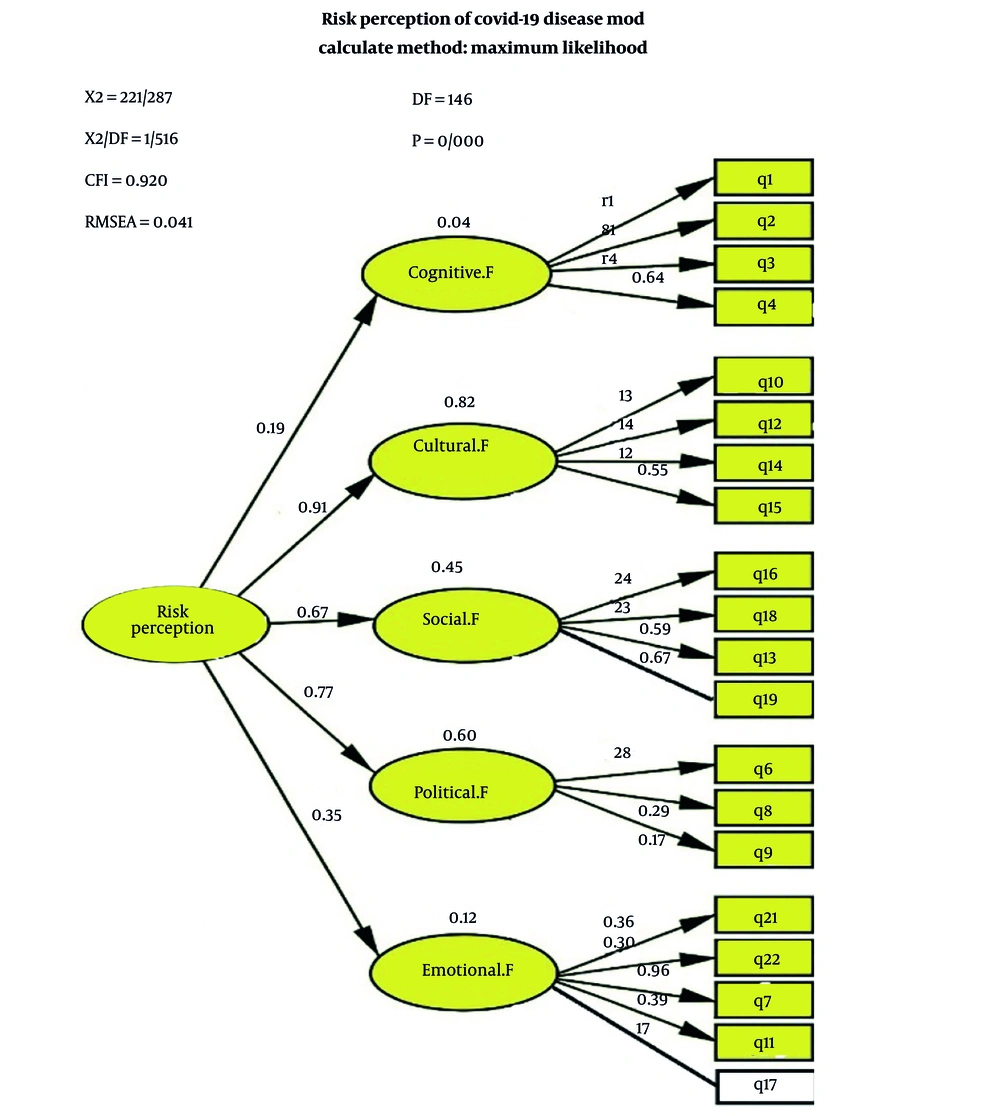
Figure 2.
Structural model of the General Perception of COVID-19 Risk Questionnaire
5. Discussion
This study aimed to develop and evaluate the psychometric properties of the GPCOVID-19R Questionnaire using CFA with the maximum likelihood method in Iran. The results demonstrated that the GPCOVID-19R has adequate validity and reliability.
Advancing the scientific understanding of risk perception is crucial, as it helps identify factors influencing individual responses to health threats (30)). Given that COVID-19 is a relatively new phenomenon, comprehensive studies on public risk perception remain limited.
According to the Effective Communication in Outbreak Management for Europe (ECOM) guidelines, an effective risk perception questionnaire should include: An introduction, information about the disease context, perceived seriousness, emotional sensitivity, and information needs (31). All these aspects were incorporated into our questionnaire, which was developed based on Schneider’s four-stage model.
The Cronbach’s alpha coefficient confirmed the internal consistency of the scale, supporting its reliability. The final 20-item questionnaire comprises five subscales: Cognitive (4 items), emotional (5 items), cultural (4 items), social (4 items), and political (3 items). These subscales capture key dimensions influencing public perceptions of COVID-19 risk. The structure aligns with other pandemic-related scales; for instance, Vieira et al. proposed a scale assessing pandemic risk perception through dimensions such as dread risk and personal exposure, including factors like infection risk, emotional health, health system capacity, financial risk, and food security (32). Despite structural differences, both scales emphasize individual and emotional aspects of risk perception.
Research also underscores the impact of culture, knowledge, responsibility, and trust in authorities on risk perception (33). A related study on Iranians’ risk perception factors identified and integrated several of these influences (34). Notably, this questionnaire’s practical application extends beyond COVID-19; for example, in Bangladesh, scores on a COVID-19 risk perception scale correlated significantly with evacuation behaviors during Cyclone Amphan (35).
One of this instrument’s strengths is its simplicity and practicality. It can be completed in approximately 10 minutes by healthcare providers, students, hospital staff, or the general public. Face and content validity assessments confirmed the clarity and readability of items.
The scoring employs a 5-point Likert scale for 16 items (from "disagree = 1" to "agree = 5"), with reverse scoring applied to questions 6, 10, 19, and 20. Total scores range from 20 to 100, with higher scores indicating greater risk perception. Interpretation categories are as follows:
- 20 - 39: Poor perception.
- 40 - 59: Moderate perception.
- 60 - 79: Good perception.
- 80 - 100: Excellent or desirable perception.
5.1. Conclusions
This study developed and psychometrically validated the GPCOVID-19R Questionnaire within the Iranian cultural context, grounded in the concept of risk perception. The instrument is easy to administer and score, demonstrating satisfactory reliability and validity. It can serve as an effective tool for health professionals to assess public perception of COVID-19 risk across various settings, aiding in targeted communication and intervention strategies.
5.2. Limitations
The items of our scale were developed based on a review of relevant literature. It is possible that certain behavioral risk factors or other protective factors were not captured by our instrument, which could be explored in future research. Additionally, due to the constraints posed by the COVID-19 epidemic, this study was conducted entirely online. Participation was voluntary and primarily recruited through social networks, including groups of friends, acquaintances, and colleagues of the researchers. This approach may have led to the exclusion of certain demographic groups, potentially affecting the representativeness of the sample.

