


1. Background
During the past decade, global mobile phone usage has significantly surged (1). This device has become an essential aspect of life, affecting occupational, social, educational, and familial domains (1). In 2020, approximately 2.87 billion individuals used cell phones daily (2). The worldwide count of mobile phone users nearly reached 3.5 billion in 2020, with further growth projected in the upcoming years (3). Young people and teenagers make up the majority of mobile phone users (4). However, as the popularity of mobile phones continues to rise among the youth, concerns regarding its potential adverse effects have emerged (5).
Mobile phones can cause psychological changes and negative physical reactions that result in a condition commonly known as mobile phone addiction (MPA) (6). A systematic review study revealed that cell phone addiction in children and adolescents is linked to feelings of insecurity, sleep disturbances, strained family and school relationships, low mood, depression, anxiety, decreased academic performance, and behavioral issues (7). Consequently, it is crucial to address MPA, particularly in teenagers and children, and conduct intervention studies to tackle this issue (7).
In addictive behaviors like smoking, alcohol use, and MPA, cessation is seen as a process. The transtheoretical model (TTM) mainly focuses on studying the process of change in cessation. This model emerged from a comparative analysis of leading theories of psychotherapy and behavior change to integrate more than 300 theories of psychotherapy (8) and suggests that four interrelated constructs are necessary for behavior modification. The first construct describes behavior change through five distinct stages: Pre-contemplation, contemplation, preparation, action, and maintenance. These stages represent the temporal, motivational, and constancy aspects of change (9). The second construct is processes of change, which involve activities and events that facilitate behavior modification. Ten processes, including consciousness-raising, dramatic relief, self-reevaluation, environmental reevaluation, self-liberation, social liberation, counterconditioning, contingency management, and helping relationships, are used to change behavior. The third construct, called decisional balance (DC), reflects an individual's assessment of the pros and cons of changing. The final construct, self-efficacy (SE), refers to a person's confidence in their ability to handle high-risk situations without relapsing, while temptation represents the opposite of SE.
A meta-analysis study suggested that the TTM has effectively modified certain behaviors, including smoking cessation, physical activity, condom use, and stress management (10). To our knowledge, there are few experimental studies on mobile phone usage (MPU) (internet gaming disorder and compulsive internet use) based on TTM (11, 12).
2. Objectives
Although there is evidence about the effectiveness of this model in modifying some behaviors, considering the prevalence of cell phone addiction, its negative consequences, and limited experimental studies in this field, especially in children and teenagers, this study aimed to determine the following: (A) Can TTM be effectively used to reduce MPA in teenagers? (B) Does an intervention based on the TTM effectively reduce the duration of MPU? (C) Does an intervention based on the TTM effectively facilitate progress in the stages of change among teenagers?
3. Methods
3.1. Study Design and Participants
This experimental study was conducted among female students in fourth to sixth grades (primary school) in Bushehr, a southwestern province in Iran, to determine the effect of education based on the TTM in MPA.
Inclusion criteria were as follows: Being in 4th to 6th grade of primary school, obtaining a score of 46 or higher from the MPA questionnaire (MPAQ) (13), being in pre-contemplation, contemplation, and preparation stages for MPU, having mental and physical health, and willingness to participate in the study. The exclusion criteria were absent from more than one educational session, incomplete questionnaire, and unwillingness to continue participation in the study.
3.2. Sample Size
Based on the results of the previous study (14), and with a significance level (α) of 0.05 and the test’s power of 80%, the minimum sample size required for each group was determined to be 30, based on the below formula:
Taking into account a potential attrition rate of 20%, the final sample size for each group was set at 36 individuals.
In this study, a multi-stage sampling method was utilized. Initially, a list of 34 government primary schools was obtained from the Bushehr Department of Education to access samples. From this list, 4 schools were randomly chosen. A lottery was then conducted to assign two schools to each group (intervention and control). To identify eligible students, all students in these schools completed MPA questionnaires and the stage of change algorithm. Individuals scoring 46 or higher and in pre-contemplation, contemplation, or preparation were identified. The total number of students with MPA in each group's schools was separately calculated. In the intervention group schools, 82 out of 182 students met the criteria; in the control group schools, 68 out of 146 students met the criteria. Information about eligible students was recorded in a list using Microsoft Excel software, and 36 students were randomly selected for each group.
3.3. Intervention
The educational intervention was conducted using motivational interviewing. To ensure comfort and minimize disruption, the interviews and completion of the questionnaires and forms took place in a serene and cozy room within each school by an MSc student of health education and promotion. The educational content was designed as eight forms (form no. 1 to 8); which were prepared based on TTM constructs.
Form no. 1 focused on self and environmental reevaluation constructs. Students shared their beliefs about the consequences of excessive MPU on their relationships with family, friends, and teachers (environmental reevaluation), as well as the impact on concentration, learning, exam scores, sleep disorders, headaches, dizziness, and skeletal pains (self-reevaluation).
Form no. 2 centered on the DC construct, with students outlining the pros and cons of excessive MPU, as well as the advantages and disadvantages of not using mobile phones, and then weighing them.
Form no. 3 was related to the counter-conditioning construct. Students selected alternative activities to excessive use of mobile phones. These activities included 22 items, such as sports, artistic pursuits (painting, music, handcrafts, etc.), reading story books, etc.
Form no. 4 was about the stimulus control construct, in which the students determined the conditions, situations, and times when they were tempted to use the mobile phone more.
Form no. 5 addressed the social liberation construct, where students established norms to reduce mobile phone usage, such as refraining from using mobile phones in bed, at parties, during study hours, at school, etc.
Form no. 6 dealt with the self-liberation construct, where students chose one or more ways to reduce mobile phone usage (including removing time-consuming mobile games, leaving time-consuming groups, etc.), and wrote and signed a behavior commitment.
Form no. 7 covered the reinforcement management construct. In this form, students selected rewards and punishments for themselves to reinforce the reduction of mobile phone usage or to penalize the failure to comply with the set norms and commitments in the previous forms.
Form no. 8 focused on the SE construct. Students created a behavior contract by determining the general goal and step-by-step goals for changing behavior.
The content of the forms was reviewed and approved by three health education faculty members. To enhance the effectiveness of the intervention and accommodate the diverse needs of individuals at different stages of change, students in the intervention group were categorized into two groups: Pre-preparation (including pre-contemplation and contemplation) and preparation stages. Each individual in the pre-preparation stage received three 45-minute educational sessions, while those in the preparation stage received two 45-minute sessions.
3.4. Educational Content
The education included motivational interviews and the completion of forms based on TTM's constructs. In this study, students in the pre-preparation stage filled out 8 forms, while students in the preparation stage filled out 7 forms (except form no. 1). The completion of forms was facilitated using a question-and-answer approach.
To facilitate helping relationships, a summary of the information extracted from the forms was sent to their parents via SMS to promote necessary changes at home.
The specific details and objectives of each session in the pre-preparation and preparation groups can be found in Table 1. The training sessions were conducted three days a week, with morning and evening shifts. Following each session, the subsequent training sessions were scheduled with a one-week gap for each student. Upon completion of the final session, reminder text messages were sent to the students in the intervention group every two to three weeks to encourage them to sustain their newly acquired behavior.
Table 1.Content of the Educational Intervention
| Stage and Session No. | Educational Content Based on TTM’s Constructs | Goal’s Based on TTM’s Constructs | Form No. |
|---|---|---|---|
| Pre-preparation stage | |||
| First | Completing the questionnaires, assessing the student's stage of change, knowing the student's beliefs about the consequences of excessive MPU, weighing the pros and cons, summarizing views, and saying a motivational sentence for yourself. | Self and environmental re-evaluation and DB construct | 1 and 2 |
| Second | Reassessing students' stage of change, reviewing the pros and cons, determining activities to replace excessive mobile phone usage, identifying conditions, situations, and times that trigger excessive mobile phone use, and strategizing ways to address it. Establishing social norms to reduce excessive mobile phone usage among students. | Counterconditioning, stimulus control, social liberation constructs | Review form 2, and complete forms 3,4 and 5 |
| Third | Reviewing previous forms, selecting one or more methods to reduce mobile phone usage, drafting a behavior contract outlining the student's overarching goal for behavior change, signing a behavior commitment, teaching self-reinforcement techniques by rewarding oneself to maintain behavior change, and sending a summary of completed form results to parents to garner support for the student. Plan and set goals by outlining step-by-step objectives and offering verbal encouragement upon achieving short-term goals. | Self-liberation, helping relationships, reinforcement management, and SE | Review previous forms, complete forms 6, 7, and 8 |
| Preparation stage | |||
| First | Completing questionnaires, assessing students' stage of change, weighing the pros and cons, and other actions akin to session 2 for students in the pre-preparation stage. | DB, counter conditioning, stimulus control, social liberation constructs | Forms 2, 3, 4, and 5 |
| Second | Activities similar to session 3 for students in the pre-preparation stage. | Self-liberation, helping relationships, reinforcement management, and SE | Review previous forms, complete forms 6, 7, and 8 |
Abbreviations: TTM, transtheoretical model; MPU, mobile phone usage; DB, decisional balance; SE, self-efficacy.
3.5. Data Collection
In this study, a questionnaire was used as the data collection tool. The questionnaire consisted of various components, including demographic factors, stage of changes, DC, SE, excessive use of mobile phones, and the MPA questionnaire. The different parts of the questionnaire are explained below.
3.5.1. Demographic Factors
This part was assessed through 9 questions, covering aspects such as age, birth rank, educational level, education and occupation of parents, type of mobile phone ownership, and membership in social networks.
3.5.2. Stage of Changes
A four-question algorithm (Figure 1) was utilized to determine the stage of change. This allowed for the classification of students into one of the five stages of excessive MPU.
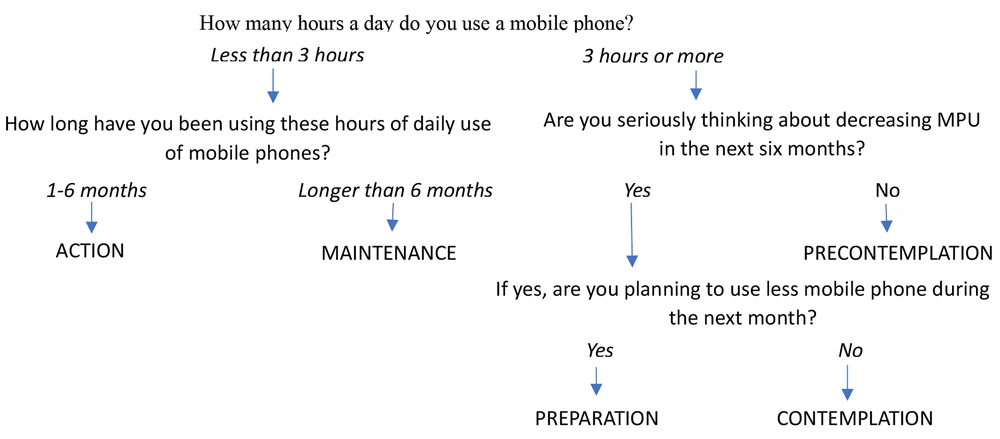
Figure 1.
Stages of change algorithm for mobile phone usage (MPU)
3.5.3. Decisional Balance
The Decisional Balance (DB) Questionnaire is a self-administered tool used to assess the advantages and disadvantages of mobile phone usage. It consists of 10 items, with 5 items focusing on the pros, such as “MPU has improved my problem-solving abilities,” and 5 items focusing on the cons, such as “I struggle to concentrate on activities unrelated to my mobile phone.” These questions were adapted from Faust’s DC digital game tool (14). Each item was scored on a 5-point Likert scale, with the scores for the pros items being reversed. The pros and cons scores were then combined to obtain a total score, which ranged from 10 to 50. A higher score indicated a stronger belief in the cons of excessive MPU. To ensure content validity, 10 health education specialists evaluated each item. They used a 3-point Likert-type scale to assess each item: 1 = essential, 2 = useful but not essential, and 3 = not essential. If an item received a rating of 3, the expert suggesting the rating was asked to propose modifications. In this study, none of the experts rated any item as “not essential.” The total content validity ratio (CVR) score of the 10 items was 0.89, indicating acceptability. To assess the questionnaire's reliability, Cronbach's alpha coefficient was calculated using responses from 30 students, yielding a value of 0.65. Faust's study (14) demonstrated that these scales exhibited sufficient internal consistency (Pros α = 0.746, and Cons α = 0.749).
3.5.4. Self-efficacy
We utilized a self-administered tool consisting of six items to evaluate SE. These items measured the level of temptation a student experienced in various situations involving mobile phone usage. For instance, one item asked, “how tempted would you be to use a mobile phone if you were feeling depressed?” This questionnaire was also modeled from Faust’s SE scale for digital games (14). Each item was rated on a 5-point Likert scale, ranging from 1 (very severe) to 5 (very mild). The total score ranged from 6 to 30, with a higher score indicating a greater belief in one's ability to limit MPU. The questionnaire showed an acceptable total CVR score and Cronbach's alpha coefficient of 0.91 and 0.78, respectively. In Faust’s study, the reliability of this scale was 0.833 (14).
3.5.5. Excessive MPU
To assess excessive mobile phone usage, a question was asked regarding the daily duration of activities such as playing games, browsing social groups, using various apps, and studying school lessons. If the usage exceeded 210 minutes, it was deemed excessive MPU.
3.5.6. Mobile Phone Addiction
The MPA questionnaire is a tool to evaluate various aspects of pathological smartphone use, employing the DSM-5 diagnostic criteria for behavioral addiction (15). It consists of 25 items, which are scored on a 5-point Likert scale ranging from 0 (strongly disagree) to 4 (strongly agree), resulting in a final score between 0 and 100. Olivencia-Carrion et al. developed and evaluated this questionnaire, reporting Cronbach's α coefficients of 0.91 (16). The Persian version of the questionnaire was assessed by Alavi et al., who confirmed its reliability with a Cronbach's α of 0.90 and a test-retest reliability of 0.65 after 3 weeks (13).
3.6. Statistical Analysis
The data were analyzed using version 22.0 of the statistical package for the social sciences (SPSS) software. Several statistical tests were used for data analysis, including descriptive statistics, the chi-square test, independent and paired t-tests, repeated measures ANOVA, the non-parametric analysis of the marginal homogeneity test, and the analysis of generalized estimating equations (GEE). The chi-square test compared qualitative variables between the two groups, while the independent t-test examined quantitative variables such as age. The paired sample t-test compared constructs (DC and SE) and MPA at two different time points within each group. The repeated measures ANOVA was used to compare changes in the mean scores of constructs and MPA within and between the two groups. The non-parametric analysis of the marginal homogeneity test evaluated the count distribution change in the stage of change and excessive use of mobile phones before and three months later. The analysis of GEE assessed changes in the count distribution in the stage of change and excessive use of mobile phones before and after between the two groups. A P-value of less than 0.05 was considered statistically significant.
3.7. Ethical Considerations
All participants provided written informed consent. To maintain ethical standards in the research, participants were given the option to withdraw from the study at any time. The collected data were handled with confidentiality and anonymity.
4. Results
A total of 72 students participated in the study, with 36 in the intervention group and 36 in the control group. There were no significant differences between the two groups regarding demographic factors, such as mobile phone ownership. The average age in the intervention group was 11.19 ± 1.09, and in the control group, it was 10.75 ± 1.2 (P = 0.105). In the intervention group, 86.1% (n = 31) of students had private mobile phones, while in the control group, 80.6% (n = 29) had private mobile phones (P = 0.527). Other demographic characteristics are presented in Table 2. Both groups were similar in TTM constructs (DC and SE, respectively P = 0.124, and P = 0.289) before education, but after training, the intervention group showed significant improvements in DC (P < 0.001) and SE (P < 0.001). Repeated measurement ANOVA found that both constructs increased in the intervention group (P < 0.001), while there were no significant changes in the control group (Table 3). The results suggest that the intervention was effective in improving DC and SE, with higher perceived levels in the intervention group compared to the control group.
Table 2.Comparison of Demographic Factors Between the Intervention (n =36) and Control (n = 36) Groups a
| Demographic Factors | Intervention Group | Control Group | P-Value |
|---|---|---|---|
| Birth rank | 0.492 | ||
| First child | 14 (38.9) | 19 (52.8) | |
| Second child | 16 (44.4) | 12 (33.3) | |
| Third child or more | 6 (16.7) | 5 (13.9) | |
| Educational level | 0.059 | ||
| Fourth grade | 8 (22.2) | 14 (38.9) | |
| Fifth grade | 7 (19.4) | 11 (30.6) | |
| Sixth grade | 21 (58.3) | 11 (30.6) | |
| Mother’s education | 0.153 | ||
| Less than diploma | 8 (22.2) | 13 (36.1) | |
| Diploma | 9 (25) | 12 (33.3) | |
| College education | 19 (52.8) | 11 (30.6) | |
| Father’s education | 0.078 | ||
| Less than diploma | 5 (13.9) | 11 (30.6) | |
| Diploma | 10 (27.8) | 13 (36.1) | |
| College education | 21 (58.3) | 12 (33.3) | |
| Mother’s job | 0.609 | ||
| Housekeeper | 24 (66.7) | 26 (72.2) | |
| Employed | 12 (33.3) | 10 (27.8) | |
| Father’s job | 0.203 | ||
| Unemployed or retired | 1 (2.8) | 2 (5.6) | |
| Employee | 16 (44.4) | 10 (27.8) | |
| Manual worker | 9 (25) | 6 (16.7) | |
| Others | 10 (27.8) | 18 (50) | |
| Mobile phone ownership | 0.527 | ||
| Private | 31 (86.1) | 29 (80.6) | |
| Parents | 5 (13.9) | 7 (19.4) | |
| Membership in social networks | 0.999 | ||
| Yes | 35 (97.2) | 35 (97.2) | |
| No | 1 (2.8) | 1 (2.8) |
a Values are expressed as No. (%).
Table 3.Changes in the Scores of Transtheoretical Model’s Constructs During the Intervention in the Intervention (n = 36) and Control (n = 36) Groups a
| Variables and Time | Intervention Group | Control Group | F | P-Value b |
|---|---|---|---|---|
| TTM constructs | ||||
| DB | 60.76 | < 0.001 | ||
| Before education | 26.58 ± 3.98 | 25.13 ± 3.89 | ||
| 3 months later | 39.91 ± 5.88 | 24.91 ± 6.56 | ||
| T | 10.09 | 0.19 | ||
| P-value c | < 0.001 | 0.845 | ||
| SE | 1.94 | < 0.001 | ||
| Before education | 15.44 ± 2.55 | 14.77 ± 2.73 | ||
| 3 months later | 23.52 ± 4.75 | 14.00 ± 4.07 | ||
| T | 9.73 | 1.39 | ||
| P-value c | < 0.001 | 0.172 | ||
| Dependent variable | ||||
| MPA | 58.58 | < 0.001 | ||
| Before education | 60.69 ± 9.5 | 65.25 ± 11.88 | ||
| 3 months later | 24.22 ± 14.07 | 59.72 ± 14.71 | ||
| T | 13.10 | 1.88 | ||
| P-value c | < 0.001 | 0.068 |
a Values are expressed as mean ± SD.
b Comparison of changes in mean scores over time between groups.
c Comparison of mean score changes over time in each group.
The repeated measurement ANOVA indicated a decrease in MPA in the intervention group after 3 months (P < 0.001), while the control group showed no significant change in pre- and post-test scores (P = 0.068). Additionally, as demonstrated in Figure 1, a comparison of the two groups over time revealed a greater decrease in addiction in the intervention group compared to the control group (Table 4).
Table 4.Changes in the Stages of Change During the Intervention between the Intervention (n = 36) and Control (n = 36) Groups a
| Time, Study Group, and Stage of Change | After | P-Value b | P-Value c | |||
|---|---|---|---|---|---|---|
| Pre-contemplation | Contemplation | Preparation | Action | |||
| Before | < 0.001 | |||||
| Intervention group | < 0.001 | |||||
| Pre-contemplation | 0 (0) | 0 (0) | 1 (3) | 8 (23) | ||
| Contemplation | 0 (0) | 0 (0) | 0 (0) | 6 (17) | ||
| Preparation | 0 (0) | 0 (0) | 1 (3) | 19 (54) | ||
| Action | 0 (0) | 0 (0) | 0 (0) | 0 (0) | ||
| Control group | 0.145 | |||||
| Pre-contemplation | 6 (17) | 4 (11) | 4 (11) | 1 (3) | ||
| Contemplation | 7 (19) | 3 (8) | 3 (8) | 2 (5) | ||
| Preparation | 2 (6) | 2 (6) | 1 (3) | 1 (3) | ||
| Action | 0 (0) | 0 (0) | 0 (0) | 0 (0) | ||
a Values are expressed as No. (%).
b Comparison of changes in the distribution of count over time in each group.
c Comparison of changes in the distribution of count over time between groups.
Changes in the distribution of counts at different stages of change of MPU behavior among students over time were compared using the non-parametric analysis of the marginal homogeneity test. The findings showed a significant change in the intervention group (P < 0.001), while no significant change was observed in the control group (P = 0.145). Additionally, the analysis of GEE showed a significant group-time interaction effect, suggesting a change in the count distribution of various stages of change of MPU behavior over time between the two groups (P > 0.001) (Table 5).
Table 5.Changes in Excessive Mobile Phone Use During the Intervention Between the Intervention (n = 36) and Control (n = 36) Groups a
a Values are expressed as No. (%).
b Comparison of changes in the distribution of count over time in each group.
c Comparison of changes in the distribution of count over time between groups.
Finally, using McNemar's non-parametric test to compare the distribution count of excessive MPU in female students between intervention and control groups, it was found that the intervention group exhibited a significant change in the frequency distribution before and after the intervention (P < 0.001). Conversely, the control group did not experience any significant changes (0.317). Furthermore, the analysis of GEE indicated a significant group-time interaction effect, suggesting significant changes in the distribution count of excessive MPU over time between the two groups (P = 0.013) (Table 5).
5. Discussion
The present study aimed to investigate the effectiveness of an educational intervention based on the TTM model in decreasing MPA in students. In this study, training improved SE and DC, altered the frequency of individuals in different stages of change, reduced the duration of MPU, and decreased MPA.
Self-efficacy is a core construct in most theories, enhanced through mastery experiences, social modeling, verbal persuasion, and practice under stress-free conditions (8). Therefore, in this study, SE was targeted through five sources of information, including performance accomplishment, vicarious experiences (modeling), verbal persuasion, emotional arousals, and integration of efficiency information, resulting in a significant improvement in this construct, aligning with previous findings in the treatment of online game addiction (11). Additionally, a relationship between SE and the stage of change was identified, suggesting that improvement in SE could lead to a shift towards the stage of action and maintenance (11, 14). This study witnessed favorable changes in the stages of change and movement towards the stage of action, indicating an enhancement in students' SE in reducing MPA.
In this study, a comparative strategy was used to assess the benefits and obstacles of engaging in or refraining from a behavior. By considering these factors and evaluating them individually, participants' understanding of the advantages of reducing MPU improved. This indicates the effectiveness of this intervention method in altering DC. According to the TTM, modifying individuals' perceptions of the benefits and barriers of behavior can facilitate progress from the pre-action stages to the action stages (8). Given the increase in the score of this construct in the present study and the advancement of students through the stages of change, the effectiveness of this intervention method can be confirmed. Therefore, conducting a motivational interview where individuals summarize the pros and cons of MPU based on their knowledge, guidance from others, and educational resources can help establish a more favorable balance between the advantages and disadvantages of excessive phone usage. These findings support the results of the previous study (11).
During the study, the intervention group showed progress in the stages of change. Previous research indicates that by intervening in the process of change, DC, and SE, people's stages can be altered, motivating them to behave differently (17-20). In this study, a motivational interview was conducted within the framework of TTM constructs, involving active participation from students in cognitive and behavioral processes, as well as support from parents. These interventions resulted in positive changes in the stages of change. It is worth noting that due to the limitations of the TTM in classifying people in different stages (8), the main objective of this study was to address MPA. Nonetheless, motivational interviewing and the implementation of TTM constructs can effectively facilitate positive changes in excessive MPU.
According to the study, the duration of MPU in the educational intervention group significantly decreased, leading to a reduction in MPA. Indah et al. found that using the TTM intervention was highly effective in reducing compulsive Internet use (12). Kim et al.'s study also showed a significant decrease in addiction scores and playing duration, followed by a decrease in depression and anxiety by using cognitive-behavioral approaches in the intervention group (21). A meta-analysis by Malinauskas and Malinauskiene, based on six articles from 2000 to 2019, which used cognitive-behavioral approaches for treating cell phone addiction, revealed that participants who underwent psychological interventions had significantly lower addiction intensity (22).
A study on female high school students found that using the health belief model's concepts, such as perceived benefits and barriers of MPU and SE, led to a decrease in the average score of MPA (23). Therefore, interventions based on psychological factors, coupled with changes in perspectives and beliefs, can effectively reduce dependency and the extent of MPU, especially when students actively engage in the process, because several studies showed when students actively participate in the learning process, they learn better (24-26).
5.1. Limitations, Implications, and Future Research
Regarding the limitations of this study, reliance on self-report data introduces the potential for both overestimation and underestimation of certain behaviors and constructs, such as the duration of MPU, dependence on mobile phones, and stages of change. However, some studies suggest that self-reports generally provide a reasonably accurate indication (27). Additionally, classifying individuals according to stages of change presents various challenges. For instance, individuals can transition through multiple stages in just a few minutes, and a significant portion of the population cannot be assigned to a specific stage (8). Therefore, this study also assessed the duration of MPU and symptoms of MPA.
The findings of this study can be applied to primary school students, but future research should investigate the effect of this intervention in other populations, including different age groups and genders.
5.2. Conclusions
Based on the study's findings, education focused on the TTM has proven effective in reducing mobile phone usage among students and alleviating dependency and related symptoms. This training helped students realize that by improving their SE, they could effectively reduce their dependency on mobile phones. Moreover, by gaining a better understanding of the pros and cons, they achieved a commendable reduction in mobile phone usage. The TTM-based education acted as a catalyst, motivating individuals to progress through the stages of change and enabling a majority of students to reach the action stage. By implementing cognitive and behavioral strategies, the education group experienced a significant decrease in MPA, with daily usage falling below 3 hours.


